

For most B2B organisations, documents are the last large reservoir of business-critical data still processed by hand. Invoices, contracts, identity documents, claims forms, shipping manifests, CVs, and email attachments all carry the information your systems need, yet they arrive in inconsistent formats, languages, and quality. Intelligent document processing exists to close that gap, turning heterogeneous documents into validated, machine-readable data with minimal human involvement.
This guide gives founders and executives a commercially grounded view: what intelligent document processing is in 2026, how it differs from legacy OCR, how the pipeline works, the market and ROI data, the use cases that pay back, the risks, and a phased way to start. Every figure here comes from named analyst and vendor research.
What intelligent document processing is in 2026
Intelligent document processing is a class of software that acquires documents in any format, classifies them by type, extracts structured data using AI, validates that data against rules and reference systems, and delivers it into downstream applications, with human review where confidence is low. Hyperscience describes it as combining OCR, natural language processing, computer vision, and machine learning to scan, classify, identify, and extract data from structured, semi-structured, and unstructured documents before validating and integrating it. The emphasis is not on recognising characters but on understanding layout, semantics, and context.

The document type matters. Structured documents have fixed layouts where fields sit in consistent positions, such as standardised forms. Semi-structured documents, including invoices, pay stubs, and bank statements, share repeating elements but vary by supplier. Unstructured documents like contracts, deeds, medical records, and emails embed information in free-form text and tables with no predictable positions. IDP earns its keep on the semi-structured and unstructured inputs that historically required manual handling, which is why advances in machine learning and generative AI have transformed the category.
This makes IDP inherently probabilistic and learning-driven. Instead of hard-coded templates, models infer where fields like invoice totals or customer IDs are likely to appear from labelled examples and semantic cues, and accuracy improves as documents are processed and corrected. It is closer to a specialised application of machine learning than to a rules engine with OCR bolted on, and it fits naturally inside a broader intelligent automation stack.
Key takeaway
IDP is the operational wing of document AI: production-scale ingestion, extraction, validation, and integration. The value is not in reading text but in understanding context, generalising to new layouts from a few examples, and feeding clean data into your systems of record with a human checking only the low-confidence cases.
IDP versus legacy OCR
OCR converts images of text into machine-readable characters, and template-based capture overlays simple rules on top, such as reading fixed coordinates for given fields. These approaches work when layouts are rigid but degrade sharply when formats change, images are noisy, or the data sits inside narrative text. FlowWright, summarising Gartner, stresses that IDP understands the context of text rather than just its characters, so it can classify documents, handle variation, and extract the right fields even as formats shift.
| Dimension | Legacy OCR / template capture | Intelligent document processing |
| How it finds data | Fixed coordinates and templates | Learns field locations from examples |
| Handles new layouts | Breaks, needs manual reconfiguration | Generalises from a few labelled samples |
| Document types | Mostly structured forms | Structured, semi-structured, unstructured |
| Maintenance | Constant template updates | Continuous learning from corrections |
Synthesis of FlowWright (Gartner) and Hyperscience.
The difference shows up in maintainability. Template capture needs constant updates as suppliers change invoice layouts or regulators introduce new forms. IDP, especially when it leans on deep learning and large language models, generalises from a small number of labelled examples and adapts more gracefully, so a single platform can extend across hundreds of document types with consistent tooling and governance.
How the IDP pipeline works
Most platforms run a five-stage pipeline that takes documents from raw inputs to validated outputs. Each stage adds intelligence, and the human only touches the cases the system is unsure about.
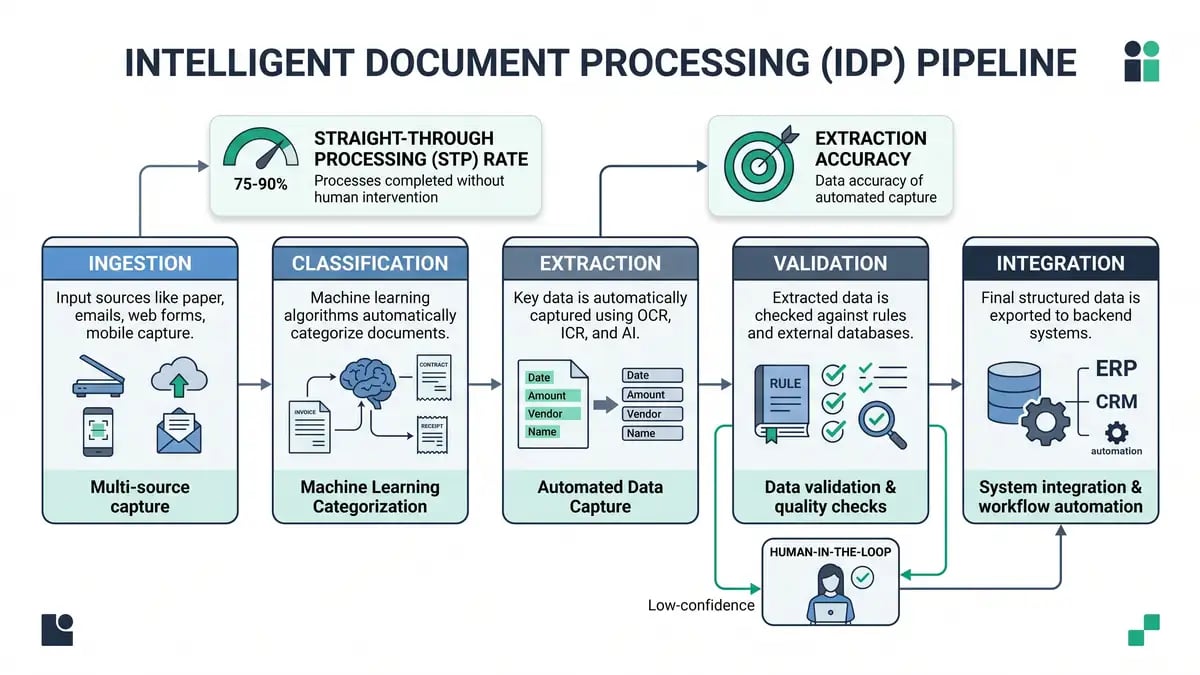
Ingestion and preprocessing
Capture documents from scanners, email inboxes, file repositories, or APIs, then de-skew, de-noise, and split or merge batches so the models get clean inputs.
Classification
Models identify each document type, invoice, purchase order, passport, or bank statement, including page-level sorting inside multi-document bundles.
Extraction
Extraction models tailored to each class pull the fields of interest, using OCR to read text and NLP to interpret it across structured, semi-structured, and unstructured content.
Validation and feedback
Format checks, cross-field consistency, and master-data lookups verify the data. Low-confidence fields route to human reviewers, whose corrections retrain the models.
Integration
Validated data flows into ERP, CRM, core banking, or claims platforms via APIs or connectors, triggering payments, record updates, or follow-on workflows.
That final stage is where IDP becomes part of a larger automation fabric. Wiring it into AI agent workflow automation and your CRM automation turns a one-off extraction tool into a system that resolves document-driven processes end to end.
Market size and adoption
IDP and adjacent document AI markets are growing far faster than most enterprise software categories. Strategic Market Research projects the global IDP market expanding from 3.2 billion USD in 2024 to 14.1 billion by 2030 at a 35.3 percent CAGR. Precedence Research sees the US market alone rising from about 1.44 billion in 2025 to 14.89 billion by 2034. The broader document AI market grows from 14.66 billion in 2025 to 27.62 billion by 2030.
| Market | Size and forecast | CAGR | Source |
| Intelligent document processing (global) | $3.2B (2024) to $14.1B (2030) | 35.3% | Strategic Market Research |
| IDP (US) | $1.44B (2025) to $14.89B (2034) | rapid | Precedence Research |
| Document AI | $14.66B (2025) to $27.62B (2030) | 13.5% | MarketsandMarkets |
| Document management systems | $9.74B (2026) to $29.78B (2034) | 15.0% | Fortune Business Insights |
| Generative AI (underlying) | $28.45B (2026) to $126.66B (2031) | 34.82% | Mordor Intelligence |
Sources: Strategic Market Research, Precedence, MarketsandMarkets, Fortune Business Insights, Mordor.
Adoption is no longer speculative. Deloitte's intelligent automation research shows organisations moving from siloed RPA pilots to integrated toolkits that combine RPA with AI and document understanding to scale automation into complex, judgement-heavy processes. In banking, McKinsey argues that capturing AI value requires rewiring the enterprise, with document-centric processes such as onboarding, credit decisioning, and compliance central to that transformation. The strategic question is not whether to adopt IDP but how fast you can turn it into advantage.
The ROI of intelligent document processing
The most detailed evidence comes from named case studies. At Thermo Fisher Scientific, a UiPath document-understanding solution tackled an accounts payable process handling roughly 824,000 invoices a year with eight full-time staff. It cut invoice processing time 70 percent, processed about 53 percent of invoices with no human involvement, and read documents at 82.4 percent accuracy with a goal of 85 percent or higher as models improved.

Other deployments show the same pattern. A large bank using AWS Textract cut human effort on Bank Secrecy Act compliance processing by 80 percent. A Forrester Total Economic Impact study of Hyperscience reports 99.9 percent data accuracy in its composite customer model, achieved with careful training and human-in-the-loop review. At the macro level, IDC put the cumulative economic impact of UiPath's RPA ecosystem at 129 billion USD over five years, with decreased expenses the largest benefit at 44 percent, revenue growth at 41 percent, and quality at 15 percent.
The pattern across deployments is consistent: 70 percent or more reduction in processing time, straight-through processing above 50 percent for complex document workflows, and accuracy near 99.9 percent when paired with validation and feedback loops.
The lesson for executives is that IDP is not only a cost play. It compresses cycle times, improves compliance and auditability, and lets you process more documents within existing headcount. To pressure-test the numbers for your own volumes, work through the AI ROI math for B2B.
Use cases by function and industry
Value concentrates in document-heavy, high-volume workflows. These are the domains where IDP pays back fastest.

Finance operations. Accounts payable and receivable are the most mature use cases. IDP classifies invoices, extracts line items and totals, checks for duplicates, and reconciles against purchase orders, as the Thermo Fisher case shows. The same applies to remittance matching in AR and to faster month-end reconciliation and close.
Banking and financial services. KYC, onboarding, and lending involve collecting and verifying identity documents, proofs of address, bank statements, and payslips. IDP classifies, extracts, and validates these against internal and external sources, populating credit tools and flagging anomalies for review, which is core to the digital transformation McKinsey describes.
Insurance, healthcare, and logistics. Insurers automate extraction from claims forms, medical reports, and policy documents to speed triage and adjudication. Healthcare providers turn medical records and discharge summaries into structured EHR data, where the 99.9 percent accuracy ceiling matters most. Logistics teams normalise bills of lading, customs declarations, and proof of delivery across formats and borders.

Professional services, legal, and HR. Contract review, due diligence, and HR onboarding all involve unstructured documents that IDP can classify and extract from, surfacing key clauses, dates, and obligations for human sign-off. For recruiting and consulting firms, parsing CVs, statements of work, and engagement letters compresses the admin that surrounds billable work. Many of these become reliable systems when built on no-code platforms, which is why no-code AI agents have lowered the barrier to deployment, and why teams pair IDP with broader business process automation services. To choose the right platforms, compare the leading AI automation tools.
Not sure which document workflow to automate first?
Book a Growth Mapping CallThe risks and how to govern them
The upside is real, but document AI carries distinct risks. Extraction accuracy starts imperfect on messy and unstructured documents; the Thermo Fisher deployment began at 82.4 percent and improved through feedback, which is why a confidence threshold and human review are not optional. LLM-based extraction adds the risk of hallucinated values, so validation against master data and source documents matters. Sensitive documents raise data privacy and security stakes, especially under HIPAA and GDPR, and integration with ERP and core systems is often where capable models stall before they can resolve a case end to end.
The accuracy mirage
Vendor accuracy figures like 99.9 percent are achieved with trained models and human-in-the-loop review on validated data, not out of the box. Set realistic confidence thresholds, route low-confidence and high-risk fields to people, monitor for model drift as document formats change, and keep an audit trail. Treat the human reviewers as the training engine, not a fallback.
The generative and agentic shift
The biggest change in 2026 is that large language models are becoming the engine behind document understanding. Mordor Intelligence projects the generative AI market growing from 28.45 billion USD in 2026 to 126.66 billion by 2031, and vendors are embedding these models into IDP to enable few-shot extraction without rigid templates, natural-language validation rules, and conversational interfaces where staff query document repositories in plain language.
The frontier is agentic automation: systems that do not just extract data but plan and execute multi-step workflows, deciding which documents to retrieve, how to interpret them, when to ask for clarification, and when to route exceptions to humans. Google Cloud documents real-world cases where its AI stack compressed development and deployment cycles, including a fivefold faster time-to-deploy for one customer. As these capabilities reach document pipelines, IDP increasingly behaves like a digital operations agent. This is the same trajectory reshaping generative AI for business and the move toward agentic workflows across the back office.
How to start: a phased approach
Treat IDP as an operating-model change, not a tool purchase. This sequence gets you to payback without stalling in a pilot.
Pick a high-volume document type
Start where the return is obvious, usually semi-structured documents like invoices. Prove the model on one class before extending to contracts or claims.
Get documents and data ready
Gather representative samples for training, clean your master data for validation lookups, and confirm you can ingest from your real sources.
Set confidence thresholds and human-in-the-loop
Decide which fields auto-process and which route to reviewers. Their corrections retrain the models, so accuracy and straight-through processing climb over time.
Integrate with systems of record
Connect the output to ERP, CRM, or core platforms so the process resolves end to end. Integration, not extraction, is where most value is won or lost.
Measure and expand
Track straight-through processing rate, accuracy, and cost per document. Prove payback, then extend to adjacent document types and functions. Most firms buy a platform rather than build.
If you would rather not architect data readiness, accuracy thresholds, and integration alone, this is where an AI automation agency earns its fee: scoping the right document class, wiring the systems, and installing the human-in-the-loop governance so accuracy holds as you scale.
Turn document chaos into clean, automated data.
peppereffect architects AI operating systems that decouple your revenue from headcount: logic-gated workflows and autonomous agents across lead generation, sales administration, operations, and marketing. Not a point tool. A working machine that ingests, validates, and resolves.
Book Your Growth Mapping CallFrequently asked questions
What is intelligent document processing? IDP is software that acquires documents in any format, classifies them by type, extracts structured data using AI, validates it against rules and reference systems, and delivers it into downstream applications such as ERP and CRM, with human review where confidence is low. It combines OCR, NLP, computer vision, and machine learning, and increasingly generative AI, to turn structured, semi-structured, and unstructured documents into validated data at scale.
How is IDP different from OCR? OCR converts images of text into characters and template capture reads fixed coordinates. Both break when layouts change or data sits in narrative text. IDP uses machine learning to understand context, classify documents, and infer field locations from examples, so it generalises to new layouts from a few labelled samples. OCR is one step inside an IDP pipeline, not the whole system.
How does intelligent document processing work? Most platforms run a five-stage pipeline: ingestion captures and cleans documents, classification identifies each type, extraction pulls fields using OCR plus NLP, validation checks the data and routes low-confidence cases to human reviewers whose corrections retrain the models, and integration delivers validated data into ERP, CRM, or core systems and triggers follow-on workflows.
What is the ROI of intelligent document processing? At Thermo Fisher, a UiPath solution cut invoice processing time 70 percent and processed about 53 percent of invoices with no human involvement. A bank using AWS Textract cut human effort on compliance processing 80 percent. Forrester reports 99.9 percent data accuracy for Hyperscience with human-in-the-loop validation. IDC put the cumulative economic impact of UiPath's RPA ecosystem at 129 billion USD over five years, led by reduced expenses at 44 percent.
What are the main use cases for IDP? Accounts payable and receivable in finance, KYC and onboarding and lending in banking, claims and policy administration in insurance, medical records in healthcare, shipping and customs in logistics, and contract and HR document handling in professional services. Most programmes start with structured and semi-structured documents such as invoices, then extend to unstructured content as models mature.
How do you start with intelligent document processing? Pick a high-volume, semi-structured document type, get your documents and master data ready, set confidence thresholds with human-in-the-loop review, integrate the output into your systems of record, and measure straight-through processing rate, accuracy, and cost per document. Prove payback, then extend. Most firms buy a platform rather than build one.
Resources
- Strategic Market Research, Intelligent Document Processing Market
- Precedence Research, IDP Market (US)
- MarketsandMarkets, Document AI Market
- Fortune Business Insights, Document Management System Market
- Mordor Intelligence, Generative AI Market
- Grand View Research, IDP IT and Telecom Segment
- UiPath, Thermo Fisher Invoice Processing Case Study
- AWS, Amazon Textract Customers
- Forrester, Total Economic Impact of Hyperscience
- IDC, Economic Impact of the UiPath Ecosystem
- Google Cloud, Real-World Generative AI Use Cases
- McKinsey, Extracting Value from AI in Banking
- Deloitte, Automation with Intelligence Survey
- Hyperscience, What Is Intelligent Document Processing
- FlowWright, Gartner Market Guide for IDP Summary