

Generative AI moved from experimental novelty to board-level agenda item in under three years. The question for B2B leaders in 2026 is no longer whether to use it, but where to deploy it, how to govern it, and how to make sure the investment returns more than another wave of unfinished pilots.
This guide gives founders and executives a commercially grounded view of generative AI: what it is, how big the market and adoption really are, where the value concentrates, the use cases that pay back, the risks that sink projects, and a phased way to start. Every figure here comes from named analyst and research sources.
What generative AI is, in executive terms
Generative AI refers to models that create new content such as text, code, images, and audio by learning patterns from vast datasets and then producing novel outputs that resemble human work. In practice, most executives meet it through large language models that power chatbots, code assistants, document analysis, and content generation. McKinsey characterises it as a class of foundation models trained on large, unstructured datasets that can both understand and generate language and other media, which makes them unusually adaptable across business functions.

The defining traits for a leader are flexibility, a conversational interface, and the ability to work with unstructured data. Traditional enterprise systems were built around structured databases and fixed workflows. Generative tools instead ingest raw text, PDFs, call transcripts, or tickets and produce coherent summaries, recommendations, or draft responses. That is why generative AI matters so much to SaaS, consulting, and recruiting, where the core assets are documents, contracts, and conversations rather than tidy tables.
One caveat defines how to use it well. Generative AI is built on probabilistic pattern completion, not deterministic accuracy. When a model drafts a report or writes code, it predicts the next token based on training, so outputs can be fluent yet occasionally wrong or fabricated. The practical framing is a co-pilot that compresses the time staff spend on repetitive knowledge work, with human review retained for quality, compliance, and judgement.
Key takeaway
Generative AI is not just another model, it is a new interaction paradigm. It excels at drafting, summarising, and generating from messy unstructured data, but it requires governance for accuracy, privacy, and IP. Treat the first deployments as co-pilots that augment your team, not autonomous decision-makers.
Generative, predictive, and agentic AI: the difference that matters
To place generative AI in your technology portfolio, contrast it with the two neighbours executives confuse it with. Traditional or predictive AI takes structured inputs and returns a classification or number: whether a lead will convert, what price to offer, which transaction looks fraudulent. Generative AI instead produces plausible continuations of complex sequences. Where a predictive churn model tells you which customers may cancel, a generative model writes the personalised email that tries to retain them.
Integration differs too. Predictive models often need months of data engineering and training per use case, which is why most enterprises run relatively few in production. Generative models are typically accessed through APIs or embedded SaaS features, so the bottleneck shifts from algorithm development to use-case design, data governance, and change management. Deloitte reports that worker access to AI rose 50 percent in 2025, largely because generative capabilities were built into existing tools.
| Dimension | Predictive AI | Generative AI | Agentic AI |
| Core job | Classify or predict from structured data | Create content from unstructured data | Plan and execute multi-step goals |
| Example | Flags an at-risk customer | Writes the retention email | Runs the full retention sequence |
| Setup effort | Months of data engineering per model | API or embedded SaaS feature | Tool integration plus orchestration |
| Main risk | Bias from skewed training data | Hallucination, IP, data leakage | Opaque autonomous actions |
Synthesis of McKinsey State of AI and Deloitte.
Agentic AI is the next step. It builds on generative models but adds planning, tool use, and statefulness, so it can pursue a goal across multiple steps: resolve a ticket, run an outreach sequence, compile a report. These systems behave more like virtual employees embedded in workflows, which magnifies both their value and their risk. If you are weighing this shift, our explainer on agentic AI versus chatbots and the deeper guide to agentic workflows map where it leads. Gartner, cited by MIT Sloan Management Review, predicts more than 80 percent of enterprises will use generative AI APIs or applications by 2026, up from about 5 percent in 2023.
Market size and adoption: 2023 to 2026
Analysts diverge on the exact numbers but agree on direction: generative AI is the fastest-growing segment of a fast-growing AI market. Grand View Research puts the generative AI market at roughly 29.6 billion USD in 2026 rising to about 324.7 billion by 2033. Precedence Research projects 37.89 billion in 2025 growing to around 1,206 billion by 2035. Bloomberg Intelligence forecasts growth from 40 billion in 2022 to 1.3 trillion by 2032, a 42 percent CAGR. The totals differ by an order of magnitude depending on scope, but all imply compounding near 40 percent for much of the decade.
Spending data tells the near-term story. IDC estimates organisations will spend around 235 billion USD on AI in 2024, nearly tripling to more than 630 billion by 2028 at roughly 30 percent CAGR. Within that, generative AI accounts for about 17.2 percent of AI spending in 2024 and is projected to reach 32 percent by 2028, growing at around 60 percent a year. Software is about 57 percent of spend, and the Americas represent nearly 60 percent of global AI investment.
| Metric | Estimate | Source |
| Generative AI value potential | $2.6T to $4.4T per year | McKinsey 2023 |
| Generative AI market by 2032 | $1.3T from $40B in 2022 (42% CAGR) | Bloomberg Intelligence 2023 |
| AI spending 2024 to 2028 | $235B to $630B+ (~30% CAGR) | IDC 2024 |
| GenAI share of AI spend | 17.2% (2024) to 32% (2028) | IDC 2024 |
| Organisations using AI in 1+ function | 88% in 2025, up from ~50% | McKinsey 2025 |
| Enterprises using genAI APIs/apps by 2026 | 80%+ from 5% in 2023 | Gartner via MIT Sloan |
Sources: McKinsey, Bloomberg Intelligence, IDC, MIT Sloan.
On adoption, McKinsey's State of AI research shows organisations using AI in at least one function rose to 88 percent in 2025, with more than a third using generative AI regularly. Stanford's AI Index notes that funding for generative AI nearly octupled between 2022 and 2023 even as overall AI investment declined. The implication for B2B leaders is blunt: using generative AI is becoming table stakes, so the advantage now lies in how well you apply it to high-value processes and how quickly you move from pilot to scale.
The ROI of generative AI
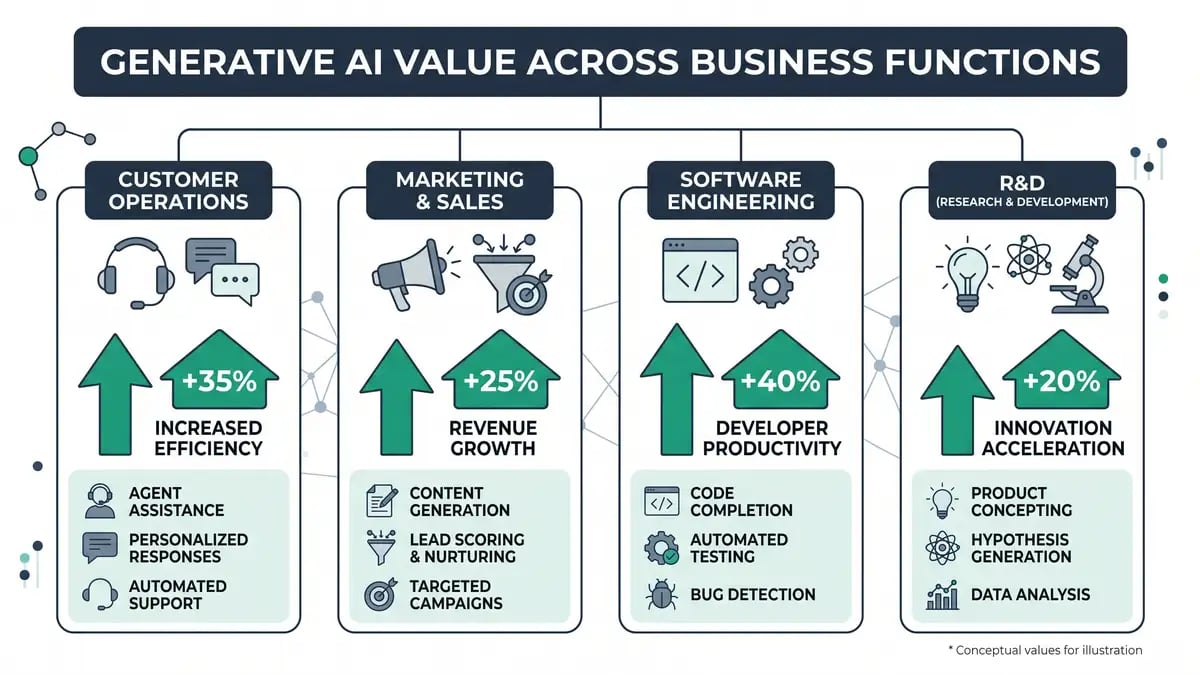
The most cited macro estimate is McKinsey's: across 63 use cases, generative AI could add 2.6 to 4.4 trillion USD in annual value, and about 75 percent of that concentrates in four functions, namely customer operations, marketing and sales, software engineering, and R&D. Combined with traditional AI, McKinsey estimates the technology could add 0.2 to 3.3 percentage points to annual labour-productivity growth. The core contribution is productivity: the same workforce delivering more output, higher quality, or more innovation.

Firm-level evidence backs the macro view. Deloitte's 2026 survey finds 66 percent of organisations report productivity and efficiency gains, 53 percent better insights and decisions, 40 percent cost reductions, 38 percent improved customer relationships, and 20 percent already attribute revenue growth to AI, while 74 percent hope to. At the worker level, a 35,000-person study across 27 economies cited by Informatica found employees saved about one hour per day on routine tasks, with roughly a fifth saving two hours. In marketing specifically, MIT Sloan's survey of 316 leaders linked AI use to a 6.2 percent rise in sales productivity, a 7 percent rise in customer satisfaction, and a 7.2 percent fall in marketing overhead.
Productivity and efficiency gains are currently more widely realised than direct revenue growth. The distribution of returns is highly skewed: a minority of well-executed programmes capture outsized value while many pilots never reach scale.
One nuance on cost. Gartner, cited by CMSWire, predicts the cost per generative AI resolution in customer service will exceed 3 USD by 2030, surpassing many offshore human agents in B2C settings. Generative AI is not always the cheapest option per interaction. Its value often lies in quality, speed, scalability, and 24/7 multilingual coverage rather than pure cost reduction, so ROI cases should weigh both cost and quality. For a structured way to model this, work through the AI ROI math for B2B.
Business use cases by function
Value concentrates where work is knowledge-intensive and customer-facing. These are the four functions McKinsey flags, plus the back-office areas that round out a deployment.

Marketing and sales. Draft product copy, generate landing-page variants, tailor outreach by industry and persona, and turn discovery-call notes into proposal drafts and slide outlines. The MIT Sloan figures above show AI-enabled marketing can lift revenue and cut spend at the same time when implemented well. Pair generative content with your CRM automation so personalisation runs on first-party data.
Customer service. Generative models power customer-facing chatbots, agent assistants that draft responses and suggest next best actions, and back-office systems that summarise and categorise tickets. As agentic capability matures, a support agent can triage, run diagnostics, and escalate only low-confidence or novel cases, which is exactly the territory of AI agent workflow automation.
Software engineering. Code assistants generate boilerplate, write tests, and create documentation, materially raising developer productivity and cutting time-to-market. Bloomberg Intelligence estimates specialised coding assistants alone could reach around 89 billion USD in annual revenue by 2032. The caveat: pair assistants with robust testing and review, since models can introduce bugs, vulnerabilities, or licence-incompatible code.
R&D, knowledge work, and back office. Literature synthesis, idea generation, and technical documentation in R&D; document processing in finance and HR; and knowledge management across the business. Many of these become reliable systems when wrapped in intelligent automation and built on no-code platforms, which is why no-code AI agents have lowered the barrier to deployment. To choose the right platforms, compare the leading AI automation tools.
Want to know which generative AI use case will pay back fastest in your business?
Book a Growth Mapping CallThe risks that sink generative AI projects
The upside is real, but so is the failure rate. S&P Global reports that the share of companies abandoning most of their AI initiatives rose from 17 percent to 42 percent, with the average organisation scrapping about 46 percent of its AI projects. Gartner, cited by Informatica, predicts 30 percent of generative AI projects will be abandoned after proof of concept by the end of 2025. The pattern is consistent: pilots stall not because of the model but because of weak data, missing governance, and poor change management.

The specific risks to govern are distinct from predictive AI. Hallucination produces fluent but fabricated output, so high-stakes uses need human review. Data privacy and security matter because sensitive information can leak through prompts. Intellectual property and copyright exposure arise when models generate content trained on third-party material. Bias, model cost, and the change-management burden round out the list. IDC's FutureScape anticipates that by 2026 around 70 percent of cloud and software platform providers will bundle generative AI safety and governance features with their core services, which helps, but does not remove the need for your own controls.
The pilot trap
Most generative AI value is lost between an impressive demo and a scaled deployment. Adding a chatbot or a code assistant is not transformation. Teams that win redesign the underlying workflow, fix the data, and define success metrics before they scale. Those that do not join the 42 percent abandoning most of their initiatives.
How to start: a phased approach
Treat generative AI as an operating-model change, not a tool purchase. This sequence keeps you out of the abandonment statistics.
Select one high-value process
Pick a high-volume, high-friction process tied to a clear metric such as time-to-resolution, content throughput, or revenue per rep. Narrow scope beats broad ambition for a first win.
Confirm data readiness
Generative AI reasons over your unstructured data. If documents, knowledge bases, and records are scattered or low quality, fix that first. Data, not the model, is the usual point of failure.
Decide build versus buy
Most firms access generative AI through cloud services and SaaS features rather than building models. Buy for speed on common use cases; reserve custom builds for genuine differentiation.
Keep humans in the loop and govern
Put human review on sensitive steps and set policy for privacy, accuracy, and IP. Build guardrails before you scale, not after an incident.
Measure, then expand
Track the outcome against the metric you chose, prove payback, then extend to adjacent processes. Embed the win into the workflow so it compounds rather than staying a demo.
If you would rather not navigate build-versus-buy and governance alone, this is where an AI consultant or a focused AI automation agency earns its fee: structuring the portfolio, aligning use cases to outcomes, and installing the system so the value compounds.
Stop running pilots. Install the operating system.
peppereffect architects AI operating systems that decouple your revenue from headcount: logic-gated workflows and autonomous agents across lead generation, sales administration, operations, and marketing. Not a demo. A working machine that pays back.
Book Your Growth Mapping CallFrequently asked questions
What is generative AI for business? Generative AI is a class of foundation models that create new content such as text, code, images, and audio by learning patterns from large datasets. For business it shows up as large language models powering chatbots, code assistants, document analysis, and content generation. Unlike rule-based automation, generative models respond to open-ended prompts, interpret ambiguous instructions, and work with unstructured data like PDFs, transcripts, and tickets. McKinsey frames it as a co-pilot that augments knowledge work rather than fully automating high-stakes decisions.
How is generative AI different from traditional AI and agentic AI? Traditional or predictive AI takes structured data and produces a classification or number, such as which lead will convert. Generative AI produces plausible continuations of complex sequences like language or code, so it writes the retention email rather than just flagging the risk. Agentic AI adds planning, tool use, and multi-step execution, pursuing a goal like resolving a ticket by orchestrating several model and tool calls, acting like a virtual employee in a workflow.
What is the ROI of generative AI? McKinsey estimates 2.6 to 4.4 trillion USD in annual value, about 75 percent concentrated in customer operations, marketing and sales, software engineering, and R&D. Deloitte finds 66 percent of organisations report productivity gains, 40 percent cost reductions, and 20 percent revenue growth. A 35,000-worker study found around one hour saved per day. Returns are real but skewed toward well-executed programmes.
What are the main business use cases for generative AI? Marketing and sales (content, personalisation, lead management), customer service (co-pilots, self-service, agentic resolution), software engineering (code, testing, documentation), and R&D and knowledge work (synthesis, drafting). Finance, HR, and operations add document processing and back-office automation. One MIT Sloan study linked AI use in marketing to a 6.2 percent rise in sales productivity and a 7.2 percent drop in overhead.
Why do most generative AI projects fail? Failure usually comes from weak data, missing governance, and poor change management, not the model. S&P Global reports the share of companies abandoning most AI initiatives rose from 17 percent to 42 percent, with the average organisation scrapping about 46 percent of projects. Gartner predicts 30 percent of generative AI projects abandoned after proof of concept by the end of 2025. The fix is disciplined use-case selection, clean data, human-in-the-loop review, and measurable success criteria.
How should a business start with generative AI? Start phased: select one high-volume, high-friction process tied to a clear metric, confirm data is clean and accessible, decide build versus buy, keep humans in the loop on sensitive steps, set governance for privacy, accuracy, and IP, measure the outcome, then expand. Treat it as an operating-model change, not just a tool purchase.
Resources
- McKinsey, The Economic Potential of Generative AI
- McKinsey, The State of AI
- Deloitte, State of AI in the Enterprise
- IDC, Global AI and Generative AI Spending
- Grand View Research, Generative AI Market Report
- Precedence Research, Generative AI Market
- Bloomberg Intelligence, Generative AI to Become a $1.3T Market
- Stanford HAI, 2024 AI Index Report
- S&P Global, Generative AI Shows Rapid Growth but Mixed Results
- Informatica, Why Most AI Projects Fail
- MIT Sloan Management Review, When AI Investments Pay Off in Marketing
- CMSWire, Will AI Cost More Than Offshore Human Agents
- Fortune Business Insights, Artificial Intelligence Market
- Grand View Research, Global AI Market