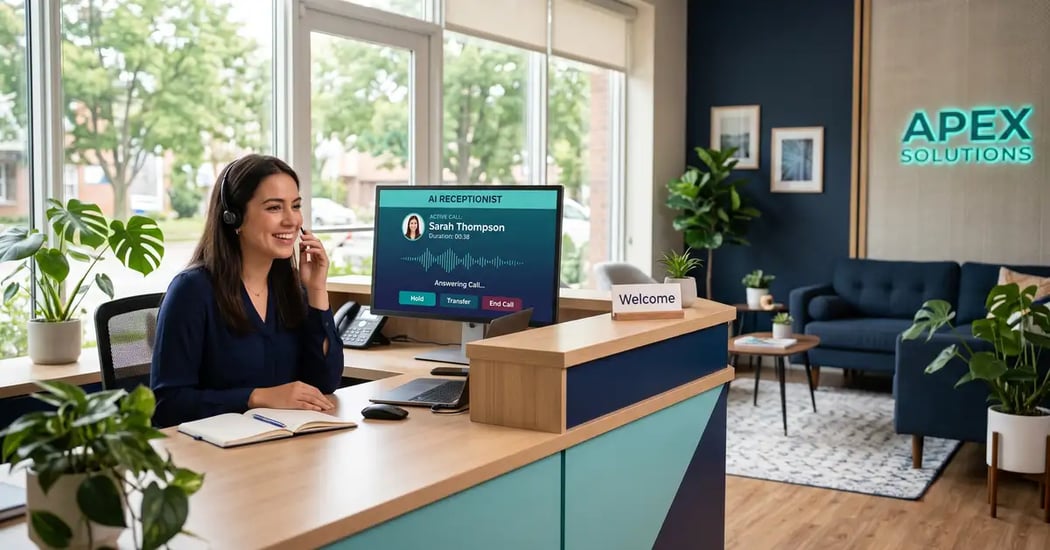

Every unanswered call is a customer who picked up the phone, waited, and gave up. For most small and mid-sized businesses that happens far more often than owners realise, and the lost revenue is enormous. An AI receptionist is the system that closes that gap: an AI-powered virtual front desk that answers every call instantly, books appointments, answers questions, captures leads, and routes calls 24/7, at a fraction of the cost of a human receptionist.
This is not a press-1 phone menu or a smarter voicemail. A modern AI receptionist understands natural speech, talks back in a human-sounding voice, and takes real action in your calendar and CRM. The economics are stark: small businesses answer only about 37.8 percent of their calls, 85 percent of missed callers never call back, and the average small business loses roughly 126,000 USD a year as a result. This guide explains what an AI receptionist does, how it differs from the alternatives, what it costs, where it pays off, the risks, and how to choose one.
What is an AI receptionist?

An AI receptionist is an AI-powered virtual receptionist that answers inbound phone calls and chats, books and reschedules appointments, routes and transfers calls, answers frequently asked questions, qualifies and captures leads, and takes messages around the clock, without breaks or shift limits. Nextiva describes its XBert AI Receptionist as an intelligent virtual agent that answers every call instantly, uses voice recognition and natural language processing to understand intent, routes calls, answers FAQs, gathers information, and escalates to a human when needed, explicitly contrasting it with a "glorified voicemail system."
The defining feature is that it acts as an intelligent front door to the business rather than a single-channel gadget. It interacts in natural language, follows structured workflows such as appointment scheduling or lead intake, and hands off cleanly to a person when complexity or emotional nuance demands it. Many vendors now bundle voice with web chat on the same conversational engine, so the same system answers the phone and the website. This is the same underlying technology covered in our guide to the AI voice agent, packaged specifically for the front desk.
There are boundaries worth naming up front. AI receptionists are best at structured, transactional tasks: greeting callers, confirming identity, booking, providing simple information, collecting contact details, and routing by business rules. They are not built to make discretionary promises, give clinical or legal advice, or handle emotionally charged negotiations. Those calls should escalate to a human, which is why most deployments are part of a wider customer service automation strategy rather than a full replacement for staff.
AI receptionist vs human, answering service, and IVR
The AI receptionist competes with three incumbents, and each comparison points to a different strength. A human receptionist still wins on empathy, judgment, and in-person tasks. A traditional answering service offers a human voice for nuanced calls. Legacy IVR is cheap but universally disliked. The AI receptionist's edge is availability, integration, and cost per call.
| Factor | Human receptionist | Answering service | Legacy IVR | AI receptionist |
| Typical cost | $2,800-3,500/mo salary | $200-600/mo | Low, bundled with PBX | $49-569/mo |
| Availability | Office hours | Extended / 24/7 | 24/7 | 24/7, many calls at once |
| Understands natural speech | Yes | Yes | No (menus only) | Yes |
| Calendar / CRM actions | Manual | Limited | No | Automatic |
| Best for | Empathy, walk-ins | Nuanced calls | Simple routing | Routine, high-volume calls |
Source: Aira, 2024; EverHelp, 2026; Nextiva, 2024
The IVR comparison is the sharpest. Traditional "press 1 for sales" systems rely on fixed menu trees and keypad tones; callers must listen to long menus, remember options, and often land in the wrong queue. RingCentral markets its AI Receptionist on exactly this contrast, promising "human-like conversations in multiple languages without rigid IVR menus" and routing by names, locations, and keywords without repeated questions. Crucially, an AI receptionist can be layered onto an existing phone system with minimal IT work, so it replaces or augments IVR without ripping out your PBX, the same low-friction path that makes broader intelligent automation attractive to small teams. It is one of the most common entry points in any roundup of AI automation tools for service businesses.
How an AI receptionist works
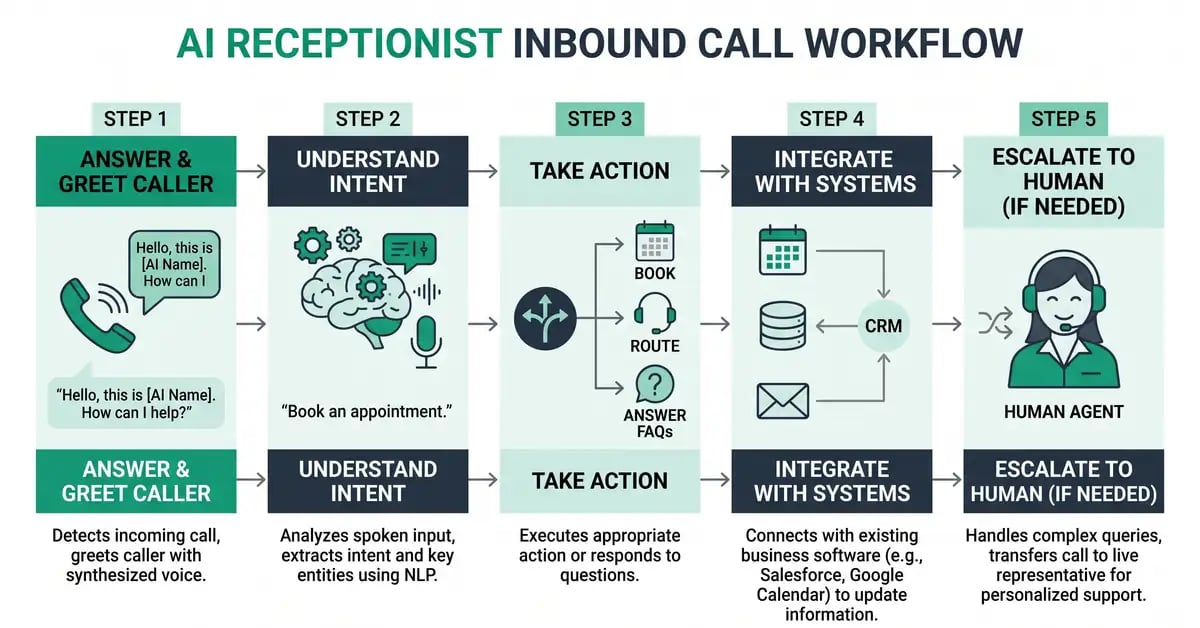
Under the hood, an AI receptionist is a real-time pipeline that has to feel instant. The whole loop, from the caller finishing a sentence to the agent replying, needs to stay within a few hundred milliseconds or the conversation feels robotic.
Answer and capture speech
The system answers in under a second and converts the caller's audio to text with streaming speech-to-text tuned for telephony, accents, and background noise. Misrecognition here propagates through the whole call, so accuracy matters most at this stage.
Understand intent with an LLM
A large language model interprets what the caller wants, even from messy phrasing like "I was supposed to come in last Tuesday but was sick, can we push to next week?" It infers a reschedule request rather than forcing a rigid form, and answers FAQs from your website and documents.
Act in calendar and CRM
Dialogue management orchestrates the workflow: query the calendar, propose open slots, write the booking back, log the call outcome, and create or update a lead record, often firing an SMS or email confirmation. GoodCall connects these actions to hundreds of apps via Zapier without custom code.
Reply in a natural voice, escalate when needed
Neural text-to-speech delivers a human-sounding reply with appropriate pacing. If the caller is frustrated or the request is complex, escalation rules transfer to a person with context attached, so automation never becomes a wall.
That integration layer is what separates a real AI receptionist from a chatbot bolted onto a phone line. Because every interaction writes structured data back into your systems, the front desk becomes a source of analytics on call volume and conversion, the same data discipline behind CRM automation.
What an AI receptionist costs, and the missed-call math

Pricing spans from tens of dollars per month for entry-level answering to several hundred for comprehensive 24/7 service, with effective per-call costs usually under a dollar. The table below shows representative plans. The pattern holds across providers: AI reception undercuts both a human receptionist and a live answering service on marginal cost, while adding round-the-clock coverage.
| Provider | Representative price | Model |
| My AI Front Desk | from ~$65/mo | AI receptionist for small practices |
| Nextiva XBert AI | $99.99/mo (up to 99 calls), then $0.99/call | AI receptionist |
| Smith.ai AI Receptionist | ~$500/mo | 24/7 AI, ~87.5% cost reduction claimed |
| ReceptionHQ | from $25/mo + ~$1.99/call | Human-backed, pay-as-you-go |
| Ruby | $250/mo (50 min) to $1,725/mo (500 min) | Human virtual receptionist |
Source: My AI Front Desk, 2025; Nextiva, 2024; Smith.ai, 2024; ReceptionHQ, 2024; Ruby, 2024
The real argument is not the subscription, it is the cost of doing nothing. Aira's analysis finds small businesses answer only 37.8 percent of calls, 85 percent of missed callers never call back, and the average business loses about 126,000 USD a year. Nextiva's ROI calculator puts human call handling at roughly 5.63 USD per call versus 0.99 USD for its AI, a 40,800 USD annual saving in its example scenario. Smith.ai claims an 87.5 percent reduction in reception costs and around 42,000 USD saved per year against a full-time hire. For a call-driven business, the AI receptionist often pays for itself by recovering a handful of leads a month, which is why it sits alongside lead generation automation in the growth stack.
Want to know how many leads your missed calls are costing you?
Book a Growth Mapping CallTop use cases by industry

AI receptionists pay off most where call volume is high, staff are busy with in-person work, and every missed call carries real revenue. The numbers below come from Aira's industry breakdown of missed-call economics:
- Dental and medical: 20 to 38 percent of calls missed, each new-patient call worth about 850 USD in lifetime value, an estimated 100,000 to 150,000 USD lost per practice per year. One clinic cut front-desk call volume about 60 percent with an AI receptionist. Healthcare voice AI is a 468M USD market in 2024 growing toward 3.18B USD by 2030.
- Law firms: roughly 35 percent of calls missed, a single client worth 5,000 USD or more, and an estimated 109B USD in missed-call losses industry-wide. Nextiva cites a firm that saved about 70,000 USD a year while streamlining intake, often paired with AI agents for sales intake on the outbound side.
- Home services and trades: 27 to 62 percent of calls missed, each worth 275 to 1,200 USD; a contractor missing 5 to 10 calls a week can lose 45,000 to 120,000 USD a year.
- Real estate: about 40 percent of calls missed; a missed buyer inquiry on a 300,000 USD home at 3 percent commission is roughly 9,000 USD in lost income.
- Salons and spas: 35 to 40 percent of calls missed during peak hours, costing an estimated 35,000 to 67,000 USD a year.
Across all of these, the AI receptionist is rarely the whole system. It is the voice front door wired into the same operational backbone as your AI email assistant and your business process automation, so a booked call flows straight into scheduling, billing, and follow-up without manual re-entry.
The risks and limits
The technology is real, but it is not a drop-in replacement for judgment. LLMs can hallucinate, producing plausible but wrong answers, which is dangerous in regulated fields; good vendors constrain responses to an approved knowledge base with retrieval-augmented generation and defer anything uncertain. Speech recognition still degrades on heavy accents, code-switching, and noisy lines. And callers in emotional or high-stakes situations still want a human, which is why answering services remain the better fit for sensitive calls.
Compliance and disclosure are not optional
In healthcare, an AI receptionist must never give clinical advice and must handle protected health information in line with HIPAA, which usually means avoiding non-compliant storage of call content. Law firms must keep an AI from offering legal advice and protect client confidentiality. Across every sector, disclose that the caller is speaking to an AI, set clear escalation paths, and confirm the vendor will not train general models on your call data without consent.
The practical answer is the hybrid model nearly every successful deployment lands on: the AI handles routine, after-hours, and overflow calls, while humans take escalations and high-stakes conversations. That keeps the cost and availability advantages without sacrificing the moments where a person genuinely matters.
How to choose and deploy an AI receptionist
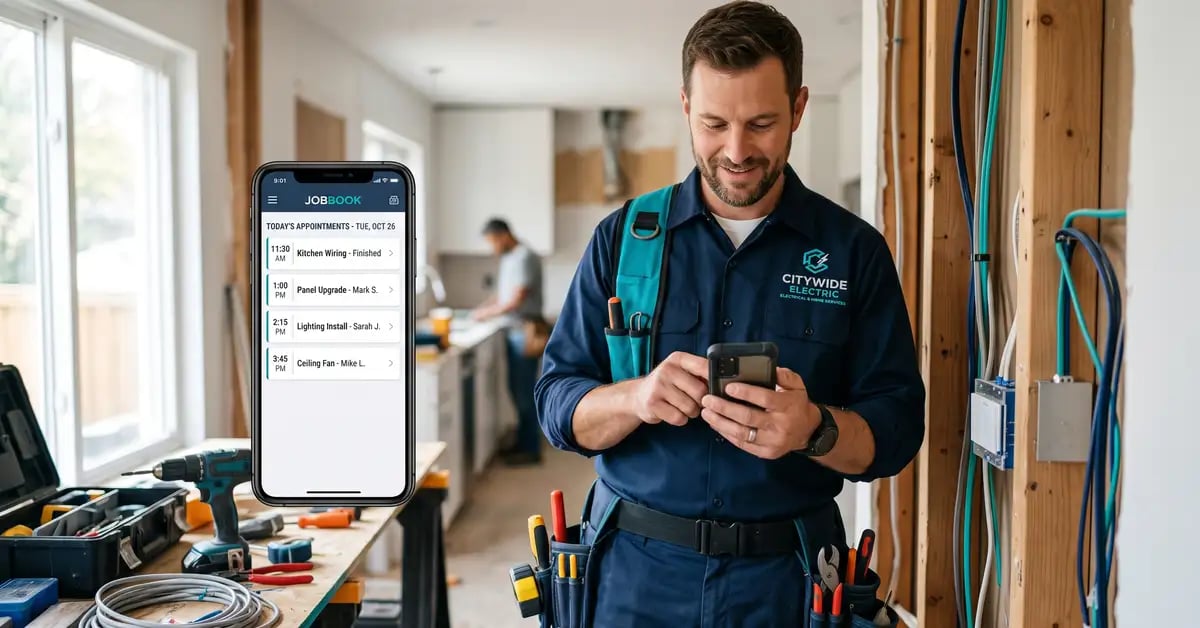
Treat this as a phased rollout, not a switch you flip on day one. The businesses that succeed start with the calls that hurt most to miss and expand from there.
Map your highest-value calls and where they leak
Identify which call types drive revenue (new patients, new matters, service bookings) and when they go unanswered, usually after hours, lunch, and peak in-person periods. That is your first target.
Choose for integration, not just price
Confirm the provider works with your existing phone system, calendar, and CRM, and that it can transfer to a human cleanly with context. Integration depth is what turns answered calls into booked revenue, and where an experienced AI consultant earns their fee.
Train it and set guardrails
Feed it your website, FAQs, and documents, write clear escalation rules for complex or sensitive calls, add AI disclosure, and confirm compliance handling for regulated data before go-live.
Pilot, measure, expand
Start on after-hours and overflow calls. Track missed-call recovery, booked appointments, average response time, and cost per call. Prove the payback, then extend the AI receptionist to more call types and hours.
The bottom line
An AI receptionist is no longer a novelty; it is a profit lever for any business that loses revenue to missed calls. It answers instantly, books and routes 24/7, integrates with your systems, and costs a fraction of a human hire, while still escalating the calls that need a person. The winners will not be the firms that buy the cheapest bot. They will be the ones that target their most valuable calls, integrate deeply, govern it properly, and treat it as the front door to a wider automated operation.
Stop losing leads to missed calls
peppereffect installs AI receptionists as part of an integrated operating system, wired into your calendar, CRM, and fulfilment so every answered call turns into a booked, tracked, followed-up opportunity. We diagnose where your front desk is leaking revenue and architect the logic-gated workflows that plug it.
Book a Growth Mapping CallFrequently asked questions
What is an AI receptionist?
An AI receptionist is an AI-powered virtual receptionist that answers calls and chats, books and reschedules appointments, routes calls, answers FAQs, qualifies and captures leads, and takes messages 24/7. It uses speech-to-text, an LLM, text-to-speech, and calendar and CRM integration to resolve a call or escalate it to a human. Unlike voicemail or a press-1 menu, it understands natural speech. Smith.ai, Ruby, RingCentral, Nextiva, Goodcall, and My AI Front Desk are common providers.
How much does an AI receptionist cost?
Most cost between about 49 and 569 USD per month depending on call volume, with per-call costs often under a dollar. My AI Front Desk starts around 65 USD per month, Nextiva's XBert is about 99.99 USD per month for up to 99 calls then 0.99 USD per call, and Smith.ai's AI Receptionist is roughly 500 USD per month. A human receptionist costs 2,800 to 3,500 USD per month in salary; live answering services run 200 to 600 USD per month.
How is an AI receptionist different from a human receptionist or answering service?
A human wins on empathy, judgment, and walk-ins but costs more and works set hours. An answering service offers human agents for nuanced calls at 200 to 600 USD per month. An AI receptionist is 24/7, handles many calls at once, integrates with your calendar and CRM, and costs far less per call, but should escalate complex or sensitive calls. Most businesses run a hybrid.
What does an AI receptionist do best?
High-volume, structured, transactional calls: greeting, intent detection, booking and rescheduling, FAQs, lead capture and qualification, messages, and context-rich routing. It excels at recovering missed and after-hours calls. The strongest industries are dental and medical, law firms, home services, real estate, and salons. It should not give clinical, legal, or financial advice.
How much revenue do businesses lose to missed calls?
Aira reports small businesses answer only about 37.8 percent of calls, 85 percent of missed callers never call back, and the average business loses about 126,000 USD a year. Dental practices lose an estimated 100,000 to 150,000 USD, home services 45,000 to 120,000 USD, and salons 35,000 to 67,000 USD. An AI receptionist answers in under a second and recovers a large share of those leads.
How do I choose and deploy an AI receptionist?
Map your highest-value call types and where calls leak, choose a provider that integrates with your phone system, calendar, and CRM and escalates cleanly, train it on your website and FAQs, set escalation rules and AI disclosure, and pilot on after-hours and overflow calls first. Measure missed-call recovery, booked appointments, and cost per call, then expand. For healthcare, confirm HIPAA-aware handling before launch.
Resources
- Aira, Missed Business Calls Statistics
- Nextiva, AI Receptionist ROI Calculator
- Smith.ai, AI Receptionist Pricing
- Ruby, Plans and Pricing
- RingCentral, AI Receptionist
- ReceptionHQ, Pricing
- My AI Front Desk, 2025 Pricing Breakdown
- Grand View Research, AI for Customer Service Market
- Grand View Research, AI Voice Agents in Healthcare Market
- Technavio, Voice AI Agents Market
- EverHelp, Answering Service Pricing Comparison
- Resonate, AI Receptionist Statistics