

For two decades, the business phone line meant one of two things: a human with a headset, or a menu that told you to press 1. In 2026 there is a third option that sounds almost indistinguishable from the first and scales like the second. An AI voice agent is a software agent that listens, understands, reasons, and speaks over the phone in natural language, and it now handles real B2B calls at a fraction of the cost of a live agent.
This is not a smarter robocall. A modern AI voice agent uses a large language model to interpret open-ended speech, calls your CRM and calendar to take action, and replies with roughly 400 to 600 milliseconds of latency, fast enough that callers often cannot tell it is automated. The category exploded in late 2024: Andreessen Horowitz reports that companies building with voice made up about 22 percent of the most recent Y Combinator class, and roughly 69 percent of those founders target B2B use cases. This guide explains what an AI voice agent is, how the pipeline works, what it costs, where it pays off, the risks, and how to deploy one.
What is an AI voice agent?

An AI voice agent is a software-based agent that conducts real-time, spoken conversations with humans over telephony or similar channels. It uses automatic speech recognition (ASR) to convert speech into text, a large language model (LLM) to interpret and reason about the input, and neural text-to-speech (TTS) to generate a natural-sounding reply, while integrating with business systems such as CRMs, scheduling tools, and ticketing platforms to take meaningful actions without human intervention.
The defining characteristics are autonomy, adaptivity, and integrability. Autonomy means that for routine interactions such as balance checks, appointment bookings, or simple troubleshooting, the agent resolves the issue end to end, producing a high containment rate that translates directly into labour savings. Adaptivity means it handles interruptions, multi-intent queries, and unexpected inputs by leaning on the general reasoning of an LLM instead of replying "I didn't understand that." Integrability is where B2B value lives: the agent must connect securely to your line-of-business systems to create cases, update records, or book meetings. As Retell AI describes it, the goal is an agent that can "listen, speak, and hold natural phone conversations like a human." This is the same agentic shift driving AI workflow automation across the rest of the business, applied to the phone.
It is worth separating this class of tool from "AI robocalls." In B2B settings, voice agents are deployed inside consented relationships such as customer service lines, existing client outreach, and opt-in reminders, and they run on platforms built for compliance. That regulatory and security posture is fundamentally different from anonymous mass-dialling, even where the underlying speech synthesis is similar.
AI voice agent vs IVR and scripted chatbots
Interactive voice response (IVR) was the first wave of phone automation: prerecorded menus navigated by keypad presses or keyword spotting, good at routing but unable to understand free-form speech. Scripted chatbots were the second wave, answering predefined questions but stumbling on ambiguous or multi-intent requests. The LLM-based voice agent is the third wave, and the difference is qualitative, not incremental.
| Capability | Traditional IVR | Scripted chatbot | AI voice agent |
| Input handling | Keypad / keyword spotting | Predefined text intents | Open-ended natural speech |
| Reasoning | Fixed decision tree | Pattern matching | LLM reasoning, multi-turn context |
| Takes actions | Routing only | Limited | Function calls to CRM, calendar, billing |
| Handles interruptions | No | No | Yes, with barge-in and turn-taking |
| Response latency | Instant menu, no dialogue | Text, no voice | ~400-600 ms per turn |
Source: TTEC, 2024; Retell AI, 2025
The practical upshot: IVR and chatbots persist for narrow tasks, but AI voice agents increasingly own high-volume transactional calls that benefit from conversational flexibility, human-like tone, and deep systems integration. Vendors describe legacy "IVA" agents as slow to set up, brittle on edge cases, and limited to one-turn interactions, in contrast with third-generation voice AI that holds natural conversations and manages complex inbound and outbound use cases. If you have mapped your call flows the way you would in business process mapping, you already know which of those calls are repeatable enough to automate first.
How an AI voice agent works: the pipeline
Under the hood, a modern voice agent is a tightly coupled pipeline. The total latency per turn is roughly the sum of speech recognition, LLM reasoning, text-to-speech, and network time, and the whole chain has to stay under about 700 milliseconds to feel conversational. Streaming at every stage is what makes that possible: the agent starts processing before you finish your sentence and starts speaking before the full reply is generated.
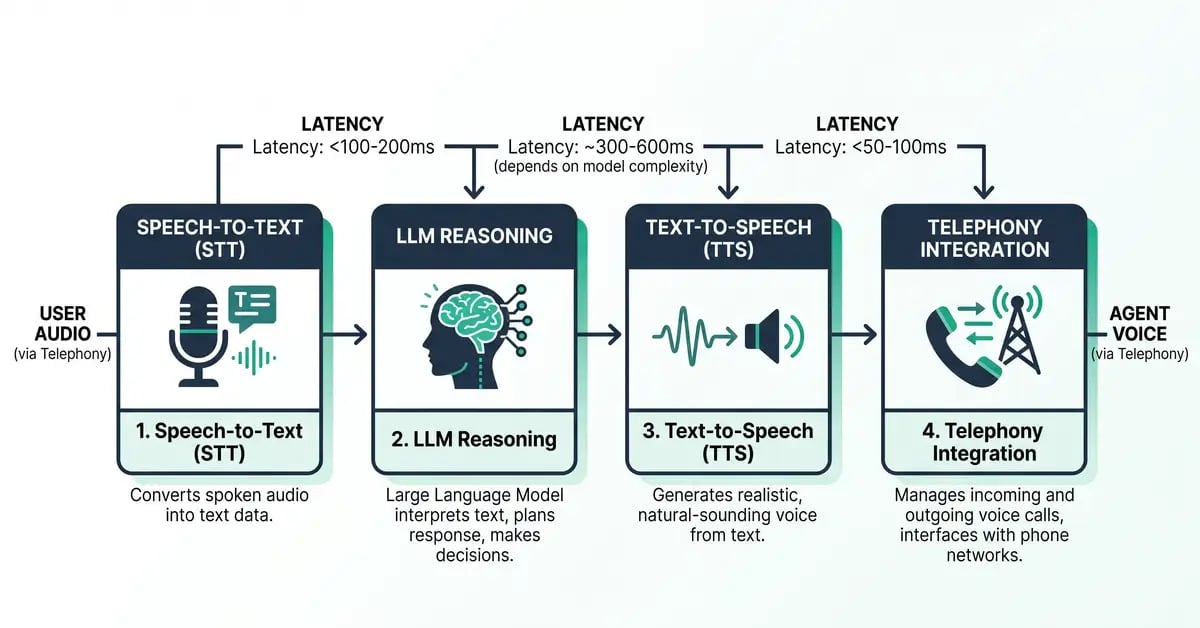
Telephony connection
An inbound or outbound call is established through a provider or SIP trunk, such as Twilio for programmable voice or Amazon Connect for cloud contact centre telephony. Amazon Connect charges roughly 0.018 USD per minute for inbound voice with no per-seat licence, so cost scales with minutes, not headcount.
Streaming speech-to-text
The audio is transcribed continuously into text fragments by a neural ASR model tuned for telephony bandwidth and noise. It must run in roughly 100 to 150 milliseconds per chunk so it does not become the bottleneck.
LLM reasoning and tool use
The LLM maintains dialogue state, interprets intent, and decides when to call external APIs, for example to find an appointment slot or update a ticket. Costs have fallen sharply: in December 2024 OpenAI cut its realtime API output token price by about 87.5 percent, making always-on agents economical.
Text-to-speech and turn-taking
A neural TTS model converts the reply to speech with realistic prosody, streaming audio so playback begins early. A dedicated turn-taking model decides when to stop and listen, enabling barge-in so callers can interrupt naturally.
Around this core sits the enterprise layer: PII detection and redaction, encrypted call recording, audit trails, and conversation intelligence for real-time transcription and sentiment analysis. This is the part that turns a clever demo into a system you can run in a regulated environment, and it follows the same governance logic as any other intelligent automation deployment. The function-calling layer makes the agent an active operator, the voice-channel expression of AI agent workflow automation.
The market and the economics

The AI voice agent sits inside the broader conversational AI market, which Grand View Research estimates at about 14.3 billion USD in 2025, rising to roughly 17.7 billion USD in 2026 and nearly 78.9 billion USD by 2033, a compound annual growth rate near 23 percent. Within contact centres specifically, Fortune Business Insights projects the call centre AI market growing from about 2.98 billion USD in 2026 to 13.52 billion USD by 2034 at a 20.8 percent CAGR. The standalone voicebot market was about 7.1 billion USD in 2024 by Market Research Future's estimate.
The economics are what make adoption move. Pricing is almost always per minute, with separate line items for the LLM, speech infrastructure, telephony, and add-ons. The table below shows the headline numbers, including the comparison that drives most business cases: an AI-resolved call costs cents, a human call costs dollars.
| Cost item | Figure | Source |
| Retell AI total per minute | 0.07 - 0.31 USD | Retell, 2025 |
| Bland AI bundled per talk minute | 0.11 - 0.14 USD | Bland, 2025 |
| Synthflow enterprise contract | from ~30,000 USD/year | Synthflow, 2025 |
| Fully automated AI-resolved call | 0.10 - 0.18 USD | Rel8, 2025 |
| Fully loaded human agent call (UK) | 4.50 - 7.00 USD | Rel8, 2025 |
Source: Retell AI pricing, 2025; Bland AI pricing, 2025; Synthflow pricing, 2025; Rel8, 2025
That gap, roughly 40 to 100 times cheaper for comparable tasks, is why the returns are dramatic. Rel8's business case for a production Amazon Connect voice agent in a regulated environment assumes build costs of 80,000 to 180,000 USD, monthly infrastructure of 2,000 to 6,000 USD, and conservative containment of 45 percent in month one rising to 58 percent by month six. For a contact centre handling 40,000 to 60,000 calls per month, that produces payback in 4 to 7 months and 12-month ROI between 800 and 1,600 percent. LivePerson reports a complementary 40 to 60 percent cut in cost per interaction across customer service AI programmes. The same per-call math is reshaping how leaders think about customer service automation budgets.
Wondering which of your call types would actually pay back?
Book a Growth Mapping CallTop use cases for AI voice agents

The highest-value deployments share a profile: high call volume, repeatable structure, and a clear escalation path. By function, that means customer service and support triage, outbound sales and lead qualification, appointment setting and reminders, inbound reception and routing, and after-hours or overflow coverage. Because agents run 24/7 at marginal cost, after-hours coverage alone can lift conversion by catching calls that previously went to voicemail.
By industry, the early adopters track call-heavy, transactional verticals. Andreessen Horowitz's breakdown of Y Combinator voice agent founders shows fintech at about 16.9 percent and customer support operations at 12.4 percent leading the B2B segment, with healthcare at roughly 18 percent of the cohort overall. The patterns map cleanly to peppereffect's own ICPs:
- SaaS: billing questions, onboarding, account setup, and routing technical issues to engineering, often paired with an AI agent for sales on the outbound side.
- Recruiting: initial phone screens against predefined criteria, confirming candidate interest, and negotiating interview times across calendars.
- Healthcare: patient intake, appointment booking, prescription refill requests, and insurance verification, on HIPAA-eligible platforms with business associate agreements.
- Real estate and hospitality: responding to listing or reservation enquiries, pre-qualifying leads, scheduling viewings, and handling modifications.
Across all of these, the agent is rarely the whole system. It is the voice front door to a wider stack, the same way an AI email assistant handles the inbox and intelligent document processing handles the paperwork. Buyers also choose between horizontal platforms like Vapi and Bland, which offer flexible tooling across industries, and verticalised platforms that ship pre-built workflows for a specific sector. Either way, the agent belongs in your wider stack of AI automation tools rather than as a standalone bolt-on.
The risks and limitations
The technology is real, but so are the failure modes. Latency can spike with call geography, model size, or traffic load, turning a smooth conversation into an awkward one. Turn-taking models can misread background noise as speech and talk over callers. ASR still degrades on heavy accents, code-switching, and noisy mobile connections. And like any LLM system, a voice agent can hallucinate, so anything stated as fact on an external call needs grounding and guardrails.
Compliance is not optional
In February 2024 the US FCC ruled that AI-generated voices in robocalls count as "artificial voices" under the Telephone Consumer Protection Act, so the same consent rules apply, including limits on calls to mobile phones without prior consent. Disclose that the caller is speaking to an AI, deploy inside consented relationships, keep a human in the loop for high-risk calls, and confirm SOC 2, HIPAA, and PCI DSS data-handling before you go live.
Trust is the other constraint. Peer-reviewed research on AI agents finds that perceived pleasantness and anthropomorphism are key drivers of emotional trust, which in turn shapes acceptance. That is why vendors invest so heavily in voice quality and why disclosure, done well, tends to increase rather than decrease confidence. The goal is not to fool the caller; it is to resolve their problem quickly and route them to a human the moment the conversation exceeds the agent's competence.
How to deploy an AI voice agent

Treat this as a phased rollout, not a switch you flip. The teams that succeed start narrow, integrate deeply, and optimise continuously.
Pick one high-volume, low-complexity call type
Appointment booking, balance enquiries, or order status are ideal first targets. Containment is achievable, the risk is low, and the ROI is easy to measure.
Choose a platform and integrate it
Connect the agent to your telephony, CRM, and scheduling systems so it can take real actions, not just talk. Integration depth is what separates a containment rate that climbs from one that stalls, which is where an experienced AI consultant earns their fee.
Design the conversation and the guardrails
Write the system prompt, set the tone, add AI disclosure, and define confidence thresholds so uncertain calls route to a human with a summary attached.
Pilot, measure, and expand
Run on a slice of traffic and track containment rate, cost per call, average handle time, and customer satisfaction. Rel8 reports containment rising from about 45 percent to 58 percent over six months of tuning. Prove payback, then add call types.
The bottom line
AI voice agents have crossed from demo to deployment because three curves converged: LLM costs fell, latency dropped to human levels, and telephony became programmable. For high-volume, transactional B2B calls, an AI-resolved interaction costs cents against dollars for a human, with documented payback in months. The winners will not be the firms that buy the flashiest voice. They will be the ones that pick the right call type, integrate it into their systems, and govern it properly.
Architect your voice automation, don't just buy a bot
peppereffect installs AI voice agents as part of an integrated operating system, wired into your CRM, calendar, and fulfilment so the agent takes action instead of just answering. We diagnose which calls to automate first and build the logic-gated workflows around them.
Book a Growth Mapping CallFrequently asked questions
What is an AI voice agent?
An AI voice agent is a software agent that holds real-time spoken conversations over the phone. It uses speech recognition to hear, a large language model to understand and reason, and text-to-speech to reply in a natural voice, while integrating with systems like your CRM and calendar to take actions such as booking appointments. Unlike IVR or scripted chatbots, it handles open-ended, multi-turn dialogue. Common platforms include Retell AI, Bland AI, Vapi, Synthflow, Twilio, and Amazon Connect.
How is an AI voice agent different from IVR and chatbots?
IVR routes callers through prerecorded menus with no real speech understanding, and scripted chatbots answer only predefined questions. An AI voice agent uses an LLM to understand nuanced speech, keep context across a conversation, call APIs to complete tasks, detect frustration and escalate, and respond with roughly 400 to 600 milliseconds of latency. It is a shift from menu navigation to open-ended reasoning.
How much does an AI voice agent cost?
Most platforms charge per minute. Retell AI lists total prices typically between 0.07 and 0.31 USD per minute; Bland AI bundles LLM, speech recognition, and text-to-speech from about 0.11 to 0.14 USD per talk minute; Synthflow enterprise contracts start around 30,000 USD annually. Rel8 estimates a fully automated call at 0.10 to 0.18 USD versus 4.50 to 7.00 USD for a fully loaded human agent call, roughly 40 to 100 times cheaper for comparable tasks.
What are the best use cases for an AI voice agent?
High-volume, transactional phone work: customer service triage, outbound sales and lead qualification, appointment setting and reminders, inbound reception, and after-hours coverage. Early-adopter industries include financial services, insurance, support desks, healthcare, recruiting, real estate, and hospitality. Andreessen Horowitz found about 69 percent of recent Y Combinator voice agent founders target B2B use cases.
Are AI voice agents legal and compliant?
They can be, but they are regulated. The FCC ruled in February 2024 that AI voices in robocalls are artificial voices under the TCPA, so consent rules apply. B2B agents are deployed inside consented relationships and run on platforms with SOC 2, HIPAA, and PCI DSS controls plus PII redaction and audit trails. Disclose the AI, keep a human in the loop for high-risk calls, and confirm data-handling before launch.
How do you deploy an AI voice agent?
Start phased. Pick one high-volume, low-complexity call type, choose a platform and connect it to your telephony, CRM, and scheduling systems, design the conversation with escalation paths and AI disclosure, set confidence thresholds, and pilot on a slice of traffic. Measure containment, cost per call, handle time, and satisfaction, then expand. Containment typically climbs from about 45 percent to 58 percent over the first six months.
Resources
- Andreessen Horowitz, AI Voice Agents: 2025 Update
- Grand View Research, Conversational AI Market Report
- Fortune Business Insights, Call Center AI Market
- Market Research Future, Voicebot Market
- Rel8, Amazon Connect AI Voice Agent Cost and ROI Business Case
- LivePerson, ROI with Customer Service AI
- Retell AI, Pricing
- Bland AI, Pricing
- TTEC, IVR vs Chatbots vs Associates
- Elias Law Group, The FCC Did Not Ban All AI Robocalls
- PMC, Trust in AI Agents (peer-reviewed study)