

Enterprise AI adoption has reached its inflection point. Eighty-eight per cent of organisations now report regular AI use in at least one business function, up from 78 per cent a year earlier. Yet only 39 per cent report meaningful enterprise-level EBIT impact, and most of that impact is concentrated in fewer than 6 per cent of organisations designated as AI high performers. The gap between deploying AI and being ready to deploy agentic AI—autonomous systems that plan, decide, and execute across multiple business systems—is wider than executives suspect.
This guide installs an Autonomy Maturity Model: a rigorous five-level framework for assessing whether your organisation possesses the data foundation, governance infrastructure, orchestration capability, and workforce readiness to scale autonomous agents—not just copilots or narrow ML. It is grounded in 2024–2026 data from Gartner, McKinsey, BCG, Deloitte, MITRE, and Cisco, benchmarked against what mid-market B2B companies ($10–40M ARR) actually achieve, and designed to produce one output: a defensible diagnosis of where you sit today and what it takes to advance.
The Master Growth Architect's Position
Agentic AI readiness is not a scaled-up version of general AI maturity. It is a distinct capability stack—multi-system orchestration, persistent memory, real-time guardrails, and human-in-exception governance—that Level 3 organisations routinely lack. The 40 per cent agentic cancellation rate is not a technology failure; it is a maturity failure. Diagnose before you deploy.
The Adoption–Readiness Paradox: Why Scale Still Eludes 94% of Enterprises

The central diagnostic finding driving this model is a sharp disconnect between deployment breadth and outcome realisation. Widespread adoption has not translated to widespread value. McKinsey's 2025 State of AI survey found that while 88 per cent of organisations have AI in production somewhere, nearly two-thirds remain trapped in experimentation or piloting phases, unable to extract meaningful business value.
The MIT Project NANDA research, after interviewing 300 leaders and surveying 350 employees across live AI deployments, reached a stark verdict: 95 per cent of organisations deploying generative AI captured zero measurable return on investment. Not low return. Zero. The failure causes are consistently non-technical—misaligned incentives, absence of end-user co-design, weak data readiness, poor workflow integration, and undefined outcomes before development begins.
The readiness gap is most acute at the agentic frontier. Gartner projects that 40 per cent of enterprise applications will include task-specific AI agents by the end of 2026, up from less than 5 per cent today. Simultaneously, Gartner estimates that over 40 per cent of agentic AI projects will be cancelled before end of 2027 due to escalating costs, unclear business value, or inadequate risk controls. Organisations lack not the technology to build agents but the organisational maturity to govern, integrate, and scale them—particularly in multi-agent orchestration environments.
This is the paradox the Autonomy Maturity Model is designed to resolve: diagnostic clarity on where your organisation sits, what capability gaps predict failure, and how to architect the 18-month path to autonomous-ready maturity. Governance alone is insufficient; maturity is the integrated prerequisite.
Established AI Maturity Frameworks: Four Models, One Converging Verdict
Four frameworks dominate enterprise AI assessment as of 2026. Each approaches maturity differently, but all converge on the same core dimensions: strategy and leadership, data readiness, infrastructure and tooling, governance and risk, talent and skills, and organisational culture. Understanding their structure provides the foundation for a differentiated agentic-focused model.
| Framework | Structure | Key Distinguishing Feature | 2025 Benchmark Data |
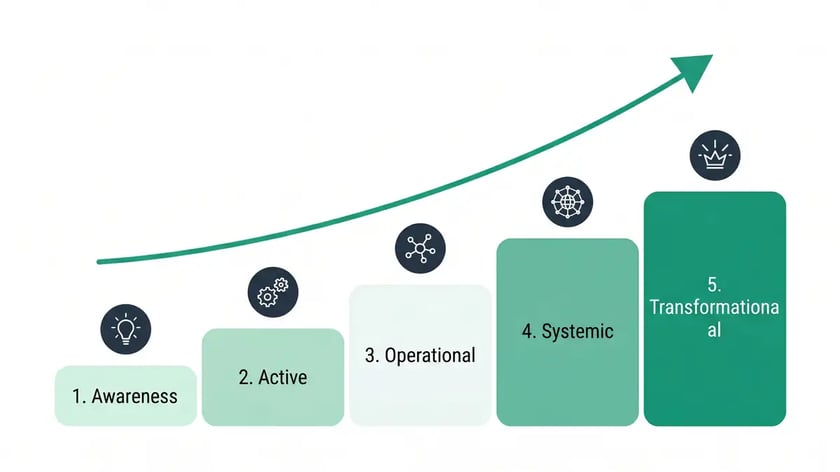
| Gartner AI Maturity Model | 5 stages: Awareness, Active, Operational, Systemic, Transformational | Industry-standard descriptive model; widely cited in executive contexts | Two-thirds of enterprises remain at Active stage; under 3% Transformational |
| MITRE AI Maturity Model | 6 pillars × 5 levels (Initial → Optimised); 20 assessment dimensions | Ethical, Equitable, and Responsible Use as foundational pillar | Government-grade rigour; adopted by federal agencies including DOT |
| Cisco AI Readiness Index 2025 | 6 pillars: Strategy, Infrastructure, Data, Governance, Talent, Culture | Annual empirical benchmark across 8,000+ enterprises globally | 42% claim strategic readiness; operational readiness lags significantly |
| Microsoft AI Transformation Framework | 5 stages with prescriptive governance and role definitions | Prescriptive roles at each stage (CoE, Data Council, Responsible AI Office) | Stage 2 to Stage 3 identified as critical inflection point for enterprises |
Sources: Gartner five-stage reference (WitnessAI), MITRE AI Maturity Model, Cisco AI Readiness Index 2025, Microsoft Enterprise AI Maturity Guide
Cisco's 2025 index surfaces the central diagnostic pattern: strategic readiness has outpaced operational readiness. Forty-two per cent of organisations now believe their AI strategy is highly prepared for adoption, but only a minority feel well-prepared across infrastructure, data, risk management, and talent acquisition. This is the "AI Preparedness Gap": executive ambition decoupled from operational capability. Agentic deployment is where that gap becomes fatal.
The Five-Level Autonomy Maturity Model

Building on established frameworks while addressing agentic-specific requirements, the Autonomy Maturity Model differentiates organisations based on their readiness to deploy, govern, and scale autonomous multi-agent systems. Unlike general AI maturity, autonomy maturity recognises that agentic systems demand specific capabilities across tool orchestration, memory management, multi-step planning, real-time guardrails, observability, and human-in-the-loop governance that copilots and narrow ML models do not require.
Awareness & Experimentation
Ad-hoc AI pilots emerge across departments without central coordination. Individual teams experiment using shadow IT and consumer-grade tools (free-tier ChatGPT, personal Claude accounts). No formal AI strategy, no governance framework, no data integration. Agentic gaps: zero understanding of orchestration, observability, or state management requirements. Fewer than 15% of B2B organisations with $10M+ ARR remain at this level globally.
Opportunistic & Fragmented Scaling
Success stories from Level 1 create pockets of proven value, but they remain isolated. Different departments pursue AI independently, duplicating effort or building incompatible solutions. Technical debt accumulates. BCG identifies 35% of enterprises as "scalers" at this level. Typical home of mid-market B2B companies ($10–40M ARR) with fragmented digital investments—roughly 35–40% sit here. Agentic gaps: no multi-system orchestration, agent design is application-specific, guardrails are ad-hoc, observability absent.
Systematic Integration & CoE Maturity
Leadership establishes an AI Center of Excellence. An AI roadmap aligned with business strategy is chartered. Enterprise platforms are selected, formal governance frameworks are implemented, and a Chief Data or Chief AI Officer may be appointed. Approximately one-third of enterprises globally reach this level. Agentic capabilities emerging: basic agent design patterns, simple 2–3 system orchestration, audit logging, human approval workflows. About 25–30% of mature mid-market B2B companies reach here.
Integrated & Autonomous-Ready
AI is embedded across the enterprise with full cross-functional alignment. Worker agents handle end-to-end processes 24/7, escalating only exceptions. Multi-agent orchestration across 5+ critical business systems. Persistent memory, real-time guardrails, comprehensive observability, and human-in-exception governance are operational. BCG's "future-built" segment: only 5% of enterprises globally. These firms achieve 5x revenue increases and 3x cost reductions from AI compared to laggards.
Optimised & Self-Improving
AI agents drive autonomous operations and continuous innovation. Full multi-agent ecosystems with collaborative decision-making across domains. Agents learn and adapt in real-time. Self-healing guardrails adjust thresholds based on performance. Agent-to-agent communication enables complex workflows spanning multiple functions. Predictive governance anticipates risk before it materialises. Fewer than 1% of organisations globally have achieved Level 5—a theoretical end-state toward which leading enterprises aspire.
The Seven Dimensions of Autonomy Maturity

The model assesses organisations across seven interdependent dimensions. These are not independent capabilities; progress in one dimension typically requires simultaneous progress in others. An organisation cannot reach Level 4 governance without Level 4 data readiness and orchestration capability. Conversely, investing in technical capability without governance maturity creates systemic risk.
| Dimension | Level 4 Target Standard | Key Leading Indicator |
| 1. Strategy & Leadership | CEO-sponsored, business-outcome-focused AI strategy with explicit agentic component | CEO public statements on AI quarterly or more frequent |
| 2. Data Foundation & Governance | 80%+ of data accessible via governed APIs; continuous quality monitoring; semantic layer | >95% data quality score on critical datasets |
| 3. Technology Infrastructure & Orchestration | Multi-system orchestration across 5+ systems; unified cloud-native MLOps | <1 week deployment-to-production time for new model |
| 4. Governance, Risk & Observability | Real-time guardrails; 100% of models continuously monitored; automated bias testing | Mean time to detect agent anomalies in hours, not days |
| 5. Talent, Skills & Workforce | 1 AI/data professional per 50–100 employees; full role spectrum (ethicists, model managers) | >80% of affected staff completed AI literacy training |
| 6. Organisational Culture & Change | AI embedded in workflows; active workforce redesign; psychological safety on AI | Employee AI adoption rate >70% weekly usage |
| 7. Process Integration & Value Realisation | 25%+ of business processes with active agentic automation; quantified ROI | >150% cumulative ROI on AI investments over 24 months |
Source: Sema4.ai AI Maturity Model 2026; benchmarks synthesised from Cisco, McKinsey, and BCG 2025 research
IBM's 2025 research on AI governance found that 27 per cent of AI efficiency gains stem from strong governance, and companies investing more heavily in AI ethics report 34 per cent higher operating profit from AI. Yet IBM also documents that one in four failed AI initiatives traces back to weak governance, and more than half of executives report their companies have no clear approach to managing AI risk or ethics. Governance maturity is not a cost centre—it is the multiplier on every other dimension.
ROI by Maturity Level: The Value Curve Accelerates at Level 3
The financial case for advancing autonomy maturity is empirically decisive. Value generation is not linear; it accelerates sharply at Levels 3 and 4. BCG's 2025 research establishes that the 5 per cent of firms globally that qualify as "future-built" (Level 4 and beyond) achieve 5x the revenue increases and 3x the cost reductions that other companies realise from AI.
| Maturity Level | Typical ROI Profile | AI Budget as % of Revenue | Agentic Allocation |
| Level 1–2 (Awareness/Opportunistic) | 20–40% gains on isolated pilots; no enterprise-level P&L impact | 1–3% | Near zero |
| Level 3 (Systematic) | 150–250% ROI over 24 months as workflows are redesigned | 3–5% | <5% of AI budget |
| Level 4 (Integrated) | 300–500% ROI over 36 months; end-to-end agentic automation | 5–10% | 15%+ of AI budget |
| Level 5 (Optimised) | Continuous compounding value; AI becomes competitive moat | >10% | 25%+ of AI budget |
Sources: BCG Value Gap Research 2025, McKinsey Seizing the Agentic AI Advantage
Agentic AI is accelerating this value gap. AI agents accounted for 17 per cent of total AI value in 2025 and are projected to reach 29 per cent by 2028. Future-built companies allocate 15 per cent of their AI budgets to agents; only 12 per cent of scalers do, and almost none of laggards. Bank of America's Erica virtual assistant delivers over 2 million daily interactions with 98 per cent resolution rate. Latin American bank Bradesco freed up 17 per cent of employee capacity and reduced lead times by 22 per cent through agentic AI focused on fraud prevention and customer concierge—delivering the kind of compound ROI that separates Level 4 organisations from their peers.
Failure Modes at Each Level: What Breaks and Why

Understanding what breaks at each tier is the fastest path to diagnosing where you are and what to architect next. Each level has a signature failure mode that reflects the capability gap that must close before advancement is possible.
| Level | Dominant Failure Mode | Root Cause | Diagnostic Signal |
| Level 1–2 | Pilot Purgatory | Pilots succeed on cleaned, non-production data; fail when scaled to enterprise data | 46% of POCs scrapped before reaching production |
| Level 2 | Fragmentation | Multiple departments build overlapping solutions; technical debt accumulates | No central CoE; duplicate model efforts in >3 departments |
| Level 3 | Governance Bottleneck | Governance designed as constraint rather than enabler; approval delays kill velocity | Deployment cycle time increases despite maturing capabilities |
| Level 4 | Orchestration Complexity | Silent or cascade failures from insufficient observability across multi-system agents | Agent actions produce incorrect outputs without flagging |
Sources: SR Analytics 95% Failure Analysis, Atlan AI Agent Observability Guide 2026
Level 4 Orchestration Paradox
Gartner estimates that by 2030, 50% of AI agent deployment failures will be due to insufficient governance platform runtime enforcement for capabilities and multi-system interoperability. As agents become more capable and more autonomous, governing them becomes exponentially harder. An agent invoking a single system with human approval is manageable. An agent invoking five systems with cascading logic, persistent state, and exceptions is fragile and risky—unless observability is engineered in from the start.
Shadow AI: The Undiagnosed Risk at Levels 1 and 2
A critical risk at low maturity that executives systematically underestimate is shadow AI: employees using unauthorised AI tools and inputting sensitive data without IT or security oversight. Menlo Security's 2025 report found a 68 per cent surge in shadow AI usage in enterprises. Sixty-eight per cent of employees use free-tier AI tools like ChatGPT via personal accounts, with 57 per cent inputting sensitive data. In a single month, Menlo logged 155,005 copy and 313,120 paste attempts—users inadvertently exposing sensitive information whilst trying to get work done.
For mid-market B2B companies handling customer data, employee records, or financial information, shadow AI poses material compliance and security risk. A finance analyst copying a customer dataset into ChatGPT, a sales executive pasting deal terms into a consumer-grade LLM, or an engineer asking a public copilot about proprietary architecture can all trigger regulatory violation. GDPR, CCPA, SOC2, and industry-specific regulations all prohibit unsanctioned data exposure. At Level 1–2 maturity, organisations typically have no visibility into shadow AI usage. By Level 4, DLP tools intercept sensitive data before it reaches unapproved systems, and curated compliant AI tools replace shadow solutions.
Diagnose your shadow AI exposure and baseline your current maturity level.
Book a Growth Mapping CallThe Agentic Delta: Why General AI Maturity Is Insufficient
The critical insight driving this model is that agentic AI success requires capabilities that general AI maturity does not automatically provide. An organisation can be sophisticated at deploying copilots, fine-tuning models, and running automated ML workflows, yet still fail at agentic deployment. The 40 per cent agentic cancellation rate Gartner projects reflects precisely this delta.
Multi-system orchestration: Agentic systems must plan and execute across ERP, CRM, data warehouses, APIs, and third-party services in real time. Most mid-market organisations at Level 3 have point-to-point integrations, not unified orchestration layers. Building this requires architectural redesign that organisations routinely underestimate.
Persistent state and memory: Copilots are stateless; agents are not. An agent handling a multi-step loan underwriting process must maintain applicant state across steps, remember credit decisions, and reason about future decisions based on historical patterns. Most enterprise data infrastructure was designed for batch processing and snapshot reporting, not persistent evolving agent state.
Real-time observability: General AI maturity includes model monitoring and periodic governance reviews. Agentic AI demands real-time capture of agent decisions, tool invocations, data retrievals, and reasoning steps—all correlated to governed business context. Atlan's research found fewer than 20 per cent of enterprises have implemented mature observability for AI agents as of 2026.
Human-in-exception governance: General AI governance assumes human approval workflows. Agentic governance must transition to human-on-the-loop exception handling—agents operate autonomously, humans intervene only when confidence is low or anomalies are flagged. This requires workforce redesign, policy frameworks, and cultural shift that Level 3 organisations have not undertaken. Agentic workflow design is the missing capability layer.
Machine-parseable tool definition: Agentic systems require explicit definition of available tools, their signatures, constraints, and interactions. A customer service agent needs formal definition of "cancel subscription," "issue refund," "escalate to manager"—not natural language descriptions, but machine-parseable action specifications. Most organisations lack this level of process formalisation.
The implication: mid-market organisations should plan agentic AI deployment not as an additive project on top of existing Level 3 maturity, but as a distinct, parallel capability-building effort requiring 12–18 months of infrastructure and governance investment concurrent with general AI scaling.
The 18-Month Roadmap: From Level 2 to Level 4
For a mid-market B2B organisation currently at Level 2 maturity, the pathway to Level 4 typically follows a phased 18-month roadmap. This is neither fast-track (which introduces risk and increases failure likelihood) nor glacial; it balances capability-building with tangible value realisation along the way. Total investment typically runs $1.5M–2.5M for a $30M ARR organisation (5–8% of annual revenue).
Months 0–3: Foundation & Assessment
Executive alignment workshops (CEO, COO, CFO, CTO). Formal maturity assessment across all seven dimensions. Prioritise 3–5 high-impact use cases with 18-month ROI target >150%. Conduct data audit and talent gap assessment. Budget: $50K–150K; 1–2 FTE. Success metric: signed AI strategy with CEO co-signature, use-case business cases documented.
Months 3–9: Infrastructure & Governance Foundation
Build unified data platform (AWS, Azure, or GCP data warehouse/lakehouse). Implement automated data pipelines for priority use cases. Establish governance framework: model risk register, bias testing, deployment checklists. Appoint Chief Data/AI Officer. Hire 2–3 senior data engineers, 1–2 ML engineers, 1 AI governance specialist. Deploy 1–2 priority-use-case models to production. Budget: $200K–400K plus $3–5M platform and infrastructure investment; 5–8 FTE.
Months 9–18: Scale & Agentic Preparation
Scale successful models to additional functions. Implement end-to-end MLOps platform with continuous monitoring and auto-remediation. Begin multi-system orchestration design. Expand governance to cover multi-model ecosystems and real-time runtime enforcement. Redesign 2–3 priority workflows for agent autonomy. Launch workforce reskilling. Deploy 1–2 autonomous agents on narrowly scoped workflows (order processing, expense approval, marketing agent deployments). Budget: $300K–500K; 8–12 FTE. Target: 4–6 models in production, 35%+ efficiency gains, first agents at 80%+ success rate with <5% escalation.
Organisations strong on leading indicators by month 9—data platform in production handling 60%+ of enterprise data, governance policies accepted, CoE operational, 2 models generating measurable savings, 3+ AI hires onboarded—have 80%+ probability of reaching Level 4 maturity within 24 months. Organisations weak on these indicators by month 9 typically stall and require mid-course correction.
Executive Self-Assessment: 10 Diagnostic Questions
Use these questions to place your organisation on the Autonomy Maturity Model today. Each answer maps directly to a maturity level and surfaces the capability gap to close next.
- Executive Sponsorship: Does your CEO or COO personally champion AI in quarterly earnings calls, board meetings, and town halls? (Yes = Level 4; Occasional = Level 3; Rare/Never = Level 1–2)
- Chief Data/AI Officer: Has your organisation appointed a Chief Data Officer, Chief AI Officer, or equivalent reporting directly to CEO/COO with decision authority? (Yes = Level 3+; In progress = Level 2–3; No = Level 1–2)
- Data Platform Coverage: What percentage of enterprise data is accessible via governed APIs or unified query layer? (>80% = Level 4; 50–80% = Level 3; 20–50% = Level 2; <20% = Level 1)
- Data Quality Monitoring: Is data quality (completeness, accuracy, freshness) monitored continuously with automated alerts? (Yes = Level 4; Manual weekly = Level 3; Ad-hoc = Level 1–2)
- Cloud & MLOps: Do you have unified cloud-native infrastructure with containerisation, orchestration, and a mature MLOps platform? (Yes, mature = Level 4; In progress = Level 3; Basic cloud only = Level 2)
- AI Governance Framework: Is there a formal governance framework covering model development, testing, deployment, monitoring, and remediation—enforced automatically at runtime? (Real-time automated = Level 4; Periodic reviews = Level 3; Ad-hoc = Level 1–2)
- Agent Observability: Can you trace every agent decision end-to-end: user intent → planner decision → tool call → data retrieved → outcome? (Yes, real-time = Level 4; Partial = Level 3; No = Level 1–2)
- Workforce Readiness: What percentage of affected staff have completed AI literacy training and have defined role transitions for AI-augmented workflows? (>80% = Level 4; 50–80% = Level 3; <50% = Level 1–2)
- Shadow AI Control: Do you have DLP controls, approved-tool inventories, and visibility into employee AI usage? (Comprehensive = Level 4; Policy only = Level 3; None = Level 1–2)
- Value Realisation: Can you quantify cumulative AI ROI over the past 24 months with documented business outcomes? (>150% ROI documented = Level 4; Pilot-level only = Level 2–3; Unmeasured = Level 1)
Count your Level 4 responses. If you score 8+ at Level 4, you are among the 5% of future-built organisations. If you score 5–7 at Level 3+, you are systematically positioned for Level 4 within 18 months. If you score below 5 at Level 3+, you are at Level 2 and should treat the roadmap above as your 18-month architectural brief.
Escape the Technician's Trap. Install the Autonomy Operating System.
peppereffect architects the Freedom Machine for B2B founders and executives: a logic-gated autonomy stack across Lead Generation, Sales Administration, Operations, and Marketing Classics. We diagnose your current maturity, architect your 18-month path to Level 4, and install the agentic infrastructure that decouples revenue from headcount.
Book Your Growth Mapping CallFrequently Asked Questions
What is the difference between AI maturity and agentic AI readiness?
General AI maturity measures an organisation's capability to deploy AI broadly—copilots, narrow ML models, fine-tuned LLMs. Agentic AI readiness is the subset of maturity that specifically enables autonomous multi-step agents: multi-system orchestration, persistent memory, real-time guardrails, and human-in-exception governance. An organisation at general AI maturity Level 3 can still fail at agentic deployment if it lacks these specific capabilities. McKinsey research confirms that fewer than 1 per cent of enterprises view their generative AI strategies as mature, despite widespread adoption.
How long does it take a mid-market B2B company to advance from Level 2 to Level 4?
The typical timeline is 18–24 months for a $30M ARR mid-market B2B organisation, assuming executive sponsorship, budget commitment of 5–8% of annual revenue, and disciplined roadmap execution. Phase 1 (months 0–3) establishes foundation and assessment. Phase 2 (months 3–9) builds infrastructure and governance. Phase 3 (months 9–18) scales and prepares for agentic deployment. Organisations that skip phases or underinvest in data governance typically stall at Level 3 and require mid-course correction, extending the timeline to 30+ months.
How much should a mid-market B2B company invest in AI to reach Level 4?
Level 4 organisations typically invest 5–10 per cent of annual revenue in AI capability. For a $30M ARR company, this translates to $1.5M–3M annually, with cumulative 18-month investment of $1.5M–2.5M on initial capability build-out. This includes external consulting, software licenses, data platform infrastructure, and team expansion. Target 150–200 per cent ROI over 24–30 months, with first measurable gains by months 9–12. Level 1–2 organisations by contrast typically invest only 1–3 per cent of revenue, which is a key reason they stall.
What is shadow AI and why does it matter for maturity assessment?
Shadow AI is employee use of unauthorised AI tools—free-tier ChatGPT, personal Claude accounts, consumer-grade copilots—without IT or security oversight. Menlo Security's 2025 research found 68 per cent of employees use free-tier AI tools with personal accounts, and 57 per cent input sensitive data. At Level 1–2 maturity, shadow AI is uncontrolled and creates regulatory, compliance, and security risk. At Level 4, organisations deploy DLP controls that intercept sensitive data before reaching unapproved systems, alongside curated compliant AI tools that employees prefer to shadow solutions.
Why do so many agentic AI projects get cancelled?
Gartner projects that 40 per cent of agentic AI projects will be cancelled by the end of 2027 due to escalating costs, unclear business value, or inadequate risk controls. The root cause is not technology failure—it is maturity failure. Organisations deploy agents without the multi-system orchestration capability, real-time observability, persistent state management, or human-in-exception governance that agentic systems require. Selecting an AI delivery partner that diagnoses maturity before recommending agents is the single most effective cancellation-risk mitigation.
What are the seven dimensions of autonomy maturity?
The model assesses seven interdependent dimensions: (1) Strategy & Leadership Alignment with CEO sponsorship and business-outcome focus; (2) Data Foundation & Governance with quality, accessibility, and semantic documentation; (3) Technology Infrastructure & Orchestration for multi-system agent deployment; (4) Governance, Risk & Observability with real-time enforcement; (5) Talent, Skills & Workforce Readiness including AI ethicists and model managers; (6) Organisational Culture & Change Readiness with psychological safety on AI; (7) Process Integration & Value Realisation with quantified ROI. Each dimension has a Level 1–5 progression; organisations cannot advance one dimension in isolation without dragging others along.
How do I know if my organisation is ready for agentic AI specifically?
Ask five targeted questions. First: can agents access business-critical systems (ERP, CRM, data warehouse) via documented APIs with governed tool definitions? Second: do you have persistent state infrastructure to maintain agent memory across multi-step workflows? Third: can you capture end-to-end agent decision traces in real time for debugging and compliance? Fourth: have you transitioned governance from human approval to human-in-exception oversight with policy-based guardrails? Fifth: have you defined machine-parseable action specifications for the processes agents will automate? Answering yes to 4 or more places you at agentic-ready Level 4. Answering yes to 2 or fewer means agentic deployment should be deferred until capability gaps close.
Resources
- McKinsey: The State of AI Global Survey 2025
- McKinsey: Seizing the Agentic AI Advantage
- BCG: Are You Generating Value from AI? The Widening Gap
- BCG: AI Leaders Outpace Laggards with Double Revenue Growth
- Cisco AI Readiness Index 2025
- MITRE AI Maturity Model
- Microsoft: Enterprise AI Maturity in Five Steps
- Gartner Five-Stage AI Maturity Model Reference
- Sema4.ai: Master the AI Maturity Model for 2026
- MIT Project NANDA: Why 95% of Generative AI Pilots Fail
- Menlo Security 2025: Shadow AI Usage Report
- Atlan: AI Agent Observability Complete Guide 2026
- IBM: How Governance Increases Velocity
- Gartner: 40% of Enterprise Apps Will Feature Task-Specific AI Agents by 2026