

What Is AI Automation for SaaS Revenue Operations?
AI automation for SaaS revenue operations is the deployment of autonomous and semi-autonomous AI across the entire revenue lifecycle — lead capture, routing, scoring, outreach, CRM hygiene, forecasting, quote-to-cash, churn prediction, and renewals — so the revenue engine runs with less manual effort, cleaner data, and faster cycles. It is not a single tool. It is an operating layer installed on top of your RevOps function, turning a collection of disconnected SaaS tools into one coordinated, largely self-running system.
For mid-market B2B SaaS companies in the $10M-$40M ARR band, this is now a unit-economics decision, not an experiment. Revenue operations has become a measurable software category in its own right: Grand View Research valued the global revenue operations market at roughly $4.39 billion in 2024, rising to $4.95 billion in 2025. The broader sales-software market is far larger — Mordor Intelligence puts it at $31.26 billion in 2025, growing to $71.83 billion by 2031, with AI sales-assistant and conversation-intelligence modules expanding at roughly 24% a year, faster than any other category.
The reason is simple economics. Sales reps spend about 60% of their time on non-selling tasks — searching for collateral, manually logging activity, and updating records. Poor data quality alone costs organisations around 15% of revenue. AI automation attacks both at once. This is the same logic behind our work on revenue operations and the broader AI-for-SaaS playbook — applied specifically to the machinery that converts pipeline into recurring revenue.
What you'll learn in this guide:
- Where manual revenue operations leak money — and how to quantify it for your ARR
- The full SaaS revenue lifecycle, stage by stage, and what AI automates at each
- The documented ROI: time reclaimed, CAC payback, win-rate lift, and cycle compression
- How agentic AI changes RevOps in 2026 — and Gartner's blunt warning about it
- Why most AI RevOps initiatives fail, and the data foundation that de-risks yours
- A sequenced rollout for a $10M-$40M ARR SaaS company
Key Takeaway
AI automation in RevOps is not about adding tools — it is about reclaiming the 60% of seller time lost to admin and the 15% of revenue lost to bad data, then compounding those gains across the entire lifecycle. The companies that win treat AI as an operational capability owned by RevOps, not an innovation experiment owned by IT.
Why Manual Revenue Operations Quietly Bleeds Revenue
The cost of misaligned RevOps is rarely on a line item, which is exactly why it persists. It hides in three places: dirty data, wasted selling time, and broken handoffs between marketing, sales, and customer success. Landbase estimates poor data quality costs the average organisation $12.9 million annually — a figure that scales down predictably for mid-market firms but never disappears. Every bounced email, misrouted lead, and stale record is a small tax on growth.
Time is the second leak. With reps spending 60% of their week on non-selling work, a nominal 40-hour week yields only about 16 hours of actual selling. Bain & Company research, summarised in Salesmotion's 2026 review, finds sellers spend only about 25% of their time in front of customers, with AI capable of doubling that and lifting win rates by over 30%. The third leak is timing: the first seller to reach a decision-maker after a trigger event is 5x more likely to win, and contacting a lead within five minutes makes conversion 21x more likely than waiting half an hour. Manual handoffs make those response times structurally impossible.
These leaks compound into the metric SaaS boards actually watch: CAC payback. DigitalApplied reports median SaaS CAC payback stretched to roughly 18 months by 2026, while self-serve trials convert to paid at about 4.6% versus 17.4% for sales-assisted, product-qualified motions. The gap is an operations-design problem, not a spend problem — and it is precisely what links to rising customer acquisition cost and the pressure to scale revenue without scaling headcount.

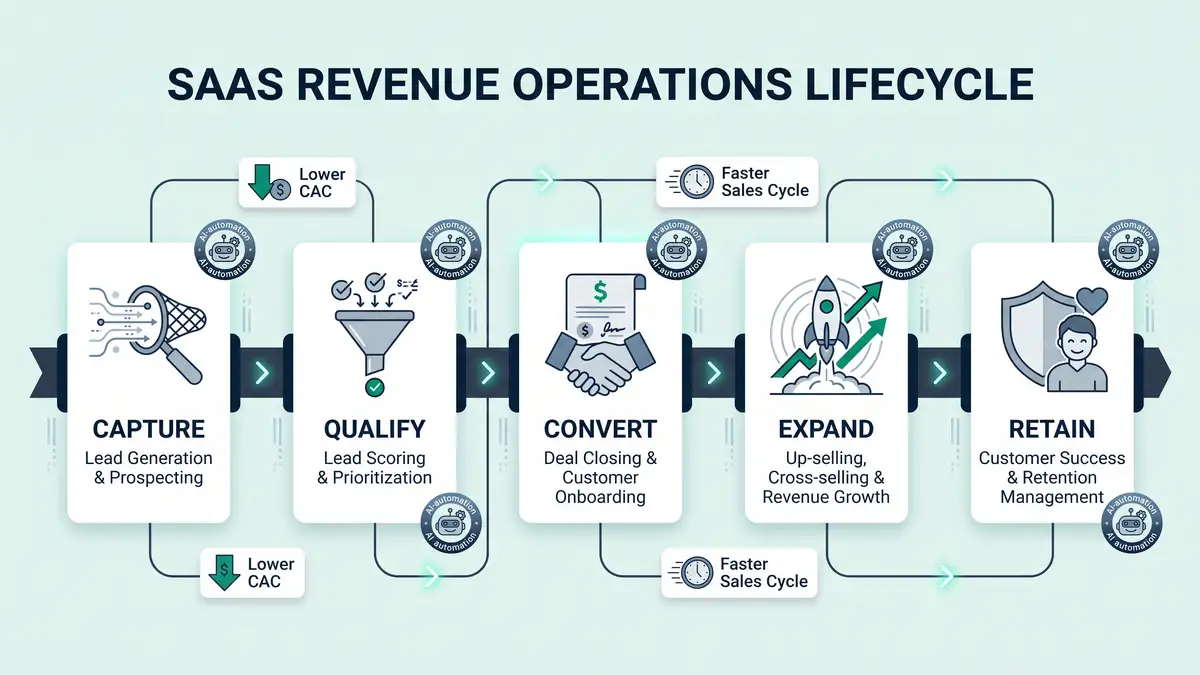
The SaaS Revenue Lifecycle: What AI Automates at Each Stage

AI automation delivers the most value when it is mapped to the lifecycle, not bolted onto one team. The revenue engine runs from first touch to renewal, and AI now operates at every stage. The compounding effect — cleaner data feeding better scoring feeding faster routing feeding accurate forecasting — is what separates a real RevOps automation system from a pile of point tools. This is the same architectural logic behind CRM automation and broader B2B sales automation, applied end to end.
At the top of the funnel, AI enrichment turns raw lists into actionable records: Cleanlist's 2026 analysis shows waterfall enrichment achieving around 94% email coverage and 85% phone coverage on exported lead lists. Mid-funnel, signal-based scoring replaces static MQL matrices. Bottom-funnel, AI drafts quotes and proposals. Post-sale, usage signals drive churn prediction and expansion. The stages below show where automation lands.
| Lifecycle Stage | What AI Automates | Documented Outcome |
| Capture & enrich | Contact enrichment, anonymous-visitor ID, data hygiene | 94% email / 85% phone coverage |
| Score & route | Signal-based scoring, instant lead assignment | 47% better conversion; 2.4x for 3+ signals |
| Outbound & sequence | Signal-triggered, personalised outreach | 15-25% reply vs 3-5% cold-email average |
| CRM hygiene | Auto-logging calls, emails, stages | Reclaims hours of admin per rep weekly |
| Forecast & pipeline | Behaviour-based forecasting, deal-risk scoring | Up to 99% forecast accuracy (Gong) |
| Quote-to-cash | CPQ pricing, proposal drafting | Part of 10-25% cycle compression |
| Retain & expand | Churn prediction, renewal/expansion plays | Protects NRR, the top growth metric |
Sources: Cleanlist (2026), Landbase (2025), Autobound.ai (2026), Salesmotion (2026)
The signal-qualified data is the headline for any RevOps leader building the business case. Landbase reports that organisations using signal-qualified leads see 47% better conversion rates, 43% larger average deal sizes, and 38% more closed deals per quarter, with accounts showing three or more active signals converting at 2.4x the rate of single-signal accounts. On the retention side, automated, usage-driven plays protect net revenue retention — the metric that, as we cover in our analysis of net revenue retention, now predicts SaaS survival more reliably than new logos.
Want to see which stage of your revenue engine is leaking the most — and what to automate first?
Book a Growth Mapping CallThe ROI: Time Reclaimed, CAC Cut, and Cycles Compressed
The returns from AI RevOps automation are now well documented, and they stack. Start with time. HubSpot data shows 64% of reps save one to five hours per week through AI automation, with about 1.5 hours saved weekly on research alone. Teams adopting a fuller AI sales stack go further — Salesmotion's 2026 synthesis finds 25-50% productivity gains within the first quarter, 20-40% more meetings booked, 10-25% shorter sales cycles, and roughly six hours per week saved on account research.
Those hours convert into acquisition efficiency. DigitalApplied found companies deploying AI agents across lifecycle email, ad copy, and content reported CAC payback periods three to five months shorter than non-adopters. Win rates move too: sellers who effectively partner with AI are 3.7x more likely to hit quota, and McKinsey's 2025 State of AI report notes that revenue increases from AI are most commonly reported in marketing and sales use cases.
Run the Math on Your ARR
At a 30-rep SaaS company, even a conservative two hours saved per rep per week equals roughly 3,000 reclaimed selling hours a year — pipeline capacity added with zero new headcount. Pair that with a 3-5 month shorter CAC payback and the model compounds: faster cash recovery, higher throughput per seller, and improved unit economics on the same spend.
| Metric | Manual / Pre-AI Baseline | AI-Automated Outcome |
| Rep selling time | ~40% (60% on admin) | 1-5 hrs/week reclaimed per rep |
| Lead conversion | Traditional scoring | +47% with signal-qualified leads |
| Outbound reply rate | 3-5% (cold email) | 15-25% (signal-personalised) |
| Sales cycle length | Baseline | 10-25% shorter |
| CAC payback | ~18 months median | 3-5 months shorter |
| Quota attainment | Baseline | 3.7x more likely (AI-partnered reps) |
Sources: Salesforce (2025), Landbase (2025), Salesmotion (2026), DigitalApplied (2026), Autobound.ai (2026)
The strategic prize is reframing growth itself. When AI compresses the SaaS sales cycle and lifts conversion, per-headcount revenue rises without proportional hiring — the core of how a SaaS CEO escapes the trade-off between growth and management overhead, and the same outcome we track in the SaaS CEO dashboard.

Agentic AI in RevOps 2026: From Rules to Autonomous Agents
The shift underway in 2026 is from rule-based automation to agentic AI — systems that pursue a goal, plan steps, and act across tools rather than firing predefined triggers. Salesforce's State of Sales data shows the appetite is real: 94% of sales leaders using AI agents call them essential, and 88% of reps say agents increase their odds of hitting targets, with high performers 1.7x more likely to use prospecting agents. For the underlying mechanics, see our guide to the best agentic automation platforms.
The forward signal is stark. Gartner predicts that by 2028, AI agents will outnumber human sellers by roughly 10 to 1 — yet fewer than 40% of sellers will report that the agents improved their productivity. That caveat is the whole game. The technology curve is not the constraint; operational design, data quality, and change management are. RevOps is the function positioned to own that design, which is why the discipline is scaling fast: the Director of Revenue Operations was the fourth fastest-growing US role in 2024, with median RevOps OTE around $129,155.
Why AI RevOps Initiatives Fail — and How to De-Risk Yours
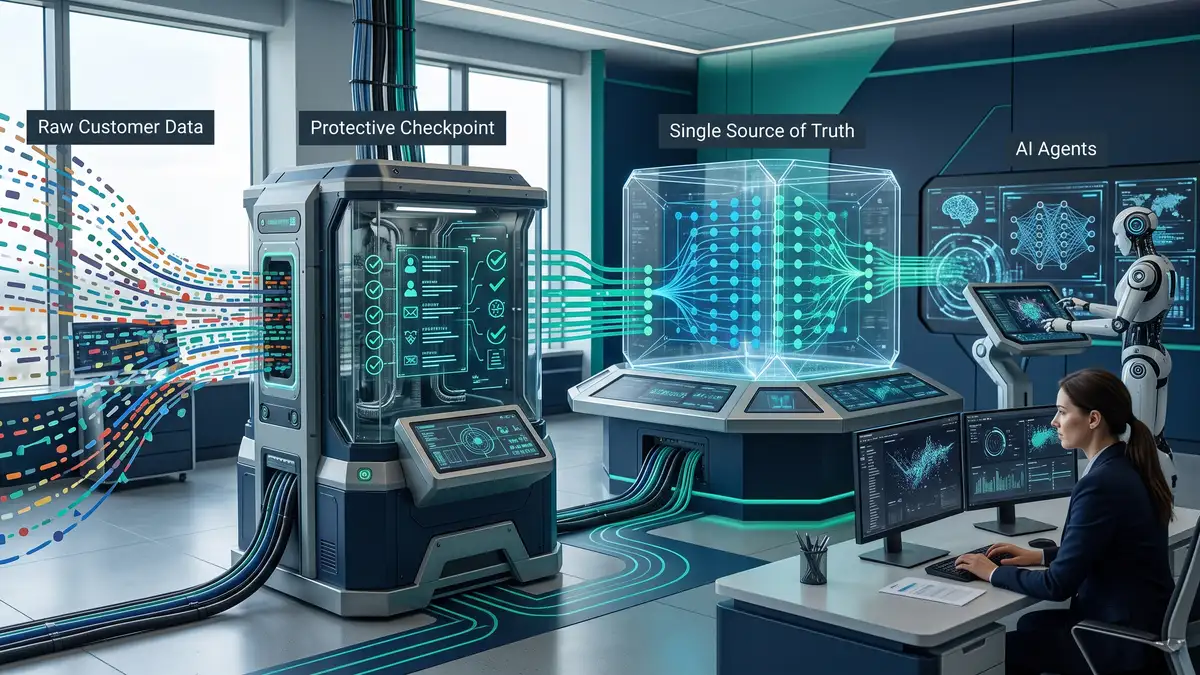
The same Gartner data that promises 10x agent scale warns that most sellers won't feel the benefit — and the reason is almost always foundational, not technological. AI models trained on noisy, incomplete CRM data produce unreliable scores, bad routing, and forecasts that erode trust. Notably, despite all the agent hype, AI appears in only about 8% of Q1 2026 RevOps job postings, while 24% still demand Salesforce certification — a clear signal that mastery of the system of record and clean data must come before agentic layers.
Avoid This Mistake
Do not deploy agents on a dirty CRM. Automating a broken process just makes it fail faster and at scale. Sequence it correctly: clean and enrich the data, unify the source of truth, instrument the metrics, then layer AI automation with human-in-the-loop approval on high-risk actions. The same anti-pattern sinks broader programmes — see our analysis of why AI projects fail.
De-risking is a sequence, not a tool purchase. The teams that succeed treat data governance and oversight as prerequisites, keeping a human in the loop on forecasts, pricing, and anything customer-facing. The four-step rollout below is the order we install RevOps automation for mid-market SaaS clients.
Clean and unify the data
Enrich contacts, deduplicate records, and consolidate marketing, sales, and CS data into one source of truth. This is the foundation every later step depends on.
Automate the highest-friction stage first
Usually CRM hygiene/auto-logging or lead routing — quick wins that reclaim selling time and prove ROI before you expand scope.
Layer signal-based scoring and forecasting
Once data is clean, add AI scoring and behaviour-based forecasting. This is where the 47% conversion lift and forecast accuracy gains materialise.
Extend to agentic, end-to-end workflows
Deploy agents that run multi-step plays across the lifecycle, with human approval gates and observability on every action.
Frequently Asked Questions
What is AI automation for SaaS revenue operations?
It is the use of AI — from rule-based automation to autonomous agents — across the full SaaS revenue lifecycle: lead capture and enrichment, scoring, routing, outbound, CRM hygiene, forecasting, quote-to-cash, churn prediction, and renewals. The goal is a coordinated, largely self-running revenue engine with cleaner data, less manual admin, and faster cycles. It sits inside the revenue operations function rather than being a standalone IT project, which is why RevOps ownership is the single biggest predictor of whether it delivers measurable business outcomes.
How much time does AI automation actually save sales teams?
HubSpot data shows 64% of reps save one to five hours per week through AI automation, with about 1.5 hours saved weekly on research alone. Teams using a fuller AI sales stack report 25-50% productivity gains in the first quarter and roughly six hours per week saved on account research. Given that reps currently spend about 60% of their time on non-selling tasks, the practical effect is rebalancing the workday toward selling. At a 30-rep company, even two hours saved per rep weekly equals around 3,000 reclaimed selling hours a year.
Does RevOps automation actually reduce CAC and shorten sales cycles?
The documented evidence says yes, when implemented on clean data. Companies deploying AI agents across lifecycle email, content, and outreach report CAC payback periods three to five months shorter than non-adopters, and teams using AI sales software see sales cycles 10-25% shorter. Faster response times drive much of this: the first seller to reach a decision-maker after a trigger is 5x more likely to win. These gains tie directly to customer acquisition cost and the ability to scale revenue without adding headcount.
What can AI automate across the revenue lifecycle?
Practically every stage. At the top of the funnel, AI enriches contacts and identifies in-market accounts. Mid-funnel, it scores leads on behavioural signals and routes them instantly. It auto-logs CRM activity, drafts personalised outreach, generates quotes and proposals, and produces behaviour-based forecasts with deal-risk scoring. Post-sale, it predicts churn and triggers renewal and expansion plays. The compounding effect — clean data feeding better scoring feeding faster routing feeding accurate forecasting — is what makes it a system rather than a set of disconnected tools.
Will AI agents replace RevOps and sales teams?
No — they reshape the work. Gartner predicts AI agents will outnumber human sellers roughly 10 to 1 by 2028, but also that fewer than 40% of sellers will report productivity gains, because outcomes depend on operational design rather than the technology itself. Agents handle repetitive execution — logging, research, routing, first-draft outreach — while humans focus on relationships, complex deals, and judgment. RevOps leaders shift from manual aggregation to designing, governing, and supervising the automated system, which is why the discipline is one of the fastest-growing in B2B.
Where should a $10M-$40M ARR SaaS company start?
Start with data, not agents. Clean and enrich your CRM, unify marketing, sales, and CS into one source of truth, then automate the single highest-friction stage — usually CRM auto-logging or lead routing — to reclaim time and prove ROI. Layer signal-based scoring and AI forecasting once data is reliable, then extend to agentic, end-to-end workflows with human-in-the-loop approval. Deploying AI on a dirty CRM is the most common failure mode; our breakdown of why AI projects fail covers the full anti-pattern.
Install the Revenue Engine That Runs Without You
peppereffect architects AI automation across your entire SaaS revenue operations — from data foundation to agentic workflows — so you decouple ARR growth from headcount. We diagnose where your revenue engine leaks, then install the system that closes it. Measurable in Hours Reclaimed, CAC payback, and pipeline velocity.
Book Your Growth Mapping CallResources
- Salesforce — State of Sales Statistics (60% non-selling time; AI agent adoption)
- Landbase — B2B Contact Data Accuracy Statistics 2025
- Autobound.ai — State of AI Sales Prospecting 2026
- Salesmotion — Best Sales AI Software 2026
- DigitalApplied — SaaS Marketing Statistics 2026
- Gartner — AI Agents Will Outnumber Sellers 10x by 2028
- McKinsey — The State of AI in 2025
- Grand View Research — Revenue Operations Market Report
- Mordor Intelligence — Sales Software Market 2031
- RevOpsCareers — RevOps Career Path 2026 (1,890 job postings)
- Cleanlist — Sales Navigator Data Enrichment 2026
- Cirra AI — RevOps Salary Benchmarks 2025