

Revenue Operations (RevOps) is the architectural function that aligns marketing, sales, and customer success around a single revenue operating system, shared data, shared process, shared accountability, so growth stops depending on heroics and starts depending on infrastructure. The fastest-growing B2B SaaS companies treat RevOps not as a department but as the underlying engine. They install it before they need it. They run it as a feedback loop. And they use it to decouple revenue from headcount. pricing page trial conversion
If you are a SaaS CEO trying to scale past $10M ARR while watching deal cycles lengthen, CAC creep up, and forecast accuracy slip below 75%, the question is not whether you need RevOps. It is whether you install it before the inefficiency compounds into a growth plateau. Companies running formal RevOps see 36% higher revenue growth and up to 28% higher profitability than peers without it, per Gartner data cited by Salesmotion. Forrester's research goes further: enterprises that lack a RevOps operating model fail at GTM execution precisely because strategy without architecture cannot scale.
What you will learn in this article:
- Why RevOps is the operating system behind the fastest-growing B2B SaaS companies
- The 5-pillar RevOps framework, strategy, process, data, systems, enablement
- RevOps team structures by ARR stage ($5M, $10M, $25M, $50M, $100M+)
- The 2026 RevOps tech stack, CRM, revenue intelligence, forecasting, CS, analytics
- How AI agents are reshaping RevOps from prediction to autonomous execution
- A 90-day RevOps installation playbook with named milestones and KPIs
- The five most common failure patterns, and how to avoid them
Key Takeaway
RevOps is not a sales support function. It is the logic-gated revenue infrastructure that decouples ARR growth from headcount. Installed correctly, it compounds returns across every pillar, Lead Generation, Sales Administration, Operations, and Marketing Classics. Without it, mid-market SaaS hits a plateau between $10M and $30M ARR and burns capital trying to grow through hiring.
What Is Revenue Operations and Why Does It Matter?
Revenue Operations is the unified discipline of aligning marketing, sales, customer success, and finance around a single revenue motion, with shared data, shared metrics, shared process, and a single owner of revenue accountability. Salesforce defines RevOps as the strategic alignment of all revenue-generating departments behind one operating system. Salesloft's RevOps guide calls it "the glue" that binds the customer lifecycle into a single, measurable flow.
The reason it matters now is structural. B2B buyers have fragmented research across 10+ touchpoints before they ever talk to sales. Marketing automation, sales engagement, CS tooling, and finance systems have multiplied to the point where the average $20M ARR SaaS runs 15-25 GTM tools with no unified data layer. The result is what Forrester calls "GTM execution debt", strategy that cannot be executed because the underlying operating model is missing. RevOps is the function that pays down that debt.
The financial case is no longer abstract. Companies that operate with formal RevOps post 21% higher sales productivity and 71% higher EBITDA for public SaaS comparables, per the 2026 RevOps Statistics roundup. Misalignment between marketing and sales, the symptom that RevOps eliminates, costs B2B companies a minimum of 10% of annual revenue every year, according to research compiled by Revenue Memo. For a $20M ARR SaaS, that is $2M of preventable leakage. For a $40M ARR business, it is $4M.

Want to see your own CAC against peer benchmarks? Run the CAC Diagnostic for your true CAC, the 30 to 50% reduction agentic deployment delivers, and a board-ready PDF in 60 seconds.
Run the CAC DiagnosticWhy Are the Fastest-Growing SaaS Companies Investing in RevOps First?
Because RevOps is the only function that compounds. Every other GTM hire scales linearly with revenue, one more AE produces one more quota. RevOps produces a multiplier. Install a forecast cadence and you reclaim 4 hours per sales leader per week. Standardise lead routing and you compress response time from 12 hours to 12 minutes. Unify your CS and sales data and you catch 30% more expansion opportunities. The same architecture that unlocked one improvement unlocks the next dozen.
Notion is the canonical case. Namrata Ram, Head of Revenue Strategy and Ops, runs RevOps as "20% what, 80% how", meaning the strategic decisions matter, but the operational execution matters four times more. Notion's product-led sales motion (PLS) only works because RevOps built the data and routing infrastructure to convert self-serve signups into enterprise deals at scale. Upwork is another instructive case: by installing Gong-powered forecasting inside a redesigned RevOps function, the team moved from 75% forecast submission compliance to 100%, and to 95% forecast accuracy inside two quarters.
The competitive moat is also widening. BCG's 2025 thesis "AI Was Made for RevOps" argues that agentic AI is shifting RevOps from a back-office prediction function to an autonomous execution layer that runs the revenue engine itself, what peppereffect frames as AI for SaaS at the architectural level. The companies that have already built a unified data foundation are years ahead. The ones still running spreadsheets and disconnected CRMs are watching the gap widen each quarter.
What Are the 5 Pillars of a Mature RevOps Architecture?
Frameworks vary across vendors, but the architecture that holds up under stress combines elements of Clari's revenue framework, Highspot's RevOps blueprint, and what peppereffect installs for clients. Five pillars, each with a single accountable owner.
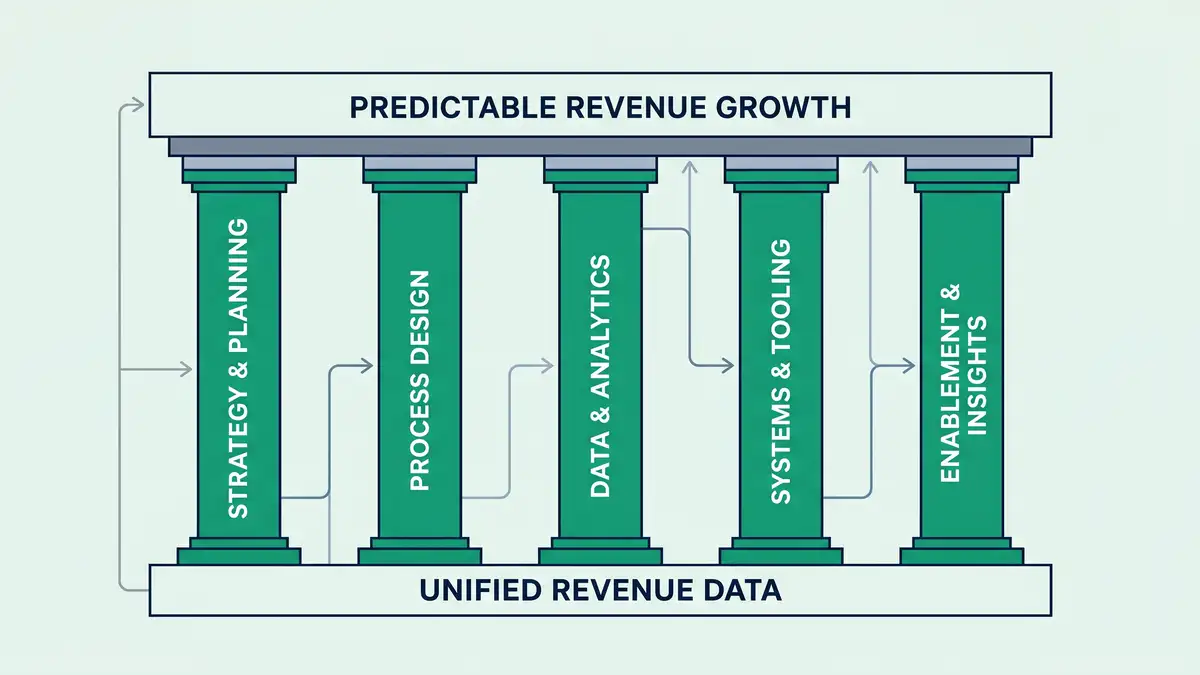
| Pillar | Mandate | Primary KPI |
| 1. Strategy & Planning | Annual operating plan, capacity model, quota and territory design, GTM motion fit | Plan-to-actual variance <10% |
| 2. Process Design | Lead-to-cash workflow, MQL/SAL/SQL SLAs, deal stage definitions, renewal motion | Stage conversion rate uplift |
| 3. Data & Analytics | Single source of revenue truth, dashboards, predictive models, attribution | Forecast accuracy ≥92% |
| 4. Systems & Tooling | CRM, revenue intelligence, forecasting, CS platform, BI, AI agents | Tool adoption ≥80%; data hygiene ≥95% |
| 5. Enablement & Insights | Onboarding, ongoing skill loops, deal coaching, win-loss intelligence | Ramp time, win rate uplift |
Sources: Clari Revenue Operations Framework, Highspot RevOps Framework, RevPartners Role Mandates
The pillars are not optional once you cross $10M ARR. Skipping Pillar 3 (Data) means your forecast is fiction. Skipping Pillar 4 (Systems) means your team works around the tools instead of through them. Skipping Pillar 5 (Enablement) means every new hire takes 9 months to ramp instead of 4. The maturity model is a tightly coupled system, not a buffet.
Key Takeaway
The 5 pillars sit on a foundation of unified revenue data and produce predictable revenue growth as their output. If any pillar is missing, the architecture cannot support the load. The fastest path to RevOps maturity is sequencing, install Data and Process first, then Systems, then Strategy at the planning cadence, then Enablement as your loop closer.
How Should a RevOps Team Be Structured by ARR Stage?
The biggest hiring mistake mid-market SaaS makes is staffing RevOps too late and too lean. The right team composition shifts as you cross specific ARR thresholds. The pattern below reflects benchmarks from RevPartners' RevOps role taxonomy, RevSearch's reporting structure analysis, and what peppereffect installs for SaaS clients between $5M and $50M ARR.
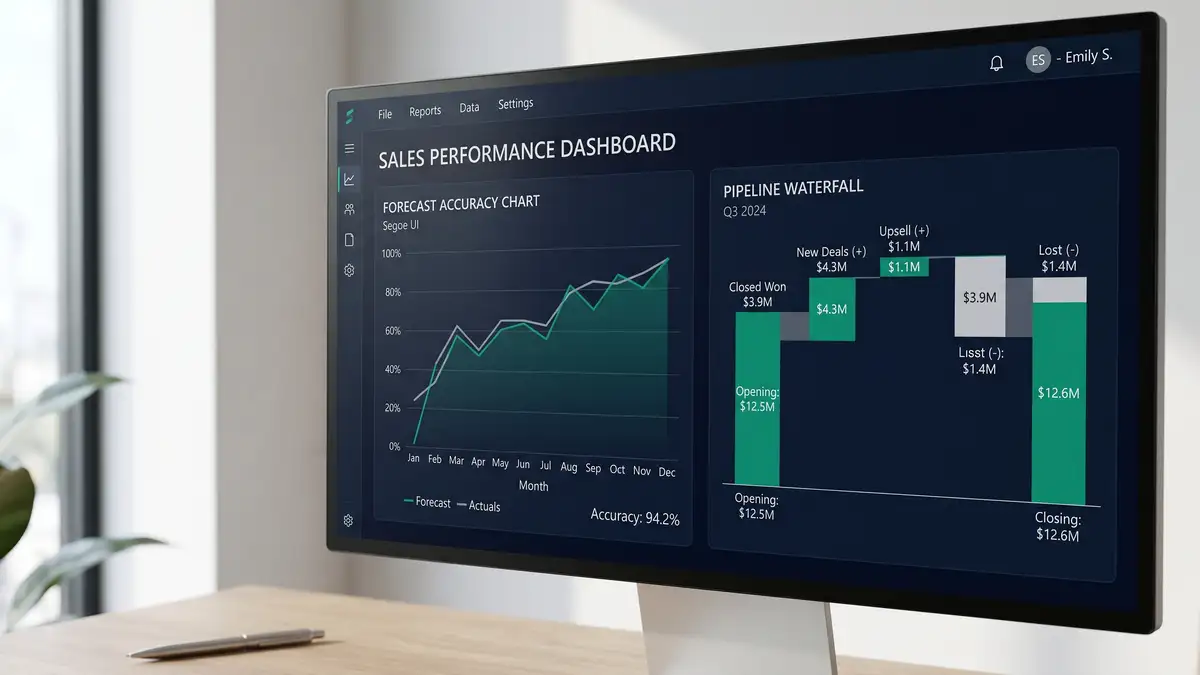
At $5M-$10M ARR, RevOps is one person, a hybrid RevOps Manager who owns CRM, forecasting, pipeline hygiene, and sales-marketing alignment. This person reports to the CRO (or, in founder-led companies, to the CEO). Their first 90 days are about installing process, not building systems. A premature systems-first hire at this stage produces dashboards no one uses.
At $10M-$25M ARR, the function splits into two specialisms, a RevOps Manager (process, forecasting, cross-functional alignment) and a Systems Manager (CRM administration, integrations, data hygiene). A MarketingOps Manager is typically added at the $15M mark to own MQL definitions, lead routing, and attribution. At this stage, RevOps reports cleanly to the CRO, with a dotted line to the CFO for revenue recognition and forecast governance.
At $25M-$50M ARR, a Director of RevOps owns the function with 4-5 direct reports, RevOps Manager, Systems Manager (sometimes elevated to Principal Revenue Systems Engineer), MarketingOps Manager, SalesOps Manager, and the first dedicated CS Ops Manager. Best-in-class teams at this stage hit 92%+ forecast accuracy at Maturity Level 3 of the RevPartners RevOps Maturity Model. Above $50M ARR, the structure stabilises at 5-6 FTE under a VP RevOps, with the Revenue Systems Engineer evolving into a multi-person engineering team running the data warehouse and AI agent layer.
| ARR Stage | RevOps Headcount | Reports To | Forecast Accuracy Target |
| <$5M (Foundational) | 0 FTE (CEO/CRO covers) | , | Historical extrapolation |
| $5M-$15M (Structured) | 1 RevOps Manager | CRO or CEO | ±10-15% variance |
| $15M-$40M (Automated) | 3-5 FTE under Director | CRO (dotted line CFO) | 92%+ accuracy |
| $40M-$100M (Predictive) | 5-7 FTE under VP RevOps | CRO | 94%+ accuracy |
| $100M+ (Autonomous) | 8-12+ FTE incl. engineering | CRO or COO | 95%+ accuracy; NRR ≥120% |
Sources: RevPartners RevOps Maturity Model, RevOps Role Definitions, RevSearch Reporting Structure
Compensation tracks the seniority curve. According to the 2026 RevOps Roles Salary Report, VP of Revenue Operations base salaries reach $274,000 at the top end, with GTM strategy directors averaging $165,000 base and the overall RevOps median (analyst to director) sitting at $138,000. These numbers should sit inside your SaaS marketing and operating budget alongside the rest of the GTM line items. Equity and OTE multipliers add 30-60% to the cash figure for senior roles. This is the calibration to use when you negotiate your first RevOps hire, and the calibration competing SaaS firms are using when they try to poach them.
Your RevOps function should compound, not consume, your CRO's time. peppereffect installs the operating system, not just another hire.
See the Freedom Machine Architecture →What Does the 2026 RevOps Tech Stack Look Like?
A mature 2026 RevOps stack has six functional layers, each with two to three dominant tools. The total spend at $25M-$50M ARR typically lands at $200K-$600K per year in software, depending on the seat count and feature tier. Below the surface, the stack architecture matters more than the brand choices, the question is whether your tools share a single data layer or run in disconnected silos.
| Layer | Function | Dominant Tools (2026) |
| CRM (System of Record) | Account, contact, deal, activity ledger | Salesforce, HubSpot |
| Revenue Intelligence | Call recording, deal coaching, conversation analytics | Gong, Clari, Chorus, Salesloft, Outreach |
| Forecasting & Pipeline | AI-driven forecasting, scenario planning, commit calls | Clari, Aviso, BoostUp, Gong Forecast |
| Customer Success | Health scoring, renewal forecasting, expansion signals | Gainsight, ChurnZero, Catalyst |
| CPQ & Billing | Quote, contract, billing, revenue recognition | Salesforce CPQ, DealHub, Maxio |
| Data & Analytics | Warehouse, ELT, transformation, BI | Snowflake / BigQuery / Databricks + Fivetran + dbt + Looker / Hex / Mode |
Sources: Knowlee 2026 Revenue Intelligence Platforms, Tellius Platform Comparison, Uplift GTM Best RevOps Tools, DealHub CPQ Reference
The reference architecture for a $25M ARR SaaS looks like this: Salesforce as system of record, Gong for conversation intelligence and forecasting, Gainsight for CS health, DealHub for CPQ, Snowflake as the warehouse, Fivetran for ingestion, dbt for transformation, and Hex or Looker for analyst-facing BI. The case study most often referenced, Snowflake's own stack, runs 900+ Fivetran connections feeding 400M+ monthly active rows into a unified customer-360 view. That is the level of data centralisation a mature RevOps function requires to operate at Maturity Level 4 or higher.

How Is AI Changing Revenue Operations in 2026?
The defining shift in 2026 is the move from AI as forecaster to AI as autonomous executor. BCG frames the inflection point clearly: "AI Was Made for RevOps, From Prediction to Execution." The first wave of AI in RevOps (2020-2024) was predictive, score the lead, score the deal, score the renewal. The second wave (2025-2026) is agentic, execute the workflow itself.
The economic impact is substantial. AI-powered RevOps implementations reduce customer acquisition cost by 36% and accelerate growth by 30%+ in published 2026 benchmarks. Clari Labs' 2026 study, summarised in Salesloft's research release, shows that enterprises operating with unified, governed revenue data reach 96% forecast accuracy, versus 87% of enterprises that still miss their targets despite owning AI tools. The differentiator is not whether you have AI. It is whether your data foundation is clean enough for AI to operate on.
The agentic use cases that are already moving the needle in 2026:
Agentic Pipeline Hygiene
Custom AI agents (built via Make, n8n, or Salesforce Einstein) auto-update CRM stage definitions, flag deals slipping past expected close, and chase missing fields without human intervention. Time reclaimed per AE: 3-5 hours/week.
AI Deal Coaching at Scale
Gong's Deal Board and Clari Copilot surface specific deal risks (missing champion, stalled stage, competitor mention) and recommend the next action. The Upwork team used this to hit 95% forecast accuracy across the rep base.
Autonomous Forecast Roll-Up
AI assists or replaces the weekly forecast call, pulling deal data, scoring confidence, generating commit/best-case/upside numbers, and surfacing variance reasons. Clari's Revenue Action Orchestration is recognised in the Gartner Hype Cycle for this category.
AI-Driven ICP Enrichment
Agentic enrichment agents continuously refresh firmographic, technographic, and intent data on every account, replacing the manual data-hygiene work that consumed entire RevOps days. This is where peppereffect's agentic workflows embed inside the RevOps stack.
The strategic implication is direct: the companies that have already invested in their RevOps data foundation can deploy agentic AI immediately. Those that haven't will spend the next 12-18 months cleaning data before they can layer AI on top. The compounding effect of that delay is what creates the moat.
What Does a 90-Day RevOps Installation Playbook Look Like?
Ninety days is the right window to install a functional RevOps operating system at $10M-$40M ARR. Less than that produces lipstick, dashboards no one uses, processes no one follows. More than that produces consulting projects that die when the consultants leave. The window below is the cadence peppereffect runs for SaaS clients and is consistent with the structured rollouts documented in Salesloft's RevOps Guide and Highspot's 10 RevOps Frameworks.
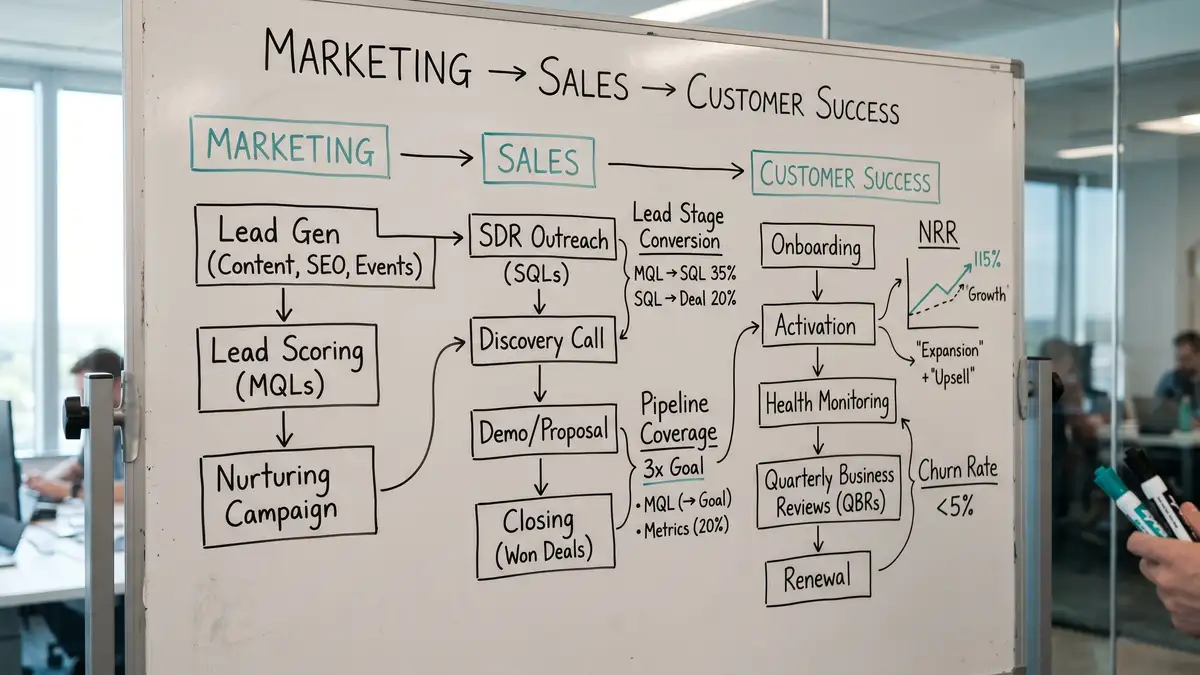
Days 1-30, Discovery and Alignment. Week 1-2: executive alignment on revenue strategy, mix, CAC, payback, and the operating plan. Week 2-3: diagnostic interviews to surface five to ten acute pain points (forecast inaccuracy, slow lead routing, broken handoff, etc.). Week 3-4: baseline current metrics, stage conversion, deal velocity, MQL-to-SAL ratio, NRR, against industry benchmarks like the ones published in SaaS Capital's 2025 revenue-per-employee report. Output: a one-page RevOps Operating Plan signed by CEO, CRO, CMO, and CFO.
Days 31-60, Quick Wins. Week 5-6: standardise the forecast process, Tuesday submission, Wednesday review, Friday CRO final. Week 6-7: install MQL/SAL/SQL definitions and SLAs (two-hour SDR contact rule). Week 7-8: deliver four quick wins, automated lead routing, a stalled-deal dashboard, automated CRM enrichment, and a deal velocity report. These four wins compound: each one saves 1-3 hours per rep per week, and they are visible to the team within the first 60 days.
Days 61-90, Systems and Analytics. Week 9: CRM data audit and cleansing (target 95%+ data hygiene). Week 9-10: install three analytics layers, sales rep dashboards, marketing attribution, executive KPIs. Week 10-11: customer success health metrics and renewal forecasting. Week 11-12: governance and the sustainable operating cadence, daily SDR standup, weekly forecast call, monthly business review, quarterly model recalibration. By Day 90, you have a working operating system that can be handed to a permanent RevOps lead.
Avoid This Mistake
Do not skip Days 1-30. The single most common failure pattern is teams that jump straight to Days 61-90, buying tools and building dashboards before they have alignment or process. Without the operating plan, every dashboard you build will be wrong and every process you install will be ignored. Process and alignment first, systems second.
What Are the Most Common RevOps Failure Patterns?
Five patterns account for the majority of failed RevOps installations, per Forrester's analysis that "RevOps strategies are missing an operating model" and consistent with the failure modes documented across the Fullcast RevOps research:
| Failure Pattern | Symptom | Antidote |
| 1. No executive alignment on the operating plan | RevOps recommendations get overridden weekly by CRO/CMO/CS | Sign a one-page RevOps Operating Plan with CEO, CRO, CMO, CFO before Day 30 |
| 2. Tools before process | $300K of software, no behaviour change | Install MQL/SAL/SQL definitions and forecast cadence before buying tools |
| 3. RevOps as centralised control | Reps work around RevOps; data integrity collapses | Position RevOps as enablement, not enforcement; embed in cross-functional rituals |
| 4. Siloed from cross-functional perspective | RevOps owns CRM only; marketing and CS data live elsewhere | Mandate a single revenue data warehouse and a unified customer-360 view |
| 5. No data governance | 30%+ of CRM contacts decay per year; forecasts become fiction | Install monthly data hygiene cadence; automate enrichment via AI agents |
Sources: Forrester: RevOps Operating Model, Fullcast RevOps Research, ZoomInfo B2B Data Decay
The pattern across all five is the same: RevOps gets installed as a tactical function instead of an architectural one. The fix is to treat RevOps as your company's scaling playbook and the precondition for reducing your SaaS sales cycle, the infrastructure that makes everything else work, rather than a sales-support team. peppereffect's brand for this is the Freedom Machine: the integrated operating system that turns ARR growth into a function of architecture, not of headcount.
Who Should Own RevOps, the CRO, CFO, or COO?
For B2B SaaS between $10M and $100M ARR, RevOps should report to the CRO, with a dotted line to the CFO for forecast governance. The case for the CRO is straightforward: revenue is the output, the CRO owns the output, and RevOps is the operating system that produces the output. The case for the CFO owning RevOps applies in PE-backed environments where forecast discipline and revenue recognition are the highest-priority constraints. The case for the COO applies above $100M ARR when RevOps becomes a multi-function organisation with its own engineering team.
Strativera's analysis reaches the same conclusion: RevOps reports to the CRO when positioned as a strategic revenue lever, to the COO when positioned as the operational backbone of the company, and reports through a matrix structure with a dotted line to the CFO under most modern best practices. RevSearch's PE-context research confirms that mature RevOps functions report to the CRO or COO with full mandate authority, not as a service function but as a peer to VP Sales, VP Marketing, and VP CS.
Key Takeaway
The reporting line is less important than the mandate. Give RevOps real authority over the operating cadence and the data layer, or it cannot do the job. A weak mandate produces a weak operating system, regardless of who the function reports to.
Frequently Asked Questions
What is revenue operations in simple terms?
Revenue Operations (RevOps) is the function that unifies marketing, sales, customer success, and finance around a single revenue motion. It owns the operating plan, the data, the systems, the processes, and the cadence that make those functions work as one team. Think of it as the operating system for your revenue engine, the layer underneath every customer-facing function that determines how well they perform. Without RevOps, each function optimises locally and the whole engine produces less than the sum of its parts. With RevOps, every improvement compounds because the architecture distributes the gain across the entire customer lifecycle.
What is the difference between RevOps and sales operations?
Sales operations is a function that supports one team, sales. It owns CRM administration, quota planning, territory design, and sales reporting. RevOps owns all of those things, plus the equivalent functions for marketing (marketing ops), customer success (CS ops), and increasingly finance (revenue accounting and forecast governance). Sales ops is a single-discipline role. RevOps is an integrating discipline that sits above marketing ops, sales ops, and CS ops and aligns them through shared data, shared metrics, and a shared operating plan. Most companies that say they "have RevOps" still operate sales ops in practice, the test is whether the function has cross-functional authority or only sales authority.
When should a SaaS company hire its first RevOps person?
Most SaaS companies should hire their first dedicated RevOps person between $5M and $8M ARR. Before $5M, the founders or CRO can run the function as a side responsibility. Above $8M, the lack of dedicated RevOps becomes a compounding bottleneck, forecasts get less accurate, lead routing breaks, and CRM data quality decays. The first hire should be a generalist RevOps Manager with cross-functional experience, not a Salesforce administrator. Pair this hire with a clear 90-day operating plan and full mandate authority. This is the same logic that governs hiring the first VP of Sales: get the architecture right before the headcount. The wrong hire, a junior Salesforce admin without strategic chops, sets RevOps back 12-18 months because the function gets categorised as administrative support rather than infrastructure.
What is the average revenue operations manager salary in 2026?
The 2026 RevOps Roles Salary Report shows the overall RevOps median (spanning analyst through director) at $138,000 base. Mid-level RevOps Managers earn $120,000-$160,000 base in major US markets. Directors of RevOps earn $160,000-$200,000 base. Vice Presidents of Revenue Operations reach $274,000 base at the top of the range. OTE multipliers add 20-40% for senior leadership. Equity grants for VPs at Series B-D SaaS typically land between 0.25% and 1.0%, meaningful enough to be a primary retention lever. These figures are calibrated to global tech hubs; remote-only roles run 10-20% below.
What metrics should a RevOps function own?
A mature RevOps function owns four metric clusters. Pipeline metrics: coverage ratio (target 3x-4x), stage conversion rates, deal velocity, and pipeline ageing. Forecasting metrics: forecast accuracy (target 92%+ at maturity), commit-to-close conversion, and slip rate. Customer success metrics: net revenue retention (target ≥110%, best-in-class ≥120%), gross retention, expansion rate, and time-to-value. Operational metrics: CRM data hygiene (target ≥95%), tool adoption (target ≥80%), ramp time, and quota attainment distribution. These four clusters give the CRO a complete operating picture of the revenue engine, what is coming in, what is converting, what is sticking, and what infrastructure is supporting it. peppereffect's SaaS CEO dashboard framework integrates these into a single weekly view.
How long does it take to install RevOps from scratch?
A functional RevOps operating system can be installed in 90 days. A mature RevOps function with 4-5 FTE, integrated systems, and a working analytics layer takes 12-18 months to build out. The 90-day install produces the operating plan, the forecast cadence, the lead routing rules, the stage definitions, and the basic dashboard layer. The 12-18 month build adds the data warehouse, the AI agent layer, the predictive scoring models, and the cross-functional governance rituals. The mistake to avoid is conflating the two, companies that try to install everything in 90 days fail, and companies that try to install nothing in 90 days never finish.
Do I need RevOps if I am running a product-led growth motion?
Yes, possibly more than sales-led companies do. PLG produces high volumes of self-serve user data that must be unified with sales and CS data to identify expansion accounts. Without RevOps, the PLG data pipeline runs separately from the sales pipeline, and the company misses upsell signals. Notion's RevOps build-out is the canonical example: their RevOps function exists specifically to convert PLG signals into enterprise sales motion. If anything, PLG companies should install RevOps earlier than sales-led companies because the data volume is higher and the lifecycle is more complex.
Install Your Revenue Operating System in 90 Days
peppereffect installs the integrated RevOps architecture for $10M-$40M ARR B2B SaaS, operating plan, forecast cadence, lead routing, data layer, AI agent stack, so revenue stops depending on headcount and starts depending on infrastructure. The Freedom Machine for the Agentic Era.
Book Your Growth Mapping CallResources
- BCG, AI Was Made for RevOps: From Prediction to Execution (2025)
- Forrester, RevOps Strategies Are Missing An Operating Model
- Salesloft / Clari Labs, 2026 Revenue AI & Data Research
- Gong Case Study, Upwork Hits 95% Forecast Accuracy
- Pocus, The Notion Playbook for Best-in-Class RevOps
- Fivetran, Snowflake's Best-in-Class Data Stack Case Study
- RevPartners, RevOps Maturity Model
- Clari, Revenue Operations Framework
- Salesloft, The Complete Guide to RevOps
- Highspot, 10 RevOps Frameworks
- RevOps Roles, 2026 Salary Report
- Salesforce, What Is Revenue Operations?
- Strativera, Who Does RevOps Report To?
- SaaS Capital, 2025 Revenue Per Employee Benchmarks