

Real estate executive search in 2026 operates against forces no other executive vertical faces simultaneously: REIT board appointments now formally prioritise debt refinancing experience at sustained 5.5%+ treasury yields per Ferguson Partners reporting, REPE Managing Partner carried interest packages can reach $10M-$50M+ over fund lifecycle, public REIT CEO compensation runs $1.5M-$8M+ inclusive equity with median 5% annual growth, large homebuilder CEOs at D.R. Horton and Lennar earning $5M-$25M+ total, and asset class specialism (multifamily vs office vs industrial vs data center) determines whether a placement succeeds or fails within 24 months. For REIT boards, REPE General Partners, developer founders, and CHROs commissioning a CEO search, COO mandate, Chief Investment Officer hire, or Head of Acquisitions appointment, the discipline now demands integrated asset class verification, capital markets cycle review, NAREIT compensation engineering, and institutional capital relationship assessment.
This article provides a systematic 7-pillar methodology for real estate executive search, compensation benchmarks across REITs, commercial developers, real estate private equity, homebuilders, PropTech, and property management, the asset class and capital markets discipline that distinguishes specialist boutiques from generalist firms, the eight pitfalls producing 40%+ first-24-month placement failure rates, and a seven-step playbook for boutique recruiters building or sharpening a real estate practice. Every benchmark cites a specific source. Executive search firm marketing grounded in this depth converts REIT board and REPE inquiries at materially higher rates than generalist positioning.
Key Takeaway
Real estate executive search in 2026 is no longer a sourcing exercise. It is integrated asset class verification, capital markets cycle review, REPE carried interest engineering, and institutional capital relationship assessment. Boutiques that treat real estate like any other vertical produce 40%+ first-24-month failure rates versus 15-20% for specialists.
The 2026 Real Estate Executive Search Landscape

The real estate executive search market is dominated by Ferguson Partners, the largest dedicated real estate executive search firm globally. Ferguson Partners positions itself as a global executive search firm specializing in tailored talent management for the real estate and financial industries, with a Real Estate practice that addresses human capital needs through Executive and Board Recruitment, Compensation, Leadership, and Management Consulting (Ferguson Partners; Ferguson Partners Real Estate practice). Ferguson Partners specializes in executive search for the real estate industry, connecting top leadership talent with leading firms globally through executive and board search (Ferguson Partners Executive and Board Search). Bill Ferguson's commentary on talent management in CRE with Walker & Dunlop documents the nuances of executive search, leadership traits that define success, and hiring trends (Walker Dunlop CRE Executive Search with Bill Ferguson, January 2025).
The broader competitive landscape includes specialist firms and Big 5 generalist practices. Talentfoot leads the 2026 US executive search rankings, followed by Russell Reynolds Associates, Korn Ferry, Heidrick & Struggles, and other top firms (Talentfoot Top Executive Search Firms USA 2026). Chief Jobs' 2026 ranking of top executive search firms lists Korn Ferry, Spencer Stuart, Egon Zehnder, Aruba Exec, Heidrick & Struggles, and Russell Reynolds Associates as category leaders (Chief Jobs 11 Top Executive Search Firms 2026). Korn Ferry's real estate practice operates across residential, commercial, industrial, and land real estate recruiting (Korn Ferry Real Estate Job Recruiters). Gillian Executive Search anchors the real estate development specialism with focus on design, architecture, construction, and financing (Gillian Executive Search).
Compensation has continued upward across real estate executive functions. Wealth Management's analysis of the top 10 highest-paid public REIT CEOs documents that median total compensation among 150 REITs studied rose 5% annually in recent years, with CEO compensation seeing comparable growth (Wealth Management Top 10 Highest-Paid Public REIT CEOs). Datarails' 2026 analysis of the highest-paid CFOs shows total direct compensation increasing 8% for CFOs versus 5% for CEOs, driven primarily by higher long-term incentive awards (Datarails Highest Paid CFO 2026, May 2026). Gallagher's 2025-2026 CEO and Executive Compensation Trends provides additional benchmarking and crafting frameworks for executive pay (Gallagher CEO Executive Compensation 2025-2026, May 2026).
The NAREIT (National Association of Real Estate Investment Trusts) Compensation Survey provides the most comprehensive REIT-specific benchmark, covering more than 240 positions commonly found at REITs and REOCs (Real Estate Operating Companies) (NAREIT Compensation Survey Report). The survey has had record participation in recent years (NAREIT Compensation Survey Record Participation). The CEM Benchmarking 2026 study, sponsored by NAREIT, provides a comprehensive look at realized investment performance across asset classes over a 26-year period showing REITs outperform private real estate by nearly 2% (CEM Study REIT vs Private Real Estate Performance). Family office real estate compensation provides another reference: Talent Gurus' Family Office Compensation Guide 2026 documents Family Office CIO P50 at $425K, CEO P50 at $350K, CFO P50 at $275K with full P25-P90 salary data by AUM tier (Talent Gurus Family Office Compensation 2026).
| Sub-Vertical | Senior Role | All-In Compensation Range | Typical Time-to-Fill |
| Top 10 Public REIT | CEO | $1.5M-$8M+ (top performers higher) | 90-150 days |
| Mid-Cap Public REIT | CEO / CFO | $500K-$1.5M (CFO +8% growth) | 90-150 days |
| REPE (Mega Fund) | Managing Partner | $1M-$5M+ cash + carry $10M-$50M+ | 120-180 days |
| REPE (Mid-Market) | Principal / Senior VP | $500K-$1.5M cash + carry | 90-150 days |
| Large Commercial Developer | CEO / President | $2M-$10M+ (incl performance) | 120-180 days |
| Public Homebuilder | CEO | $5M-$25M+ (incl performance shares) | 90-150 days |
| PropTech Scale-Stage | CEO | $300K-$500K base + equity | 60-90 days |
| Family Office Real Estate | CIO / CEO / CFO | $275K-$425K P50 by AUM tier | 90-120 days |
Sources: Wealth Management Top 10 Public REIT CEOs; Datarails 2026 CFO Compensation; NAREIT Compensation Survey; Talent Gurus Family Office Compensation 2026
The 7 Pillars of Real Estate Executive Search Methodology
Boutiques that systematically apply seven pillars to real estate executive search achieve 75-85% completion rates on retained mandates versus 60-65% for firms without integrated asset class verification and capital markets infrastructure. Recruitment operations infrastructure that supports this methodology separates top-quartile real estate recruiters from the median.
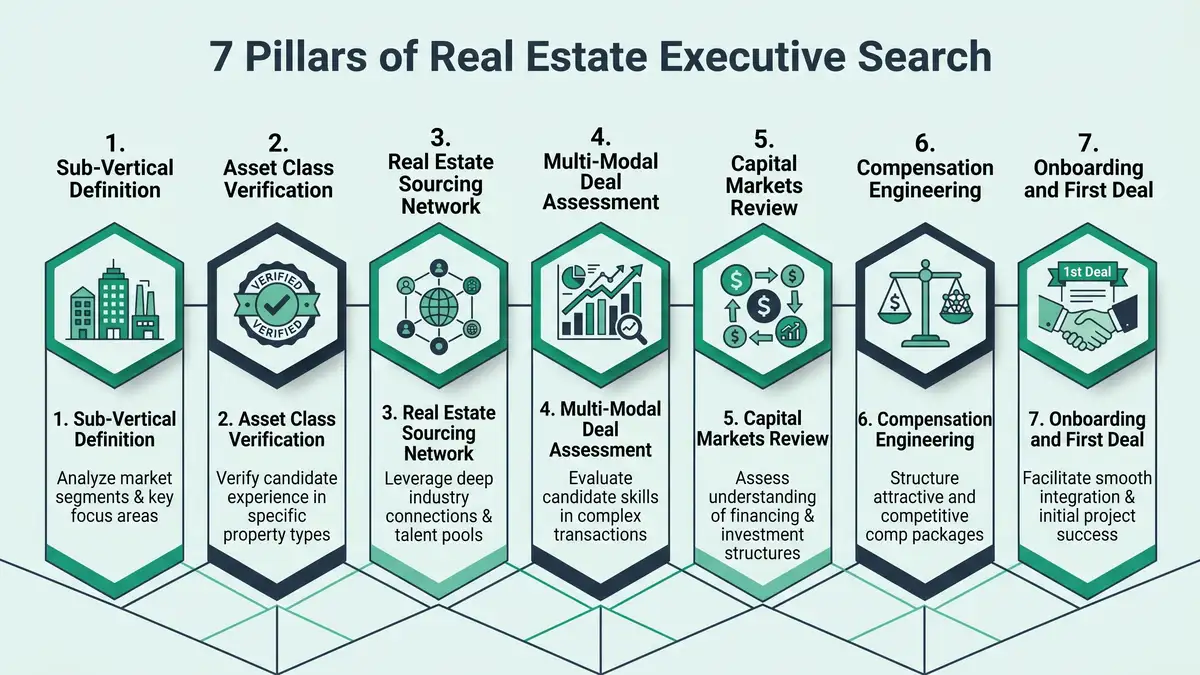
Sub-Vertical Definition
Map the role to public REIT, commercial real estate developer, real estate private equity, homebuilder, PropTech, property management, or brokerage. Each sub-vertical has distinct competency requirements, capital markets dynamics, compensation structures, and sourcing channels.
Asset Class Verification
Verify the candidate's depth across multifamily, office, retail, industrial, hospitality, data center, healthcare, life sciences, single-family rental, self-storage, or specialty asset classes. A retail asset specialist cannot run an industrial-focused REIT; cross-class transitions produce 40%+ first-24-month placement failure rates. Specialist firms calibrate at sourcing.
Real Estate Sourcing Network
Combine LinkedIn with NAREIT (REITs), ULI (Urban Land Institute), NMHC (National Multifamily Housing Council), ICSC (International Council of Shopping Centers), PREA (Pension Real Estate Association), AFIRE (Association of Foreign Investors in Real Estate), CRE (Counselors of Real Estate), CCIM, IREM, BOMA networks.
Multi-Modal Deal Assessment
Combine acquisition underwriting case studies, asset management scenarios, capital raising deck reviews, disposition timing analysis, and direct deal team reference calls. Pure interview-based assessment correlates poorly with 24-month placement success in real estate roles.
Capital Markets Cycle Review
Review the candidate's track record across cycle phases including debt refinancing during periods of sustained high treasury yields, equity issuance discipline, mezzanine and preferred equity structuring, and hybrid capital solutions. Ferguson Partners reporting indicates 78% of REIT board appointments since Q1 2025 prioritise candidates with direct experience navigating debt refinancing at 5.5%+ treasury yields.
Compensation Engineering
Structure offers using NAREIT Compensation Survey covering 240+ REIT positions, Ferguson Partners reports, REPE carry waterfall structures (typically 8% preferred return, 80/20 catch-up, then 20% carry on residual), public REIT Equilar proxy filings, performance share unit benchmarks, and homebuilder Equilar proxy data. CFO compensation has grown 8% recently versus 5% for CEOs per Datarails.
Onboarding and First Deal Close
Manage board orientation, investment committee integration, capital markets relationship transition (Goldman Sachs, Morgan Stanley, JPM Real Estate Capital Markets, BAML, Wells Fargo CRE), first quarterly earnings call prep for public REIT CEOs, and first acquisition close for REPE roles within 90-150 days post-acceptance.
Want the full real estate executive search audit checklist mapped to your specific sub-vertical?
Request the Real Estate Search DiagnosticREIT and Public Real Estate Company Executive Search

REIT executive search at the largest public companies operates under intense capital markets scrutiny. Wealth Management's analysis of top-paid public REIT CEOs and the FTI Consulting median 5% compensation growth documents the trajectory across 150 REITs studied, with CEO total compensation growing consistently inclusive of restricted stock, performance share units, and deferred compensation (Wealth Management Top 10 Public REIT CEOs). The largest REITs by market cap (Prologis, American Tower, Equinix, Public Storage, Simon Property Group, Welltower, Realty Income, Digital Realty, AvalonBay, Equity Residential) typically pay CEO total compensation in the $5M-$15M range with significant performance share component tied to total shareholder return (TSR) and AFFO (adjusted funds from operations) growth.
The compensation architecture at REITs is uniquely transparent through SEC proxy disclosures. Equilar proxy filing analysis allows specialist search firms to model precise comparables when engineering offers. The NAREIT Compensation Survey provides additional REIT-specific benchmarking covering 240+ positions (NAREIT Compensation Survey). CEM Benchmarking's 2026 study sponsored by NAREIT documents that REITs have outperformed private real estate by nearly 2% over a 26-year period, providing institutional credibility to REIT CEO compensation structures (CEM Study REIT Performance).
Asset class specialism dictates REIT CEO candidate profile. A multifamily REIT (AvalonBay, Equity Residential, Camden Property Trust) demands different operating expertise than an industrial REIT (Prologis, Rexford Industrial), an office REIT (Boston Properties, Vornado, SL Green), a healthcare REIT (Welltower, Ventas), or a data center REIT (Digital Realty, Equinix). Specialist real estate executive search firms calibrate asset class match precisely; generalist firms attempting cross-class placements produce 40%+ first-24-month failure rates as the candidate's operational depth fails to translate.
The Capital Markets Calculation
Ferguson Partners' 2026 reporting documents that 78% of REIT board appointments since Q1 2025 prioritise candidates with direct experience navigating debt refinancing during periods of sustained 5.5%+ treasury yields. This single dimension has reshaped REIT CEO and CFO candidate profiles. Specialist firms run capital markets cycle assessment as a structured pillar; generalists discover this requirement late in the search process and produce candidate rejection rates 30%+ higher than specialists.
Real Estate Private Equity (REPE) Executive Search

Real estate private equity executive search at the largest funds (Blackstone Real Estate, Brookfield Real Estate, Starwood Capital, KKR Real Estate, Apollo Real Estate, Carlyle Real Estate, GTIS Partners, Rockpoint Group) operates under distinct compensation dynamics. Managing Partner cash compensation typically runs $1M-$5M+ cash, but carried interest creates the meaningful wealth: 20% carry on residual returns after 8% preferred return and 80/20 catch-up, applied across multi-billion dollar funds, can produce realized carry of $10M-$50M+ over a successful fund lifecycle for senior partners. Junior partners and principals receive proportionally smaller carry allocations.
The REPE search paradigm has shifted toward executives capable of structuring hybrid capital solutions. Blackstone Real Estate's 2025 appointment of a former infrastructure debt specialist as Head of Capital Markets reflects a broader industry trend where approximately 63% of new REPE fund launches incorporate non-traditional capital partners including sovereign wealth funds, family office co-investment vehicles, and credit fund mezzanine partners. Specialist search firms understand these dynamics; generalist firms place candidates with traditional equity-only experience into roles that require credit and structured capital sophistication.
Compensation engineering for REPE roles must model both cash and carry economics simultaneously. A Managing Partner offered $2M base plus 100 carry points on a $10B fund with target 1.5x net multiple produces approximately $2M base plus expected carry value of $10M-$20M across the fund lifecycle, requiring 5-8 year vesting and clawback provisions. Specialist search firms model this calculation explicitly; generalists treat cash and carry as separate negotiations and produce sub-optimal candidate placements. Financial services executive search overlaps with REPE search at the boundary between alternative asset management and real estate private equity.
Homebuilder, Developer, and Property Management Search

Homebuilder executive search at large public companies (D.R. Horton, Lennar, NVR, PulteGroup, Toll Brothers, Meritage Homes, KB Home, Taylor Morrison) operates with material compensation scale. Public homebuilder CEOs routinely earn $5M-$25M+ total compensation inclusive of performance share units tied to homes delivered, gross margin, and TSR metrics. The competency assessment demands regional housing market understanding, land acquisition pipeline track record, construction operations expertise, and capital allocation across regional divisions.
Commercial real estate developer executive search at large privately-held developers (Related Companies, Tishman Speyer, Hines, Brookfield Properties, Beacon Capital Partners, Stockbridge, BentallGreenOak) operates with different economics. Developer CEO compensation routinely runs $2M-$10M+ with significant promote (the developer's share of profit above a return threshold) creating long-tail wealth creation tied to project success. The competency assessment demands entitlement and permitting expertise, capital stack structuring at the project level, joint venture partner relationships, and exit strategy execution. Engineering executive search for construction leadership intersects with developer search at the chief operating officer and construction executive level.
Property management executive search at CBRE, JLL, Cushman & Wakefield, Colliers, Newmark, Greystar, Lincoln Property, and BH Companies operates with distinct multifamily vs commercial dynamics. Multifamily property management (Greystar with 800,000+ units managed) requires operating efficiency expertise across regional portfolios. Commercial property management requires tenant relationship sophistication, leasing strategy, and capital improvement programming across office, retail, and industrial portfolios.
Building a real estate executive search practice and need asset class verification infrastructure?
Book a Boutique Practice Audit8 Common Pitfalls in Real Estate Executive Search
The first-24-month placement failure rate for real estate executive hires runs 30-50% across the industry. Specialist boutiques produce 15-20% failure rates; generalists without asset class and capital markets infrastructure produce 50%+ failure rates. The delta is concentrated in eight repeating pitfalls:
Pitfall 1: Insufficient Asset Class Specialism Understanding
Treating a retail asset specialist as suitable for an industrial-focused REIT, or treating a multifamily operator like a hospitality REIT CEO, produces 40%+ first-24-month failure rates. Each asset class has distinct operating economics, tenant dynamics, and capital markets characteristics. Specialist firms calibrate precisely; generalists default to "real estate experience" without asset class match.
Pitfall 2: Missing Development vs Operating Company Distinction
A REIT CEO running an operating portfolio with consistent quarterly distributions operates differently than a developer CEO managing project-level entitlement, construction, and lease-up phases. Treating these as interchangeable produces 35%+ failure rates within 24 months.
Pitfall 3: Under-Pricing REPE Packages
Missing REPE carried interest economics, waterfall structures, vesting schedules, and clawback provisions produces 30-40% offer rejection rates from senior candidates. Search firms competing for REPE Managing Partners without specialist REPE compensation depth cannot price competitively.
Pitfall 4: Single-Channel Sourcing
LinkedIn-only sourcing for senior real estate roles misses 70%+ of qualified candidates. NAREIT, ULI, NMHC, ICSC, PREA, AFIRE, CRE Counselors, CCIM, IREM, and BOMA networks each surface candidate pools not visible on LinkedIn.
Pitfall 5: Ignoring Capital Markets Cycle Dynamics
Per Ferguson Partners reporting, 78% of REIT board appointments since Q1 2025 prioritise candidates with direct debt refinancing experience at 5.5%+ treasury yields. Search firms that miss this dimension present candidates with strong operating track records but no cycle navigation depth and produce candidate rejection at the late stage.
Pitfall 6: Missing Institutional Capital Relationships
For REPE and developer roles, candidate relationships with pension fund LPs (CalPERS, CalSTRS, NY Common, NY State Teachers), sovereign wealth funds (GIC, ADIA, NBIM), insurance company real estate allocations, and family office co-investors materially impact fund raising capacity. Search firms that fail to assess institutional capital depth produce placements that underperform on capital formation expectations.
Pitfall 7: No Development Track Record Verification
A developer CEO claim of "$5B of development completed" without verified entitlement history, construction completion track record at the project level, and lease-up or sell-out performance is often resume inflation. Specialist firms verify through project-by-project reference calls with capital partners, construction managers, and brokers.
Pitfall 8: Ignoring Construction Expertise for Developers
Developer CEO candidates without genuine construction management expertise produce cost overrun and timeline failure rates 2-3x higher than peer placements. Specialist firms run construction depth assessment as a separate pillar; generalists rely on resume claims.
The 7-Step Playbook for Building a Real Estate Executive Search Practice
Boutiques entering or sharpening a real estate practice need an 18-24 month transition runway and capital investment in asset class verification infrastructure, compensation data subscriptions, and real estate advisor recruitment.
Choose Real Estate Sub-Vertical with $50M+ Addressable Market
Public REITs, commercial developers, real estate private equity, homebuilders, PropTech, or property management. Each has $50M+ annual addressable market in retained search at premium fee economics.
Hire or Embed Real Estate Advisors
Former REIT CEOs, REPE Managing Partners, ULI fellows, NMHC board members, ICSC senior advisors at Director or Partner level. Without this, the firm cannot credibly assess asset class depth or capital markets cycle navigation.
Build Asset Class Verification Infrastructure
Subscribe to NAREIT Compensation Survey, Ferguson Partners reports, NMHC research, ICSC member directory, PREA institutional capital database, Equilar REIT and homebuilder proxy data. Build automated asset class verification into candidate intake workflow.
Develop Multi-Channel Real Estate Sourcing
NAREIT, ULI, NMHC, ICSC, PREA, AFIRE, CRE Counselors, CCIM, IREM, BOMA networks. Each channel requires dedicated relationship investment over 12-24 months.
Develop Multi-Modal Deal Assessment
Acquisition underwriting case study templates, asset management scenario rubrics, capital raising deck review processes, disposition timing analysis frameworks. Train all senior consultants on the methodology. Recruitment assessment methodology grounded in deal depth differentiates specialist boutiques.
Install Compensation Engineering Capability
Subscribe to NAREIT Compensation Survey, Ferguson Partners reports, Equilar REIT and homebuilder proxy data, Datarails CFO compensation analysis, Gallagher CEO and Executive Compensation Trends, REPE carry waterfall benchmarks. Train consultants on cash plus carry engineering.
Build BD Around Real Estate Thought Leadership
Publish proprietary research on REIT CEO compensation, REPE carry economics, asset class talent dynamics. Speak at ULI Fall Meeting, NMHC Annual Meeting, ICSC RECon, NAREIT REITweek, AFIRE annual meeting. Co-author with Ferguson Partners, NAREIT, or PREA for distribution leverage.
Build the Real Estate Executive Search Practice That Compounds
The boutiques that win in real estate executive search are not the ones with the most LinkedIn outreach. They are the ones with integrated asset class verification, capital markets cycle review, REPE carried interest engineering, and institutional capital relationship assessment infrastructure. peppereffect installs the AI-powered operating system that runs all four, so your senior consultants spend their time on judgment, not coordination. Architect your real estate practice for 75-85% completion rates, 33-35% fee economics, and inbound pipeline that compounds.
Book Your Real Estate Practice Architecture CallOr explore the 4 Pillars services
Frequently Asked Questions About Real Estate Executive Search
What is real estate executive search?
Real estate executive search is the recruitment discipline focused on placing senior leaders across REITs, commercial real estate developers, real estate private equity, homebuilders, PropTech, property management, and brokerage. The vertical differs from general executive search through asset class specialism understanding, capital markets cycle awareness, carried interest engineering, NAREIT compensation discipline, and multi-channel sourcing through NAREIT, ULI, NMHC, ICSC, and PREA networks.
What are the 7 pillars of real estate executive search methodology?
The 7 pillars are: 1) Sub-vertical definition; 2) Asset class verification (multifamily, office, retail, industrial, hospitality, data center, healthcare each require distinct expertise); 3) Real estate sourcing network through NAREIT, ULI, NMHC, ICSC, CRE Counselors, CCIM, PREA, AFIRE; 4) Multi-modal deal assessment with acquisition underwriting and capital raising case studies; 5) Capital markets cycle review including debt refinancing experience at 5.5%+ treasury yields; 6) Compensation engineering using NAREIT Compensation Survey, Ferguson Partners reports, REPE carry waterfall structures, public REIT Equilar proxy data; 7) Onboarding and first deal close with board orientation and capital markets relationship transition.
How much do real estate executives earn in 2026?
Public REIT CEO total compensation runs $1.5M-$8M+ inclusive of equity. Top 10 highest-paid public REIT CEOs documented by Wealth Management have shown median 5% annual growth. Large commercial developer CEO compensation $2M-$10M+. REPE Managing Partner $1M-$5M+ cash plus carried interest reaching $10M-$50M+ over fund lifecycle. Homebuilder CEO at large public builders $5M-$25M+ total comp inclusive of performance shares. CFO compensation has grown 8% recently versus 5% for CEOs per Datarails 2026. Executive search compensation benchmarks in real estate vary by sub-vertical and asset class.
Which firms specialise in real estate executive search?
Specialist firms include Ferguson Partners (largest dedicated real estate executive search firm globally), Gillian Executive Search (real estate development, design/architecture, construction, financing), Crown Advisors, RETS Associates, Equity Partners HR, Real Estate Search Partners. Talentfoot leads broader 2026 US executive search rankings. The Big 5 (Korn Ferry Real Estate Practice, Spencer Stuart Real Estate, Heidrick and Struggles Real Estate, Russell Reynolds Real Estate, Egon Zehnder Real Estate) all operate dedicated real estate practices.
How long does it take to fill a REIT CEO, REPE Managing Partner, or homebuilder CEO role?
Public REIT CEO searches run 90-150 days. REPE Managing Partner 120-180 days due to fund vintage timing and carried interest negotiation. Homebuilder CEO 90-150 days. Commercial developer CEO 120-180 days at large developers. Property management CEO 60-90 days. PropTech CEO 60-90 days. REIT board appointments since Q1 2025 have prioritised candidates with direct experience navigating debt refinancing during periods of sustained 5.5%+ treasury yields per Ferguson Partners 2026 reporting.
What are common pitfalls in real estate executive search?
The 8 most common pitfalls are: 1) Insufficient asset class specialism understanding; 2) Missing development vs operating company distinction; 3) Under-pricing REPE packages missing carried interest economics; 4) Single-channel sourcing missing NAREIT/ULI/PREA networks; 5) Ignoring capital markets cycle dynamics; 6) Missing institutional capital relationships; 7) No development track record verification; 8) Ignoring construction expertise for developers. AI candidate screening infrastructure helps automate asset class verification and capital markets cycle assessment.
How do I build a real estate executive search practice?
The 7-step playbook: 1) Choose real estate sub-vertical with $50M+ addressable market; 2) Hire or embed real estate advisors including former REIT CEOs and REPE Managing Partners; 3) Build asset class verification infrastructure with NAREIT, NMHC, ICSC subscriptions; 4) Develop multi-channel real estate sourcing across NAREIT, ULI, NMHC, ICSC, PREA, AFIRE; 5) Develop multi-modal assessment with deal flow case studies; 6) Install compensation engineering using NAREIT Compensation Survey and Ferguson Partners reports; 7) Build BD around real estate thought leadership at ULI, NMHC, ICSC, NAREIT events. Transition takes 18-24 months. Executive search business development grounded in real estate thought leadership drives 2-3x conversion rates. interim CEO and CFO placement
Resources
- Ferguson Partners Executive Search and Talent Management
- Ferguson Partners Real Estate Practice
- Ferguson Partners Executive and Board Search
- Walker Dunlop Mastering Executive Search in CRE with Bill Ferguson
- NAREIT Compensation Survey Report
- NAREIT Compensation Survey Record Participation
- CEM Benchmarking Study REIT vs Private Real Estate Performance
- Wealth Management Top 10 Highest-Paid Public REIT CEOs
- Talentfoot Top Executive Search Firms USA 2026
- Chief Jobs 11 Top Executive Search Firms 2026
- Korn Ferry Real Estate Job Recruiters
- Gillian Executive Search Real Estate Development
- Datarails Highest Paid CFO 2026
- Gallagher CEO Executive Compensation 2025-2026
- Talent Gurus Family Office Compensation 2026