

Legal executive search in 2026 operates against a backdrop that no other professional services vertical contends with simultaneously: average AmLaw 100 profits per equity partner of $3.59M, lateral partner guarantees of $20M+ becoming the new benchmark for elite practitioners, Fortune 500 General Counsel compensation packages converging with C-suite benchmarks, and conflicts-clearance processes that add 4-12 weeks to every Big Law partner move. For managing partners, executive committees, boards, CHROs, and heads of talent commissioning a lateral partner search, GC search, or senior in-house mandate, the discipline now demands integrated bar verification, conflicts management, book portability assessment, origination credit engineering, and compensation modeling.
This article provides a systematic 7-pillar methodology for legal executive search, compensation benchmarks across Big Law lateral partners, Fortune 500 General Counsel, senior in-house counsel, and boutique litigation, the bar-and-conflicts discipline that determines whether a placement closes in 90 days or 180, the eight pitfalls that produce 40-50% lateral partner failure rates within 24 months, and a seven-step playbook for boutique recruiters building or sharpening a legal practice. Every benchmark cites a specific source. Executive search firm marketing grounded in this depth converts AmLaw partner inquiries at materially higher rates than generalist positioning.
Key Takeaway
Legal executive search in 2026 is no longer a sourcing exercise. It is integrated conflicts clearance, book portability assessment, lateral guarantee engineering, and multi-channel sourcing across bar associations and law school networks. Boutiques that treat legal like any other vertical produce 40-50% lateral partner failure rates within 24 months versus 15-20% for specialists.
The 2026 Legal Executive Search Landscape

The AmLaw 100 generated $178.95B in aggregate gross revenue in 2026 across approximately 128,868 attorneys, with average revenue per lawyer of $1.39M and average profits per equity partner of $3.59M (BCG Attorney Search, 2026). The distribution within the AmLaw 100 is highly skewed: elite practices (Wachtell, Sullivan & Cromwell, Davis Polk, Kirkland & Ellis, Cravath, Latham & Watkins, Skadden, Paul Weiss, Simpson Thacher, Sidley Austin) post PEP that often exceeds $7M-$10M, with David Lat's analysis showing the top 20 most profitable firms producing partner economics that comfortably justify $20M+ guarantees for star laterals (David Lat Original Jurisdiction, April 2026).
The lateral partner market in 2026 has reset the compensation benchmark for elite practitioners. A Law360 Pulse analysis by Aebra Coe documents that guaranteed compensation packages of $20M or more per year, once reserved for a small handful of rainmakers, have become commonplace at firms like Kirkland & Ellis, Latham & Watkins, and Paul Weiss as they compete for top M&A, capital markets, restructuring, and litigation talent (Law360 Pulse, April 2026). Macrae's commentary on the same trend notes that the $20M benchmark now applies to perhaps 50-100 partners industry-wide, but the threshold for "elite lateral" compensation has shifted upward such that $7M-$15M guarantees are now table stakes for highly productive partners at Vault-50 firms (Macrae, April 2026).
For practitioners outside the rainmaker tier, Major Lindsey & Africa's 2024 Partner Compensation Survey shows that average compensation for AmLaw partners reached $1,411,000, rising 26% in just two years (Major Lindsey & Africa 2024 Partner Compensation Survey). The compression of cash compensation across the partnership reinforces the importance of book portability and origination credit in lateral negotiations: a partner who can credibly bring $5M-$10M of portable revenue commands a meaningfully higher guarantee than one whose book is firm-attached.
The senior in-house and General Counsel market has moved in a different direction. Legal Dive's analysis of Major Lindsey & Africa's 2024 In-House Counsel Compensation Survey shows that total cash compensation for GCs and CLOs dropped 4% since 2021 to an average of $556,794, after years of consistent gains (Legal Dive, July 2024). The compression is concentrated in mid-market and lower-cap public companies; Fortune 100 and large public company GC packages have continued to grow, with Lateral Link's overview of Fortune 500 GC compensation noting that top GC packages routinely reach $1.5M-$5M+ in total annual compensation, with Fortune 100 GC equity-vesting events occasionally producing $10M+ realised compensation (Lateral Link, 2026).
| Sub-Vertical | Senior Role | All-In Compensation Range | Typical Time-to-Fill |
| AmLaw 100 (Elite Firms) | Lateral Equity Partner | $7M-$20M+ guaranteed (top tier) | 120-180 days |
| AmLaw 100 (Vault 50) | Lateral Equity Partner | $2M-$7M (incl guarantee) | 90-150 days |
| AmLaw 100 (Average) | Equity Partner | $1.41M average | 90-150 days |
| Magic Circle | Lateral Equity Partner | £1M-£3M+ (PEP basis) | 120-180 days |
| Fortune 100 | General Counsel | $3M-$10M+ (incl equity) | 120-180 days |
| Fortune 500 | General Counsel | $1.5M-$5M+ (incl equity) | 90-150 days |
| Mid-Market Public | General Counsel | $556K-$1.5M (average $556,794) | 60-120 days |
| Boutique Litigation | Partner | $1M-$5M+ (contingency upside) | 60-120 days |
Sources: BCG Attorney Search 2026 AmLaw 100; Macrae April 2026; MLA Global 2024 Partner Compensation Survey; Legal Dive July 2024; Lateral Link 2026 Fortune 500 GC overview
The 7 Pillars of Legal Executive Search Methodology
Boutiques that systematically apply seven pillars to legal executive search achieve 75-85% completion rates on retained mandates versus 60-65% for firms without integrated bar verification and conflicts infrastructure. The methodology compresses what generalist search treats as separate disciplines into a single integrated workflow. Recruitment operations infrastructure that supports this methodology separates top-quartile legal recruiters from the median.
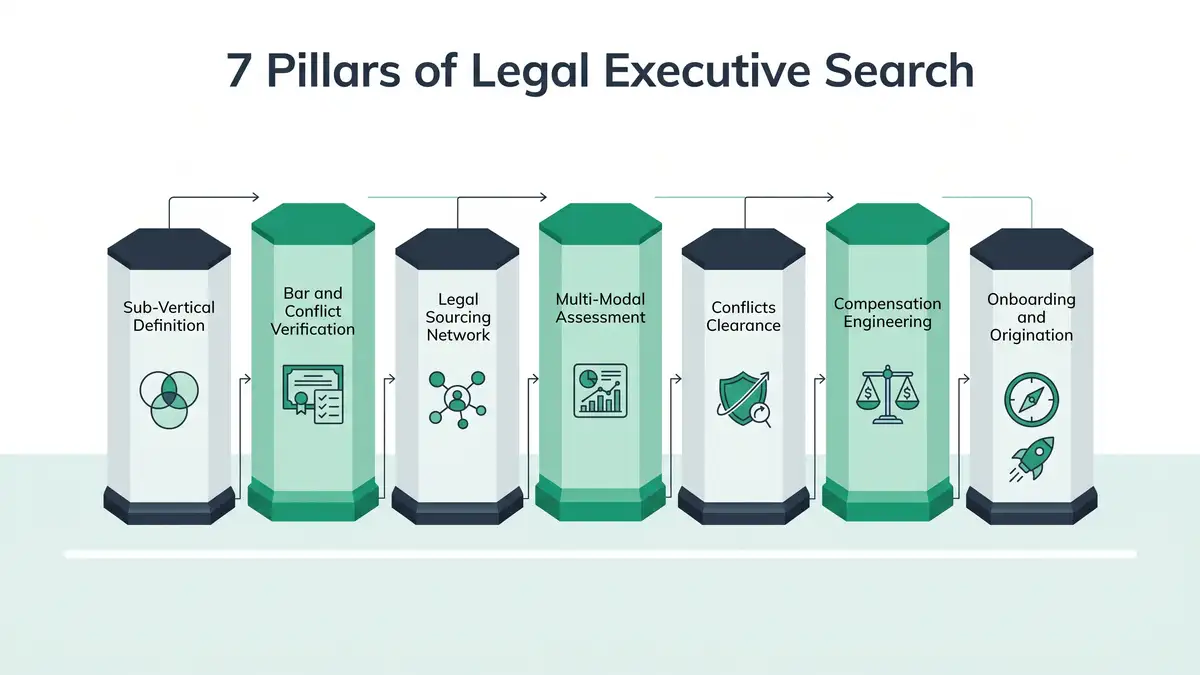
Sub-Vertical Definition
Map the role to AmLaw lateral partner, Magic Circle partner, Fortune 500 GC, senior in-house counsel, or boutique litigation. Each sub-vertical has distinct competency requirements, compensation structures, conflicts dynamics, and sourcing channels. A litigation rainmaker and a regulatory-savvy GC require fundamentally different assessment processes.
Bar Admission and Conflicts Verification
Verify state bar admission and good standing across all jurisdictions the candidate practices in. Run state bar disciplinary history checks. Conflicts review at both source firm and target firm typically requires 4-12 weeks per lateral partner move; specialist search firms integrate this timeline into the search calendar from day one.
Legal Sourcing Network
Combine LinkedIn with ABA member directories, state bar member directories, Above the Law alumni networks, Law360 partner directories, law school alumni networks (Harvard Law, Yale Law, Stanford Law, NYU Law, Columbia Law, Penn Law, Michigan Law, UChicago Law), law review alumni networks, AmLaw 100 partner directories, and practice area specialist communities. Single-channel LinkedIn sourcing misses 60-70% of qualified candidates for senior legal roles.
Multi-Modal Assessment
Combine deal/case review (representative matter walk-through), book portability assessment (which clients follow, which are firm-attached, what waivers required), client reference calls (validating book portability), prior firm management committee references, and structured interviews. Pure interview-based assessment for legal executive roles correlates poorly with 24-month placement success.
Conflicts Clearance Management
Manage parallel conflicts reviews at both source and target firms. Coordinate waivers, ethical screening procedures, and client notifications. Track conflicts blockages (specific clients that prevent a move). Specialist legal search firms maintain conflict-cleared candidate registries with weekly committee review.
Compensation Engineering
Structure offers across base draw, points or equity units, lateral guarantees (typically 2-3 years for $5M+ packages), signing bonuses, origination credit allocation, deferred compensation, and clawback provisions. Use American Lawyer PEP data, Major Lindsey & Africa Partner Compensation Survey, Equilar GC pay data, and Wells Fargo Legal Specialty Group as benchmarks. Under-pricing legal mandates costs candidates and clients real money.
Onboarding and Origination
Manage origination credit tracking from Day 1, client transition support including formal client notifications, bar admission transfers where cross-jurisdictional, practice group integration, and 12-month book ramp expectations. The typical "honeymoon" period for lateral partners runs 18-24 months before originations-based compensation kicks in fully.
Want the full legal executive search audit checklist mapped to your specific sub-vertical?
Request the Legal Search DiagnosticAmLaw 100 Lateral Partner Search: Compensation and Book Portability

AmLaw 100 lateral partner search in 2026 centres on Practice Group Heads, Office Managing Partners, and senior practice partners across M&A, capital markets, private equity, litigation (commercial and IP), restructuring, antitrust, tax, regulatory, and bankruptcy. Demand is driven by three forces: the continuing concentration of profitable work at elite firms (top 20 AmLaw firms capture a disproportionate share of high-margin matters), aggressive lateral hiring as firms compete for star practitioners, and partner retirements creating succession openings in established practice groups.
The compensation architecture at elite firms varies by partnership structure. Cravath, Sullivan & Cromwell, Davis Polk, and Wachtell historically operated lockstep partnerships where partners advance through seniority-based units rather than negotiating individual packages. Kirkland & Ellis, Latham & Watkins, Paul Weiss, and Skadden operate points-based systems where partners receive points allocated annually based on contribution, allowing significant compensation differentiation. The 2026 Law360 analysis notes that points-based firms have driven the $20M+ benchmark for elite laterals because they can structure aggressive guarantees that lockstep firms cannot match without breaking the partnership compact (Law360 Pulse, April 2026).
Book portability is the critical engineering variable in any lateral partner negotiation. Industry research from Wells Fargo Legal Specialty Group and Citi Hildebrandt Client Advisory has historically shown that 30-40% of lateral partner books typically port to the new firm within 12-24 months; 60-70% does not. The failure rate produces a structural risk for the target firm: a $10M guarantee for a partner whose actual portable book turns out to be $3M produces $7M of subsidy from existing partners until either originations recover or the partner exits.
Specialist legal executive search firms manage this risk through structured book portability assessment. The assessment includes client-by-client portability review (who decides where to send work; what conflicts exist at the target firm; what relationship depth exists), origination credit history at the source firm, fee transition agreements with the source firm, and client reference calls with the candidate's top 10-20 clients. Recruitment assessment methodology grounded in client reference calls separates 75-85% completion-rate boutiques from generalist firms producing 60-65% completion rates.
The Portability Calculation
A partner with claimed $10M of personal originations, of whom 35% typically ports per industry benchmarks, brings approximately $3.5M of actual portable revenue to the target firm. At an elite firm operating on a 1.5x leverage ratio with associates, that $3.5M supports approximately $5M-$6M of partner compensation sustainably. A $20M guarantee against a $3.5M portable book is a $14M-$16M subsidy from existing partners. Specialist search firms model this calculation explicitly for the management committee.
Fortune 500 General Counsel and Senior In-House Search

General Counsel search in 2026 spans Fortune 100, Fortune 500, mid-market public companies, and late-stage private companies, with role variants including CLO (Chief Legal Officer), GC, Deputy GC, and Divisional GC. Compensation diverges sharply based on company size and equity component. Lateral Link's overview of Fortune 500 GC compensation notes that top Fortune 100 GC packages combine base ($600K-$1M), cash bonus ($600K-$1.5M), and equity (RSUs and PSUs valued at $1M-$5M annually depending on company size), with multi-year retention awards layered on top during transitions (Lateral Link, 2026).
The Major Lindsey & Africa 2024 In-House Counsel Compensation Survey, distributed via the ACC and analyzed by Legal Dive, shows that the broader GC and CLO market saw a 4% drop in total cash compensation since 2021, with average GC/CLO cash compensation at $556,794. The drop reflects cost discipline at mid-market companies; large-cap public company GC compensation continued to grow over the same period (Legal Dive, July 2024). The full survey is available via the ACC document repository as a PDF (ACC In-House Counsel Compensation Survey, June 2025).
GC search engineering differs from lateral partner search in three structural ways. First, conflicts are simpler: the candidate's prior firm or company conflict relevance is bounded to the specific matters the company is pursuing. Second, equity vesting and retention design dominate the negotiation: a strong GC candidate typically forfeits $2M-$5M of unvested equity at the prior employer, requiring make-whole sign-on equity grants from the new employer. Third, board and CEO interaction during the search adds 30-45 days to the typical timeline, as candidate finalists meet with audit committee chairs, compensation committee chairs, and the CEO.
Senior in-house roles below GC (Head of M&A, Head of Litigation, Head of Compliance, Chief Privacy Officer, Chief Compliance Officer, Head of IP, Head of Employment) typically run faster (60-90 days) and at lower compensation ($400K-$1M+ depending on company size and function), but require specialist sub-vertical expertise. A Head of IP search at a biotech company demands different sourcing channels and assessment criteria than a Head of Litigation search at a financial institution.
Big Law Lateral Partner Hiring Trends in 2026
Firm Prospects' analysis of 2025-2026 lateral hiring trends identifies five forces shaping the legal market: increased lateral hiring at elite firms, escalating compensation guarantees, growing focus on practice group team moves rather than individual partners, accelerating partner mobility between AmLaw 100 firms, and concentrated lateral activity in M&A, restructuring, regulatory, and litigation practices (Firm Prospects, February 2026).
The team-move trend reflects firms' acknowledgement that individual partner laterals fail at high rates absent supporting infrastructure. Bringing a partner alongside two or three senior associates, paralegals, and dedicated practice support staff materially improves the probability that the partner's book ports successfully. Team-move negotiations typically extend the search timeline by 60-90 days as the source firm reviews potential team departures and the target firm negotiates packages for each team member.
The Big Law associate scale provides important context for partner economics. Larson Maddox's 2026 analysis notes that Big Law associate salaries at firms following the Cravath scale start at $225,000 for first-year associates and rise to $435,000 by the eighth year, with specialty practice areas commanding 15-25% premiums in major markets (Larson Maddox, March 2026). BCG Search's complete attorney compensation report corroborates the $225K-$435K range and notes that NYC, SF, DC, and LA remain the highest-paying markets (BCG Attorney Search, 2025-2026). For a search firm pricing a lateral partner mandate, the leverage math is essential: a partner book of $5M supporting a team of 4-5 associates at average compensation of $300K generates approximately $5M-$6M of allocated salary cost, leaving narrow margin for partner compensation absent fee premium and high-margin matter mix.
Recruitment Firms Specializing in Legal Executive Search
The legal executive search market is dominated by boutiques rather than the Big 5 generalist firms (Korn Ferry, Spencer Stuart, Heidrick & Struggles, Russell Reynolds Associates, Egon Zehnder). The Big 5 operate legal practices but primarily focus on Chief Legal Officer and General Counsel search where corporate executive search expertise outweighs deep law firm relationships.
Specialist firms include Major Lindsey & Africa (MLA Global), widely regarded as the largest legal recruiter globally with extensive partner compensation survey data, an in-house counsel compensation survey published in partnership with the ACC, and global coverage across AmLaw partner and in-house roles (MLA 2024 Partner Survey; MLA 2024 In-House Survey). Macrae focuses on senior partner lateral moves with deep relationships in M&A and capital markets practice groups (Macrae). BCG Attorney Search publishes extensive law firm rankings and compensation data and operates a broad partner and associate placement business (BCG Search AmLaw 100 rankings). Lateral Link, Mestel & Company, Garrison & Sisson, Kinney Recruiting, Whistler Partners, Larson Maddox, Tabby Group, and Cadence Search complete the boutique landscape with varying specialisms.
Boutiques dominate this market for three reasons: deep relationships with specific practice groups built over decades, conflicts management infrastructure that prevents the search firm from breaching off-limits agreements across competing AmLaw firms, and compensation engineering expertise around lateral guarantees, points allocation, and origination credit. The Big 5 generally cannot match boutique conflict registries or practice-group-specific networks for AmLaw lateral partner search.
Building a legal executive search practice and need conflict management infrastructure architecture?
Book a Boutique Practice AuditBar Admission, Conflicts, and Regulatory Discipline
Bar admission verification is the first regulatory hurdle in any legal executive search. State bars in all 50 US states (and the District of Columbia, plus relevant federal courts), the Solicitors Regulation Authority (England and Wales), the Law Society of Ireland, the Hong Kong Law Society, the Singapore Academy of Law, and other jurisdictional authorities maintain member directories with admission dates, good-standing status, and disciplinary history. Specialist search firms run bar verification at sourcing, not at offer; a candidate suspended from practice in any jurisdiction triggers immediate disqualification regardless of other qualifications.
Conflicts-of-interest discipline distinguishes legal executive search from every other vertical. When an AmLaw partner moves, both the source firm and the target firm must independently review conflicts arising from the partner's prior client matters. The Model Rules of Professional Conduct Rule 1.10 (imputed disqualification) and equivalent state rules require that the moving partner's prior client conflicts attribute to the entire target firm, unless waivers are obtained or ethical screening procedures are implemented. The conflicts review typically takes 4-12 weeks; in complex cases involving large M&A practices it can extend to 16-20 weeks.
Specialist legal search firms manage this discipline through structured conflicts coordination. The recruiter works as intermediary between source and target firm conflicts counsel, schedules parallel conflict reviews to compress timeline, identifies likely waiver candidates and screening implementation paths, and tracks blockages (specific clients that absolutely prevent a move). Boutiques without conflicts infrastructure routinely lose 30-50% of advanced-stage lateral partner mandates to clearance failures.
8 Common Pitfalls in Legal Executive Search
The first-24-month placement failure rate for AmLaw lateral partners runs 40-50% across the industry. Specialist boutiques produce 15-20% failure rates; generalists with no legal-specific infrastructure produce 50%+ failure rates. The delta is concentrated in eight repeating pitfalls:
Pitfall 1: Insufficient Conflicts Due Diligence
Search firms that cannot manage parallel conflicts reviews at source and target firms produce 30-50% mandate failure rates at the clearance stage. Specialist boutiques run conflicts review at sourcing, not at offer; generalists rely on the target firm's general counsel to discover conflicts late in the process.
Pitfall 2: Missing Book Portability Assessment
The single highest predictor of lateral partner failure is book non-portability. Wells Fargo Legal Specialty Group and Citi Hildebrandt data historically suggest 30-40% of expected lateral partner books port; 60-70% does not. Search firms that do not run client reference calls or formal portability assessment produce 40-50% lateral partner failure within 24 months.
Pitfall 3: Compensation Under-Pricing
Missing 2-3 year lateral guarantee mechanics, origination credit allocation, points vs lockstep dynamics, and the deferred compensation buyout from prior firm produces offer rejection rates 2-3x higher than specialists. Search firms charge 33-35% of base on Big Law lateral mandates because the engineering complexity warrants the fee.
Pitfall 4: Single-Channel Sourcing
LinkedIn-only sourcing for senior legal roles misses 60-70% of qualified candidates. Law school alumni networks (Harvard, Yale, Stanford, NYU, Columbia, Penn, Michigan, Chicago), law review alumni networks, ABA member directories, state bar directories, and practice-area specialist communities each surface candidate pools not visible on LinkedIn.
Pitfall 5: Ignoring Bar Grievance and Disciplinary History
Failure to run state bar disciplinary history checks at sourcing produces 8-16 week delays at offer when undisclosed grievances or disciplinary proceedings surface. Specialist firms run state bar checks before extending to long list; generalists discover issues at offer stage.
Pitfall 6: Generalist Treatment of Specialist Practice Areas
Treating an IP litigation partner like a regulatory partner, or treating a restructuring partner like a corporate M&A partner, produces 30%+ assessment errors. Each practice area has distinct origination dynamics, client relationships, and compensation conventions. Specialist firms maintain practice-area-specific consultants; generalists rely on shared consultants without practice depth.
Pitfall 7: Missing Law School and Pedigree Assessment
Elite AmLaw firms (Wachtell, Cravath, Sullivan & Cromwell, Davis Polk) effectively require law degrees from Harvard, Yale, Stanford, NYU, Columbia, Penn, Michigan, or Chicago for partner-track hires, with law review participation as an additional credential. Search firms that fail to assess pedigree against the target firm's actual hiring practices waste mandate cycles on candidates the firm will not seriously consider.
Pitfall 8: No Client Reference Calls
Client reference calls are the single most predictive assessment for lateral partner book portability. Calling the candidate's top 10-20 clients to validate the relationship depth, decision-making authority, and intent to move work to the new firm produces a 0.7+ correlation with 24-month placement success. Search firms that skip client reference calls due to confidentiality concerns produce 40-50% lateral partner failure rates.
The 7-Step Playbook for Building a Legal Executive Search Practice
Boutiques entering or sharpening a legal practice need an 18-24 month transition runway and capital investment in bar verification infrastructure, conflicts management systems, compensation data subscriptions, and law-school-network development. The playbook below sequences these investments to produce mature practice capability by Month 24.
Choose Legal Sub-Vertical with $100M+ Addressable Market
AmLaw lateral partner, Fortune 500 General Counsel, senior in-house counsel, or boutique litigation partner. Each has $100M+ annual addressable market in retained search. Specialist depth beats generalist breadth in legal at 2-3x the fee economics.
Hire or Embed Legal Industry Advisors
Ex-AmLaw partners, former CLOs, ex-state bar disciplinary counsel, or law firm management consultants at Director or Partner level. Without this, the firm cannot underwrite mandate timelines or assess practice-area-specific candidates credibly.
Build Bar Admission and Conflicts Verification Infrastructure
Subscribe to state bar member directories (50 states + DC), Solicitors Regulation Authority register (UK), Hong Kong Law Society register, Singapore Academy of Law register, and equivalent international authorities. Build automated bar verification into candidate intake workflow. Build conflicts registry tracking off-limits agreements and blockages. Total annual cost: $40K-$100K.
Develop Legal Sourcing Network
Law school alumni networks (Harvard, Yale, Stanford, NYU, Columbia, Penn, Michigan, Chicago), law review alumni databases, ABA section memberships, state bar memberships, AmLaw 100 practice group directories, Above the Law and Law360 partner alert networks. Each channel requires dedicated relationship investment.
Develop Multi-Modal Assessment
Deal/case review templates, book portability assessment rubrics, client reference call scripts, management committee reference call scripts, practice-area-specific assessment guides. Train all senior consultants on the methodology. The investment in assessment infrastructure produces the highest lateral placement quality differentiation.
Install Compensation Engineering Capability
Subscribe to American Lawyer PEP data and AmLaw 200 financial database, Major Lindsey & Africa Partner Compensation Survey, MLA In-House Counsel Compensation Survey, Equilar GC pay studies, Wells Fargo Legal Specialty Group reports. Train consultants on offer engineering across base, points, lateral guarantees, origination credit, deferred compensation, RSU/PSU vesting, and clawbacks. Executive search compensation benchmarks grounded in industry data convert at 2-3x generalist rates.
Build BD Around Legal Thought Leadership
Publish proprietary research on lateral partner trends, GC compensation, and practice-area-specific talent dynamics. Speak at ACC events, AmLaw conferences, NALP gatherings, and law firm management committee retreats. Co-author with Major Lindsey & Africa, BCG Search, or Wells Fargo Legal Specialty Group for distribution leverage. Build the inbound pipeline that converts legal mandates at 2-3x generalist rates.
Build the Legal Executive Search Practice That Compounds
The boutiques that win in legal executive search are not the ones with the most LinkedIn outreach. They are the ones with integrated bar verification, conflicts management, book portability assessment, and compensation engineering infrastructure. peppereffect installs the AI-powered operating system that runs all four, so your senior consultants spend their time on judgment, not coordination. Architect your legal practice for 75-85% completion rates, 33-35% fee economics, and inbound pipeline that compounds.
Book Your Legal Practice Architecture CallOr explore the 4 Pillars services
Frequently Asked Questions About Legal Executive Search
What is legal executive search?
Legal executive search is the recruitment discipline focused on placing senior legal leaders including AmLaw 100 and Magic Circle lateral partners, Practice Group Heads, Office Managing Partners, Fortune 500 General Counsel and Chief Legal Officers, deputy GC and divisional GC, Heads of Litigation, Heads of IP, Heads of Compliance, and senior counsel for boutique litigation firms. The vertical differs from general executive search through bar admission verification, conflicts-of-interest clearance taking 4-12 weeks per move, book portability and origination assessment, lateral guarantee structuring, and law-school and law-review pedigree screening for elite firms.
What are the 7 pillars of legal executive search methodology?
The 7 pillars are: 1) Sub-vertical definition (Big Law lateral partner, GC, in-house senior counsel, boutique litigation); 2) Bar admission and conflict-of-interest verification at sourcing; 3) Legal sourcing network spanning ABA, state bars, law school alumni, law review networks, Above the Law and Law360 alumni databases; 4) Multi-modal assessment with deal/case review, book portability assessment, client reference calls, and law firm management committee references; 5) Conflicts clearance management with both source and target firm reviews; 6) Compensation engineering across base, points or equity, lateral guarantees, origination credit, and deferred compensation; 7) Onboarding with origination tracking, client transition support, and bar admission transfer where applicable.
How much do AmLaw 100 partners and Fortune 500 General Counsel earn in 2026?
AmLaw 100 average profits per equity partner (PEP) reached $3.59M in 2026 across $178.95B aggregate gross revenue. Top elite firms (Wachtell, Sullivan & Cromwell, Davis Polk, Kirkland) post PEP of $7M-$10M+. Lateral partner pay for top practitioners now routinely reaches $20M+ per year in guaranteed compensation at firms like Kirkland and Latham. Major Lindsey & Africa's 2024 Partner Compensation Survey shows average partner compensation reached $1,411,000, up 26% in two years. Fortune 500 General Counsel total compensation typically runs $1.5M-$5M+ at large public companies, with Fortune 100 GC packages reaching $5M-$10M+ when equity vests, though Legal Dive reports total cash compensation for GCs and CLOs dropped 4% since 2021 to an average of $556,794 across the broader corporate market.
Which firms specialise in legal executive search?
Specialist firms include Major Lindsey & Africa / MLA Global (largest legal recruiter globally), Macrae, BCG Attorney Search, Lateral Link, Mestel & Company, Garrison & Sisson, Kinney Recruiting, Whistler Partners, Tabby Group, Cadence Search, and Larson Maddox. The Big 5 (Korn Ferry, Spencer Stuart, Heidrick, Russell Reynolds, Egon Zehnder) operate legal practices primarily focused on Chief Legal Officer and General Counsel search. Boutiques dominate Big Law lateral partner search due to deep relationship networks and conflict management infrastructure.
How long does it take to fill an AmLaw 100 partner or Fortune 500 GC role?
AmLaw 100 lateral partner searches run 90-180 days primarily due to conflicts-clearance requirements at both source and target firms taking 4-12 weeks. Fortune 500 General Counsel searches run 90-150 days. Senior in-house counsel searches run 60-90 days. Boutique litigation partner searches run 60-120 days. Origination credit and book portability assessment add 2-4 weeks to lateral partner searches. Bar admission transfer adds 4-8 weeks for cross-jurisdictional moves.
What are common pitfalls in legal executive search?
The 8 most common pitfalls are: 1) Insufficient conflicts due diligence; 2) Missing book portability assessment producing 40-50% lateral partner failure within 24 months; 3) Compensation under-pricing; 4) Single-channel sourcing missing law school, law review, and bar association networks; 5) Ignoring bar grievance and disciplinary history; 6) Generalist treatment of specialist practice areas; 7) Missing law school pedigree assessment for elite firms; 8) No client reference calls validating book portability. AI candidate screening infrastructure helps automate the disciplinary history and bar admission verification at sourcing.
How do I build a legal executive search practice?
The 7-step playbook: 1) Choose legal sub-vertical with $100M+ addressable market; 2) Hire or embed legal industry advisors (ex-Big Law partners, former CLOs); 3) Build bar admission and conflicts verification infrastructure ($40K-$100K annually); 4) Develop legal sourcing network across ABA, state bars, law school alumni, law review networks; 5) Develop multi-modal assessment including client reference calls; 6) Install compensation engineering using American Lawyer PEP data, Major Lindsey & Africa surveys, Equilar GC data; 7) Build BD around legal thought leadership. Transition takes 18-24 months. Executive search business development grounded in legal thought leadership drives 2-3x conversion rates. life sciences executive search CMO and VP Marketing search non-profit executive search REIT and real estate private equity search
Resources
- BCG Attorney Search 2026 AmLaw 100 Most Profitable Law Firms
- David Lat Original Jurisdiction 2026 Top 20 Most Profitable Law Firms
- Law360 Pulse Is $20M Partner Pay Becoming Ubiquitous In BigLaw
- Macrae $20 Million Becomes the New Benchmark for Top Lateral Partner Pay
- Major Lindsey & Africa 2024 Partner Compensation Survey
- Major Lindsey & Africa 2024 In-House Counsel Compensation Survey
- ACC In-House Counsel Compensation Survey 2024 (MLA Partnership)
- Legal Dive Legal Executives Pay Dropped After Years of Gains
- Lateral Link General Counsel Compensation in Fortune 500 Companies
- Firm Prospects 5 Lateral Hiring Trends Shaping the Legal Market
- Larson Maddox Big Law Salary Scale 2026 Cravath vs AmLaw 100-200
- BCG Attorney Search Complete Attorney Compensation Report 2025-2026
- BCG Attorney Search Ultimate Guide to America's Top Law Firms by Practice Area
- Rightful Advice 2026 AmLaw 100 Results: Latest Financials & Performance Data
- Law360 GC Cheat Sheet Corporate News May 2026