

Client relationships in executive search compound through the partnership model. Boutique and mid-market retained firms that operate the partnership model with a tightly held portfolio of multi-year client relationships compound 35 to 45 percent EBITDA premium versus transactional competitors, command 30 to 40 percent fee premium for advisory layers, and capture 70 percent or more of revenue from repeat mandates. Firms operating transactionally restart business development at the end of every mandate and lose the lifetime value compounding that transforms enterprise economics over 3 to 5 year horizons.
This guide architects the partnership model for managing directors and partners of boutique to mid-market retained executive search firms (James Sterling persona). We benchmark the transactional versus partnership economics, the 7-pillar partnership architecture, client tier segmentation, quarterly business review cadence, succession planning advisory, post-placement integration mechanics, the 8 partnership pitfalls, and the 7-step playbook for transitioning from transactional to partnership economics. Every recommendation reinforces the operating logic of recruitment firm profitability and the relationship discipline of executive search methodology.
Transactional Versus Partnership Client Relationship Models
The single most consequential strategic decision for boutique and mid-market retained executive search firms is whether to operate transactionally or as partnership firms. Per JRG Partners' analysis of retained executive search, retained search is fundamentally a long-term strategic partnership built on trust, discretion, and accountability rather than transactional placement work. The architectural distinction shows up at every layer of the firm: pricing, capacity allocation, client portfolio composition, advisory layers, governance cadence, and exit valuation multiples.
Transactional firms operate one mandate at a time. Business development restarts at the end of each engagement. Client relationship depth is limited to the active mandate window. Repeat mandate rate typically lands at 30 to 50 percent of revenue. EBITDA margins compress because BD overhead consumes a high fixed percentage of revenue.
Partnership firms operate continuous multi-year client relationships. Business development is concentrated on retention and expansion within a tightly held client portfolio. Repeat mandate rate typically lands at 70 percent or higher. Advisory layers (talent intelligence, succession planning, diversity strategy) generate premium recurring revenue. EBITDA margins expand because partner attention compounds against the same relationships rather than diffusing across new prospects.
Per CFO Selections' analysis of retained versus contingent search differences, the partnership economics extend to candidate trust as well. A retained recruiter who has built confidentiality trust with candidates over years can approach the market with the discretion that confidential searches require, while transactional recruiters lose access to the senior talent pool through inability to protect confidentiality. Per RecruitBPM's 2026 retained versus contingency analysis, the exclusive relationship in retained search enables the discretion that compounds across partnership horizons.
The partnership thesis
Client relationships in executive search are not transactional events. They are multi-year compounding assets that transform firm economics when treated as strategic infrastructure rather than mandate-by-mandate transactions. Partnership firms compound 35-45 percent EBITDA premium, command 30-40 percent fee premium for advisory layers, and protect their enterprise value at exit through repeat client defensibility. Transactional firms pay the full BD cost forever and trade short-term mandate revenue against long-term firm value.

The 7-Pillar Partnership Model
The partnership operating model resolves into seven interconnected pillars. Per Pixcell's analysis of SHREK executive search firm comparison and the operational patterns of leading elite firms, the partnership architecture distinguishes itself from transactional models on every pillar.
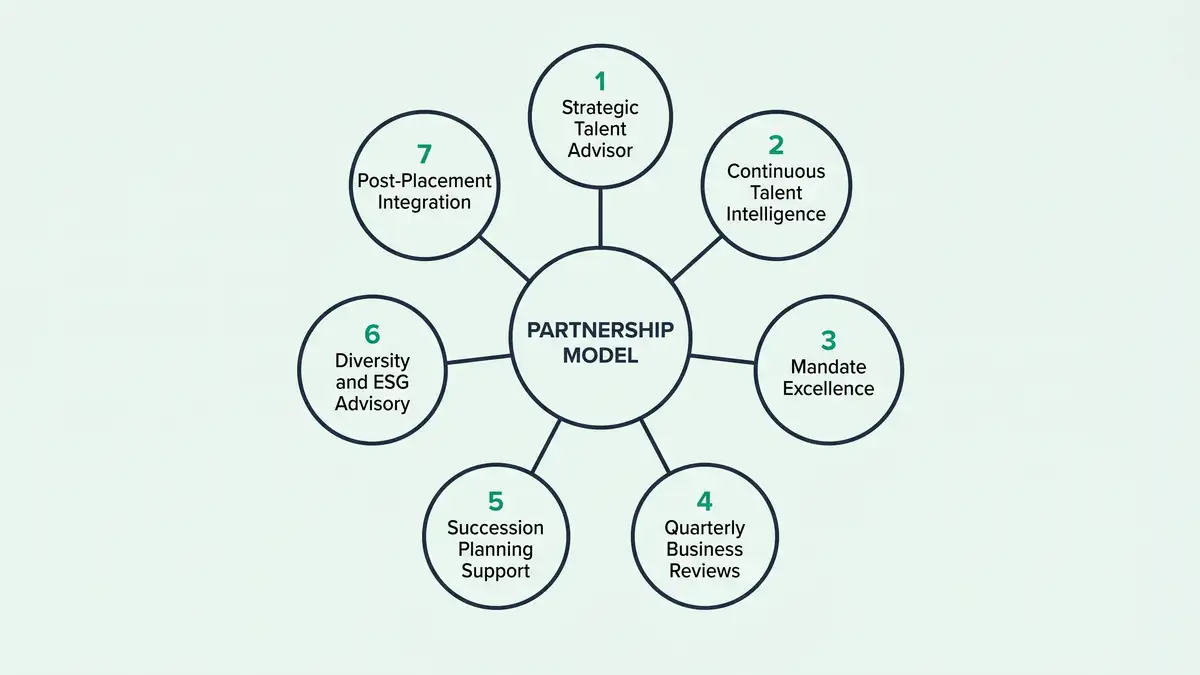
| Pillar | Scope | Cadence |
| 1. Strategic Talent Advisor | Board-level positioning, long-horizon talent strategy | Continuous |
| 2. Continuous Talent Intelligence | Quarterly market mapping, compensation benchmarking | Quarterly |
| 3. Mandate Excellence | Delivery discipline per individual search | Per mandate |
| 4. Quarterly Business Reviews | Governance cadence with client leadership | Quarterly |
| 5. Succession Planning Support | Proactive talent pipeline for critical roles | Annual + on-demand |
| 6. Diversity and ESG Advisory | Slate diversity, leadership pipeline depth | Per mandate + annual |
| 7. Post-Placement Integration | 90/180/365-day follow-through with placed executives | Post each placement |
Sources: JRG Partners retained executive search, Pixcell SHREK firms comparison, Talentfoot top executive search firms 2026
The Economics of Repeat Client Relationships
The mathematics of repeat client relationships drive every other partnership decision. Per Buffkin Baker's recognition as a top global 25 executive search firm by Hunt Scanlon Media, the firms achieving recognition through firm size and growth typically operate partnership models with high repeat rate concentrations. Per peppereffect's recruitment firm profitability framework, repeat mandate rate of 70 percent or higher correlates with 35 to 45 percent EBITDA premium versus single-mandate firms.
The lifetime value math compounds across three dimensions. Reduced BD cost per mandate: repeat clients eliminate the proposal cycle, the positioning sell, the credential review, and the initial trust building that consumes 15 to 30 percent of mandate revenue in BD overhead at transactional firms. Premium fee tolerance: partnership clients pay 30 to 40 percent fee premium for advisory layers and prioritised access versus market 25 percent baseline retainer. Advisory layer expansion: partnership clients increasingly purchase talent intelligence subscriptions, succession planning advisory, and diversity strategy engagements that compound annual revenue per client.
Per Hunt Scanlon's Executive Search Review analysis of boutique firms leading the industry, Korn Ferry generates approximately 40 percent of revenue from non-recruiting advisory services, while Spencer Stuart and Heidrick are more search-pure; the advisory revenue trajectory at Korn Ferry illustrates the long-term economics of partnership model maturation. peppereffect's analysis of executive search pricing models details the premium fee economics that partnership firms command across mandate and advisory layers.
Client Tier Segmentation and Capacity Discipline
Partnership model firms operate with disciplined client tier segmentation. The capacity math: each partner can sustain 3 to 5 Tier 1 strategic partnerships (50 to 70 percent of revenue), 10 to 15 Tier 2 active clients with future Tier 1 potential, and a Tier 3 dormant relationships set the partner monitors for re-engagement triggers. Beyond those bounds, relationship depth erodes and partnership advantage compresses.

| Tier | Per Partner | Revenue Share | Investment Profile |
| Tier 1 Strategic Partner | 3-5 clients | 50-70% of revenue | Continuous engagement, all 7 pillars active |
| Tier 2 Active Client | 10-15 clients | 20-35% of revenue | Mandate excellence + occasional advisory |
| Tier 3 Dormant Relationship | 20-50 contacts | 5-15% of revenue | Monitoring for re-engagement triggers |
Sources: peppereffect recruitment firm profitability framework, Juicebox 12 best executive search firms 2026
The Quarterly Business Review Architecture
The quarterly business review (QBR) is the operating cadence that distinguishes partnership firms from transactional firms. Per peppereffect's executive search KPI framework, QBR discipline at scale separates the firms that compound client value from those that lose it through neglect.
The QBR agenda for Tier 1 strategic partners typically covers six sections over 90 minutes:
Talent landscape update
Quarterly intelligence on the client's competitive talent landscape: leadership transitions at competitors, sector compensation movement, emerging skills gaps. peppereffect's analysis of talent mapping strategy details the underlying intelligence asset.
Active mandate review
Status, candidate slate, milestone tracking, risk surfacing across active mandates. Honest review of any delivery friction.
Placed executive integration check
90/180/365-day post-placement integration check on previously placed executives. Surface integration friction while it can still be corrected.
Succession planning update
Annual or semi-annual succession readiness review for the client's critical leadership roles. Per peppereffect's talent mapping methodology, succession readiness mapping is the highest-value advisory deliverable.
Next-mandate discussion
Proactive discussion of upcoming hiring needs over the next 6 to 12 months. The QBR is where Tier 1 partnerships generate forward mandate flow without competitive RFP processes.
Partnership value review
Honest review of the partnership value delivered, advisory layer effectiveness, billing review, and adjustments for the coming quarter. The discipline that protects partnership longevity against drift.
Need to architect the partnership operating model for your firm?
Book a Growth Mapping CallTrust, Confidentiality, and the Ethics of Partnership Model
Trust is the load-bearing structure of executive search partnerships. Per Fusion Recruiters' analysis of confidential leadership hiring, confidential searches require the trust infrastructure that only retained partnership relationships can sustain. Per MLA Global's analysis of contingency versus retained legal search, the architectural difference enabling confidentiality is the exclusive partnership relationship; firms operating across multiple competing clients in the same talent pool cannot sustain the discretion required for sensitive searches.
The 5 trust-building behaviours that compound across partnership horizons: intellectual honesty about candidates (telling the client the truth about a candidate's gaps, not selling); confidential discretion (protecting client information and candidate identities with rigour); off-limits respect (declining to approach candidates within client portfolio companies for stated periods); delivery transparency (honest mandate status updates including bad news); conflict-of-interest discipline (declining engagements that would compromise confidentiality across the partnership portfolio).
peppereffect's broader analysis of executive search methodology details how confidentiality discipline becomes the operating culture that distinguishes partnership firms across hiring decisions and consultant behaviours.
The Succession Planning Advisory Layer
Succession planning advisory is the highest-margin partnership extension layer. Tier 1 strategic partners increasingly purchase succession planning advisory as the natural extension of the mandate work that established the relationship. The economics: succession planning engagements typically command $50k to $300k fees with 12 to 18 month delivery cycles, generating 60 to 80 percent gross margin versus 55 to 65 percent on mandate work.
Per peppereffect's talent mapping strategy framework, the underlying succession-readiness mapping methodology is the deliverable architecture. The partnership extension follows a predictable sequence: first mandate establishes credibility; second mandate confirms delivery; third mandate plus QBR cadence opens the succession advisory conversation; succession diagnostic engagement establishes the advisory layer; ongoing succession monitoring becomes the partnership recurring revenue.

Post-Placement Integration Mechanics
Post-placement integration is the underinvested pillar that distinguishes partnership firms from transactional firms most clearly. The cadence: 30-day check-in with the placed executive and client sponsor on initial integration; 90-day performance review covering early signals of fit, friction points, and adjustments; 180-day cultural integration assessment with the placed executive's direct reports and peer team; 365-day succession readiness review covering the placed executive's developmental trajectory.
Per peppereffect's diversity executive search methodology, post-placement integration is also where diversity placement quality compounds or erodes; the 30/90/180-day cadence surfaces integration friction while it can still be corrected. The mechanics of integration protect placement guarantee provisions, reinforce client trust, and generate the data that informs future mandate work.
8 Partnership Model Pitfalls
1. Treating every client as transactional
The default mode for boutique firms under growth pressure. Every new mandate gets treated as standalone rather than partnership extension. The result: 30 to 50 percent of potential lifetime client value evaporates through BD restart at each mandate end.
2. Over-extension across too many strategic partners
Per the capacity discipline, each partner can sustain 3 to 5 Tier 1 partnerships. Partners managing 8 to 12 strategic relationships compound relationship neglect across the portfolio and compress partnership quality.
3. BD without delivery follow-through
Winning the next mandate while previous placed executives are struggling in integration. The asymmetry compounds: clients remember integration friction longer than they remember mandate excellence.
4. Confidentiality breaches
A single confidentiality breach destroys multi-year partnership trust. Per CFO Selections' analysis of retained search differences, the trust infrastructure that supports confidential searches is the load-bearing structure of partnership economics.
5. Conflicts of interest
Taking mandates that conflict with Tier 1 partner client portfolios. The short-term mandate revenue trades against long-term partnership integrity and eventual Tier 1 client departure.
6. Succession advisory without methodology
Offering succession planning advisory without the underlying succession-readiness mapping methodology and credentialed assessment frameworks. Partnership clients quickly recognise generic succession advisory and downgrade the partnership.
7. Talent intelligence without rigor
Offering quarterly market intelligence reports that are anecdotal rather than systematic. Partnership clients pay for talent intelligence depth and rigor that justifies the advisory premium; anecdotal updates do not.
8. Post-placement abandonment
The transactional firm pattern: collect the placement fee, ignore the integration. Partnership firms invest in 30/90/180/365-day integration follow-through that compounds placement quality and reinforces relationship trust.

The 7-Step Playbook for Transitioning from Transactional to Partnership Model
Identify Tier 1 candidate clients across current portfolio
Score current clients on three dimensions: mandate volume potential, advisory layer fit, relationship quality with senior decision-makers. The top 3 to 5 per partner are Tier 1 candidates. The selection discipline matters more than the count.
Build relationship investment plan per Tier 1 candidate
For each Tier 1 candidate, document: relationship history, key stakeholders, talent landscape, current pain points, advisory entry point hypothesis. The investment plan is the discipline that converts opportunity into partnership.
Deliver mandate excellence at higher service level
Across active mandates with Tier 1 candidates, deliver mandate work at a higher service level than market baseline: faster shortlist, deeper candidate intelligence, structured assessment integration, post-placement integration check-ins. The service level differential is what earns the partnership invitation.
Offer first advisory layer
After 2 to 3 successful mandates, offer the first advisory layer: quarterly talent intelligence report, succession diagnostic, or diversity slate analysis. The offer establishes the partnership conversation without imposing the structure.
Install QBR cadence
Once the advisory layer is accepted, install the QBR cadence as the partnership operating rhythm. The QBR becomes the platform from which the remaining 6 pillars of the partnership model deploy.
Develop succession diagnostic offering
Build the firm's succession diagnostic methodology and offer it to Tier 1 partners as the partnership extension layer. peppereffect's analysis of talent mapping strategy details the underlying methodology architecture.
Evolve to embedded partnership
Over 18 to 36 months, the partnership matures into embedded advisory: the firm becomes the client's de facto external talent function, with continuous engagement, predictable mandate flow, and recurring advisory revenue. The embedded partnership is the compounding asset that drives the 35-45 percent EBITDA premium and protects exit valuation.
Architect Your Firm's Partnership Operating Model With peppereffect
peppereffect installs the AI-augmented partnership operating model that compounds client relationships from transactional mandates into multi-year partnership economics. We architect tier segmentation, design QBR cadence, build succession advisory methodology, install post-placement integration discipline, and engineer the relationship discipline that converts client portfolio into compounding firm value.
Book a Growth Mapping CallFrequently Asked Questions About Client Relationships in Executive Search
What is the partnership model in executive search?
The partnership model in executive search is the operating architecture that converts transactional mandate relationships into multi-year compounding client portfolios. Partnership firms operate continuous engagement across 7 pillars (strategic talent advisor, continuous talent intelligence, mandate excellence, quarterly business reviews, succession planning support, diversity and ESG advisory, post-placement integration). The model compounds 35 to 45 percent EBITDA premium versus transactional competitors, captures 70 percent or more of revenue from repeat mandates, and commands 30 to 40 percent fee premium for advisory layers.
How many strategic partnership clients can a partner sustain?
Each partner can sustain 3 to 5 Tier 1 strategic partnership relationships (50 to 70 percent of revenue) plus 10 to 15 Tier 2 active clients with future Tier 1 potential. Beyond these bounds, relationship depth erodes and partnership advantage compresses. The capacity discipline is the operating constraint that protects partnership quality at scale.
Why is repeat client rate the key partnership economic metric?
Repeat client rate above 70 percent correlates with 35 to 45 percent EBITDA premium versus single-mandate firms. Per Great Recruiters research, 79 percent of placement revenue at top-performing firms comes from repeat clients. The economics compound through three mechanisms: reduced BD cost per mandate (15 to 30 percent of revenue at transactional firms eliminated), premium fee tolerance for advisory layers (30 to 40 percent above market baseline), and advisory layer expansion (succession planning, talent intelligence subscriptions).
What is the quarterly business review for executive search clients?
The quarterly business review (QBR) is the partnership operating cadence with Tier 1 strategic partners. Standard 90-minute agenda covers six sections: talent landscape update, active mandate review, placed executive integration check, succession planning update, next-mandate discussion, and partnership value review. The QBR is the platform from which the remaining pillars of the partnership model deploy and is the discipline that distinguishes partnership firms from transactional firms.
How does confidentiality build executive search partnership trust?
Confidentiality is the load-bearing structure of executive search partnerships. Per CFO Selections' analysis of retained versus contingent search, the exclusive partnership relationship enables the discretion that confidential searches require. The 5 trust-building behaviours that compound across partnership horizons are intellectual honesty about candidates, confidential discretion, off-limits respect, delivery transparency, and conflict-of-interest discipline. Trust compounds across mandates through demonstrated delivery and protected information.
What is the role of post-placement integration in partnerships?
Post-placement integration is the partnership pillar that distinguishes partnership firms from transactional firms most clearly. The cadence: 30-day check-in with the placed executive and client sponsor, 90-day performance review covering early integration signals, 180-day cultural integration assessment with the executive's team, 365-day succession readiness review covering developmental trajectory. The mechanics protect placement quality, reinforce client trust, and generate the data that informs future mandate work.
How do executive search firms transition from transactional to partnership model?
The 7-step playbook: 1) Identify Tier 1 candidate clients across current portfolio; 2) Build relationship investment plan per Tier 1 candidate; 3) Deliver mandate excellence at higher service level; 4) Offer first advisory layer (talent intelligence, succession diagnostic, or diversity slate); 5) Install QBR cadence; 6) Develop succession diagnostic offering; 7) Evolve to embedded partnership over 18 to 36 months. The discipline that compounds value is treating each Tier 1 candidate as a multi-year strategic investment rather than a current mandate. succession planning services that compound LTV
Resources
- JRG Partners: Retained Executive Search Firm
- CFO Selections: Difference Between Retained and Contingent Search
- Pixcell: SHREK Executive Search Firm Comparison
- Talentfoot: Top Executive Search Firms USA 2026 Rankings
- Fusion Recruiters: Confidential Leadership Hiring
- Buffkin Baker: Top Global 25 Executive Search Firm
- Hunt Scanlon: Executive Search Review Boutique Firms Lead Industry Surge
- Juicebox: 12 Best Executive Search Firms 2026
- MLA Global: Contingency vs Retained Legal Search
- RecruitBPM: Retained vs Contingency Recruitment 2026
- N2Growth: Top Executive Search Firms 2026
- Top Executive Search Firms Rankings 2026
- Top 5 Executive Search Firms