

Succession planning is the most under-served advisory layer at boards and C-suites globally. The boutique executive search firm that builds succession planning services on top of its placement practice converts transactional fee income into recurring advisory revenue, multiplies LTV across each client relationship, and lifts the firm's exit multiple from 5-8x EBITDA to 10-15x through the recurring revenue premium.
This article installs the 7-pillar succession planning service model that boutique to mid-market executive search firms (5-50 consultants, $5-50M revenue) use to enter the succession advisory category. James Sterling, Managing Director of a global executive search boutique, will use this as the strategic blueprint for the next layer of firm growth that compounds beyond the placement fee model.

The advisory revenue thesis
Boutique executive search firms that add succession planning services to their portfolio command 30-50% higher revenue per client relationship and unlock board-level access that compounds into multi-year retainers and downstream placement mandates. The firms operating succession advisory as a productised practice trade at premium EBITDA multiples because the recurring revenue layer transforms the valuation profile from transactional service business to advisory practice. The strategic question is not whether to add succession planning, but how to operationalise the service model without compromising the placement practice.
The opportunity: why succession planning is under-served
Roughly 60-70% of boards report inadequate CEO succession plans according to NACD's survey of public company directors. PwC's governance insights research on CEO succession planning documents the same readiness gap across mid-cap and private companies. Deloitte's analysis of the importance of CEO succession planning confirms the structural under-investment at the board level.
The global top firms run dedicated succession advisory practices. Spencer Stuart's Board and CEO practice, Russell Reynolds Global Leadership Monitor, Korn Ferry's assessment and succession capability, Heidrick and Struggles' CEO succession planning services, and Egon Zehnder's executive leadership succession guide all operate succession as a core service line distinct from search execution.
The boutique opportunity sits in sector specialisation. A boutique firm with deep authority in FinTech, MedTech, industrial automation, or PE portfolio companies can deliver sector-specific succession services that generalist competitors cannot match. The sector-specialised succession service is the premium product that justifies the 30-40% fee premium over generalist competitors. See niche vs generalist recruitment for the positioning architecture that supports sector-specialised succession authority.
Why succession planning unlocks premium advisory revenue
The economic case for succession services is structural rather than incremental. The 7 specific value layers compound to produce 3-5x higher LTV per client relationship versus placement-only engagements.

| Revenue dimension | Per-engagement | Annual retainer | Downstream impact |
| Project fee (single succession) | $25k-$150k | One-time | 2-3x placement mandates |
| Ongoing board retainer | n/a | $50k-$200k | Continuous mandate flow |
| PE portfolio multi-company retainer | n/a | $100k-$500k | 5-10 placements per year per platform |
| Emergency succession premium | +30-50% | n/a | Highest-trust relationship anchor |
| Development planning add-on | $15k-$50k per executive | $30k-$100k | Multi-year executive integration |
Sources: Consulting Success retainer pricing, Korn Ferry assessment and succession, Spencer Stuart executive assessment services.
The recurring revenue layer transforms the firm's valuation profile. Per ClearlyAcquired's analysis of valuation multiples for consulting and professional service firms, advisory businesses with 25%+ recurring revenue trade at 10-15x EBITDA versus 5-8x for transactional placement businesses. The same EBITDA generates 50-100% higher enterprise value purely from the recurring revenue mix. See recruitment firm valuation for the multiple math that compounds with the succession layer.
The 7-pillar succession planning service model
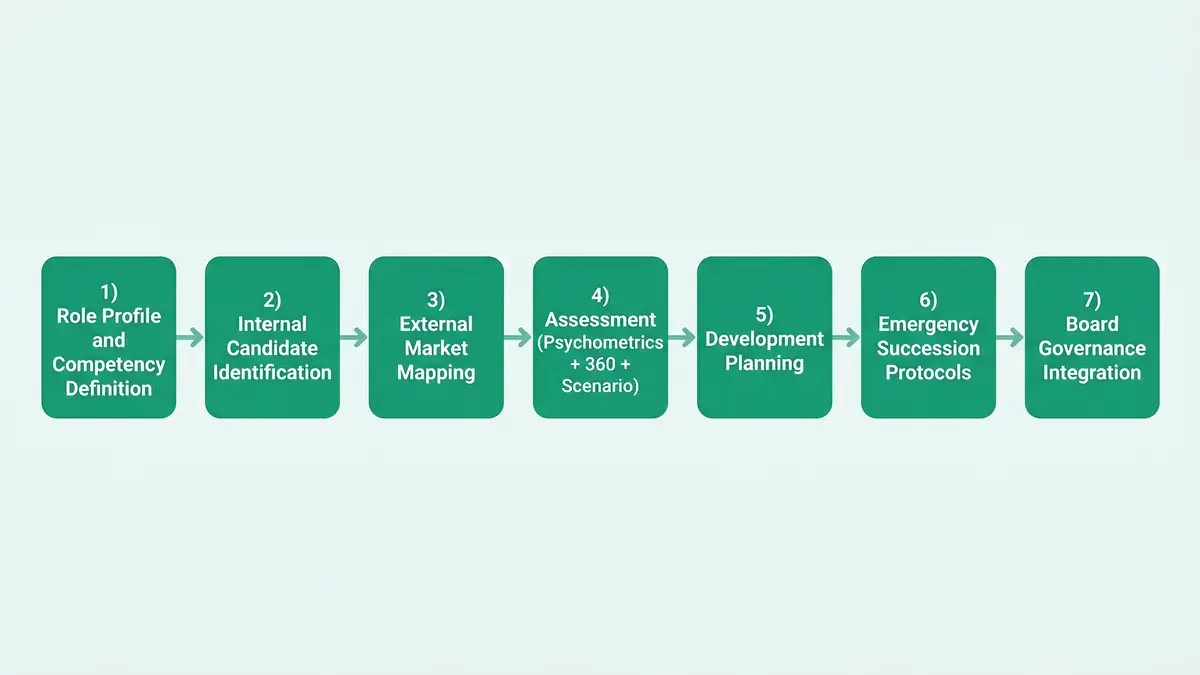
Elite succession practices structure their offering around seven interlocking pillars. The 7-pillar architecture is the productisation framework that converts ad-hoc succession work into a repeatable service.
| Pillar | Output | Fee component |
| 1. Role profile and competency definition | Documented competency framework, KPI structure, strategic context | $10k-$30k |
| 2. Internal candidate identification | Internal slate of 3-7 named candidates with readiness assessment | $15k-$40k |
| 3. External market mapping | External slate of 8-15 named candidates with benchmark intelligence | $20k-$60k |
| 4. Assessment via psychometrics, 360, scenario testing | Validated assessment of each candidate against role profile | $25k-$75k |
| 5. Development planning | Individual development plans for identified successors | $15k-$50k per executive |
| 6. Emergency succession protocols | Documented playbook for sudden incumbent loss | $15k-$40k |
| 7. Board governance integration | Quarterly review with nomination committee, refresh cadence | $50k-$200k annual retainer |
Sources: AESC assessments for executive selection methodology, Heidrick CEO succession planning, Egon Zehnder guide to executive leadership succession.
Pillars 1-3: defining the role and the candidate universe
The foundation pillars define what the role actually requires and who could fill it. Pillar 1 creates the competency framework through structured interviews with the board, current incumbent, key executives, and key stakeholders. The deliverable is a 10-15 dimension competency framework anchored in the firm's strategic context, plus the KPI structure that defines success in the role over a 3-5 year horizon.
Pillar 2 develops the internal slate of 3-7 named candidates with readiness assessment ratings: ready-now, ready-in-1-year, ready-in-3-years. TMI Network's analysis of building strong talent pipelines for future leadership documents the readiness assessment methodology. Pillar 3 maps the external candidate universe with 8-15 named candidates benchmarked against the role profile. See talent mapping strategy for the methodology that drives the external slate.
Pillar 4: assessment depth that justifies advisory pricing

The assessment pillar is what separates premium succession services from extended search. Elite practices combine three assessment instruments: validated psychometrics (Hogan Assessment Suite, ghSMART Executive Intelligence, Spencer Stuart Executive Intelligence, Korn Ferry KFALP), 360-degree reviews from peers and reports, and scenario-based interviews or business case simulations.
Hogan Assessments' analysis of equitable succession planning strategy documents the psychometric methodology that produces validated readiness scores. ghSMART's executive selection solution uses the same Executive Intelligence framework that produced the original Topgrading methodology. The combined assessment produces a defensible board-ready report that justifies $25k-$75k per engagement.
Pillar 5: development planning that retains successors
The development planning pillar converts assessment insights into actionable individual development plans for each identified successor. The plan covers stretch assignments, board exposure, M&A or transformation experience, executive coaching, and external development programmes. Center for Creative Leadership's research on succession planning and leadership documents the development methodology that produces 60-70% successor retention versus 25-35% for unstructured succession programs.
Each development plan generates $15k-$50k in advisory revenue per executive, with multi-year support extending into $30k-$100k annual retainer. The development pillar is also the relationship anchor that converts the succession engagement into a multi-year client relationship rather than a one-off project.
Pillar 6: emergency succession protocols
Emergency succession is the highest-stakes and highest-margin variant of the service. When an incumbent CEO dies, leaves abruptly, or is forced out, the firm with documented emergency succession protocols becomes the first call. Russell Reynolds' analysis of crisis-era ready succession plans documents the playbook structure: interim CEO identification, board governance during transition, communication framework, regulatory disclosure protocols, accelerated permanent succession.
Emergency succession engagements typically run $40k-$200k+ per event with 30-50% premium pricing over planned succession because the timeline compression and stakes elevate the engagement. The protocols are typically documented as part of the annual retainer relationship and activated when needed.
Pillar 7: board governance integration

The governance integration pillar converts project-based succession work into ongoing advisory retainer. The deliverable is a quarterly review cycle with the board's nomination or governance committee covering: succession bench depth and readiness updates, market intelligence on competitor moves, refresh of external candidate slate, development plan progress for identified successors, emergency protocols stress test, and emerging leadership risks.
NACD's analysis of turning the nominating governance committee into a strategic asset documents the quarterly cadence that elite practices use. The annual retainer ranges from $50k-$200k for a single-company engagement to $100k-$500k for PE portfolio multi-company arrangements.
Who buys succession planning services
The buyer universe segments into five distinct categories with different decision dynamics, pricing tolerance, and engagement structures.

| Buyer segment | Decision-maker | Engagement structure | Annual spend |
| Public company boards | Nomination/governance committee chair | Annual retainer + project fees | $100k-$300k |
| PE portfolio companies | PE operating partner or platform CEO | Multi-company retainer + placements | $150k-$500k |
| Founder/CEO planning transition | Founder or board chair | Project fee + advisory retainer | $80k-$250k |
| CHRO as integrator | CHRO or VP Talent | Project fee + development add-ons | $60k-$200k |
| Family businesses and foundations | Family council or board | Multi-year retainer | $50k-$300k |
Sources: Harvard Law Corporate Governance on succession planning in private equity, Council of Nonprofits on succession planning, CLA Connect on business succession planning.
Private equity portfolio company succession is the highest-leverage buyer segment for boutique firms because a single PE relationship generates 5-10 placements per year across the portfolio plus the standing succession retainer. See executive search for private equity for the channel architecture that converts succession services into portfolio-wide placement flow.
Industry data and market context
Spencer Stuart's CEO Transitions in Europe 2025 documents 18% annual CEO turnover in European public companies. Heidrick's Board Monitor US 2026 demographic report shows continued board renewal acceleration. Russell Reynolds' analysis of strengthening long-term CEO succession planning highlights the gap between board-level demand and current succession service capacity.
The Conference Board's CEO succession practices research reports that 39% of CEO departures occur in less than 5 years of tenure, accelerating the cadence of succession need. McKinsey's research on CEO succession at family businesses documents the value creation differential between firms with planned succession (8-15% revenue lift in transition year) versus unplanned succession (5-10% revenue decline).
The 7-step playbook to enter the succession services category
Define your succession ICP and target board universe
Select 30-50 named target boards in your dominant niche sector. Map nomination committee chairs, board chairs, CEO incumbents. The ICP must be tight enough to allow sector-specific positioning but large enough to support 3-5 active engagements at scale.
Build the pilot service offering with 1-2 friendly clients
Convert existing high-trust client relationships into pilot succession engagements at 50% pricing in exchange for case study rights. The pilots build the operating muscle and produce the case studies that anchor future BD.
Hire or partner for assessment depth
Three options: hire dedicated assessment partner ($200k+ base plus commission), partner with assessment provider (Hogan, ghSMART, Talogy, Plum) for white-label delivery, or build internal capability over 18-36 months with structured certification. The partnership route accelerates time-to-market by 12-18 months.
Productise into repeatable 7-pillar framework
Document the methodology across all seven pillars. Standardise the deliverable templates (competency framework, internal slate report, external slate report, assessment summary, development plan, emergency playbook, governance review pack). The productisation converts custom consulting into repeatable service with consistent margins.
Install consulting-grade pricing discipline
Price at consulting firm rates ($25k-$150k project fees, $50k-$200k annual retainers), not search firm rates. The boutique that prices succession services at placement fee rates leaves 60-70% of value on the table. Reference points include Spencer Stuart Board Practice and Russell Reynolds CEO succession pricing.
Build the BD motion around succession
Develop thought leadership specifically on succession (sector-specific research, board readiness diagnostics, succession governance frameworks). Use as the BD opener with target boards rather than placement-first conversation. The succession topic opens doors that placement BD cannot. See executive search business development for the BD operating system.
Scale into annual retainer mode
Convert each project engagement into ongoing annual retainer at the close of the initial deliverable. Target 25-35% retainer conversion rate. Each retainer becomes the relationship anchor that feeds 2-3 placement mandates per year plus the recurring advisory revenue layer.
Need to install the succession planning service layer that converts boutique search into advisory practice?
The succession service builds on the foundational practices documented in building an executive search practice and complements the operational discipline in recruitment firm operations manual. Each succession engagement compounds the relationship value documented in client relationships in executive search.
Architect Your Firm's Succession Advisory Layer
peppereffect installs the 7-pillar succession planning service model that converts boutique executive search firms from transactional placement businesses into recurring advisory practices. We engineer the assessment infrastructure, productisation framework, consulting-grade pricing, BD motion, and retainer conversion architecture that compounds client LTV by 3-5x and lifts firm exit multiples by 50-100%. The Freedom Machine for global boutique recruitment firms.
8 common pitfalls in launching succession services
1. Launching without sector authority
Generalist succession services compete directly with Spencer Stuart, Russell Reynolds, Heidrick, Korn Ferry, Egon Zehnder. The boutique cannot win that comparison. Anchor in defensible sector authority before launching the service.
2. Selling at search firm pricing
Pricing succession services at placement fee equivalents (10-20% of incumbent compensation) destroys the value capture. Consulting-grade fees ($25k-$150k project, $50k-$200k retainer) are the correct anchor.
3. No integration with placement practice
Succession services and placement search must operate as an integrated practice. The succession engagement produces the candidate intelligence that feeds the placement mandate. Operating them as separate silos destroys the BD compounding effect.
4. No assessment infrastructure
Without validated psychometrics, structured 360, and scenario-based assessment, the succession deliverable looks like extended search. The assessment depth is what justifies advisory pricing.
5. Founder dependency in succession delivery
If only the founder can deliver the succession engagement, the practice cannot scale. Build the delivery team to include 1-2 partner-level practitioners with succession depth before scaling BD.
6. Skipping the productisation step
Each succession engagement delivered as custom consulting cannot scale. Productise into the 7-pillar framework with standardised deliverables to lock in repeatable margins.
7. Treating it as a side hustle
Succession requires dedicated capacity, dedicated thought leadership, dedicated BD. A succession practice run as a side offering inside the placement business produces marginal results. The practice needs its own P&L and partner attention.
8. No multi-year retainer ambition
Each engagement that ends at the project deliverable foregoes the recurring revenue compound. Target 25-35% retainer conversion at every engagement close. The retainer is where the value compounds.
Frequently Asked Questions
What is succession planning in HR?
Succession planning is the structured process of identifying, developing, and retaining successors for critical leadership roles within an organisation. The discipline covers CEO and C-suite succession, board-level succession, and key leadership roles below the C-suite. Elite succession planning combines internal candidate identification with external market mapping, validated assessment through psychometrics and structured interviews, individual development planning for identified successors, emergency succession protocols for sudden incumbent loss, and ongoing board governance integration. The output is a documented succession plan with named candidates at multiple readiness levels (ready-now, ready-in-1-year, ready-in-3-years) refreshed quarterly.
How to write a succession plan?
Writing a succession plan follows a 7-pillar structure: 1) Document the role profile and competency framework anchored in strategic context and 3-5 year KPI structure; 2) Identify internal candidates through structured assessment of 3-7 named individuals with readiness ratings; 3) Map external market for 8-15 benchmarked candidates; 4) Conduct validated assessment using psychometrics (Hogan, ghSMART, Korn Ferry KFALP), 360-degree reviews, and scenario-based interviews; 5) Build individual development plans for identified successors covering stretch assignments, board exposure, executive coaching; 6) Document emergency succession protocols for sudden incumbent loss; 7) Install quarterly governance review with the nomination committee. The complete plan typically runs 30-60 pages of documented framework plus standing review cadence.
What are the 7 pillars of succession planning services?
The 7 pillars are: 1) Role profile and competency definition through structured stakeholder interviews; 2) Internal candidate identification with readiness assessment; 3) External market mapping with benchmark intelligence; 4) Assessment via psychometrics, 360-degree reviews, and scenario testing; 5) Development planning for identified successors with stretch assignments and coaching; 6) Emergency succession protocols for sudden incumbent loss; 7) Board governance integration with quarterly nomination committee review. Each pillar produces a measurable deliverable and carries a specific fee component ranging from $10k-$30k for the role profile through to $50k-$200k for the annual governance retainer.
How much do succession planning services cost?
Succession planning services range from $25k-$250k per engagement depending on scope. A single-role succession project typically costs $25k-$150k covering role profile, internal and external slate, assessment, and initial development plan. Annual retainers for ongoing board-level succession advisory run $50k-$200k. PE portfolio multi-company succession retainers reach $100k-$500k per year. Emergency succession engagements command 30-50% pricing premium over planned succession. Individual executive development planning adds $15k-$50k per executive per year. Most engagements also generate downstream placement mandate fees that compound the total client relationship value 2-3x.
Who buys succession planning services?
The buyer universe segments into five categories: 1) Public company boards through nomination or governance committee chair, with annual spend of $100k-$300k; 2) Private equity portfolio companies through PE operating partner or platform CEO, with multi-company spend of $150k-$500k; 3) Founder or CEO planning transition, with project fees and advisory retainers totalling $80k-$250k; 4) CHRO as integrator within larger corporate, with $60k-$200k project plus development add-ons; 5) Family businesses and foundations through family council or board, with multi-year retainers of $50k-$300k. Private equity portfolio company succession is the highest-leverage buyer segment because a single relationship generates 5-10 placements per year plus the standing retainer.
How does succession planning revenue affect recruitment firm valuation?
Recurring advisory revenue from succession planning transforms the recruitment firm's valuation profile. Transactional placement firms typically trade at 5-8x EBITDA. Firms with 25%+ recurring advisory revenue trade at 10-15x EBITDA. The same EBITDA generates 50-100% higher enterprise value purely from the recurring revenue mix. The succession layer also increases EBITDA margins (50-65% margins on retainer revenue versus 30-45% on transactional placement) and reduces revenue concentration risk. The combined effect can lift exit multiples from 4-6x at boutique baseline to 10-12x for firms with mature succession practices. See the recruitment firm valuation framework for the complete value driver scorecard.
How do I add succession planning to my executive search practice?
The 7-step playbook: 1) Define succession ICP and target board universe of 30-50 named boards in your dominant niche sector; 2) Build pilot service with 1-2 friendly clients at 50% pricing in exchange for case study rights; 3) Hire dedicated assessment partner, partner with assessment provider (Hogan, ghSMART, Talogy, Plum), or build internal capability; 4) Productise into repeatable 7-pillar framework with standardised deliverables; 5) Install consulting-grade pricing ($25k-$150k project, $50k-$200k retainer) not search firm pricing; 6) Build BD motion around succession thought leadership rather than placement-first conversation; 7) Scale into annual retainer mode with 25-35% retainer conversion target. The transition from pilot to mature practice typically takes 18-24 months.
Resources
- Spencer Stuart Board and CEO Practice
- Spencer Stuart CEO Transitions in Europe 2025
- Spencer Stuart Executive Assessment Services
- Russell Reynolds Global Leadership Monitor
- Russell Reynolds: Is Your CEO Succession Plan Crisis-Era Ready
- Russell Reynolds: Strengthening Long-Term CEO Succession Planning
- Korn Ferry Assessment and Succession Planning
- Korn Ferry Assessment and Succession Capability
- Heidrick CEO Succession Planning Services
- Heidrick Board Monitor US 2026 Demographic Report
- Egon Zehnder Guide to Executive Leadership Succession
- NACD Succession Planning Survey
- NACD: Nominating Governance Committee as Strategic Asset
- PwC Governance Insights on CEO Succession Planning
- Deloitte: Importance of CEO Succession Planning
- McKinsey: CEO Succession at Family Businesses
- The Conference Board CEO Succession Practices
- Center for Creative Leadership: Succession Planning and Leadership
- Hogan Assessments: Equitable Succession Planning Strategy
- ghSMART Executive Selection Solution
- AESC Assessments for Executive Selection
- Harvard Law Corporate Governance: Succession Planning in Private Equity
- Council of Nonprofits: Succession Planning
- CLA Connect Business Succession Planning
- Consulting Success Retainer Pricing
- ClearlyAcquired: Valuation Multiples for Consulting and Professional Service Firms
- Bullhorn GRID 2026 Industry Trends Report
- Hunt Scanlon: Key Trends Shaping Future of Executive Recruiting
- TMI Network: Building Strong Talent Pipeline for Future Leadership
- Brady Ware Emergency Succession Planning