

Executive search marketing is the operating system that generates inbound mandates through positioning, content authority, thought leadership, partnership networks, founder-led social, PR, conference presence, and disciplined paid acquisition. Boutique and mid-market firms that operate marketing as strategic infrastructure compound mandate flow over multi-year horizons. Firms that rely on outbound BD alone pay the full cost-per-mandate forever and lose ground to brand-aware competitors who close warm inbound opportunities faster.
This guide architects executive search marketing for managing directors and partners of boutique to mid-market retained search firms (James Sterling persona). We benchmark the 8-pillar marketing framework, content economics, owned audience mechanics, founder-led LinkedIn strategy, partnership networks, AI augmentation, 8 KPIs, 8 execution pitfalls, and the 7-step launch playbook. Every recommendation maps to the boutique constraint set of building an executive search practice and reinforces the broader talent acquisition strategy firms install for their clients.
What Executive Search Marketing Is and Why Outbound Alone Is Failing in 2026
Executive search marketing is the discipline of building mandate flow through positioning, content authority, thought leadership, partnership networks, owned audience, founder-led social, PR, conference presence, and paid acquisition. Per Clockwork Recruiting's analysis of best practices for marketing executive search firms, the discipline differs structurally from B2B SaaS marketing (transactional purchase, shorter cycle) and from corporate brand marketing (consumer or B2B customer-facing). The buyer in executive search marketing is the board member, CEO, CHRO, or PE operating partner who commissions a mandate. That buyer is in market only when a critical hiring need exists, which makes mental availability and brand recall the deciding economic factor.
The economics of outbound-only BD have deteriorated through 2026. Per Mailforge's analysis of average cold email response rates, cold email response rates have dropped to 1 to 5 percent in most B2B categories with executive audiences responding even lower due to inbox saturation. Per SalesBread's cold email versus LinkedIn analysis, LinkedIn InMail response rates have also compressed to 5 to 7 percent and are continuing to decline as senior executives mute and filter unsolicited outreach. Outbound still works, but the marginal cost-per-mandate has risen materially while inbound mandate flow from brand authority continues to compound.
Per RecruiterFlow's analysis of how to be successful in the executive search business, the firms reporting strongest growth through 2026 are the ones that treat marketing as strategic infrastructure: codified positioning, content cadence, founder-led visibility, partnership networks, owned audience. Firms that treat marketing as an afterthought compete on price for the same mandates their competitors are already closing on warm inbound.
The executive search marketing thesis
Executive search marketing is not a tactical activity. It is the multi-year infrastructure that compounds mandate flow, justifies premium retainer fees, and creates BD leverage against outbound-dependent competitors. The firms that install marketing as strategic infrastructure compound 2 to 3x repeat client rates, justify retainer fees 20 to 40 percent above market benchmarks, and shorten BD cycles from months to weeks. Outbound-only firms pay the full cost-per-mandate forever.

The 8-Pillar Executive Search Marketing Framework
The framework integrates eight pillars that operate as an interconnected system. Per Metaview's executive search strategy framework and the operating patterns of high-performing boutique firms, mature firms name a single owner per pillar, codify KPIs, and run quarterly improvement cycles across the system.
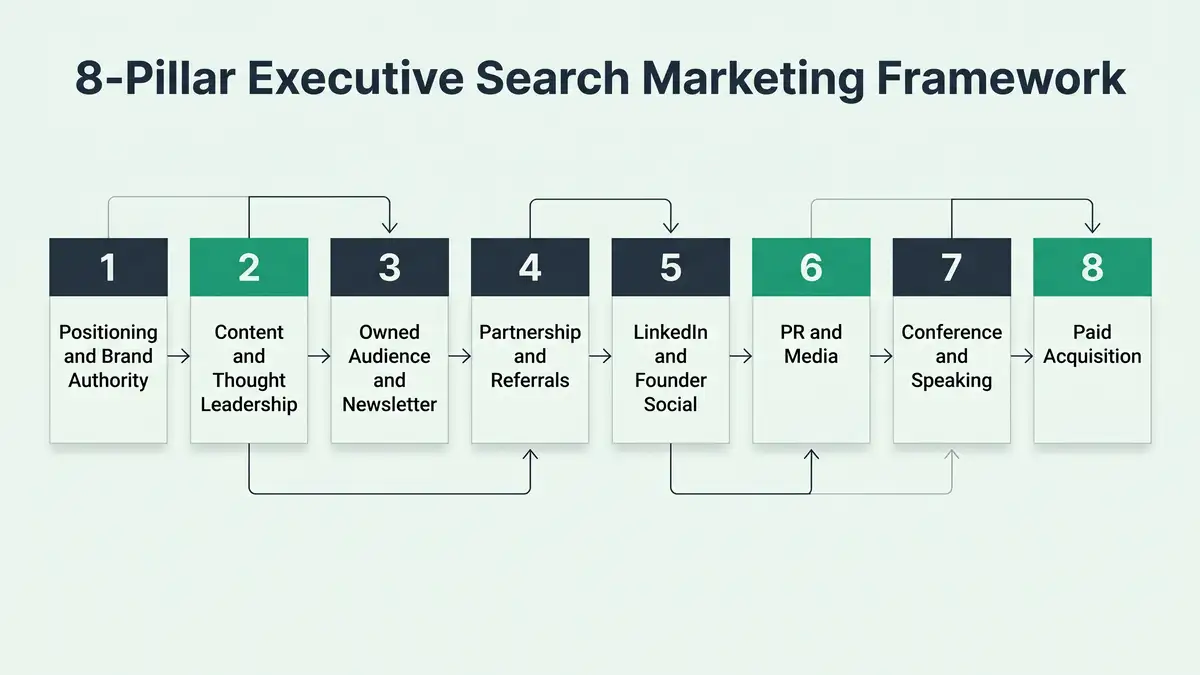
| Pillar | Scope | Primary KPI |
| 1. Positioning and Brand Authority | Sector specialism, function expertise, mandate type focus | Unprompted brand recall in target sectors |
| 2. Content and Thought Leadership | Sector analyses, leadership profiles, salary benchmarks, succession case studies | Engagement, citation, inbound inquiry from content |
| 3. Owned Audience and Newsletter | Weekly or bi-weekly newsletter to mandate buyers and influencers | Subscriber growth, open rate, mandate inquiry from list |
| 4. Partnership and Referrals | PE firms, board advisors, leadership coaches, complementary professional services | Partner-driven mandate flow, referral rate |
| 5. LinkedIn and Founder-Led Social | Founder posts 3-5x weekly, partner profiles active, employee advocacy | Founder profile views, post engagement, profile-driven inquiries |
| 6. PR and Media | Hunt Scanlon, Bloomberg, WSJ, sector press, Hunt Scanlon Top 50 inclusion | Media mentions, share of voice in target sectors |
| 7. Conference and Speaking | AESC Global, Hunt Scanlon, sector and PE conferences, board events | Speaking invitations, on-stage exposure, lead capture |
| 8. Paid Acquisition | Google Ads (branded + unbranded), LinkedIn ABM, content syndication | Cost-per-acquisition, mandate-quality of paid leads |
Sources: Clockwork best practices for executive search marketing, Metaview executive search strategy, N2Growth executive search strategy
Positioning and Brand Authority: The Foundation Pillar
Positioning is the firm's strategic claim to a defined market segment. Per April Dunford's quickstart guide to positioning, weak positioning manifests as undifferentiated firms competing on price for generic mandates. Strong positioning anchors on one of four dimensions: sector specialism (tech, life sciences, financial services), function specialism (CFO search, board search, CHRO search), geographic concentration (US Midwest tech, London FS, Singapore family office), or mandate type (PE portfolio CEO search, succession planning, distressed restructuring).
Per AlphaApex Group's analysis of executive search recruitment firms, the boutiques that punch above their weight in mandate flow are the ones with sharpest positioning. peppereffect's analysis of the executive search industry in 2026 details how positioning sharpness drives the 2-3x revenue-per-consultant differential between sharply-positioned and generically-positioned firms.
Content and Thought Leadership: The 5 Content Types That Generate Mandates
Content marketing for executive search firms is not a publishing schedule. It is the systematic creation of intelligence assets that compound the firm's market authority. Per Edelman's 2024 B2B Thought Leadership Impact Report, 75 percent of B2B decision-makers say thought leadership leads them to research a vendor they had not previously considered, and 60 percent say it makes them willing to pay a premium fee. The data is consistent across multiple research waves.
Per NYT Licensing's guide to thought leadership content marketing, five content types work specifically for executive search firms:
Sector analyses and market intelligence
Annual or quarterly reports on the talent market in the firm's sector specialism. Compensation benchmarks, leadership trends, hiring volume, talent flow patterns. Sector analyses become the firm's authority anchor and the primary asset that buyers cite when commissioning a mandate.
Leadership profiles and executive interviews
Long-form interviews with placed executives, board members, and sector leaders. Profiles humanize the firm's network and signal access. Best distributed via the firm's newsletter, LinkedIn, and selectively to industry press.
Salary and compensation benchmarks
Per Tempting Talent's executive search compensation analysis, salary benchmark content drives substantial organic search traffic and inbound inquiries from compensation committees, boards, and CHROs evaluating offers. The data has built-in search demand.
Succession planning case studies
Anonymized case studies of completed succession engagements showing methodology, outcomes, and lessons learned. Case studies are the highest-leverage business development asset for converting prospect conversations into engagement contracts. peppereffect's analysis of talent mapping strategy details how succession-readiness mapping becomes both a deliverable and a content asset.
Frameworks and methodology articles
Codified frameworks for the firm's approach: assessment methodology, off-limits discipline, succession-readiness scoring. Frameworks position the firm as a thinking partner rather than a transactional vendor and justify premium fees.
Owned Audience and Newsletter: The Mandate-Generation Flywheel
The newsletter is the highest-leverage owned asset for boutique executive search firms. It bypasses platform algorithms, builds direct relationships with mandate buyers, and compounds across time. Per Beehiiv's comparison of newsletter platforms, the creator economy infrastructure for newsletters has matured through 2026 with platforms supporting monetization, segmentation, and advanced analytics that make boutique-scale newsletter operations viable without dedicated marketing operations teams.
The newsletter as a mandate-generation flywheel works through three mechanisms: building mental availability with mandate buyers between hiring events; signaling continuous market authority through cadence; and creating a direct distribution channel for content that bypasses paid amplification. Boutique firms running weekly newsletters with curated sector intelligence typically grow lists from 0 to 3,000 to 10,000 subscribers within 18 to 36 months with consistent content cadence.
Need to architect your firm's executive search marketing operating system?
Book a Growth Mapping CallFounder-Led LinkedIn Strategy: The 3-8x Multiplier
LinkedIn personal profiles consistently outperform brand pages by 3 to 8x on engagement. Per Digital Applied's LinkedIn statistics for 2026 B2B marketing, founder-led content distribution outperforms brand-page content across every metric: reach, engagement, comment volume, profile views, and inbound inquiry. Per MRR Unlocked's founder-led LinkedIn guide, the strategy works because audiences trust individuals over corporate accounts and the LinkedIn algorithm preferentially distributes personal content.
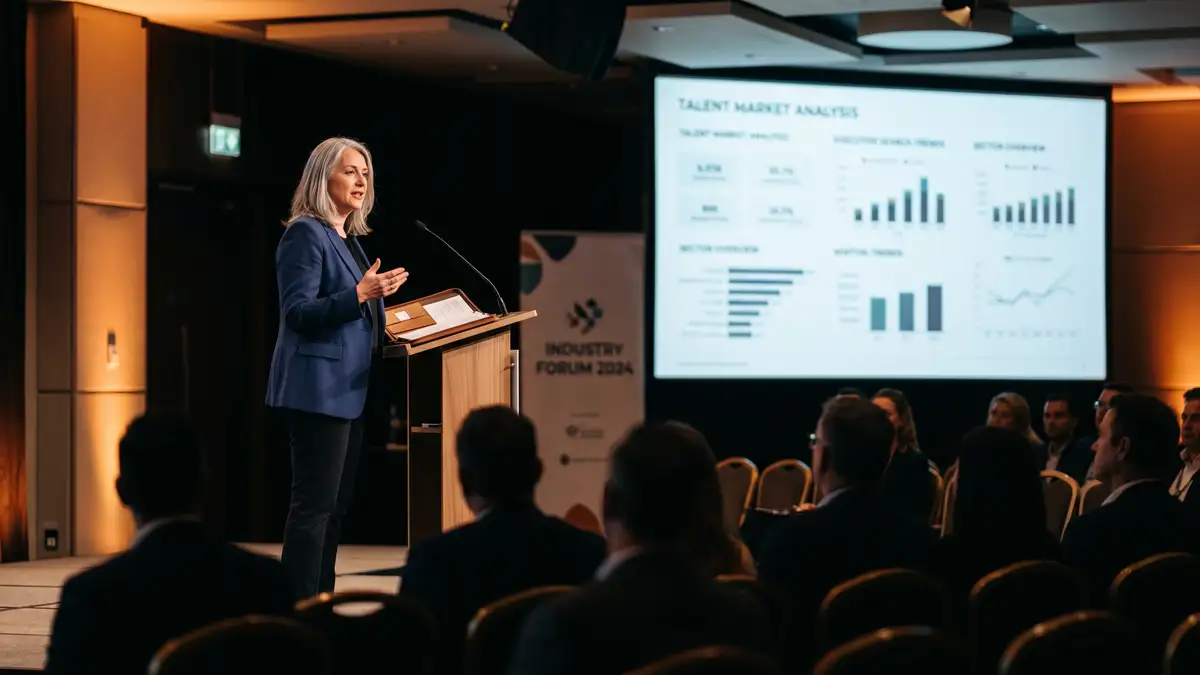
The founder-led LinkedIn strategy for executive search firms in 2026 follows a disciplined cadence: 3 to 5 posts weekly from the founder's profile, mix of original insights and commentary on sector developments, 20 percent personal stories and 80 percent professional substance, active commenting on adjacent founders' content, monthly LinkedIn newsletter publication. The founder is the firm's chief content officer; this is non-negotiable for boutique scale.
Partnership and Referral Network Economics
Partnerships are the highest-margin mandate flow channel for boutique executive search firms. Per Loxo's account-based prospecting playbook for executive search, the elite firms cultivate partnership networks across PE firms, board advisors, leadership coaches, accounting firms, law firms, and complementary professional services. Mandate flow from these networks typically converts 3 to 5x higher than cold outbound and at materially lower cost-per-mandate.
Per Cowen Partners' analysis of private equity executive search, the PE channel specifically generates outsized mandate flow because PE firms commission multiple executive searches across their portfolio with predictable cadence. A single PE relationship can generate 5 to 15 mandates per year across portfolio companies. Per peppereffect's analysis of executive search for private equity, the PE-aligned firm builds its entire BD operating model around the partnership cadence rather than around individual mandate hunts.
Paid Acquisition for Executive Search
Paid acquisition has specific use cases in executive search marketing that fit boutique economics. Per First Ascent Design's analysis of LinkedIn Ads for recruitment, the channels that work for executive search are Google Ads for branded and unbranded search ("executive search firm [sector]"), LinkedIn ABM targeting specific board members and C-suite at named accounts, and content syndication of premium sector reports.
Per Aquent's analysis of marketing automation tools for 2026, the boutique-scale paid acquisition stack includes Google Ads, LinkedIn Campaign Manager, a marketing automation platform (HubSpot, ActiveCampaign), conversion tracking (Google Analytics 4), and attribution modeling. Total budget for boutique firms typically lands in the $20k to $80k annual range with mandate-quality KPIs rather than impression or click volume.

The 8 KPIs That Measure Executive Search Marketing
Per ThriveTRM's analysis of why standard recruiting metrics fail in executive search, the metrics that matter for executive search marketing are different from generic B2B SaaS marketing benchmarks. Mature firms track eight KPIs together: mandate inquiry volume, mandate conversion rate (inquiry-to-engagement), mandate fee scale, repeat client rate, partnership-driven mandate flow, content engagement, brand awareness in target sectors, and founder profile growth on LinkedIn.
The framework that compounds: track quarterly, review monthly, instrument continuously. peppereffect's broader analysis of executive search KPIs details the dashboard architecture that integrates marketing KPIs with operational and financial metrics across the firm.
AI Augmentation in Executive Search Marketing 2026
AI has reshaped the executive search marketing operating model through 2026. Per Bullhorn's GRID 2026 industry trends report, top-performing firms deploying AI report 3.5 to 4.5x revenue growth versus laggards. Per Hunt Scanlon's AI Talent in New York 2025 analysis, the most consistent pattern across high-performing 2026 firms is AI deployment inside disciplined human governance rather than AI as a replacement for human judgment.
What AI augments well in 2026: content generation drafts (sector analyses, leadership profiles, salary benchmark commentary), LinkedIn post drafting and optimization, sentiment analysis of LinkedIn engagement, newsletter personalization at scale, AI-driven content distribution timing, predictive lead scoring for inbound inquiries. What AI does not replace: founder voice and judgment, sensitive client communication, strategic positioning decisions, partnership relationship cultivation. peppereffect's broader guidance on AI for executive search details the human-AI workflow architecture for marketing operations.
8 Executive Search Marketing Execution Pitfalls
1. No clear positioning
"Full-service executive search across all sectors" is not positioning. It is a confession that the firm has no edge. Boutiques that fail to position sharply compete on price for generic mandates and lose to sharply-positioned competitors at every BD inflection point.
2. Content without authority
Generic content about "the future of leadership" attracts generic engagement. Authority content combines proprietary intelligence (compensation data, talent flow patterns from the firm's mandates) with the firm's distinct point of view on sector-specific dynamics.
3. Channel sprawl without focus
Activating on 10 channels at low quality outperforms 0 channels but underperforms activating on 3 channels at high quality. Sequence focused activation: positioning first, founder LinkedIn second, newsletter third, partnerships fourth. Add channels only when the prior layer is operating well.
4. Founder absence from social
Boutique firms without an active founder on LinkedIn are invisible. The brand page cannot compensate for founder absence. Founder LinkedIn presence is the highest-leverage marketing activity for boutique scale and is non-delegable.
5. No measurement framework
Tracking impressions and engagement alone is not measurement. Mature firms track mandate inquiry volume, conversion rate, fee scale, and partnership-driven flow alongside engagement metrics. Without business-tied measurement, marketing investment becomes hard to defend at the budget table.
6. Leadership skepticism without sponsorship
Marketing without founder and senior partner sponsorship dies in the quarterly P&L conversation. Skepticism wins when results are not measured against mandate flow. Tie marketing investment to mandate KPIs and protect the investment through measurement discipline.
7. BD-marketing misalignment
When the BD team and the marketing function operate in silos, marketing produces leads that BD does not convert and BD chases leads marketing did not source. The two functions must operate from shared targeting, shared KPIs, and shared review cadence.
8. No continuous improvement cycle
Marketing strategy set in year 1 and never revisited ossifies. The 2026 channel economics shift quarterly: LinkedIn algorithm changes, conference circuit evolution, paid acquisition cost inflation. Build quarterly review cadence into the strategy itself.

The 7-Step Playbook for Boutique Firms Launching Marketing Operations
Define and codify positioning
Apply April Dunford's positioning framework to the firm. Define the sector, function, geographic, or mandate-type specialism. Pressure-test the positioning by interviewing existing clients and prospects: does the firm's claimed positioning match how the market perceives it. Codify the positioning statement and use it as the editorial anchor for every content asset.
Codify the content strategy
Define the 5 content types the firm will produce, cadence per type, ownership, and distribution channels. Build a 90-day editorial calendar with specific topics, target keywords, and publication dates. Resist over-customization at this stage; the discipline is consistency, not novelty.
Build the founder LinkedIn presence
The founder commits to 3 to 5 posts weekly on LinkedIn. Hire a content collaborator if needed (writing assistant, ghostwriter, video editor) but the founder voice is non-delegable. The founder LinkedIn presence is the highest-leverage marketing activity for boutique scale.
Launch the newsletter
Per Beehiiv's newsletter platform comparison, the boutique-scale newsletter infrastructure is now affordable and operationally lightweight. Launch with a defined cadence (weekly or bi-weekly), seed the list with the firm's existing relationships, and grow systematically through content distribution.
Build the partnership network
Identify 10 to 20 strategic partners across PE firms, board advisors, leadership coaches, complementary professional services. Cultivate the relationships through content sharing, mutual referrals, joint events. peppereffect's analysis of executive search process details how partnership-driven mandate flow compounds over multi-year horizons.
Measure outcomes against mandate flow
Instrument the analytics layer to track mandate inquiry volume, conversion rate, fee scale, repeat client rate, and partnership-driven mandate flow. Marketing without business-tied measurement is theater. Per Brian Heger's analysis of LinkedIn Talent Solutions' Future of Recruiting, the firms succeeding in 2026 are those that instrument the discipline rigorously.
Run quarterly improvement cycles
Quarterly improvement cycles review KPI achievement, identify highest-leverage interventions, reallocate investment across pillars. The 2026 channel economics shift continuously; the firm that runs disciplined quarterly improvement cycles compounds advantage against firms operating with set-and-forget marketing strategy.
Architect Your Executive Search Marketing Operating System With peppereffect
peppereffect installs the AI-augmented executive search marketing operating system that compounds inbound mandate flow over multi-year horizons. We architect positioning, codify content strategy, build founder LinkedIn presence, launch the newsletter, develop partnership networks, and engineer the measurement discipline that converts marketing from cost center into compounding business infrastructure.
Book a Growth Mapping CallFrequently Asked Questions About Executive Search Marketing
What is executive search marketing?
Executive search marketing is the operating system that generates inbound mandates through positioning, content authority, thought leadership, partnership networks, owned audience, founder-led social, PR, conference presence, and paid acquisition. Per Clockwork Recruiting's analysis, the discipline differs structurally from B2B SaaS marketing because the buyer (board, CEO, CHRO, PE operating partner) is in market only when a critical hiring need exists. Mental availability and brand recall are the deciding economic factors.
Why is outbound BD alone failing in 2026?
Outbound BD alone is failing because response rates have compressed across cold email (1 to 5 percent) and LinkedIn InMail (5 to 7 percent and declining) as senior executive inboxes saturate. Per Mailforge's analysis and SalesBread's cold email versus LinkedIn comparison, the marginal cost-per-mandate from outbound has risen materially while inbound mandate flow from brand authority continues to compound. Outbound still works as a tactic but cannot be the only strategy.
What is the 8-pillar executive search marketing framework?
The 8 pillars are: 1) Positioning and brand authority (sector, function, geographic, or mandate-type specialism); 2) Content and thought leadership (sector analyses, leadership profiles, salary benchmarks, succession case studies, framework articles); 3) Owned audience and newsletter (weekly or bi-weekly direct distribution); 4) Partnership and referrals (PE firms, board advisors, complementary professional services); 5) LinkedIn and founder-led social (3 to 5 posts weekly from founder); 6) PR and media (Hunt Scanlon, industry press, sector publications); 7) Conference and speaking (AESC, sector and PE events); 8) Paid acquisition (Google Ads, LinkedIn ABM, content syndication). Each pillar requires defined owner, KPIs, and integration with adjacent pillars.
How much should boutique executive search firms spend on marketing?
Boutique executive search firms typically allocate 5 to 15 percent of mandate revenue to marketing investment. The allocation includes content production (research, writing, design, video), platform subscriptions (LinkedIn Sales Navigator, newsletter platform, analytics tools), paid acquisition spend ($20k-$80k annual for typical boutique), conference and speaking expenses, PR and media relations. Per Aquent's marketing automation tools analysis, the modern boutique-scale marketing stack is operationally lightweight compared to enterprise alternatives.
What is the ROI of founder-led LinkedIn for executive search firms?
Founder-led LinkedIn profiles consistently outperform brand pages by 3 to 8x on engagement. Per Digital Applied's LinkedIn statistics for 2026, the multiplier holds across reach, engagement, comment volume, and inbound inquiry. The strategy works because audiences trust individuals over corporate accounts and the LinkedIn algorithm preferentially distributes personal content. Per MRR Unlocked's founder-led guide, 3 to 5 posts weekly from the founder with disciplined content mix delivers the highest mandate flow ROI of any single marketing investment for boutique firms.
How long does it take to build executive search marketing operations?
Boutique executive search firms typically reach operational marketing maturity in 9 to 18 months from launch. Sequence: positioning codification (weeks 1-4), content strategy and 90-day editorial calendar (weeks 4-8), founder LinkedIn launch (weeks 4-8), newsletter launch (weeks 8-12), partnership network development (months 3-12), measurement framework instrumentation (months 4-6), quarterly improvement cycles (ongoing). Mandate flow attribution to marketing typically emerges within 6 to 12 months of disciplined operation.
What are common executive search marketing execution pitfalls?
The 8 most common pitfalls are: 1) no clear positioning; 2) content without authority; 3) channel sprawl without focus; 4) founder absence from social; 5) no measurement framework; 6) leadership skepticism without sponsorship; 7) BD-marketing misalignment; 8) no continuous improvement cycle. Each pitfall is preventable with disciplined operating cadence and quarterly governance review. executive search business development niche specialisation versus generalist coverage recruitment agency branding architecture
Resources
- Clockwork Recruiting: Best Practices for Marketing Your Executive Search Firm
- Metaview: Executive Search Strategy
- N2Growth: Executive Search Strategy Attracting Top Leaders
- AlphaApex Group: Executive Search Recruitment Firms
- April Dunford: A Quickstart Guide to Positioning
- Edelman: 2024 B2B Thought Leadership Impact Report
- NYT Licensing: Getting Started with Thought Leadership Content Marketing
- Tempting Talent: Executive Search Compensation
- Beehiiv: Newsletter Platform Comparison
- MRR Unlocked: Founder-Led LinkedIn Guide
- Digital Applied: LinkedIn Statistics 2026 B2B Marketing Data
- SalesBread: Cold Email vs LinkedIn
- Mailforge: Average Cold Email Response Rates
- First Ascent Design: LinkedIn Ads for Recruitment
- Aquent: Best Marketing Automation Tools 2026
- Loxo: Account-Based Prospecting Playbook for Executive Search
- Cowen Partners: Private Equity Executive Search
- RecruiterFlow: How to Be Successful in Executive Search Business
- ThriveTRM: Why Standard Recruiting Metrics Fail in Executive Search
- Brian Heger: Future of Recruiting LinkedIn Talent Solutions
- Hunt Scanlon: Top 50 Executive Search Firms
- Hunt Scanlon: AI Talent New York 2025
- Bullhorn: GRID 2026 Industry Trends Report
- AESC: Events Calendar
- Russell Reynolds: Global Leadership Monitor