

Where Does the 3:1 LTV:CAC Rule Actually Come From?
The LTV:CAC ratio compares the gross-margin profit a customer produces over their lifetime against the fully loaded cost of acquiring them. The 3:1 floor everyone quotes is not a benchmark drawn from a dataset. It's one investor's rule of thumb, written by David Skok in SaaS Metrics 2.0 in January 2013 and still maintained on his site, most recently updated on 18 June 2026.
His exact words: "The best SaaS businesses have a LTV to CAC ratio that is higher than 3, sometimes as high as 7 or 8." He calls these guidelines, and says he validated them against many SaaS businesses over two years. That's field experience honestly labelled. It is not a survey, a sample, or a distribution, and Skok never claimed it was.
The queries landing on this page are things like "bessemer saas ltv cac 3x benchmark" and "ltv to cac ratio 3:1 rule of thumb source". People want the provenance, and they are chasing it to the wrong firm. On 23 September 2026 we opened the Bessemer page this article itself used to cite. It carries no LTV:CAC figure, no CAC payback figure and no unit-economics benchmark, and we could not reach any Bessemer page that does.
The 3x rule is Skok's. So is the twelve-month payback ceiling that keeps getting attributed to Bessemer: "the profitability is anemic if the time to recover CAC extends beyond 12 months."
What you'll get from this page:
- The provenance of the 3:1 rule, quoted from the original, and which widely-repeated attributions are wrong
- The only LTV:CAC formula that survives a finance review, and the three inputs founders systematically inflate
- A fourth error nobody models: the acquisition channel that used to be free and isn't producing any more
- What that costs, measured across 3,663 live-confirmed B2B domains, broken out by category and headcount
- The arithmetic that turns a 4.0:1 ratio into 2.8:1 with no change to your product, price, churn or sales team
Key Takeaway
A ratio is a fraction, and both halves drift. Most teams audit the numerator obsessively and treat the denominator as a spend decision. But CAC has a second half you never approved: the demand that used to arrive without an invoice. Across the domains we measure, the median company lost 63% of its organic sessions from peak. Nobody booked that as a CAC increase. The ratio moved anyway.
How Do You Calculate LTV:CAC Without Flattering Yourself?
The formula is LTV = (ARPA x Gross Margin) / Churn Rate, divided by CAC = Fully Loaded Sales and Marketing Spend / New Customers Acquired. Simple enough. Three input errors inflate it anyway, and they compound.
The first is revenue LTV instead of gross-margin LTV. A $100k customer at 70% gross margin is worth $70k of lifetime value, not $100k. The second is a thin CAC: paid media only, with sales development, RevOps tooling and onboarding engineering left out of the numerator. The third is blended CAC across paid, organic and referral, which lets a profitable channel subsidise an unprofitable one inside a single average. Skok's own framework is explicit that CAC has to be segmented by channel and cohort before it means anything.
| Input | Correct source | Common miscalculation |
| ARPA | Annualised, segmented by cohort | Blended across plans, discounts included |
| Gross margin | Actual, after hosting, support and COGS | Revenue only, which inflates LTV by the margin gap |
| Churn rate | Gross revenue churn, monthly cohort | Net churn, which masks real leakage behind expansion |
| CAC | Fully loaded sales, marketing, RevOps and onboarding | Paid ad spend only |
Source: David Skok, SaaS Metrics 2.0, last updated 18 June 2026.

Run your own numbers, including the part your model leaves out.
The LTV:CAC and Organic Erosion Calculator gives you the ratio, the payback period, and then the adjusted ratio once your lost organic demand is priced at your own category's measured value per visit. Nothing you type is transmitted or stored.
The Fourth Miscalculation: The Channel That Stopped Being Free
Every CAC model treats acquisition as a spend decision. You pay, leads arrive, you divide. Organic search never entered the model because it never appeared on an invoice, and a line item with no invoice doesn't get audited.
That worked while organic demand was stable. It stopped working. We run a continuous scan across B2B domains for the Share of Model work, and on 23 September 2026 we aggregated it specifically for this question. The scan covers 4,855 rows and 3,665 live-confirmed unique domains. For 3,663 of them we can compute both a current organic value and a loss against peak.
Here's the method, so you can argue with it. For each domain, we take the live estimated value of its organic keyword footprint per month and divide by its current monthly organic sessions. That gives a value per visit derived from the CPC of the keywords that domain ranks for. Multiply that by the sessions it has lost since its peak month and you get a replacement cost: what the missing demand would cost to buy back at the price of its own keywords. It is not a claim about what anyone spent.
The Headline Number
Median value of one organic visit: $0.46. Median organic sessions now: 11,020 a month, against 35,258 at peak. Median replacement cost of what's missing: $8,924 a month, or $107,088 a year. These are medians of per-domain values, not medians multiplied by each other.
The distribution matters more than the median. Of the 3,663 domains, 473 are below $1,000 a month and would reasonably ignore this. Another 967 sit between $1,000 and $5,000. But 1,055 are between $5,000 and $25,000, 731 are between $25,000 and $100,000, and 437 are above $100,000 a month. That's 1,168 companies, 31.9% of the set, carrying more than $25,000 a month of unpriced acquisition cost.
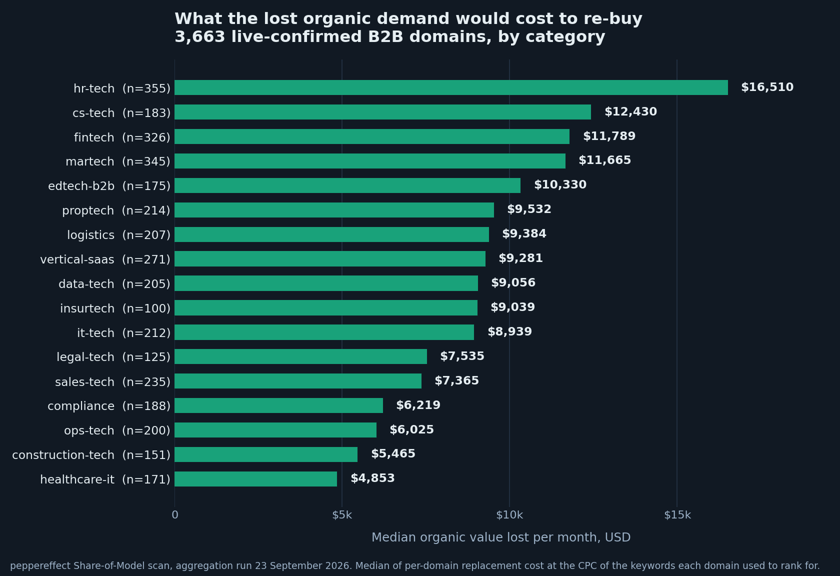
| Category | Domains | Median value per visit | Median lost per month | Median decline |
| hr-tech | 355 | $0.50 | $16,510 | 63% |
| martech | 345 | $0.43 | $11,665 | 67% |
| fintech | 326 | $0.44 | $11,789 | 60% |
| vertical-saas | 271 | $0.58 | $9,281 | 62% |
| sales-tech | 235 | $0.45 | $7,365 | 65% |
| proptech | 214 | $0.64 | $9,532 | 64% |
| it-tech | 212 | $0.40 | $8,939 | 63% |
| logistics | 207 | $0.44 | $9,384 | 62% |
| data-tech | 205 | $0.35 | $9,056 | 62% |
| ops-tech | 200 | $0.39 | $6,025 | 61.5% |
| compliance | 188 | $0.42 | $6,219 | 58.5% |
| cs-tech | 183 | $0.45 | $12,430 | 67% |
| edtech-b2b | 175 | $0.39 | $10,330 | 61% |
| healthcare-it | 171 | $0.55 | $4,853 | 59% |
| construction-tech | 151 | $0.55 | $5,465 | 61% |
| legal-tech | 125 | $0.47 | $7,535 | 60% |
| insurtech | 100 | $0.50 | $9,039 | 65% |
Source: peppereffect Share-of-Model scan, aggregation run 23 September 2026, n=3,663 live-confirmed B2B domains. All seventeen categories shown; the seventeen sum to the full set. Aggregates only, no company names and no domains. The sample is drawn from companies that showed a decline signal, so it overstates decline against the whole B2B market.
Note the spread in value per visit: $0.35 in data-tech against $0.64 in proptech. The same lost session is worth nearly twice as much depending on what you sell, because CPC in your category is what sets the replacement price. Category also separates the decline: martech and cs-tech both sit at 67%, compliance at 58.5%.
What This Data Does Not Say
It does not say why the organic traffic fell. We measure the loss and its replacement price, not the cause. Core updates, competitive displacement, site migrations and AI answers all sit inside this number, and we have not separated them. Anyone who hands you a single-cause explanation for a 63% median decline across seventeen categories is selling you something.
How Much Does the Ratio Actually Move?

Take the median company in the set. It has $107,088 a year of organic demand missing. Suppose it decides to hold pipeline flat and buys that demand back. CAC rises by $107,088 divided by however many customers it closes in a year.
That's the whole mechanism. It's arithmetic, not a forecast, and it's why two companies with identical products can report ratios a full point apart. Start both at a $10,000 CAC and a 4.0:1 ratio, then vary only the number of new customers they close.
| New customers per year | CAC added | New CAC | CAC increase | Ratio after |
| 25 | $4,284 | $14,284 | +43% | 2.8:1 |
| 50 | $2,142 | $12,142 | +21% | 3.3:1 |
| 100 | $1,071 | $11,071 | +11% | 3.6:1 |
| 250 | $428 | $10,428 | +4% | 3.8:1 |
Worked from the peppereffect median replacement cost of $107,088 a year, against a starting CAC of $10,000 and an LTV of $40,000. Replace the median with your own figure in the calculator.
A company closing 25 deals a year drops below Skok's floor on this alone. One closing 250 barely notices. Same collapse, same category, same product. The difference is deal count, which is exactly the variable nobody adjusts for when they compare their ratio to a benchmark.
For context on the spend it sits inside: SaaS Capital's 2026 spending benchmarks, fielded in March 2026 across more than 1,000 private B2B SaaS companies, put median sales spend at 15% of ARR, up from 13% the year before, and marketing flat at 8%. So the median company already spends 23 cents of every ARR dollar on acquisition. The organic line was never in that 23 cents.
Why Does the Same Collapse Cost a Small Company 44 Times More Per Head?
We joined the scan to verified headcounts for 1,514 of the domains. The absolute loss climbs with size, as you'd expect. Per employee, it inverts hard.
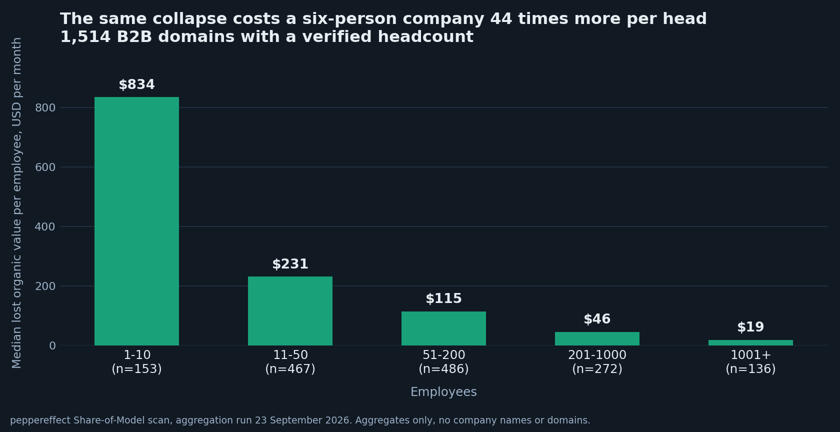
| Employees | Domains | Median lost per month | Per employee | Median decline |
| 1-10 | 153 | $4,752 | $834 | 67% |
| 11-50 | 467 | $5,215 | $231 | 66% |
| 51-200 | 486 | $11,287 | $115 | 64% |
| 201-1000 | 272 | $20,736 | $46 | 59% |
| 1001+ | 136 | $57,161 | $19 | 59% |
Source: peppereffect Share-of-Model scan joined to verified headcount, 23 September 2026, n=1,514.
A six-person company was being handed $834 of organic demand per head per month and now isn't. A 2,400-person company lost $19. That's a 44x spread on the per-head figure, and the percentage decline barely moves across the bands, 67% at the small end and 59% at the large one.
Per head, small companies were receiving far more free demand than large ones, which is why the same collapse lands on them harder. We measured the demand and its price, not their ratios, so read the causal half of that as our inference rather than a finding. It is the same structural point as revenue per employee, seen from the acquisition side.
Does CAC Payback Matter More Than the Ratio?
Often, yes. LTV:CAC tells you whether a customer is eventually profitable. Payback tells you when. For a company financing its own growth, an 8:1 ratio with a 30-month payback is worse than a 4:1 with a nine-month payback, because the second is funding its next cohort while the first is still waiting.
Skok's guideline here is tighter than most people remember: "many of the best SaaS businesses are able to recover their CAC in 5-7 months", with profitability "anemic" past twelve. Five to seven months. Not eighteen.
And payback moves with the same erosion. If replacing lost organic demand pushes CAC up 21%, payback stretches by 21% too, against unchanged gross profit per customer. The ratio and the payback period degrade together, which is why fixing one by spending more rarely fixes the other.
What Does NRR Really Do to the Ratio?

Net revenue retention is the strongest lever in the LTV half, and the easiest place to fool yourself. Churn sits in the denominator. Feed net churn into the formula instead of gross churn and any cohort with expansion produces an LTV that runs away to a number nobody should put in a board deck. That is why the table above says gross revenue churn. NRR belongs in the story you tell about the business. Gross churn belongs in the arithmetic.
The benchmark, though, is lower than the number that circulates. SaaS Capital's retention research, the fourteenth annual run of the survey and fielded across more than 1,000 private B2B SaaS companies, reports a median net retention of 101% and a median gross retention of 91%. Not 110%. If your board deck compares you to 110% as "the median", it's comparing you to a number that isn't in the source.
Avoid This Mistake
Never report NRR without its denominator. "125% NRR" measured on your top twenty accounts is a sampling artifact, not a business health metric. Sophisticated investors now ask for logo-cohort NRR segmented by ACV band. If your expansion is concentrated in three whales, your ratio is fragile rather than strong, and the gross retention number is where that shows.
Where Does the Replacement Demand Come From Now?
Some of the demand has not disappeared, it has changed shape, and the new shape behaves differently. Pew Research Center, tracking 68,879 Google searches from 900 US adults in March 2025, found users clicked a traditional result in 8% of visits where an AI summary appeared, against 15% where none did.
The traffic that does arrive is worth more per head. Orbit Media's study of 97 GA4 accounts and 28.9 million sessions between July 2025 and June 2026 puts AI-referred conversion at 1.91% against 0.5% from Google organic, with ChatGPT at 2.1% and carrying 82.3% of the 141,000 AI-referred B2B visits in the sample.
The AI-referred traffic that does arrive converts several times better than organic and is currently a fraction of the volume. That changes what you are buying. You are no longer buying a ranking on a page a buyer scrolls. You are buying whether your name appears in the answer at all, which is a share, and a share is zero-sum. Our own answer sampling across B2B buying queries finds a median of three vendor names per answer, never more than four. If you are the fifth, click rate is irrelevant, because there is no click. Being named once proves little, because most firms are. Our GEO vs SEO moat analysis shows what keeps a brand named across runs, and which parts of that a competitor can copy in a quarter. We wrote up the diagnostic for that in the AI visibility audit, and the traffic-side symptom in impressions up, clicks down.
What to Change in the Model This Week
Pull your peak organic month, not last year's average
Go back through analytics to the highest organic session month you've ever had. That's the baseline. Everything since is drift you've been absorbing without naming it. Compare it to the current month, not to last quarter.
Price the gap at your own CPC, not ours
Take the lost sessions and multiply by what a click in your category actually costs you in paid search. Our category medians are in the table above if you want a sanity check. Yours will be better.
Put it in CAC as a named line, then recompute
Add it to fully loaded acquisition cost and divide by new customers. The recomputed ratio is the one your economics are actually running at. Report both numbers with the assumption stated, so the board can argue with the assumption instead of the conclusion.
Segment CAC by channel before you cut anything
A blended CAC hides which channel is carrying the others. You cannot tell whether paid is expensive or merely covering for a collapsed organic channel until the two are separated. Do this before any spend decision.
Measure whether you're in the answer
Rankings and citations are separate questions now. Check whether your brand is named in AI answers for your buying queries, and how often, and against whom. That number moves the acquisition line before it shows up in sessions. Here's what generative engine optimization services should deliver if you hire that work out.
Want step five done for you?
We measure whether your brand is named in AI answers for your own buying queries, across engines, and show you who is named instead. No charge, and it isn't a sales call in disguise.

Frequently Asked Questions
Where does the 3:1 LTV:CAC ratio rule actually come from?
From David Skok's SaaS Metrics 2.0, first published on forentrepreneurs.com in January 2013 and still maintained, last updated 18 June 2026. His wording is "The best SaaS businesses have a LTV to CAC ratio that is higher than 3, sometimes as high as 7 or 8", and he presents it as a guideline validated in the field rather than as research. It is not a Bessemer benchmark. The Bessemer page this article previously cited carries no LTV:CAC figure, checked on 23 September 2026. The twelve-month payback ceiling often credited to Bessemer is also Skok's.
What is a good LTV:CAC ratio for B2B SaaS?
Above 3 is the conventional floor and comes from Skok, who also notes the best businesses sometimes reach 7 or 8. Treat it as an orientation rather than a grade. A ratio is only comparable between companies that compute CAC the same way, and most don't: gross-margin versus revenue LTV, gross versus net churn, and blended versus segmented CAC each move it by a wide margin. Before comparing yourself to anything, recompute with fully loaded CAC and gross-margin LTV, then add the replacement cost of any organic demand you've lost.
How do I account for lost organic traffic in CAC?
Take your peak monthly organic sessions, subtract current monthly organic sessions, and multiply the difference by what a click costs you in paid search for the same keywords. That annualised figure divided by new customers per year is what should be added to CAC if you intend to hold pipeline flat. Across 3,663 live-confirmed B2B domains we measured on 23 September 2026, the median replacement cost is $8,924 a month, or $107,088 a year, at a median value per organic visit of $0.46.
Does CAC payback period matter more than the LTV:CAC ratio?
For a company funding growth from its own cash, usually yes. The ratio says a customer is eventually profitable; the payback period says how long the cash is tied up before the next cohort can be funded. Skok's guideline is five to seven months, with profitability "anemic" beyond twelve. Both metrics degrade together when acquisition cost rises, so a payback problem is rarely solved by spending more.
What is a good net revenue retention rate for private B2B SaaS?
SaaS Capital's retention survey, in its fourteenth annual run across more than 1,000 private B2B SaaS companies, reports a median net retention of 101% and a median gross retention of 91%. The widely repeated 110% figure does not appear in that source. Report both numbers, and always disclose the denominator, because NRR measured on your largest accounts describes those accounts rather than your business.
Why would AI search change my unit economics?
Because it changes where demand arrives and how much of it converts. Pew found that Google users click a traditional result in 8% of visits where an AI summary appears against 15% where none does. Orbit Media, across 97 B2B sites and 28.9 million sessions, found AI-referred visitors convert at 1.91% against 0.5% from organic search. Lower volume, higher intent, and a channel where being named in the answer is the whole game. That is a share of a finite list, not a ranking you can climb incrementally.
Corrections Made to This Page on 23 September 2026
Three figures on the previous version were attributed to Bessemer's State of the Cloud report: a twelve-month CAC payback ceiling, a claim that best-in-class operators post 6:1, and a claim that Bessemer flags payback beyond eighteen months as a working-capital risk. We opened the cited page and none of them are on it. The payback line belongs to David Skok. The other two have been removed. A median NRR of 110% attributed to SaaS Capital has been corrected to the 101% their research actually reports. A benchmark of 4.0:1 sourced from an SEO agency's own analysis has been removed, along with a table of ratio-impact estimates that had no measurement behind it and a set of CAC-compression percentages we could not support.
Find Out What Your Acquisition Line Is Really Carrying
peppereffect measures whether your brand is named in AI answers for your own buying queries, across engines, and shows you who gets named instead. It takes one query list from you and nothing else. The measurement is free.
Resources
- David Skok: SaaS Metrics 2.0, the origin of the 3x LTV:CAC guideline
- SaaS Capital: B2B SaaS Retention Benchmarks, median NRR 101% and GRR 91%
- SaaS Capital: 2026 Spending Benchmarks for Private B2B SaaS Companies
- Orbit Media: AI Traffic Conversion Rates, 97 B2B sites and 28.9 million sessions
- Pew Research Center: click behaviour when an AI summary appears
- peppereffect: LTV:CAC and Organic Erosion Calculator
- peppereffect: Decouple Revenue From Headcount
- peppereffect: Why Is My Organic Traffic Dropping
- peppereffect: Traffic Collapse in AI Search
- peppereffect: AI ROI for B2B