

What Is a Franchise Prototype and Why Does It Matter for B2B Founders?
Michael Gerber introduced the franchise prototype concept in The E-Myth Revisited to answer a deceptively simple question: why do 49.4% of businesses fail within five years while McDonald's operates 40,000+ locations with near-perfect consistency? The answer isn't better burgers. It's better business systems.
A franchise prototype is a fully documented, systems-dependent operation designed so that any competent person — not just the founder — can deliver consistent results. Ray Kroc didn't build McDonald's by finding 40,000 brilliant operators. He built a system so complete that the operator's individual talent became almost irrelevant. The system was the product.
For B2B founders — consultants, coaches, and agency owners — this concept represents the single most important strategic shift available. You don't need to franchise your business. You need to build it as if you were going to franchise it. That mental model changes everything: from how you document delivery, to how you onboard clients, to how you eventually exit.
What you'll learn in this article:
- Why Gerber's Fatal Assumption traps most B2B founders in the Technician's role
- How the franchise prototype model applies to consulting, coaching, and agency operations
- The three-tier system architecture that separates scalable businesses from founder-dependent ones
- How agentic AI and workflow automation now enable individual businesses to achieve franchise-level systematisation without franchising
- The valuation multiplier effect: why systems-dependent businesses command 2-3x higher exit prices
Key Takeaway
The franchise prototype isn't about franchising. It's about building your B2B operation so that the system delivers the result, not the founder. Companies that achieve this shift command higher valuations, scale without proportional headcount, and protect their founders from burnout — the three outcomes that define the Freedom Machine.

Why Do Most B2B Founders Get Trapped Working IN Their Business?
Gerber identified the Fatal Assumption that destroys most small businesses: "If I can do the technical work of a business, I understand how to build a business that does that work." This assumption drives consultants to become their own bottleneck, coaches to fill every hour with delivery, and agency owners to review every deliverable personally.
The data confirms the scale of this problem. According to a 2024 Entrepreneur survey, 53% of founders experienced burnout, while 73% of tech founders reported hidden mental health challenges. The root cause isn't work ethic — it's structural. Founders who haven't systematised their operations have no choice but to work in the business rather than on it.

Gerber's framework identifies three personalities competing inside every founder: the Entrepreneur (vision), the Manager (control), and the Technician (execution). In most B2B service businesses, the Technician dominates. The founder is the service. Without documented business systems, the founder's calendar becomes the company's capacity constraint.
Research on solo practitioners confirms the mathematical ceiling. A consultant charging $300/hour with 1,500 billable hours per year (accounting for admin, sales, and recovery time) hits a revenue ceiling of approximately $450,000 before serious burnout. Breaking through requires either hiring (which creates management complexity) or systematising (which creates leverage).
| Founder Type | Delivery Time | Strategy/Growth Time | Revenue Ceiling |
| Solo consultant (no systems) | 70-80% | 10-15% | $100K-$300K |
| Systematised consultant | 40-50% | 30-40% | $500K-$1M+ |
| Agency owner (team + systems) | 20-30% | 40-50% | $3M-$10M+ |
Sources: Founder Reports — Entrepreneur Mental Health Statistics, ZipDo — Entrepreneur Burnout Statistics 2025
What Are the Three Tiers of Business Systems?
Sam Carpenter's Work the System methodology complements Gerber's franchise prototype by providing a practical architecture for building systems-dependent operations. Carpenter identifies three tiers that every business needs:
Strategic Objective
A one-page document defining where the business is going, how it will get there, and what it will not do. This replaces the founder's intuition with documented intent. Every operational decision flows from this single page.
General Operating Principles
A two-to-three page document establishing decision-making rules for the entire organisation. These principles enable team members (or AI agents) to make judgment calls without the founder's direct input — the critical enabler for scaling.
Working Procedures
The specific step-by-step protocols for every repeatable process in the business. Carpenter estimates that 95% of procedures follow a simple 1-2-3 step format. The remaining 5% use a narrative format for complex decisions. This documentation is where the franchise prototype lives.
W. Edwards Deming's quality management principles reinforce this architecture. Deming demonstrated that variation is the enemy of quality — and in service businesses, undocumented processes create enormous variation in delivery. Every client gets a slightly different experience because the founder improvises each engagement. The franchise prototype eliminates this improvisation by encoding best practices into repeatable workflows.
Key Takeaway
The franchise prototype doesn't require perfection. It requires documentation. A 20-page process manual that captures 80% of your delivery methodology creates more leverage than years of undocumented expertise locked inside the founder's head. Start with the strategic objective, define operating principles, then document your highest-frequency working procedures.

How Does the Franchise Prototype Apply to Modern B2B Services?
The traditional franchise model — document processes, recruit franchisees, ensure compliance — doesn't directly apply to most B2B service businesses. But the principle applies perfectly. The question isn't "How do I franchise my consulting practice?" It's "How do I build my consulting practice so that any qualified person — or system — could deliver 90% of the value I currently deliver personally?"
This reframe produces immediate clarity about what needs to change:
| Business Area | Founder-Dependent Approach | Systems-Dependent Approach |
| Client onboarding | Founder conducts intake call, manually gathers requirements | Documented intake sequence with diagnostic questionnaire and automated data collection |
| Proposal generation | Founder writes custom proposals from scratch | Templated proposal system with modular sections selected by client profile |
| Service delivery | Founder delivers everything personally | Playbook-driven delivery with quality checklists at each milestone |
| Business development | Founder relies on referrals and personal network | Systematised lead generation with documented outreach sequences |
| Quality control | Founder reviews all output personally | Quality criteria checklist applied by team or automated review |
Sources: SystemHUB — Build Your Own E-Myth, Waybook — Implementing the E-Myth Methodology

For the high-ticket consultant or coach, the franchise prototype means separating the intellectual capital (your unique methodology and insights) from the delivery infrastructure (how that methodology gets applied to each client). The intellectual capital stays with the founder. The delivery infrastructure becomes the system.
Consider a coaching business generating $500K annually with 15 active clients. Without systems, the founder spends 70-80% of time on delivery, leaving minimal capacity for growth. With a documented franchise prototype — including intake templates, session frameworks, progress tracking systems, and automated nurture sequences — the founder can handle 40-60 clients with the same time investment, potentially tripling revenue without proportional effort.
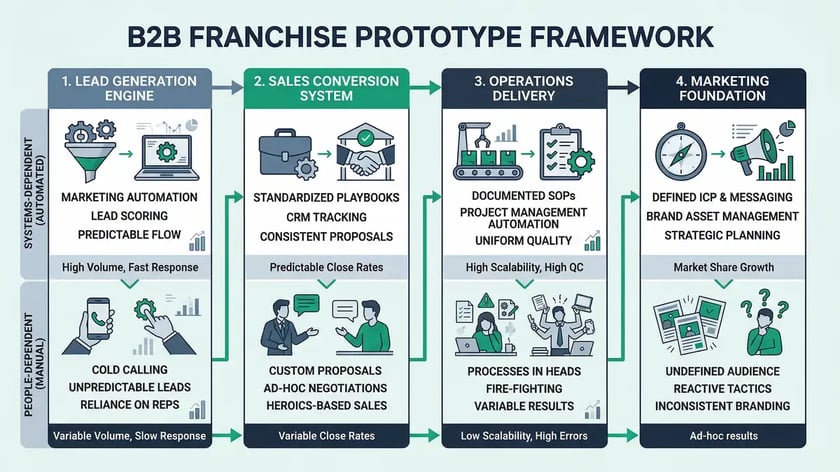
Ready to build your franchise prototype? peppereffect installs systems-dependent operations across the 4 Pillars — Lead Generation, Sales, Operations, and Marketing — so your business runs on logic, not luck.
Book a Growth Architecture CallHow Does AI Transform the Franchise Prototype for 2026?
Here's where the franchise prototype concept becomes revolutionary for individual B2B businesses. Traditional franchise prototyping required people to execute documented procedures. In 2026, agentic AI executes those procedures autonomously — without fatigue, without shortcuts, without the founder's involvement.
Gartner predicts that 40% of enterprise applications will feature task-specific AI agents by 2026, up from less than 5% in 2025 — the fastest adoption curve the firm has documented for any enterprise technology in the past decade. For B2B founders, this means the cost and complexity of building a franchise prototype has dropped by an order of magnitude.
McKinsey's 2025 Superagency report estimates that generative AI could enable automation of up to 70% of business activities across almost all occupations. For service businesses — where much of the "work" is information processing, communication, and decision-making — the automation potential is even higher.
| Process | Traditional Franchise Approach | AI-Powered Franchise Prototype |
| Client intake | Trained franchisee follows 20-step script | AI agent gathers requirements, runs diagnostics, populates CRM |
| Proposal creation | Template + manual customisation | AI agent ingests client data, generates personalised proposal |
| Quality control | Manager reviews against checklist | AI agent reviews deliverables against quality criteria before delivery |
| Lead nurturing | Sales rep follows call schedule | AI agent runs personalised outreach sequences at scale |
| Reporting | Analyst compiles weekly report | AI agent generates real-time dashboards and exception alerts |
Sources: Gartner — AI Agents in Enterprise Apps 2026, McKinsey — Superagency in the Workplace 2025
Common Mistake: Automating Before Documenting
Many founders jump directly to AI automation tools without first documenting their current processes. This creates automated chaos — fast execution of poorly defined workflows. The franchise prototype sequence is: document first, optimise second, automate third. AI amplifies whatever process you feed it. If the process is broken, the AI will execute the broken process faster.
What Is the Valuation Impact of a Systems-Dependent Business?
Beyond operational freedom, the franchise prototype has a direct impact on what your business is worth. In M&A transactions, buyers and investors apply a key-person discount of 15-25% to businesses where revenue depends heavily on the founder. In severe cases — where the founder is the service — discounts can reach 20-50%.
The inverse is equally powerful. Businesses with documented systems, trained teams, and repeatable processes command significantly higher multiples:
| Business Type | Typical Multiple (SDE/EBITDA) | Key-Person Discount | Exit Value on $500K Revenue |
| Owner-dependent service firm | 1.5-3.0x | 15-25% | $563K-$1.3M |
| Systematised service firm | 3.0-5.0x | 5-10% | $1.4M-$2.4M |
| Agency with team + systems | 4.0-6.0x | ~5% | $1.9M-$2.9M |
| SaaS / product business | 8.0-15.0x | Minimal | $4.0M-$7.5M |
Sources: Mark S. Gottlieb CPA — Key Person Risk in Business Valuation, Eqvista — Revenue Multiples by Industry 2026
The franchise prototype effect on valuation is straightforward: a buyer evaluating your business asks three questions. Can revenue survive the founder's exit? Can delivery scale without proportional cost? Is the risk profile acceptable? Systems-dependent businesses answer "yes" to all three. Owner-dependent businesses cannot.
How Do You Build a Franchise Prototype for Your B2B Business?
Building a franchise prototype doesn't require a year-long transformation programme. It requires a structured four-phase approach that moves from documentation through to autonomous execution. Here's the architecture:
Document the Current System (Weeks 1-4)
Map your complete client journey from prospect to referral. Identify every step, decision point, and handoff. Create your strategic objective (one page), operating principles (two pages), and initial working procedures for your highest-frequency processes. The goal is a 20-40 page process manual — not perfect, just documented.
Identify Automation Opportunities (Weeks 5-8)
Score each documented process on two dimensions: frequency (how often it runs) and founder dependency (does the founder's unique judgment matter, or could a defined process handle it?). High-frequency, low-dependency processes are your first automation targets — typically CRM updates, scheduling, follow-ups, and reporting.
Deploy AI Agents Across the 4 Pillars (Weeks 9-16)
Install agentic workflows for each pillar of your operation: lead generation engines, sales conversion sequences, operations delivery systems, and marketing infrastructure. Each agent follows the documented procedures from Phase 1 — the franchise prototype becomes the AI's operating manual.
Measure and Optimise (Ongoing)
Track three metrics that define franchise prototype maturity: Hours Reclaimed (founder time freed from delivery), Delivery Consistency Score (client satisfaction variance), and Revenue per Employee (operational leverage). The 2025 SaaS Capital benchmark of $129K median RPE provides a useful North Star, though systematised service firms should target $200K-$400K.
Key Takeaway
The franchise prototype isn't a theoretical exercise — it's a 16-week implementation that transforms founder-dependent operations into systems-dependent ones. The companies that will dominate B2B services in the agentic era are those building their operations as franchise prototypes today, deploying AI agents to execute documented processes, and measuring success through revenue decoupled from headcount.
What Does Revenue Per Employee Reveal About Systems Maturity?
Revenue per employee (RPE) is the clearest single metric for measuring how effectively a business has implemented the franchise prototype. It reveals whether revenue scales with headcount (people-dependent) or with systems (systems-dependent).
The 2025 SaaS Capital benchmark report shows the median private SaaS company achieves $129,724 per employee, up from $125,000 the previous year. But the variance is enormous: bootstrapped companies at $1M-$3M ARR average $110,000, while high-performing SaaS businesses target $300K-$500K. Public SaaS companies achieve a $283K median with a $369K top quartile.
For B2B service businesses, RPE benchmarks differ by model:
| Business Model | Revenue per Employee | Systems Maturity |
| Traditional consulting firm | $100K-$180K | Low — founder/senior staff deliver most value |
| Systematised consulting firm | $200K-$350K | Medium — playbooks enable junior delivery |
| AI-augmented consulting firm | $350K-$600K+ | High — agents handle 60-70% of delivery tasks |
| High-leverage SaaS | $300K-$800K+ | Very high — software delivers value at scale |
Sources: SaaS Capital — 2025 Revenue Per Employee Benchmarks, Great Place to Work — Revenue Per Employee Ratio
The franchise prototype's power is visible in that jump from $100K-$180K to $350K-$600K+. That's not a marginal improvement — it's a 3-4x increase in operational leverage achieved by replacing founder dependency with documented systems executed by AI agents. The founder's expertise gets encoded once, then deployed infinitely.
Frequently Asked Questions
What is the franchise prototype concept from The E-Myth Revisited?
The franchise prototype is Michael Gerber's concept of building your business as if you were going to franchise it — even if you never intend to. It means documenting every process so the business runs on systems rather than the founder's personal effort. The prototype separates the founder's intellectual capital (unique methodology) from the delivery infrastructure (how that methodology gets applied). This creates a business that can scale, be sold, or run without the founder's daily involvement. The concept draws from McDonald's model where Ray Kroc built operational systems so complete that individual operator talent became secondary to process consistency.
How does the franchise prototype apply to consulting and coaching businesses?
For consultants and coaches, the franchise prototype means documenting your client delivery methodology into repeatable playbooks, templates, and decision trees. Instead of personally conducting every intake call, writing every proposal, and delivering every session, you create systems that capture 80-90% of your process. This allows you to delegate delegate work through documented systems to team members or AI agents while reserving your personal involvement for the highest-value strategic interactions. The result is a business that can handle 3-5x more clients without proportional time investment from the founder.
What is the Fatal Assumption in the E-Myth framework?
Gerber's Fatal Assumption is the belief that "if I can do the technical work of a business, I understand how to build a business that does that work." This assumption traps skilled practitioners — consultants, developers, designers, coaches — in what Gerber calls the Technician's role. They become the best employee of their own company rather than its architect. Breaking free requires adopting the franchise prototype mindset: designing business systems that deliver results independent of any single person, including the founder.
How does a systems-dependent business affect company valuation?
Systems-dependent businesses typically command 2-3x higher valuation multiples than owner-dependent ones. Buyers apply a key-person discount of 15-25% (sometimes up to 50%) when revenue depends heavily on the founder. A systematised service firm generating $500K annually might achieve a 4.0-5.0x multiple ($2M-$2.5M valuation), while an identical owner-dependent firm might only achieve 1.5-2.5x ($750K-$1.25M). The difference is entirely attributable to whether the business has a documented franchise prototype that de-risks the buyer's investment.
What role does AI play in building a modern franchise prototype?
AI transforms the franchise prototype by replacing human franchisees with autonomous agents. Traditional franchise prototyping required recruiting and training people to follow documented procedures. In 2026, agentic AI executes those same procedures — without fatigue, inconsistency, or the need for ongoing management. Gartner predicts 40% of enterprise applications will feature task-specific AI agents by 2026. For B2B founders, this means a single person can now operate a business with franchise-level consistency and scale.
What are the three system tiers in Sam Carpenter's Work the System?
Carpenter's framework identifies three documentation tiers: the Strategic Objective (a one-page vision document defining direction and boundaries), General Operating Principles (a two-to-three page set of decision-making rules), and Working Procedures (step-by-step protocols for every repeatable process). Together, these three tiers create the complete operating system for a business. Carpenter estimates 95% of working procedures follow a simple 1-2-3 step format, making documentation far less daunting than most founders assume.
How long does it take to build a franchise prototype for a B2B business?
A functional franchise prototype can be built in 16 weeks using a four-phase approach: documentation (weeks 1-4), automation opportunity assessment (weeks 5-8), AI agent deployment across the 4 Pillars (weeks 9-16), and ongoing measurement. The initial documentation phase produces the highest immediate leverage — even before any automation is deployed, having documented processes enables delegation, reduces key-person risk, and increases business valuation. Perfection is not the goal; documentation is.
Build Your Franchise Prototype With peppereffect
peppereffect installs the AI operating system your B2B business needs to scale without headcount. We architect systems-dependent operations across all 4 Pillars — Lead Generation, Sales Administration, Operations, and Marketing — so your business runs on documented logic, not founder heroism.
Architect Your Freedom MachineExplore the Freedom Machine Framework →
Resources
- SCORE — Small Business Failure Rates in 2024: Summary (BLS Data)
- SaaS Capital — 2025 Revenue Per Employee Benchmarks for Private SaaS Companies
- Gartner — 40% of Enterprise Apps Will Feature AI Agents by 2026
- McKinsey — Superagency in the Workplace: AI's Full Potential at Work
- Mark S. Gottlieb CPA — Unlocking Key Person Risk in Business Valuation
- Entrepreneur — 1 in 2 Founders Reported Burnout in 2024
- Work the System — Sam Carpenter's Business Methodology
- SystemHUB — Build Your Own E-Myth: Applying Gerber's Principles