

What Is LinkedIn Profile Optimization and Why Does It Matter for B2B?
LinkedIn profile optimization is the systematic process of engineering every element of your LinkedIn presence — headline, About section, Featured content, Skills, and engagement signals — to maximize search visibility, build authority, and convert profile visitors into qualified leads. For B2B founders, consultants, and executives, your LinkedIn profile is not a digital resume. It is a landing page that operates 24/7, pre-qualifying prospects before they ever book a call.
The data is unambiguous. LinkedIn generates 80% of all B2B social media leads and delivers 277% more leads than Facebook and Twitter combined, with 89% of B2B marketers actively using the platform for lead generation. The platform now exceeds 1.2 billion users globally with 1.4 billion monthly website visits — and four out of five members drive business decisions. That means your profile sits in front of the most concentrated B2B buying audience on the internet.
Yet most profiles fail the basic conversion test. They list job titles instead of transformation promises. They describe responsibilities instead of outcomes. They ignore keyword architecture entirely, rendering themselves invisible to the exact prospects searching for solutions they provide. Optimized profiles rank 95% higher in search results and generate 71% higher callback rates compared to incomplete profiles — a visibility gap that translates directly into pipeline.
What you'll learn in this guide:
- How LinkedIn's algorithm ranks profiles — and the 5 signals that determine whether prospects find you
- The headline formula that front-loads keywords within the critical 60-character search window
- How to architect your About section as a conversion narrative, not a biography
- Why the Featured section is your highest-leverage lead capture asset
- The content posting cadence that compounds visibility without burning quality
- How to measure LinkedIn profile optimization ROI through your Social Selling Index
Key Takeaway
Your LinkedIn profile is a B2B landing page that either converts visitors into pipeline or leaks them to competitors. Optimized profiles generate 21× more views, 71% higher callback rates, and directly correlate with 51% higher quota achievement among social sellers. This is not vanity — it is revenue infrastructure.
How Does LinkedIn's Algorithm Rank Profiles in Search Results?
LinkedIn's search algorithm operates as a sequential filtering system that progressively narrows visibility from broad candidate pools to the 3-5 profiles that receive proactive outreach. Understanding this filtering architecture is the foundation of effective LinkedIn lead generation — because if the algorithm cannot find you, prospects never will.
Research modeling recruiter and prospect search behavior reveals a four-stage visibility funnel: from an initial 100 profiles matching basic search criteria, approximately 40 survive the keyword scan, 20 demonstrate sufficient section completeness, 8 show recent activity signals, and only 3 possess robust social proof through recommendations and endorsements. Those final 3 profiles capture the outreach.
The algorithm maps 39,000 distinct skills across 875 million professionals, clustering individuals by expertise and matching them against search parameters. When you optimize your profile with strategically positioned keywords across the headline, About section, experience descriptions, and Skills section, you feed this matching system the precise data required for higher-ranking placement. Profiles showing weekly engagement activity rank 3-5× higher in search results than static profiles — engagement compounds visibility advantages over time.
| Algorithm Signal | Weight | What It Means |
| Keyword Match (Headline + About) | Very High | Primary keywords in first 60 characters of headline determine search placement |
| Profile Completeness ("All-Star") | High | Complete sections signal authenticity; 18%+ callback rate vs. 7.2% for bare-bones |
| Engagement Recency | High | Weekly activity generates 3-5× more search visibility than static profiles |
| Skills + Endorsements | Medium-High | 5+ skills = 17× more profile views; endorsements add social proof layer |
| Network Proximity | Medium | 1st and 2nd degree connections surface more frequently in search results |
Sources: Growleads, LiSeller, Neal Schaffer
Key Takeaway
LinkedIn's algorithm is a sequential filter, not a popularity contest. Only 3 out of 100 matching profiles receive proactive outreach. The profiles that survive every filtering stage share three characteristics: keyword-optimized headlines, complete sections with engagement signals, and social proof through endorsements. Engineer all three — or remain invisible.
How Do You Write a LinkedIn Headline That Ranks and Converts?

Your LinkedIn headline is 220 characters of the most valuable real estate in B2B. The first 60 characters determine search ranking prominence and mobile visibility. On mobile — where the majority of LinkedIn engagement now happens — only 40-60 characters render before truncation. This structural reality demands ruthless front-loading of primary keywords and your value proposition.
Most professionals waste this space with a generic job title: "CEO at Company X." That tells the algorithm nothing about what problems you solve, who you serve, or why a prospect should click. The headline optimization formula that outperforms generic titles across every metric follows this architecture:
[Primary Keyword/Title] | [Value Proposition] for [Target Audience] | [Credential/Proof]
Example: "Growth Architect | AI Operating Systems for B2B Founders Scaling Past $10M | 200+ Systems Deployed" — this uses 95 of 220 characters, positions the primary keyword within the critical 60-character window, articulates a specific transformation promise, and closes with a credibility signal. Compare that to "CEO at peppereffect" — which communicates nothing to either the algorithm or a prospect scanning search results.
Testing headline variations systematically reveals measurable performance differentials. Create 3-5 variations with different keyword placements, run each for 2-3 weeks, and measure profile view changes. One senior executive who revised their headline from a generic title to a keyword-optimized version saw noticeable improvement in search prominence within the first week of implementation.
How Do You Architect Your About Section for Maximum Conversion?
The LinkedIn About section is 2,600 characters of conversion copy — not a biography. Recruiter and prospect scanning patterns concentrate heavily on the initial 200-300 characters visible before the "see more" truncation point. If your opening sentences fail to articulate your primary value proposition and hook attention, the remaining 2,300 characters never get read.
The data supports an aggressive keyword integration approach. Profiles containing 3+ exact keyword matches in headline and summary demonstrate 2× greater message volume from recruiters and prospects compared to profiles with lower keyword density. For B2B consultants and coaches targeting the Freedom Machine outcome — 7-figure revenue with fewer than 5 hours per week of founder input — the About section must directly address the transformation you deliver, not the process you follow.
Hook (First 200 Characters)
Open with a compelling question or bold statement containing your primary keyword. Address the prospect's pain directly: "B2B founders trapped in 60-hour weeks don't have a work ethic problem — they have a systems architecture problem." This must capture attention before "see more" truncation.
Transformation Promise (300-500 Characters)
Articulate the specific outcome you deliver for your target audience. Quantify results: "I install AI operating systems that decouple revenue from headcount — clients typically see 3-5× capacity expansion within 90 days without adding a single hire." Embed 2-3 secondary keywords naturally.
Proof Points (500-800 Characters)
List 4-5 bullet-point achievements using secondary keywords and quantified results. "Deployed 200+ autonomous workflow systems," "Reduced client CAC by 40-60% through lead generation automation," "Built Freedom Machines generating $2M+ with <10 hours/week founder input."
Call-to-Action (100-200 Characters)
Close with a clear, executive-appropriate CTA: "Book a Growth Mapping Call to diagnose your biggest operational bottleneck → [link]." Never end with a passive statement — direct visitors to the next conversion step.
Fully completed About sections containing 1,500+ characters with strategic keyword integration generate substantially higher outreach than minimal summaries under 500 characters. The investment compounds — keyword-rich headlines plus comprehensive About sections plus active engagement produce multiplicative visibility improvements, not additive ones.

Why Is the Featured Section Your Highest-Leverage Lead Capture Asset?
The LinkedIn Featured section functions as a mini landing page embedded directly into your profile — yet most professionals either leave it empty or fill it with outdated content that fails to convert. Strategic Featured section architecture transforms passive profile visitors into qualified leads by showcasing proof of capability, lead magnets, and clear conversion pathways.
For high-ticket consultants and coaching business founders targeting the David Vance archetype, the Featured section should follow a deliberate sequencing strategy optimized for the prospect's decision journey:
| Featured Position | Content Type | Purpose |
| Position 1 (Most Visible) | Lead Magnet (Guide, Checklist, Template) | Low-commitment conversion — captures email, initiates relationship |
| Position 2 | Case Study / Client Results | Social proof — demonstrates transformation with quantified outcomes |
| Position 3 | Best-Performing LinkedIn Post | Thought leadership signal — shows expertise depth and engagement |
| Position 4 | Booking Link / Calendar | High-intent conversion — direct path for ready-to-buy prospects |
Sources: Pierre Herubel, Copyblogger
The visual presentation matters as much as the content selection. Featured items with professionally designed thumbnails — branded graphics using tools like Canva with consistent color schemes and clear value propositions — outperform text-only entries that blend into the profile background. One practitioner who systematically redesigned their Featured section thumbnails to incorporate branding elements reported measurable increases in featured content clicks and downstream lead generation within weeks of implementation.
Measurement is straightforward: monitor which Featured items generate clicks, which drive qualified conversations, and which get ignored. Rotate underperforming content with alternative resources every 30-60 days. Your Featured section is not a museum — it is a live testing environment for conversion optimization.
Ready to architect a LinkedIn profile that generates leads autonomously? Explore peppereffect's Lead Generation systems — built for B2B founders escaping the Technician's Trap.
See Lead Generation SystemsWhat Content Strategy Compounds LinkedIn Profile Visibility?
Posting content on LinkedIn is not optional for profile optimization — it is a ranking signal. LinkedIn's 2025-2026 algorithm ("Nexus") explicitly rewards consistent publishing with preferential search placement and expanded distribution. Profiles showing weekly engagement activity rank 3-5× higher than static profiles. For B2B founders, this means your content strategy is not separate from your profile optimization strategy — they are the same system.
The empirical data on posting frequency is clear. Research from Buffer analyzing 2025-2026 data demonstrates that posting 2-5 times weekly represents the optimal balance — delivering approximately 1,182 additional impressions per post and 0.23 percentage point engagement rate improvement compared to posting once weekly. This functions as a threshold switch: LinkedIn's algorithm recognizes sustained activity patterns and rewards them with preferential feed placement.
The content format hierarchy has shifted dramatically. Document posts (PDF carousels) now achieve 6.60% engagement rates — 278% higher than video and 596% higher than text-only posts. The mechanical advantage is threefold: carousels create higher dwell time as users swipe through slides (the primary algorithmic ranking signal), they function as save-worthy reference materials, and they maximize mobile screen real estate. Native video follows at 5.60% engagement, growing 2× faster than other categories.
| Content Format | Avg. Engagement Rate | vs. Text-Only | Best For |
| Document Posts (PDF Carousels) | 6.60% | +596% | Frameworks, processes, step-by-step guides |
| Multi-Image Posts | 6.60% | +596% | Before/after, data visualizations, comparisons |
| Native Video (30-90 sec) | 5.60% | +487% | Expert insights, behind-the-scenes, reactions |
| Text + Single Image | 2-4% | Baseline | Quick insights, opinions, engagement prompts |
| External Link Posts | ~1.5% | -60% reach penalty | Avoid — algorithm suppresses outbound links |
Sources: Sprout Social, Dataslayer, Buffer
Avoid This Mistake
Do not chase posting frequency at the expense of quality. LinkedIn's Nexus algorithm now prioritizes dwell time over reaction counts — a post receiving 30 seconds of sustained reader attention outperforms content receiving 50 rapid likes. Engagement bait tactics (polls asking "agree or disagree?", empty controversy posts) are explicitly detected and suppressed. Publish substantive content that rewards extended consideration, or the algorithm will bury you.
How Do You Measure LinkedIn Profile Optimization ROI?
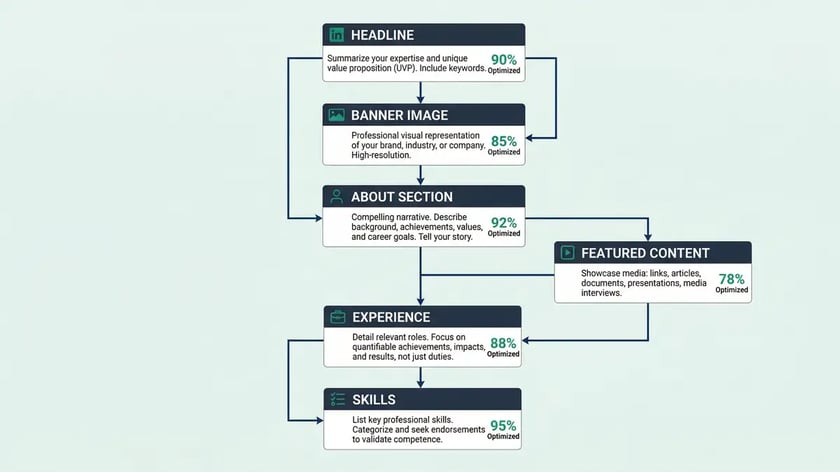
The Social Selling Index (SSI) is LinkedIn's proprietary scorecard for profile optimization effectiveness — and it correlates directly with revenue outcomes. SSI leaders create 45% more opportunities than peers, reach sales quotas 51% more frequently, and outsell non-social media users by 78%. Your SSI score is not a vanity metric — it is a leading indicator of whether your profile is converting or leaking.
The SSI assesses four dimensions on a 0-100 scale:
| SSI Dimension | What It Measures | How to Improve |
| Establish Professional Brand | Profile completeness, thought leadership publishing | Complete all sections, publish 2-5 posts/week with expertise content |
| Find the Right People | Search and research functionality usage | Use Sales Intelligence tools, search for prospects weekly |
| Engage with Insights | Content sharing, commenting, and conversation initiation | Comment meaningfully on 5-10 posts/day from target prospects |
| Build Relationships | Connection with decision-makers, trust building | Send personalized connection requests to ICP matches; nurture with value |
Sources: Kondo, inBeat Agency
Beyond SSI, track these operational metrics to quantify LinkedIn outreach performance: profile views per week (baseline: 40 average; post-optimization target: 100-200+), search appearances (available in LinkedIn analytics), connection request acceptance rate (benchmark: 26% with personalized message), and inbound message volume from qualified prospects. For B2B service providers, the ultimate conversion metric is booked calls sourced from LinkedIn — track this in your CRM with UTM parameters or manual source attribution.
Key Takeaway
LinkedIn's Social Selling Index directly predicts quota achievement and opportunity creation. Sales professionals with high SSI scores achieve quota 51% more frequently and create 45% more opportunities. Check your score at linkedin.com/sales/ssi — then systematically improve the lowest-scoring dimension first for maximum uplift.
What Professional Photo and Visual Standards Maximize Engagement?
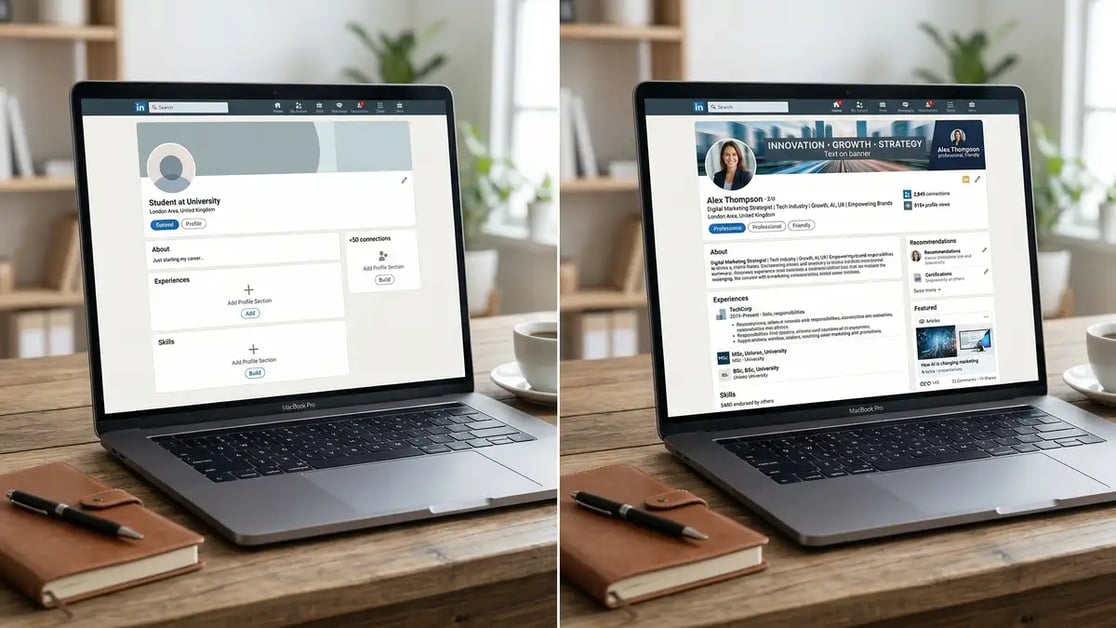
Profiles with professional photographs receive 21× more views and 9× more connection requests — making your profile photo the single highest-return optimization investment available. The research from Pursue Networking is clear: you do not need a professional photographer. You need systematic execution of lighting, composition, and expression.
The reproducible framework: position yourself 2-4 feet from a north-facing window or cloudy-day light source. Set the camera at eye level, 4-6 feet distant. Frame your face at 60-75% of the image with eyes on the upper third line. Genuine smiles with visible teeth generate 30-40% more engagement than forced expressions — but eye engagement matters more than smile presentation. A professional who implemented this framework saw profile views increase by 340% within two weeks and received three inbound client inquiries directly attributable to the updated photo.
Your banner image is equally important yet almost universally neglected. Use it as a billboard for your value proposition — include your headline, a clear CTA, and your brand colors. This is prime visual real estate that most professionals fill with a generic stock photo of a skyline. For coaching and consulting professionals, a banner showing your framework name, client results, or upcoming lead magnet converts significantly better than decorative imagery.
Frequently Asked Questions
How do I create a professional LinkedIn profile for B2B lead generation?
Start with a keyword-optimized headline using the formula: [Primary Keyword/Title] | [Value Proposition] for [Target Audience] | [Credential]. Complete every profile section to reach "All-Star" status — profiles at this level achieve 18%+ callback rates versus 7.2% for bare-bones profiles. Add a professional photo (21× more views), write a 1,500+ character About section with 3+ keyword matches, and populate your Featured section with a lead magnet, case study, and booking link. This systematic approach to B2B lead generation transforms your profile from a passive resume into an active conversion engine.
How do I optimize my LinkedIn profile with AI tools?
AI tools like Claude and ChatGPT can help generate headline variations, rewrite About sections for keyword density, and draft experience descriptions that emphasize outcomes over responsibilities. The most effective approach: feed the AI your target keywords, ICP description, and 3-5 client outcomes, then ask it to generate 5 headline variants and an About section following the Hook → Transformation → Proof → CTA structure. However, AI-generated content still requires human review to ensure authenticity and brand voice consistency. The real leverage comes from using AI to systematize your content repurposing workflow — turning one expert insight into multiple LinkedIn posts.
What is a good LinkedIn SSI score for B2B professionals?
The average LinkedIn SSI score is approximately 40-50 out of 100. B2B professionals actively generating leads should target 70+ SSI, which places them in the top 20% of their industry and network. SSI leaders (scores above 75) create 45% more opportunities and achieve sales quotas 51% more frequently than peers with lower scores. Check your score at linkedin.com/sales/ssi — it updates daily. Focus improvement efforts on your lowest-scoring dimension first, as marginal gains there produce the largest overall SSI increase.
How often should I post on LinkedIn for maximum visibility?
Research shows 2-5 posts per week is the optimal frequency for B2B professionals — delivering approximately 1,182 additional impressions per post compared to posting once weekly. Posting 6-10 times weekly generates further gains, but with diminishing returns and increasing quality maintenance challenges. The critical constraint is quality sustainability: LinkedIn's Nexus algorithm prioritizes dwell time over reaction counts, meaning one substantive post that holds attention for 30+ seconds outperforms three shallow posts that generate quick likes. Document posts (PDF carousels) at 6.60% engagement rate should anchor your content marketing mix.
How do I increase my LinkedIn profile views for B2B sales?
The five highest-impact actions: (1) Optimize your headline with primary keywords in the first 60 characters. (2) Add a professional photo (21× view increase). (3) Complete your About section with 1,500+ characters and strategic keyword placement (2× more messages). (4) List 5+ relevant skills with endorsements (17× more views). (5) Post 2-5 times weekly with document posts or native video. Average professionals see 40 profile views monthly; after systematic optimization, expect 100-200+ views within 30 days. Combine with LinkedIn outreach for compounded pipeline generation.
What LinkedIn headline examples work best for consultants and coaches?
High-converting headlines for consultants follow the architecture: [Expertise] | [Transformation] for [Audience] | [Proof]. Examples: "Business Coach | Freedom Machine for 7-Figure Consultants Working <20 hrs/week | 150+ Clients Scaled" or "AI Growth Architect | I Build Operating Systems That Decouple Revenue from Headcount | $50M+ Client Revenue Generated." The key is front-loading your primary keyword within 60 characters (the search ranking window), then using the remaining 160 characters to articulate a specific transformation promise and credential. Test 3-5 variations over 2-3 week intervals and measure profile view changes to identify the highest-performing version.
How does LinkedIn profile optimization connect to lead generation automation?
An optimized LinkedIn profile is the top-of-funnel conversion point for your entire lead generation automation system. When prospects encounter your profile through search, content engagement, or outreach sequences, the profile either converts them (they click the Featured lead magnet, send a message, or book a call) or loses them. The downstream automation — CRM capture, lead nurturing sequences, proposal automation — depends entirely on the profile converting initial attention into qualified interest. Profile optimization is not a branding exercise; it is the entry gate for your entire sales automation architecture.
Turn Your LinkedIn Profile Into a Lead Generation Engine
peppereffect architects complete LinkedIn lead generation systems — from profile optimization through outreach automation to CRM integration. Decouple your pipeline from manual prospecting.
Book Your Growth Mapping CallRead: LinkedIn Lead Generation for B2B → LinkedIn lead generation for B2B LinkedIn outreach automation
Resources
- Growleads — LinkedIn Profile Optimization: Get 71% More Interviews
- Buffer — How Often Should You Post on LinkedIn in 2026?
- Dataslayer — LinkedIn Algorithm February 2026: What's Working Now
- inBeat Agency — 40+ Important Social Selling Statistics for 2025
- Sprout Social — Your Definitive Guide to LinkedIn Engagement Rate
- Belkins — B2B LinkedIn Outreach Benchmarks (2025 Study)
- Pursue Networking — LinkedIn Profile Photo Lighting and Composition
- Edelman-LinkedIn — 2025 B2B Thought Leadership Impact Report