

What is the Technician's Trap and why does it kill B2B founders?
The Technician's Trap is the operating state Michael Gerber diagnosed in The E-Myth Revisited: a skilled practitioner — coder, recruiter, consultant, marketer — starts a business doing the work they love, then discovers that running the business is an entirely different job. Within 18 months they are buried in admin, sales, fulfillment, hiring, finance, and customer service. The work that excited them now consumes 10% of their week. The other 90% is the operational debt of being the only person who knows how anything actually gets done.
Gerber called this the Fatal Assumption: the belief that understanding the technical work of a business is the same as understanding the business that does that technical work. It is not. And the cost of that mistake compounds for two decades of small-business statistics: roughly 20% of new U.S. employer firms fail in year one and only about 35% survive to year ten, according to U.S. Small Business Administration data. The problem is rarely the product. It is the founder becoming the bottleneck.
What you'll learn in this article:
- Why Gerber's three-personality framework (Technician, Manager, Entrepreneur) still predicts founder failure 40 years later
- How the Fatal Assumption manifests differently in SaaS, recruiting, and high-ticket consulting
- Why the modern Freedom Machine is the agentic-era successor to Gerber's Franchise Prototype
- The exact operating system you need to install to escape the trap — without hiring a 50-person agency to babysit it
- What measurable freedom looks like: Hours Reclaimed, valuation lift, and decoupled revenue growth
Key Takeaway
The Technician's Trap is not a time-management problem. It is an architecture problem. You cannot work harder out of it because the system itself was built around a single human dependency. The escape is to engineer a business that runs the way a franchise prototype does — and in 2026, that prototype is built from agentic workflows, not 600-page operations manuals.

What are Gerber's three personalities and why do they collide?
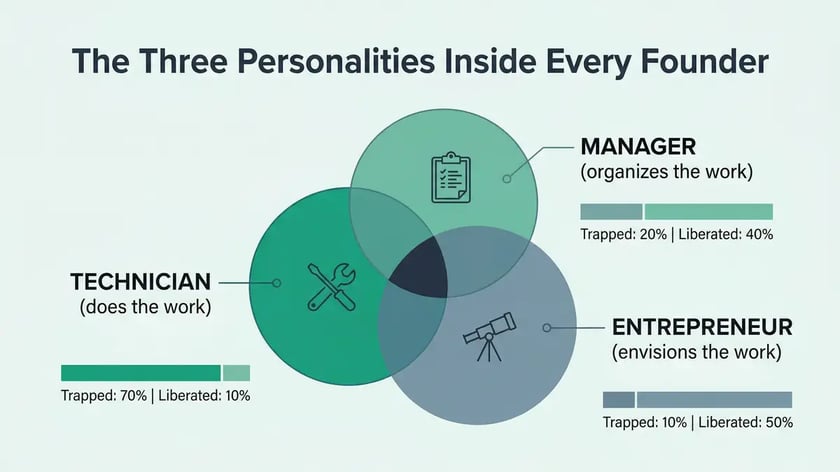
Every founder, Gerber wrote, contains three competing personalities: the Technician, the Manager, and the Entrepreneur. The Technician lives in the present and loves doing the work. The Manager lives in the past and craves order, predictability, systems. The Entrepreneur lives in the future and dreams of what could be. A balanced founder gives each personality roughly equal weight. The problem is that most B2B founders are 70% Technician, 20% Manager, 10% Entrepreneur, which is exactly inverted from what scaling a business actually requires.
The Technician thinks the business is the work. So when the work piles up, the Technician's instinct is to do more of it personally — write the proposal, run the demo, debug the integration, screen the candidate, deliver the coaching session. This is why a $2M consulting business and a $20M consulting business often look identical from the inside: both founders are still personally producing. The only thing that changed is the price tag and the burnout severity.

Gerber's prescription was uncomfortable: stop working in the business and start working on it. That meant building systems, documenting every process, hiring people you could plug into those systems, and treating your own company like the prototype for a hypothetical franchise. The reason almost no founder did this in 1986 — and almost none do it today — is that building the prototype is harder than doing the work. There is no dopamine in writing a process document. There is dopamine in shipping the deliverable. So the Technician wins, the system never gets built, and the founder becomes the system.
Forty years later, the diagnosis is unchanged but the solution has been transformed. The reason most founders historically failed to escape the Technician's Trap was that the cost of building the systems exceeded the cost of just doing the work themselves. McKinsey's research on generative AI and the future of work estimates that current language models can already automate 60% to 70% of the activities that consume employee time across knowledge-work roles. That math collapses Gerber's old equation entirely.
How does the Fatal Assumption show up in modern B2B?
Gerber wrote about bakers and barbers. The Fatal Assumption now wears different uniforms, but the mechanism is identical. In SaaS, it is the founder-CEO who personally runs every enterprise sales cycle because no SDR can articulate the product the way she does. In boutique recruiting, it is the managing director who personally vets every shortlist because his reputation depends on the quality of every placement. In high-ticket consulting, it is the founder who delivers every coaching call, writes every proposal, and posts every LinkedIn update because the brand is the human.
Each of these founders is doing the most expensive version of the wrong job. They have built businesses that cannot be sold, cannot be scaled, and cannot be left alone for two weeks without revenue collapsing. Harvard Business Review's research on founder burnout traces this to a specific psychological pattern: founders score high on perseverance but low on adaptability, which makes them brilliant at pushing through obstacles and terrible at recognising when the obstacle is themselves.
| Persona | Technician's Trap Symptom | Operational Cost |
| SaaS Founder (Sarah Chen) | Personally closes every deal >$50K ARR | Sales cycles 90+ days, growth capped at founder bandwidth |
| Search Firm MD (James Sterling) | Manually screens every shortlist candidate | 70% of week on sourcing, 6-month placement cycles |
| Coach/Consultant (David Vance) | Delivers every session, writes every email | Revenue caps at ~$2M, founder works 60+ hour weeks |
| Boutique Agency Owner | Reviews every deliverable before client send | Margin compression, churn when founder is unavailable |
Sources: HBR — Why Founders Burn Out, NC State Poole College — Founder Burnout Research, Mercury — Avoiding Founder Burnout
Avoid This Common Mistake
Founders who recognise the trap usually try to escape it by hiring. They onboard a junior, teach them the work, and discover six months later that they have replaced one bottleneck with two — themselves and the new hire who needs constant supervision. Hiring without first installing the system simply distributes the chaos. The order matters: system first, people second.
What is the Franchise Prototype — and what replaces it in 2026?
Gerber's central proposition was that you should build your business as if you were going to franchise it. Not because you would, but because the discipline of franchise design forces you to remove yourself from every critical operation. Every process must be documented. Every decision must follow a rule. Every role must be performable by an "ordinary person" — Gerber's deliberately provocative phrase — without requiring the founder's judgement.
Ray Kroc's McDonald's prototype is the example Gerber used. Kroc didn't build a restaurant. He built a system that built restaurants. The fries were 0.28 inches thick because that produced the optimal browning at 338°F. The patty weighed 1.6 ounces because that fit the bun. Nothing was a matter of opinion. Everything was a logic gate. The "business" that scaled was the system, not the food.
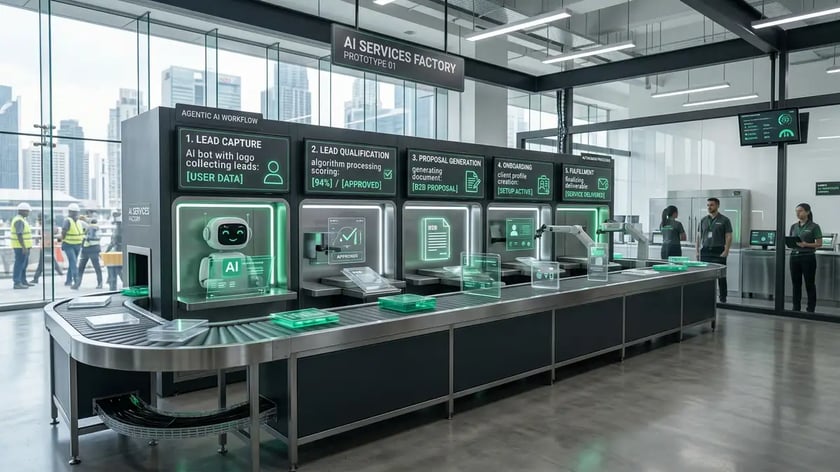
The B2B equivalent of Kroc's manual is no longer a binder. It is an agentic operating system — a stack of autonomous workflows, logic-gated processes, and AI agents that execute the work the founder used to do personally. Where Gerber's franchise required ordinary humans following written rules, the modern Freedom Machine requires ordinary workflows following machine-readable rules. The output is identical — predictable, consistent, founder-independent execution — but the cost structure is roughly 90% lower and the operational throughput is roughly 10x higher.
Key Takeaway
The Franchise Prototype was never about owning multiple locations. It was about owning a system that operates without you. In 2026, that system is built from agentic workflows, not from a 600-page operations manual. The discipline is the same. The implementation cost has collapsed.
| Dimension | Gerber's 1986 Prototype | 2026 Agentic Freedom Machine |
| Documentation medium | Printed operations manual | Machine-readable workflow definitions |
| Execution unit | Trained human employees | Logic-gated AI agents |
| Time to install | 2-3 years per business unit | 90-120 days for the full operating system |
| Cost per process automated | $50K-$200K (hire + train + manage) | $2K-$15K (architect + deploy + monitor) |
| Founder dependency removed | ~60% (humans still need supervision) | ~85% (agents escalate exceptions only) |
Sources: McKinsey — Generative AI and the Future of Work, Professional Leadership Institute — E-Myth Revisited Summary
What does the modern Franchise Prototype actually look like?
peppereffect builds these systems across four pillars — Lead Generation, Sales Administration, Operations, and Marketing Classics. Each pillar replaces a category of founder labour with an agentic workflow. Together they form what we call the Freedom Machine: a complete operating system that runs the business while the founder works on the business.
Pillar 1 — The Engine (Lead Generation)
Cold email, LinkedIn outreach, and content systems run autonomously. Agents identify ICP-matched accounts, draft personalised messages, manage replies, and book qualified meetings into the calendar. The founder no longer "does sales." The system does sales and the founder shows up for the close. See lead generation automation for the full architecture.
Pillar 2 — The Conversion (Sales Administration)
Proposal generation, lead nurture, and CRM automation. Every meeting outcome triggers the right follow-up sequence. Every deal stage has its own agent watching for stalls. Proposals are generated in minutes, not days, from a structured intake form. Deal velocity accelerates by 30-40% in most deployments.
Pillar 3 — The Delivery (Operations)
Client onboarding, automated fulfillment, and project management. New clients are welcomed, provisioned, and launched without a human touching the keyboard. Fulfillment runs through agentic workflows that execute the deliverable and route exceptions to a human only when judgement is required.
Pillar 4 — The Foundation (Marketing Classics)
Web architecture, search visibility (SEO/GEO), and paid acquisition. The brand layer that compounds while the operating layer executes. This is the part that builds mental availability for the 95% of buyers not yet in-market — the Ehrenberg-Bass principle that traditional agencies forget.
Curious what your own escape from the Technician's Trap looks like? Map the founder bottlenecks in your business with a Growth Architecture Diagnostic.
Book the DiagnosticWhy does the Technician's Trap destroy company valuation?
If you are the system, you are also the discount. Every M&A buyer applies a key-person risk discount to founder-dependent businesses, typically in the 20-40% range, because the moment the founder walks away the operational engine seizes. A $5M consulting firm with a founder-dependency tag often transacts at 1-2x revenue. The same firm with documented systems and a founder-independent delivery layer transacts at 4-6x revenue. The difference is roughly $15-25 million in enterprise value created not by selling more, but by removing yourself from the operational critical path.
This is the second cost of the Fatal Assumption that founders never see until it is too late: not just the burnout and not just the capped revenue, but the permanent compression of the asset they are building. Gallup's State of the Global Workplace research estimates that disengagement and operational dysfunction cost the global economy roughly $8.8 trillion in lost productivity — a number that is, in aggregate, the price tag of every Technician's Trap operating in the world right now.

The good news: this is the easiest valuation lift available to a B2B founder. You do not need to grow revenue 4x to quadruple enterprise value. You need to remove the founder from the delivery layer. Agentic systems are uniquely well-suited to this task because they can absorb the judgement-heavy work that previously required the founder's brain — qualifying a lead, scoping a project, drafting a proposal, screening a candidate, generating a deliverable. None of these tasks require humans anymore. They require a well-designed agent and a logic-gated workflow.
This is not theoretical. Basecamp's published operating handbook shows what a deliberately founder-independent SaaS business looks like — written processes, async-first communication, six-week shipping cycles, no manager class. The business runs without the founders' daily intervention, and it has done so profitably for over two decades. The Technician's Trap is not inevitable. It is a choice founders make every time they prioritise doing the work over building the system that does the work.
What does it take to install a Freedom Machine?
Three things, in order. First, diagnostic clarity: you need to know exactly which founder dependencies are capping your business and how much each one is costing you in time, deal velocity, and forgone valuation. Second, architectural design: you need a logic-gated map of every workflow that currently routes through the founder's brain, with each routed to either an agentic system, a templated process, or a delegated owner. Third, installation discipline: you need to deploy the systems sequentially, starting with the highest-leverage bottleneck, and resist the temptation to build everything at once.
The reason most founders fail at this is not technical. It is psychological. Removing yourself from the critical path feels like demotion. The Technician personality protests at every step because building a system that does the work it loves feels like building a system that makes it obsolete. This is why the discipline of treating your own business as a Franchise Prototype matters so much: it reframes the work as design rather than delegation. You are not giving up the work. You are upgrading the work from execution to architecture.
Key Takeaway
The escape from the Technician's Trap is sequential: diagnose, architect, install. Skip the diagnosis and you build the wrong system. Skip the architecture and you build a tool collection instead of an operating system. Skip the installation discipline and you build everything at once and ship nothing. Order is the difference between a Freedom Machine and a software graveyard.
Frequently Asked Questions
What is the main message of The E-Myth Revisited?
The main message is the Fatal Assumption: founders mistake technical skill for business skill, and that mistake destroys most small businesses. Gerber argues that you cannot escape the trap by working harder — you escape it by treating your business as the prototype for a hypothetical franchise. That discipline forces you to systematise every process, document every decision, and remove yourself from the critical path. The book's enduring value is that it diagnoses an architecture problem rather than a productivity problem. The Freedom Machine framework is the modern, agentic-era successor to Gerber's prototype.
Is The E-Myth Revisited still relevant in 2026?
More relevant than ever. The diagnosis is unchanged — founders still trap themselves in the Technician role — but the solution has been radically improved. Gerber's prescription required hiring people and training them to follow written processes, which was expensive and slow. Today, agentic workflows can absorb 60-70% of those processes with no humans required, according to McKinsey research on generative AI. The economics of escape have collapsed by an order of magnitude. The framework still applies; the implementation is now ten times cheaper.
What is the Franchise Prototype concept?
The Franchise Prototype is Gerber's core operational discipline: design your business as if you were going to franchise it, even if you never will. That means documenting every process, codifying every decision, and ensuring any "ordinary person" — or any well-designed agent — could execute the work without your involvement. The discipline forces you to separate the value of the business from the value of yourself. McDonald's is the canonical example. Modern agentic workflows serve as the digital equivalent of Kroc's franchise manual.
How do I know if I'm trapped as a Technician?
Three diagnostic signals. First, your revenue is capped by your personal hours — if you took two weeks off, the business would visibly suffer. Second, you have hired people but they cannot make decisions without you, which means you scaled the cost base without scaling capacity. Third, you can list at least three workflows where you are the only person who knows how something gets done. If any of these are true, you are in the trap. The good news is that the diagnosis is the first step out — most founders never get this far because they are too busy doing the work.
Why do founders burn out and what does the research show?
Founders burn out because the personality traits that get a business started — perseverance, hustle, personal ownership — are exactly the traits that prevent founders from delegating and systematising. Research from NC State and HBR shows that entrepreneurs with the highest "obsessive passion" for their work are also the most likely to burn out. The fix is structural, not motivational: you cannot rest your way out of a Technician's Trap because the trap reproduces itself the moment you return. You have to remove yourself from the critical path.
How does AI automation help escape the Technician's Trap?
AI automation collapses the cost of building Gerber's Franchise Prototype. Where previously you needed to hire and train humans to execute documented processes, you can now deploy agentic workflows that execute the same processes autonomously. AI workflow automation handles lead qualification, proposal generation, client onboarding, candidate screening, and project management without requiring the founder's daily intervention. The founder shifts from execution to architecture, which is the role Gerber called the Entrepreneur.
How long does it take to build a Freedom Machine?
For a $2M-$10M B2B business, the core operating system can be installed in 90-120 days when sequenced correctly. The first 30 days are diagnosis and architecture — mapping every founder dependency and designing the logic-gated workflows that will replace them. The next 60-90 days are sequential installation, starting with the highest-leverage bottleneck (usually sales automation or fulfillment). Most founders see Hours Reclaimed in week three and material revenue impact by month four.
Escape the Technician's Trap. Install the Freedom Machine.
peppereffect installs end-to-end agentic operating systems for B2B founders who are tired of being the bottleneck in their own business. We architect, build, and deploy the four pillars — Lead Generation, Sales Administration, Operations, and Marketing Classics — so your revenue stops scaling with your hours.
Book a Growth Architecture CallRead the full Freedom Machine framework →
Resources
- The E-Myth Revisited (full PDF) — Michael E. Gerber, Internet Archive
- Why Founders Burn Out — Harvard Business Review
- Generative AI and the Future of Work — McKinsey Digital
- Frequently Asked Questions About Small Business — SBA Office of Advocacy
- State of the Global Workplace — Gallup
- What Makes Entrepreneurs Burn Out — NC State Poole College of Management
- Avoiding Founder Burnout — Mercury
- How We Work — Basecamp Operating Handbook