

What Is LinkedIn Executive Search and Why Does It Matter for Boutique Firms?
LinkedIn executive search is the systematic use of LinkedIn's professional network, recruiting tools, and thought leadership infrastructure to source passive C-suite candidates, cultivate mandate-generating relationships, and position boutique search firms as trusted advisors within target industries. Unlike contingency recruitment — where firms chase active job seekers and achieve completion rates of roughly 10% — retained executive search firms leveraging LinkedIn achieve completion rates exceeding 95% by engaging passive candidates who represent 66–90% of successful C-level placements.
The global executive search market reached $63.99 billion in 2026, growing at a compound annual rate of 10.11% through 2031. Within this expanding market, boutique and mid-tier firms face a clear strategic choice: build a LinkedIn-enabled mandate generation engine, or cede ground to larger consolidators with deeper technology budgets. The data overwhelmingly favors the former. Recruiting professionals with active LinkedIn profiles and thought leadership presence receive 47% more inbound opportunities compared to peers with dormant profiles, and 73% of B2B decision-makers trust thought leadership content more than traditional marketing materials when evaluating professional service firms.
What you'll learn in this article:
- How elite search firms architect their LinkedIn presence to generate retained mandates — not just source candidates
- The specific LinkedIn tools, licensing tiers, and Boolean search techniques that separate top-performing recruiters from the pack
- Why thought leadership content is now the highest-ROI business development activity for boutique executive search
- How AI integration is compressing search timelines from 5–6 months to under 90 days
- The exact metrics — InMail response rates, content engagement benchmarks, network growth targets — that predict mandate generation success
Key Takeaway
LinkedIn has evolved from a sourcing tool into strategic infrastructure for mandate generation. Boutique executive search firms that deploy systematic personal brand development, thought leadership content, and AI-assisted sourcing on LinkedIn achieve measurably superior completion rates, higher-quality placements, and inbound mandate flow that decouples growth from cold business development.

Why Does LinkedIn Dominate Executive Recruiting in 2026?
LinkedIn has achieved near-ubiquitous adoption among executive search professionals, with 77% of recruiters using the platform regularly and 72% citing it as their preferred hiring tool. The platform reaches over 65 million job seekers weekly and facilitates seven hires per minute — more than three million annual placements globally. For executive search specifically, LinkedIn maintains 180 million senior-level professionals, 63 million decision-makers, and 10 million C-level executives on its network, creating unprecedented visibility into candidate markets that historically required years of relationship-building and conference attendance to access.
The concentration of decision-makers makes LinkedIn qualitatively different from every other recruitment channel. Four in five LinkedIn members exert influence over business decisions — either directly as decision-makers or through advisory roles. This means every connection request, InMail, and content interaction potentially reaches someone who can commission a search, refer a mandate, or become a placement candidate. No other platform offers this density of executive-level professional engagement.

The shift is not merely quantitative — it is structural. In 2023, only 12% of FTSE 100 chief executives maintained active LinkedIn profiles. By 2025, that number had surged to 85% — a 650% increase in just two years. C-suite executives now use LinkedIn for stakeholder communication, investor relations, talent attraction, and personal brand development. For search professionals, this creates direct visibility into executive communication styles, leadership positioning, and professional networks — intelligence that was previously available only through personal relationships or expensive proprietary databases.
The performance gap between LinkedIn and traditional outreach channels is now decisive. LinkedIn InMail achieves 100% deliverability into recipients' message feeds — bypassing spam filters entirely — while cold email manages only 83% inbox delivery with 17% bouncing or landing in spam. InMail open rates reach 50–60% compared to cold email's 15–27%, and response rates in executive recruitment specifically hit 18–25% versus cold email's 1–5%.
| Metric | LinkedIn InMail | Cold Email | Advantage |
| Deliverability | 100% | 83% | InMail +17% |
| Open rate | 50–60% | 15–27% | InMail 2–3x |
| Response rate (executive) | 18–25% | 1–5% | InMail 4–5x |
| Top performer response | 30–40% | ≤12% | InMail 3x |
| Optimal message length | <400 characters | 50–125 words | InMail rewards brevity |
Sources: SalesSo — LinkedIn InMail Statistics 2025, Wave Connect — LinkedIn Statistics 2025
How Do Elite Search Firms Build High-Status LinkedIn Networks That Generate Mandates?
Mandate generation through LinkedIn is not a byproduct of volume — it is an engineered outcome of systematic network cultivation, strategic positioning, and consultative relationship development. The distinction matters. Contingency recruiters broadcast job openings to active seekers. Elite retained search professionals architect networks of corporate decision-makers, board members, and private equity sponsors who commission searches based on trusted advisor relationships — relationships built methodically through LinkedIn over months and years.

The process begins with precise targeting. Boolean search techniques — using AND, OR, NOT operators with quotation marks and parentheses — enable recruiters to isolate specific corporate decision-makers who represent ideal mandate sources. A search firm specializing in technology CFO placements, for example, can construct a query targeting Chief Financial Officers at Series C+ technology companies in specific metropolitan areas with private equity board experience — narrowing millions of possible LinkedIn profiles to dozens of highly qualified prospects worthy of personalized outreach.
Define Your Ideal Mandate Source Profile
Identify the 3–5 corporate decision-maker archetypes who commission your searches: CHROs, PE operating partners, board chairs, or CEO/founders within your vertical specialization. Build Boolean search strings targeting each archetype by title, company size, industry, and geography.
Build a Warm Connection Architecture
Send personalized connection requests that reference shared interests, mutual connections, or specific insights from the target's published content. Avoid generic templates. Connect with 15–25 targeted decision-makers weekly — quality over volume. Strategic LinkedIn lead generation starts with warm, relevant outreach.
Engage Before You Ask
Comment thoughtfully on targets' content for 2–4 weeks before initiating business conversation. Share relevant market intelligence, introduce useful connections, or forward relevant research. This consultative positioning establishes trust before any mandate discussion emerges.
Convert Network Depth Into Mandate Flow
After establishing trust, transition to consultative conversations about emerging talent needs. Offer confidential market intelligence on competitor leadership changes, compensation benchmarks, or talent availability within the target's sector — positioning yourself as an indispensable advisor, not a transactional recruiter.
Key Takeaway
Elite search firms treat LinkedIn as a mandate generation engine, not a candidate sourcing tool. The systematic approach — target, connect, engage, convert — mirrors the consultative sales process that B2B lead nurturing systems deploy, with one critical difference: the "leads" you're nurturing are potential clients who commission six-figure retained searches, not buyers of software subscriptions.
What LinkedIn Tools Do Executive Recruiters Need?
The right LinkedIn tooling dramatically amplifies search efficiency, but the tool investment must match your firm's search volume, team size, and sourcing strategy. LinkedIn's recruiting ecosystem offers three primary tiers: Recruiter Lite for individual practitioners, Recruiter Corporate for high-volume teams, and Sales Navigator as a cost-effective alternative for boutique firms. The differences are not trivial — pricing spans from $170/month to $1,080/month per seat, with capabilities that directly impact sourcing speed, candidate engagement volume, and team collaboration.
| Feature | Recruiter Lite | Recruiter Corporate | Sales Navigator |
| Price per seat/month | $170 | $1,080 | $99–$149 |
| Search filters | 20+ | 40+ | 50+ |
| Monthly InMails | 30 | 150 | 50 |
| Boolean search | Yes | Yes | Yes |
| Bulk messaging | No | Yes | No |
| Team collaboration | Limited | Advanced | Limited |
| Full profile visibility | Limited | Full (no connection needed) | Extended network |
Sources: Juicebox — LinkedIn Recruiter Pricing 2026, Snov — LinkedIn Recruiter vs Sales Navigator
For boutique executive search firms conducting 5–15 concurrent searches annually, Sales Navigator often provides the best cost-to-capability ratio. Its 50+ search filters exceed Recruiter Lite's 20+ filters, its 50 monthly InMails outstrip Lite's 30, and its automated saved search alerts surface new candidates matching specification criteria without manual re-searching. The primary limitation — no bulk messaging — is less impactful for retained search firms conducting targeted, personalized outreach to small candidate pools (typically 50–150 passive candidates per search). Firms executing 20+ concurrent searches or operating multi-recruiter teams benefit from Recruiter Corporate's bulk capabilities and team collaboration features, justifying the elevated annual investment of $12,960 per seat.

Beyond tool selection, AI-powered executive search automation is reshaping what these tools can accomplish. Organizations using AI-assisted recruiting report 20% time savings across recruiter workweeks — the equivalent of a full recovered day — with screening time reductions reaching 75% through AI-powered evaluation. Candidates selected through AI-powered assessment are 14% more likely to succeed in subsequent interviews and 18% more likely to accept offers, directly improving placement success rates and client satisfaction metrics.
Ready to build a LinkedIn-powered mandate generation engine for your search firm? Explore our Lead Generation systems designed specifically for elite B2B firms.
Book a Growth Mapping CallHow Does Thought Leadership Generate Executive Search Mandates?
Thought leadership is now the highest-ROI business development activity available to boutique executive search firms — and the data is unambiguous. The 2025 Edelman-LinkedIn B2B Thought Leadership Impact Report — the seventh consecutive annual collaboration examining thought leadership influence on purchasing decisions — found that 73% of B2B decision-makers trust thought leadership as a more credible basis for assessing supplier capabilities than traditional marketing materials. Among "hidden buyers" (internal stakeholders influencing decisions without primary authority), trust preference reaches 71%.
The business impact extends beyond brand perception to direct deal influence. According to the same research, 86% of business decision-makers report using thought leadership content to invite previously unconsidered suppliers to bid on opportunities, while 55% explicitly use thought leadership assessment when vetting organizations for hiring, partnership, or engagement. For search firms, this translates directly: clients evaluating search firm engagement assess firm credibility through founder thought leadership visibility, content quality, and market intelligence demonstrated in their LinkedIn presence — often months before a formal mandate discussion begins.
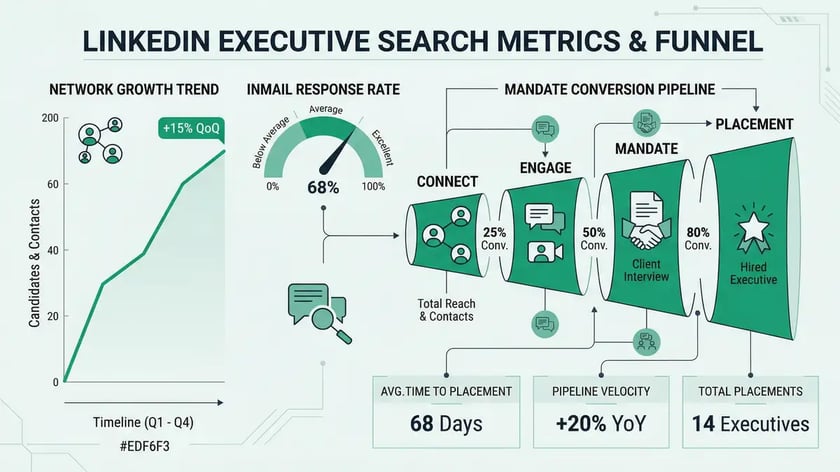
Building thought leadership authority follows a structured progression. The initial phase (months 1–3) focuses on profile optimization and positioning clarity, growing to 500–1,000 engaged followers. Phase two (months 4–8) emphasizes consistent content publication — minimum 2–4 substantial posts weekly — targeting 1,000–5,000 engaged followers. The authority phase (months 9–12+) achieves 5,000+ engaged followers with measurable inbound mandate inquiry. This phased progression acknowledges that meaningful inbound opportunity generation requires 3–6 months of sustained content engagement before traction materializes.
| Content Pillar | Purpose | Example Topics |
| Market intelligence | Demonstrate deep industry knowledge | C-suite compensation trends, sector hiring velocity, talent migration patterns |
| Leadership assessment insights | Showcase evaluation expertise | What distinguishes transformational CFOs, red flags in executive interviews |
| AI and search innovation | Position as forward-thinking | How AI reshapes sourcing, ethical considerations in automated screening |
| Client success patterns | Build social proof | What great retained search processes look like (anonymized case patterns) |
| Sector-specific intelligence | Establish vertical authority | PE value creation leadership, healthcare CEO transitions, Chief AI Officer demand |
Sources: InfluenceFlow — Personal Brand Building on LinkedIn 2026, Column Content — Thought Leadership Statistics 2026
Avoid This Mistake
Many search firm founders treat LinkedIn content as a broadcasting channel for job postings and company updates. This approach achieves minimal engagement and zero mandate generation. Thought leadership requires original insight, market intelligence, and contrarian perspective — not repackaged job descriptions. The firms generating inbound mandates from LinkedIn are those whose founders publish perspective on leadership transitions, market dynamics, and executive assessment methodology that clients cannot find elsewhere.
How Is AI Accelerating LinkedIn-Based Executive Search?
Artificial intelligence has compressed the executive search cycle from the historical 5–6 month average to 55–90 days for specialist AI-assisted searches, while simultaneously increasing placement success rates to 80% on exclusive mandates. The productivity impact is substantial: organizations using AI-assisted recruiting report time savings equivalent to a full recovered day per recruiter per week, with screening time reductions of up to 75%.
LinkedIn itself has invested heavily in native AI capabilities, transitioning from keyword-based candidate matching to neural retrieval systems using transformer-based networks that assess topical relevance, conversation quality, and engagement authenticity. This algorithmic evolution creates meaningful differentiation between high-quality, personalized recruiter engagement — which the algorithm rewards with enhanced visibility — and volume-based, generic automated outreach, which is algorithmically deprioritized. The platform's AI features for recruiting now automate routine search steps, enabling practitioners to concentrate on relationship development and candidate persuasion.
For boutique search firms, the implications are strategic. Firms that integrate AI workflow automation into their LinkedIn-based sourcing achieve measurable competitive advantages: candidates selected through AI-powered evaluation are 14% more likely to succeed in interviews and 18% more likely to accept offers. Combined with LinkedIn's own AI-enhanced search capabilities, these tools enable smaller firms to match — and often exceed — the candidate identification speed of larger competitors, effectively decoupling search capacity from recruiter headcount.
| AI Application | Impact | Time Saved |
| Resume screening and candidate matching | 75% reduction in screening time | 15–20 hours/search |
| AI-powered candidate evaluation | 14% higher interview success rate | 5–8 hours/search |
| Automated interview scheduling | Eliminates coordination overhead | 3–5 hours/search |
| Full AI-assisted search cycle | Compress 5–6 months to 55–90 days | 3–4 months/search |
Sources: TalentBridge — AI Recruitment 2026, Alpha Apex Group — AI Executive Search Firms 2026
Key Takeaway
AI does not replace the relationship-driven judgment that defines elite executive search — it eliminates the manual overhead that prevents firms from scaling. The firms winning in 2026 combine AI-powered sourcing efficiency with human-in-the-loop approval gates for final candidate assessment, achieving both speed and quality. This is the same Freedom Machine architecture that decouples revenue from headcount across every B2B vertical.
Frequently Asked Questions
How much does LinkedIn Recruiter cost for executive search firms?
LinkedIn Recruiter Lite costs approximately $170/month per seat with 30 monthly InMails and 20+ search filters. Recruiter Corporate runs approximately $1,080/month per seat ($12,960 annually) with 150 InMails, 40+ filters, and bulk messaging. Many boutique search firms find LinkedIn Sales Navigator at $99–$149/month provides superior value with 50+ filters and 50 InMails — adequate for the targeted, personalized outreach that retained search requires.
What is a good LinkedIn InMail response rate for executive recruiters?
Executive recruitment achieves the highest InMail response rates across all industries at 18–25%, compared to the platform average of 10–25%. Top-performing recruiters consistently achieve 30–40% response rates through personalized messaging under 400 characters, strategic subject lines of 3–5 words, and warm introductions leveraging mutual connections. Messages that demonstrate specific knowledge of the candidate's background substantially outperform generic templates.
How long does a typical executive search take?
Traditional retained executive searches average 20–24 weeks (5–6 months) from engagement to placement acceptance. AI-assisted searches conducted by specialist firms have compressed this to 55–90 days, with the most significant time savings occurring in candidate screening (75% reduction) and initial evaluation stages. The CRM automation infrastructure supporting modern search firms further accelerates pipeline progression and reduces administrative overhead.
What percentage of executive placements come from passive candidates?
Research consistently shows that 66–90% of successful C-level placements originate from passive candidates — professionals who are employed, reasonably satisfied, and not actively job-seeking. This is precisely why systematic lead generation infrastructure matters for executive search: the most qualified senior executives must be identified, engaged, and persuaded through relationship-based outreach rather than job board advertising.
How do retained search fees work?
Retained search firms charge 25–35% of the placed executive's total first-year compensation, typically disbursed in three stages. Minimum retainer fees commonly range from $80,000 to $100,000 for mid-level executive placements, with C-suite searches frequently exceeding $150,000. This compares to contingency fees of 15–25% paid only upon placement — but retained search delivers 95% completion rates versus contingency's 10%, making the total cost-per-successful-placement substantially lower for retained engagements.
Who are the biggest executive search firms globally?
The "Big 5" global recruiting firms — including Korn Ferry, Heidrick & Struggles, and Egon Zehnder — generated a combined $7.43 billion in fee revenue in their most recent reporting period. However, boutique and mid-tier firms maintain competitive advantages in client relationships, personalized service, and specialist sector expertise. LinkedIn-enabled thought leadership is the primary mechanism through which smaller firms scale their reach without scaling headcount.
Does LinkedIn's Social Selling Index still matter for recruiters?
LinkedIn's SSI has declined in strategic importance as the platform shifted from broadcast-first models toward neural retrieval systems that prioritize content quality, conversation depth, and authentic engagement over activity volume. High-frequency generic engagement (bulk InMails, automated connection requests) increasingly fails to generate algorithmic support. The firms outperforming on LinkedIn are those investing in targeted candidate relationships and authentic community participation rather than gaming activity metrics.
Architect Your Search Firm's LinkedIn Mandate Engine
peppereffect installs AI-powered lead generation and CRM automation systems for elite executive search firms — the same infrastructure that decouples placement capacity from recruiter headcount. Stop chasing mandates. Start attracting them.
Book Your Growth Mapping CallExplore Lead Generation Systems → LinkedIn lead generation for B2B LinkedIn profile optimization
Resources
- Mordor Intelligence — Executive Search Market Size & Share Outlook to 2031
- Hunt Scanlon — Executive Recruiting Sector Grew 11 Percent
- Edelman & LinkedIn — 2025 B2B Thought Leadership Impact Report
- SalesSo — LinkedIn InMail Statistics 2025: Response Rates & Key Data
- Recruiterflow — Executive Search Strategy That Works in 2026
- InfluenceFlow — Personal Brand Building on LinkedIn: The Complete 2026 Guide
- HireCruiting — How Much Do Executive Search Firms Charge?
- OST Marketing — The Business Case for LinkedIn Exec Comms in 2025