

What Is Outbound Lead Generation — And Why Does It Still Matter in B2B?
Outbound lead generation is the process of proactively identifying and contacting potential buyers through direct channels — cold email outreach, LinkedIn messaging, cold calling, and targeted advertising — rather than waiting for prospects to find you. In B2B markets with complex sales cycles and high average contract values, outbound remains the fastest path to pipeline because it puts timing and targeting in the seller's hands. automating cold email outreach
Yet the conversation has shifted. 72% of B2B buyers now conduct independent research before engaging with sales, according to Forrester's State of Business Buying report. Inbound strategies — SEO, content marketing, thought leadership — capture these self-educating buyers. The question is no longer outbound or inbound. It's how to architect both into a unified B2B lead generation system that maximizes pipeline velocity and minimizes customer acquisition cost.
What you'll learn in this article:
- How outbound and inbound lead generation fundamentally differ in mechanics, cost, and timeline
- Real benchmarks: response rates, conversion rates, CAC, and deal velocity for each channel
- When outbound wins, when inbound wins, and why the systems architect's answer is "both"
- How AI is transforming outbound from spray-and-pray to precision targeting
- The integration framework that delivers 40-60% more revenue per sales rep
Key Takeaway
Outbound lead generation delivers pipeline within 30 days. Inbound requires 6-12 months but produces higher-quality deals. Companies integrating both through account-based strategies generate 40-60% more revenue per sales rep than single-channel specialists.
How Do Outbound and Inbound Lead Generation Actually Differ?
The distinction goes deeper than "we reach out" versus "they come to us." Outbound and inbound operate on fundamentally different economic models, timelines, and buyer psychology. Understanding these mechanics is the prerequisite for building a system that leverages both.
Outbound lead generation is seller-initiated. Your team identifies target accounts, crafts personalized messages, and initiates contact through cold email, LinkedIn outreach, or direct calls. The advantage: speed and targeting precision. The cost: ongoing labor and tool investment with diminishing returns if not systematized.
Inbound lead generation is buyer-initiated. Prospects discover your brand through SEO, content marketing, social media, or referrals — then self-qualify by consuming content and requesting information. The advantage: compounding returns and higher buyer intent. The cost: upfront investment with delayed payoff.
| Dimension | Outbound | Inbound |
| Who initiates | Seller contacts prospect | Buyer discovers seller |
| Time to pipeline | Days to weeks | Months to quarters |
| Cost model | Linear (scales with headcount) | Compounding (scales with content) |
| Lead quality | Variable (depends on targeting) | Higher (self-qualified intent) |
| CAC trajectory | Flat or rising over time | Declining as assets compound |
| Control | High (you choose who, when) | Low (market timing dependent) |
| Best for | Immediate pipeline, named accounts | Brand authority, long-term efficiency |
Sources: HubSpot State of Sales Report, Forrester B2B Buyer Research

What Are the Real Benchmarks for Outbound vs. Inbound?
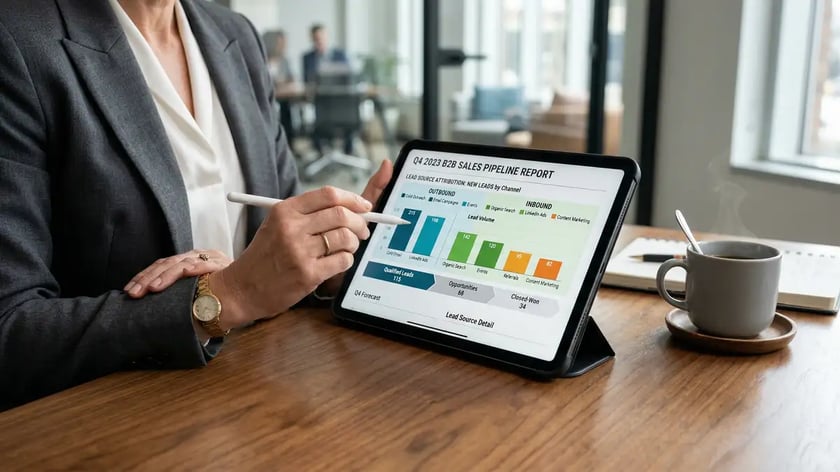
Benchmarks separate strategic decisions from gut feelings. The data below compiles performance metrics across both channels, giving B2B leaders the numbers they need to allocate budget and resources with confidence.
Outbound channel performance: Cold email delivers 1-3% reply rates at baseline, rising to 5-8% for top performers using AI personalization. LinkedIn outreach achieves 25-35% connection acceptance rates cold, and 45-60% with personalized notes. LinkedIn InMail through Sales Navigator produces 10-25% response rates — significantly higher than any email channel.
Inbound channel performance: Organic search delivers 2-5% visitor-to-lead conversion for typical B2B SaaS, with top performers reaching 5-12%. Blog-to-SQL conversion averages 0.5-2%. But webinar attendance converts at 15-35% to qualified leads — making gated content the inbound channel with the highest conversion density.
| Metric | Outbound | Inbound | Winner |
| Time to first meeting | 3-7 days | 5-14 days | Outbound (40% faster) |
| Meeting-to-close cycle | 30-60 days | 25-50 days | Inbound (20% faster) |
| Opportunity-to-deal close rate | 20-35% | 30-45% | Inbound (higher intent) |
| Deal stall rate | 8-12% | 4-7% | Inbound (lower stall) |
| CAC ($25K-$75K ACV) | $1,500-$5,000 | $2,000-$8,000 | Outbound (35-45% lower) |
| CAC payback period | 6-12 months | 12-24 months | Outbound (faster payback) |
| Average deal size | Baseline | 15-30% higher | Inbound (larger deals) |
Sources: HubSpot State of Sales, Salesforce State of Sales, Forrester Sales Research
Key Takeaway
Outbound wins on speed and initial CAC. Inbound wins on close rates, deal size, and long-term efficiency. For B2B companies at $10M-$40M ARR, outbound CAC runs 35-45% lower than inbound in the first 18 months — but inbound CAC improves with scale as content compounds.
When Should B2B Companies Use Outbound vs. Inbound?
The answer depends on three variables: your sales runway, your average contract value, and whether you're building a market or capturing existing demand. Here's the decision framework a B2B sales automation architect would apply.
Immediate Pipeline Need (0-90 Days)
Deploy outbound first. Cold email sequences and LinkedIn outreach produce meetings within days, not months. This is non-negotiable for companies with aggressive quarterly targets or limited cash runway.
Market Education Required
If prospects don't yet search for your solution category, inbound alone will not generate demand. Outbound educates the market while content builds long-term search visibility through generative engine optimization.
High ACV ($50K+ Deals)
Enterprise deals require both. Outbound identifies and engages target accounts; inbound content nurtures multi-stakeholder buying committees through the 6-8 content pieces they consume before contacting sales.
Scaling Past $20M ARR
At this stage, inbound economics improve dramatically. Content compounds, organic traffic grows, and lead nurturing sequences convert at scale. Shift investment ratio toward inbound while maintaining targeted outbound for named accounts.
Competitive Market With Established Players
Integrate both through account-based marketing (ABM). Use intent data to identify buyers already researching solutions, then deploy warm outbound with content that positions your differentiation.
Avoid This Mistake
The most expensive error in B2B lead generation is committing fully to one channel and abandoning the other. Companies running outbound-only hit a ceiling when rep capacity maxes out. Companies running inbound-only wait 12-18 months for pipeline while competitors close deals. The systems architect's answer is always sequenced integration — not either/or.
Map your lead generation architecture in 30 minutes. Our diagnostic identifies whether your current mix of outbound and inbound is optimized — or leaking pipeline.
Book Your Growth Mapping Call
How Is AI Transforming Outbound Lead Generation?
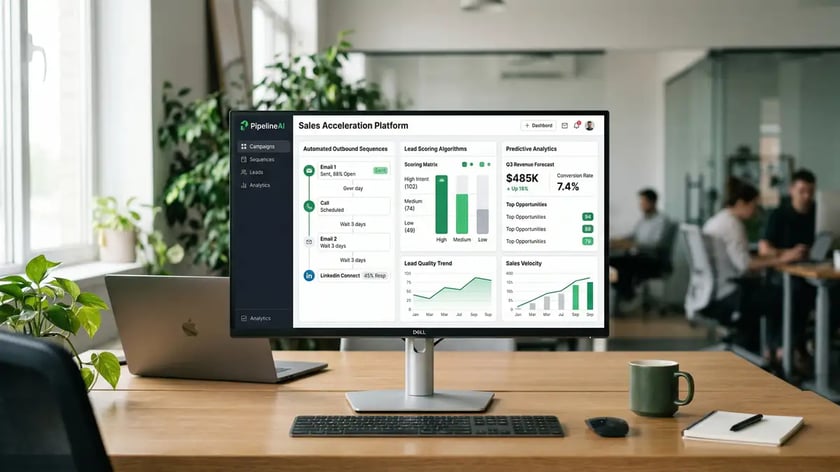
AI has fundamentally changed the economics of outbound. What required a team of 10 SDRs manually researching, writing, and following up now runs through AI workflow automation that handles prospecting at scale while maintaining personalization quality.
The impact is measurable. AI-personalized cold emails generate 40-60% higher reply rates than template-based outreach, according to Salesforce research. AI-generated subject lines improve open rates by 15-25%. And intent data matching — identifying companies actively researching your solution category — increases conversion by 35-50% versus random prospecting.
The most significant shift is multi-touch AI sequencing. Platforms orchestrating email, LinkedIn, and phone touchpoints through agentic workflows show 45-65% higher opportunity creation than single-channel outreach. This isn't incremental improvement — it's a structural advantage available to any B2B company willing to deploy the infrastructure.
| AI Capability | Performance Improvement | Adoption (2024) |
| AI-personalized cold emails | +40-60% reply rate vs. template | 40-45% of SaaS companies |
| AI intent matching | +35-50% conversion improvement | 30-35% of enterprise |
| Multi-touch AI sequencing | +45-65% opportunity creation | 25-30% of mid-market |
| AI conversation intelligence | +15-25% close rate improvement | 20-25% of enterprise |
| AI prospecting list creation | 30-45% time savings vs. manual | Mainstream adoption starting |
Sources: Salesforce State of Sales, 6sense Intent Data Report, Gong State of Sales Productivity
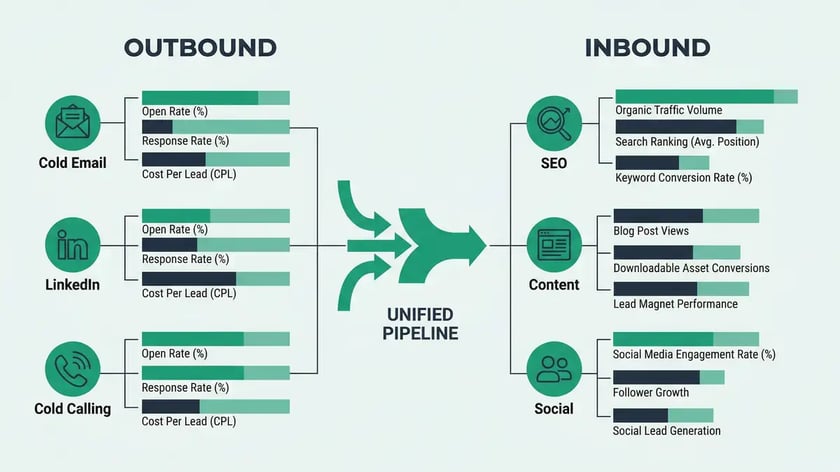
The Systems Architect's View — Why Integration Beats Either Channel Alone
The data is unambiguous. Companies running integrated outbound and inbound strategies through a unified CRM automation infrastructure outperform single-channel specialists across every metric that matters.
According to Demandbase's ABM benchmark study, account-based marketing that combines content-driven awareness with strategic outbound produces 40-60% higher deal velocity for companies above $10M ARR. The integration model follows a clear sequence: inbound content builds awareness and captures intent signals, then targeted outbound converts that awareness into pipeline.
The numbers compound at every stage. Sales reps working integrated pipelines generate 18-28 opportunities per quarter versus 8-12 on single-channel. Blended CAC drops 20-35%. Sales cycles compress by 25-40%. And close rates reach 35-50% — higher than either channel achieves independently.
| Metric | Single-Channel | Integrated (Outbound + Inbound) | Lift |
| Pipeline per rep per quarter | 8-12 opportunities | 18-28 opportunities | +120-180% |
| Blended CAC | Baseline | 20-35% lower | Significant savings |
| Sales cycle duration | 60-180 days | 45-90 days | 25-40% faster |
| Close rate | 20-45% (varies by source) | 35-50% | +15-25% |
| Revenue per sales rep | 1.0x baseline | 1.4-1.8x | +40-80% |
Sources: Demandbase ABM Benchmark, HubSpot State of Sales
For a $10M-$40M ARR SaaS company, this translates to concrete numbers: an integrated strategy generates $25M-$45M in annual pipeline versus $15M-$25M outbound-only — with lower CAC and faster payback. The Freedom Machine methodology architects exactly this kind of infrastructure: proposal automation handles the conversion layer, while content systems and outbound sequences feed the pipeline from both directions.
Frequently Asked Questions
What is the difference between outbound and inbound lead generation?
Outbound lead generation is seller-initiated — your team identifies target prospects and contacts them directly through cold email, LinkedIn, or phone. Inbound lead generation is buyer-initiated — prospects discover your brand through search engines, content, or referrals and self-qualify. Outbound delivers faster pipeline; inbound delivers higher-quality deals. The most effective B2B companies integrate both through a unified sales automation architecture.
Is email marketing inbound or outbound?
It depends on the trigger. Cold email sent to prospects who haven't opted in is outbound. Nurture sequences sent to subscribers who downloaded content or signed up for a newsletter are inbound. The distinction matters for compliance (CAN-SPAM, GDPR), conversion rates, and cost modeling. Cold email averages 1-3% reply rates; opt-in nurture email delivers 30%+ open rates and 5%+ click rates.
What are the typical response rates for B2B cold email outreach?
Standard B2B cold email outreach delivers 1-3% reply rates. Top performers using AI personalization achieve 5-8%. The key variables are subject line relevance, personalization depth, sending timing, and whether intent data confirms the prospect is actively researching solutions. Multi-touch sequences combining email with LinkedIn touchpoints push reply rates to 4-9%.
How long does inbound lead generation take to produce results?
Expect 6-12 months to break even on content marketing investment for B2B SaaS. SEO rankings for competitive keywords take 4-12 months depending on domain authority. First pipeline value from organic search typically appears at 8-16 weeks, but full funnel maturation — from visitor to customer — requires 12-24 months. This is why B2B content strategy should be treated as infrastructure investment, not a campaign.
How does account-based marketing bridge outbound and inbound?
ABM uses intent data to identify companies already researching your solution category (inbound signal), then deploys personalized outbound to those specific accounts. This combines the targeting precision of outbound with the intent quality of inbound. Companies using ABM integration report 40-60% higher deal velocity and 35-50% improvement in close rates versus either channel alone.
What industries benefit most from outbound lead generation?
B2B SaaS companies ($10M-$40M ARR), executive search firms, and high-ticket consulting businesses see the highest outbound ROI. These industries share high average contract values ($25K-$100K+), identifiable decision-makers, and complex sales cycles where proactive engagement accelerates deal velocity. Outbound becomes less effective in low-ACV, high-volume markets where inbound economics dominate.
Architect Your Outbound + Inbound Lead Generation Engine
peppereffect installs integrated lead generation systems that combine outbound precision with inbound compounding — decoupling your pipeline growth from headcount. See how the 4 Pillars methodology integrated 4-Pillar architecture works for B2B companies at your stage.
Explore Lead Generation SystemsResources
- HubSpot State of Sales Report — Pipeline velocity and conversion benchmarks
- Forrester State of Business Buying — B2B buyer research behavior data
- Salesforce State of Sales — AI impact on outbound performance
- Demandbase ABM Benchmark Report — Account-based marketing performance data
- 6sense Intent Data Report — Intent matching and predictive scoring benchmarks
- Gong State of Sales Productivity — Conversation intelligence and AI coaching impact
- Content Marketing Institute — B2B content marketing benchmarks and ROI timelines
- Woodpecker Cold Email Statistics — Cold email performance benchmarks
automating lead generation systems
agentic workflow architecture outbound sales strategy B2B demand generation strategy