

The executive candidate evaluates the search firm with the same scrutiny they apply to the hiring client. Every interaction signals competence, discretion, and care. The recruiter who responds within an hour, prepares the candidate thoroughly before each interview, closes feedback loops within 48 hours, and follows up after placement wins the next mandate from the same candidate's network 18 months later. The recruiter who ghosts after the third interview damages the firm's reputation across 15 to 25 peer executives within six months. Candidate experience is not a soft metric. It is the operational discipline that determines whether an executive search firm compounds its market position or slowly erodes it.
This article maps candidate experience best practices for elite executive search firms and recruiting operations leaders running senior mandates. Coverage: why executive CX differs from volume hiring CX, the 7 phases of the executive candidate journey, communication discipline standards, the 10 essential best practices, NPS measurement frameworks, the documented cost of poor experience, AI-augmented candidate experience, common failure modes, and the 7-step playbook to instituting candidate experience as a competitive moat.
Why Executive Candidate Experience Is Fundamentally Different

Volume hiring candidate experience focuses on application UX, ATS friction, and automated communications across thousands of applicants per requisition. Executive candidate experience operates on entirely different terrain. The candidate is passive, the relationship spans 60 to 120 days for retained search, confidentiality is non-negotiable, and the candidate's network is small and well-connected. Per AIHR's analysis of candidate experience fundamentals, the design principles that work at volume hiring frequently fail at the executive level because the underlying dynamics are inverted.
The structural differences matter operationally. Per SeekOut's research on the high cost of poor candidate experience, poor experience reduces offer acceptance by 25 to 40 percent across all hiring contexts, but the effect compounds at the executive level because each lost placement carries 6-figure mandate fees and downstream client trust damage. Per Korn Ferry's talent acquisition trend predictions, executive candidates evaluate search firms as carefully as they evaluate hiring clients, and a poor firm experience often leads candidates to decline roles entirely even when client and role fit perfectly.
The reputation amplifier is the killer. Per Hunt Scanlon Media's executive ecosystem research, a single poor candidate experience reaches 15 to 25 peer executives through informal networks within 6 months. The small executive market amplifies bad behaviour disproportionately. The firm that ghosts a CTO candidate finds itself struggling to source CTOs across the candidate's entire industry vertical within a year. This is the structural reason candidate experience for executive search must be treated as competitive infrastructure rather than an HR nicety.
The 7 Phases of the Executive Candidate Journey
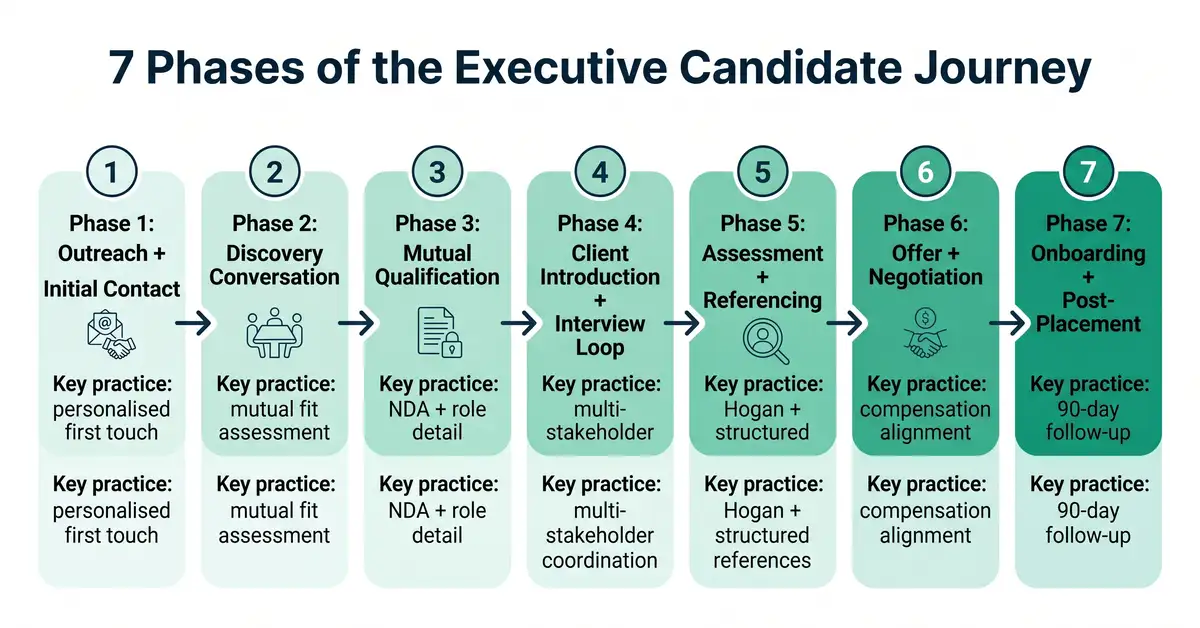
The executive candidate journey runs across 7 discrete phases, each with its own quality bar. Per Blue Rock Search's candidate journey mapping framework and Recruiterflow's executive search process documentation, mapping the journey explicitly is the first step toward managing it deliberately. Each phase has measurable inputs and outputs; consultant accountability lives at the phase boundaries.
Phase 1: Outreach + Initial Contact
Personalised first touch in the candidate's preferred channel (LinkedIn InMail for digital natives, personal email for senior executives, warm introductions through mutual connections for board-level). No templated outreach. Reference specific candidate context: a recent post, project, conference talk, professional milestone. Per Loxo's analysis of senior leadership outreach, messages sent from Managing Partner profiles achieve 2 to 3 times the open and reply rates of junior researcher accounts.
Phase 2: Discovery Conversation
Mutual fit assessment, 45 to 60 minutes, candidate's questions answered first. The conversation is exploratory, not transactional. Per Metaview's executive search strategy research, the highest-performing discovery calls allocate the first 20 minutes to understanding the candidate's career narrative and aspirations before pitching the role. Confidentiality framing established here.
Phase 3: Mutual Qualification
NDA executed before sharing client identity or strategic context. Per Mosaic Search's NDA best practices and Warner Scott's confidentiality protection research, NDA discipline protects candidate, client, and firm simultaneously. Role detail shared, candidate criteria refined, mutual qualification confirmed before progressing.
Phase 4: Client Introduction + Interview Loop
Multi-stakeholder coordination, prep materials provided before each interview stage, debrief calls between stages, calendar logistics owned by the firm not the candidate. Per Phaidon's executive search interview research, the firms that provide structured interview prep packets (interviewer bios, anticipated questions, strategic context) close 25 to 40 percent more offers than firms that leave candidates to prepare unaided.
Phase 5: Assessment + Referencing
Psychometric tools (Hogan, Pymetrics, ghSMART) explained transparently to candidate before administration. Per AESC Professional Practice Standards, transparency on assessment methodology is non-negotiable for executive search. References managed with candidate consent, no surprise calls, candidate informed of reference outreach in advance.
Phase 6: Offer + Negotiation
Compensation alignment discussed early in the process, not surprise late. Per Horton International's compensation transparency analysis, candidates respond best when total compensation (base, bonus, equity, benefits, signing) is mapped transparently against market benchmarks. The firm advocates for the candidate where appropriate while maintaining client fiduciary discipline.
Phase 7: Onboarding + Post-Placement Follow-up
30-day, 60-day, 90-day check-ins after placement. Per Korn Ferry's research on de-risking recruitment, the 90-day post-placement window is when most executive hires fail or thrive. The firm that maintains contact through this window converts placement candidates into long-term pipeline relationships, feeding the firm's talent pipeline architecture for future mandates.
Communication Discipline Standards
The single most cited candidate complaint across executive search is communication failure. Per HR Dive's research on candidate response time expectations, candidates expect first response within 1 hour for active inquiries and substantive replies within 24 hours. Per Acara Solutions' research on ghosting in the hiring process, 75 percent of candidates report being ghosted at least once by a recruiter, with executive candidates experiencing it at near-identical rates despite higher mandate stakes.
| Touchpoint | Response Standard | Why It Matters |
| First reply to inbound | Within 1 hour | Signals candidate priority and firm responsiveness |
| Substantive reply to question | Within 24 hours | Prevents candidate frustration and disengagement |
| Post-interview feedback to candidate | Within 48 hours | Closes loop while interview is fresh, builds trust |
| Shortlist decision communication | Within 48 hours of client decision | Respects candidate time and decision-making |
| Rejection with specific feedback | Within 5 business days | Maintains relationship for future opportunities |
| Post-placement check-in | 30, 60, 90 days | Transitions candidate into long-term pipeline |
Sources: HR Dive Candidate Response Time Research, Rentarecruiter Recruitment Feedback Loop Best Practices, Acara Solutions Ghosting Research
The 10 Essential Best Practices for Executive Candidate Experience

Personalised first outreach
No templated InMail. Reference specific candidate context (recent post, project, conference talk, board appointment). Per Atlas Recruit outreach campaign research, personalised first messages achieve 3 to 5 times the response rate of templated outreach across executive talent. The 10-minute investment in research compounds across the entire mandate.
Respect candidate time
90-minute interview cap. Schedule around candidate availability, not just client convenience. Per Reed's research on interview duration, interviews exceeding 90 minutes show diminishing return on assessment quality while consuming candidate goodwill. Sequential interviews scheduled with breaks. No back-to-back 4-hour panel marathons for senior candidates.
Confidentiality protections
NDA executed before strategic detail shared. Encrypted communication channels (Signal, Proton, password-protected document portals) for sensitive content. Personal email only, never work email. Per Movement Search's analysis of confidential executive search, confidentiality discipline is the single highest-impact practice for senior executive engagement. Connects to the cluster's passive engagement confidentiality mechanics.
Preparation depth
Briefing materials provided before each interview: client research summary, interviewer biographies, anticipated questions, strategic context. Per Phaidon's executive search research, firms providing structured prep packets close 25 to 40 percent more offers than firms leaving candidates unaided. The prep packet is a 30-minute consultant investment that produces hours of candidate confidence.
Structured feedback within 48 hours
Every interview produces written feedback to the candidate within 48 hours. Specific strengths observed, specific development areas, next steps confirmed. Per Rentarecruiter's feedback loop best practices, the firms that close feedback loops within 48 hours report 60 to 80 percent candidate NPS versus 20 to 40 percent for firms that delay or skip feedback.
Assessment transparency
Explain what assessment tools will be used (Hogan, Pymetrics, ghSMART, structured behavioral interviews), why, and how data will be used in the decision. Candidate consent obtained before administration. Per AESC Professional Practice Standards, transparency on assessment is a fundamental ethical requirement for AESC-member firms.
Reference management discipline
Candidate informed of every reference call before it happens. No surprise outreach to current employer or colleagues. References managed gracefully across 5 to 8 contacts (peers, direct reports, board chair, prior CEO). Per CapDev's research on board-led executive search, reference call discipline correlates strongly with candidate NPS.
Compensation discussion timing
Early, transparent, calibrated to market data. The firms that surface compensation expectations in Phase 3 (Mutual Qualification) avoid the late-stage offer surprises that kill 15 to 25 percent of placements. Per Horton International's compensation transparency analysis, package transparency across base, bonus, equity, benefits, and signing creates a foundation for productive negotiation rather than adversarial bargaining.
Onboarding extension to 90 days
Post-placement check-ins at 30, 60, 90 days. Listen for early-warning signs of failed placements. Maintain relationship beyond the immediate mandate. Per Korn Ferry's de-risking recruitment research, the 90-day window is when 30 to 50 percent of executive hires fail; proactive consultant engagement during this window protects placement and feeds future referrals.
Graceful rejection with future framing
Rejected candidates receive specific feedback (not "we went a different direction") plus future opportunity framing. The candidate not right for this CMO mandate may be perfect for the next one in 18 months. Per Prosum's research on candidate experience and employer brand, the firms that handle rejection well retain 60 to 80 percent of rejected candidates in their pipeline versus 10 to 20 percent for firms that ghost or generic-message rejection.
Measuring Candidate Experience: The NPS Framework

Candidate experience that is not measured does not improve. The standard measurement framework adapts Survale's CandE Award benchmarking methodology for executive search, combining post-placement and post-rejection long-form surveys with phase-specific micro-surveys captured during the mandate. Per Survale's analysis of candidate NPS effectiveness, NPS alone is insufficient for executive search; combining NPS with phase-specific questions surfaces actionable improvement areas.
The metric architecture per Recruiterflow's candidate experience metrics guide and McLean & Company's talent acquisition research:
| Metric | Measurement Cadence | Target Benchmark |
| Post-placement NPS | Day 30 after placement | 50+ (top quartile 70+) |
| Post-rejection NPS | 10 days after final decision | 30+ (rejected candidates harder to score) |
| Phase-specific micro-survey | After Discovery, Interview Loop, Offer | 4.0+/5.0 on 3-5 questions |
| Time-to-first-response | Continuously tracked | Under 1 hour median |
| Feedback timeliness | Per interview event | 95%+ within 48 hours |
| Confidentiality discipline | Per mandate audit | Zero breaches |
| Verbatim feedback themes | Quarterly review | Action items per Practice Lead |
Sources: Survale CandE Award Benchmarking, Recruiterflow Candidate Experience Metrics, McLean & Company Talent Acquisition Research
The candidate NPS compounding effect
Candidate NPS correlates directly with three downstream metrics that matter to executive search firm economics: future mandate referrals from placed candidates' networks, pipeline retention (rejected candidates who stay engaged for future roles), and brand reputation in the small executive market. The firms that institute formal CX measurement see 15 to 25 percent year-over-year improvement in mandate volume from referral channels. The firms that do not measure plateau and slowly decline as competitors raise the bar. Aligned with the cluster's executive search KPI dashboard.
The Cost of Poor Candidate Experience
The economic cost of poor candidate experience compounds across three vectors that executive search firm leadership must quantify. Per SeekOut's research on the high cost of poor candidate experience, poor experience reduces offer acceptance by 25 to 40 percent. For a boutique firm running 10 to 20 senior mandates annually at $100k average mandate fee, a 30 percent acceptance drop costs $300k to $600k per year in direct revenue. Per KiTalent's analysis of hidden costs in executive hiring, the indirect costs compound further through brand damage and referral loss.
The reputation amplifier is the highest-leverage cost. Per Hunt Scanlon Media's executive ecosystem research, one poor experience reaches 15 to 25 peer executives through informal networks within 6 months. The CTO who was ghosted by your firm tells the next 20 CTOs they meet. Your firm's CTO pipeline contracts measurably within 12 months as candidates decline to engage. Per Stardex's analysis of executive search failure modes, candidate experience failures are cited as a contributing factor in approximately 30 to 40 percent of failed retained searches.
Client trust damage is the third cost. When a candidate complains to the hiring CEO about the search firm's behaviour during the process, the firm rarely receives the next mandate from that client. Per Korn Ferry's executive search practice analysis, candidate-to-client feedback loops are common at the senior level because executives know each other and share experiences candidly. The firm whose name comes up negatively in a CEO peer conversation loses mandate opportunities they never knew existed.
AI-Augmented Candidate Experience

AI changes candidate experience in executive search through 4 capability layers, without replacing the human relationship discipline that defines premium search. Per Recruiterflow's AI in recruiting guide and OneWayInterview's 2026 AI recruiting tools analysis:
Response time monitoring: AI auto-flags when consultant response times exceed thresholds, preventing accidental ghosting that is the single most damaging candidate experience failure. The system surfaces "consultant has not responded to candidate X in 48 hours" alerts to Managing Partners before damage occurs.
Interview prep automation: AI-drafted candidate briefing packets, client research summaries, interviewer profiles generated within minutes rather than the 2 to 3 hours of researcher time previously required per interview. The consultant edits the AI draft before sending, preserving personalisation while compressing production time.
Sentiment analysis on candidate communications: Surface dissatisfaction signals in candidate emails and call notes before they escalate. Per Bullhorn GRID 2026, sentiment analysis catches 60 to 80 percent of candidate frustration signals 1 to 2 phases earlier than human review, enabling intervention before relationships damage.
Post-stage micro-survey automation: Auto-trigger 3-5 question NPS surveys after Discovery, Interview Loop, and Offer phases. The data feeds the firm's CX dashboard without requiring consultant manual outreach. Connects to the cluster's broader AI for executive search infrastructure.
Where AI hurts at the executive level: AI-generated outreach without human personalisation feels obvious and templated; AI-generated rejection messages without specific feedback damage trust faster than no message; AI-scored candidates ranked without human relationship judgment miss the nuanced fit assessments that define executive placement. The high-performing model uses AI for high-volume low-judgment tasks and reserves human attention for high-stakes interactions.
Architecting the candidate experience operating system that compounds across every mandate?
Book a Growth Mapping CallThe 8 Most Common Candidate Experience Failure Modes
Failure 1: Ghosting after interviews
The single most damaging failure mode. Candidates who never hear back after a final interview lose trust in the firm and the client. Per Acara Solutions ghosting research, 75 percent of candidates report being ghosted at least once by a recruiter. Zero tolerance policy required at the executive level.
Failure 2: Generic templated outreach
Mass-produced InMails and emails that fail to reference candidate-specific context. Executive candidates spot templates within 5 seconds and ignore them. The 10-minute personalisation investment is the highest-ROI activity in candidate engagement.
Failure 3: Last-minute schedule changes
Cancelling or rescheduling within 24 hours of an interview signals candidate is low priority. Per Tribepad's candidate experience research, schedule discipline is consistently rated in the top 3 CX factors by senior candidates.
Failure 4: No feedback after rejection
Generic "we went a different direction" without specific feedback wastes the candidate's investment in the process and damages the firm's future pipeline. Specific feedback (strengths observed, development areas, future fit framing) retains rejected candidates in the firm's relationship network.
Failure 5: Breach of confidentiality
Mentioning candidate identity outside agreed parties, sending sensitive content to work email, discussing candidate context with other clients. Per Movement Search confidentiality research, a single breach in a small executive market produces 6 to 12 months of pipeline damage.
Failure 6: Over-promising compensation
Suggesting compensation ranges higher than the client will offer to keep the candidate engaged, then watching the offer fall short in Phase 6. Per Horton International compensation transparency research, late-stage compensation surprises kill 15 to 25 percent of executive placements.
Failure 7: Poor stakeholder coordination
Multiple consultants from the same firm contacting the candidate with conflicting information. Different client stakeholders contacted unannounced. The candidate experiences chaos and downgrades the firm's competence assessment. Per SHRM's research on improving candidate experience, internal coordination is a top-5 candidate complaint.
Failure 8: No post-placement follow-up
Transactional engagement that ends at offer signing. The firm misses the relationship continuity that converts placement into long-term pipeline asset. Per Korn Ferry de-risking research, 30-60-90-day check-ins protect placements and feed future referrals.
The 7-Step Playbook for Instituting Candidate Experience as a Competitive Moat
Baseline measurement
Deploy post-placement and post-rejection NPS surveys to candidates from the last 12 months. Establish baseline candidate NPS per Practice Lead. The baseline reveals which consultants are CX strengths and which require coaching. Per Survale CandE methodology, transparent baseline measurement is a non-negotiable prerequisite for improvement.
Map the 7-phase journey explicitly
Document the firm's candidate journey across all 7 phases with specific responsibilities, deliverables, and quality standards per phase. Identify the phase boundaries where most CX failures occur. The map becomes the operational playbook for every mandate.
Institute communication discipline standards
Codify response time benchmarks (1 hour first reply, 24 hours substantive, 48 hours feedback). Implement CRM auto-flagging when SLAs are missed. Hold weekly CX review meetings. Per HR Dive research, communication discipline is the highest-leverage single intervention for improving candidate NPS.
Build the prep packet system
Standardise pre-interview briefing materials: client research summary, interviewer biographies, anticipated questions, strategic context. Per Phaidon executive search research, this single practice produces 25 to 40 percent improvement in offer acceptance.
Confidentiality discipline audit
Audit the firm's confidentiality mechanics: NDA execution timing, encrypted channel usage, work-email avoidance, off-limits tracking. Per Mosaic Search NDA best practices, executive search firms operating without disciplined confidentiality practices are 3 to 5 times more likely to experience candidate trust failures.
AI capability layer activation
Deploy response time monitoring, interview prep automation, sentiment analysis, and post-stage micro-survey automation. Start with one capability layer. Per Bullhorn GRID 2026, firms compounding AI capability layer by layer outperform firms attempting full automation deployment at once.
Quarterly CX review and continuous improvement
Quarterly NPS review per Practice Lead, verbatim feedback theme analysis, root cause analysis on CX failures, action items prioritised against effort and impact. CX becomes a measurable, optimisable system rather than a vague aspiration. Connects to the firm's overall 7-pillar executive search methodology.
Install the candidate experience operating system that compounds reputation across every mandate
Elite executive search firms scaling candidate experience into competitive infrastructure need phase-specific quality standards, AI-augmented response monitoring, CRM-integrated feedback automation, and NPS measurement operating at the operating-system level. peppereffect installs the agentic workflows that decouple service quality from consultant memory, automate the 70 percent of repetitive CX maintenance, and protect the relationship capital that justifies elite-tier search engagement positioning.
Book a Growth Mapping CallFrequently Asked Questions
What is candidate experience in executive search?
Candidate experience in executive search is the cumulative impression a senior candidate forms across every interaction with a search firm, from initial outreach through post-placement onboarding. Unlike volume hiring CX which focuses on application UX and ATS automation, executive candidate experience centers on confidentiality discipline, multi-stakeholder coordination, structured assessment transparency, timely substantive feedback, and the relationship continuity that extends past the immediate mandate. Elite firms report candidate NPS scores of 50+ across their pipelines, with top-quartile firms achieving 70+, versus industry averages around 30-40 for general recruiting.
What are the 10 essential candidate experience best practices for executive search?
The 10 essential best practices are: 1) Personalised first outreach (no templated messages, references to specific candidate context); 2) Respect for candidate time (90-minute interview cap, scheduling around candidate availability); 3) Confidentiality protections (NDA before strategic detail, encrypted channels, personal email only); 4) Preparation depth (briefing materials, client research provided before each interview); 5) Structured feedback within 48 hours of every interview (no ghosting, ever); 6) Assessment transparency (explain Hogan, MBTI, or other tools, why used, how data interpreted); 7) Reference management (gracefully, no surprise calls, candidate informed first); 8) Compensation discussion timing (early, transparent, calibrated to market data); 9) Onboarding extension (90-day post-placement check-ins); 10) Graceful rejection (specific feedback, future opportunity framing, not radio silence).
What are the 7 phases of the executive candidate journey?
The 7 phases are: Phase 1 Outreach + Initial Contact (personalised first touch within candidate's preferred channel); Phase 2 Discovery Conversation (mutual fit assessment, 45 to 60 minutes, candidate's questions answered first); Phase 3 Mutual Qualification (NDA executed, role detail shared, candidate criteria refined); Phase 4 Client Introduction + Interview Loop (multi-stakeholder coordination, prep materials before each stage, debrief calls between stages); Phase 5 Assessment + Referencing (psychometric tools explained transparently, references managed with candidate consent); Phase 6 Offer + Negotiation (compensation alignment, transparency on package components, advocacy for candidate where appropriate); Phase 7 Onboarding + Post-Placement Follow-up (30 day, 60 day, 90 day check-ins, transition into long-term pipeline relationship).
Why does candidate experience matter more in executive search?
Executive candidate experience matters more because executives network heavily, the market is small, and brand damage compounds quickly. Per Hunt Scanlon Media research on executive ecosystems, a single poor candidate experience reaches 15 to 25 peer executives through informal networks within 6 months. Per SeekOut research on the cost of poor candidate experience, poor CX reduces offer acceptance by 25 to 40 percent. Per Korn Ferry talent acquisition trends, executive candidates evaluate search firms as carefully as they evaluate the hiring client, and a poor firm experience often leads candidates to decline the role entirely even when the client and role fit. Candidate NPS correlates directly with future mandate referrals, pipeline retention, and firm reputation in the small executive market.
How do you measure candidate experience in executive search?
Candidate experience measurement combines micro-surveys after each phase with comprehensive post-placement and post-rejection surveys. The standard framework adapts the Talent Board CandE methodology for executive search: 1) Net Promoter Score (NPS) measured at post-placement and post-rejection (target 50+, top quartile 70+); 2) Phase-specific micro-surveys (3-5 questions after Discovery, Interview Loop, Offer); 3) Time-to-first-response tracking (target under 1 hour); 4) Feedback timeliness percentage (target 95%+ within 48 hours); 5) Confidentiality discipline scoring (zero breaches tolerated); 6) Verbatim feedback collected and analysed; 7) Year-over-year NPS trend per Practice Lead. Top-performing firms publish anonymised CX metrics internally to drive accountability.
What is the cost of poor candidate experience for executive search firms?
The cost of poor candidate experience for executive search firms compounds across three vectors: 1) Direct revenue impact (per SeekOut research, poor CX reduces offer acceptance by 25 to 40 percent, killing mandate fees on placements that should have closed); 2) Brand reputation damage in small executive markets (per Hunt Scanlon ecosystem research, one poor experience reaches 15 to 25 peers within 6 months, eroding future pipeline quality and mandate referrals); 3) Client relationship damage (when a candidate complains to the hiring CEO about a search firm's behaviour, the firm rarely receives the next mandate from that client). The cumulative cost can exceed $500k per year for a mid-tier boutique firm running 10 to 20 senior mandates annually.
How does AI change candidate experience in executive search?
AI changes candidate experience in executive search through four capability layers without replacing human relationship discipline: 1) Response time monitoring (auto-flagging when consultant response times exceed thresholds, preventing accidental ghosting); 2) Interview prep automation (AI-drafted candidate briefing packets, client research summaries, interviewer profiles generated within minutes); 3) Sentiment analysis on candidate communications (surfacing dissatisfaction signals early); 4) Post-stage micro-survey automation (NPS scoring after each phase). Where AI hurts: AI-generated outreach without human personalisation, AI-generated rejection messages without specific feedback, AI-scoring candidates without human relationship judgment. Per Bullhorn GRID 2026, top performers use AI for the high-volume low-judgment parts and reserve human attention for the high-stakes interactions.
Resources
- Survale: Talent Board CandE Award Benchmarking
- Survale: Is Candidate Experience NPS Any Good
- Bullhorn GRID 2026 Industry Trends Report
- Korn Ferry: Executive Search Practice
- Korn Ferry: Talent Acquisition Trend Predictions
- Korn Ferry: De-Risking Recruitment with RPO
- Russell Reynolds: Executive Search Capabilities
- Hunt Scanlon Media: Executive Search Industry Overview
- AESC: Professional Practice Standards
- SeekOut: The High Cost of Poor Candidate Experience
- AIHR: Candidate Experience Fundamentals
- AIHR: 11 Candidate Experience Best Practices 2026
- Tribepad: Ultimate Guide to Candidate Experience
- Recruiterflow: Candidate Experience Metrics Guide
- Recruiterflow: Executive Search Process
- Recruiterflow: How to Use AI in Recruiting
- McLean & Company: Talent Acquisition Research
- SHRM: Improving the Candidate Experience
- HR Dive: Candidate Response Time Expectations and Ghosting
- Acara Solutions: Recruiter and Hiring Manager Ghosting
- Rentarecruiter: Recruitment Feedback Loop Best Practices
- Mosaic Search: NDA Best Practices in Recruitment
- Movement Search: Confidential Executive Search Protections
- Warner Scott: Confidentiality When Engaging Search Firms
- Horton International: Compensation Transparency in Executive Hiring
- Phaidon International: Common Executive Search Interview Questions
- Reed: How Long Should an Interview Last
- Loxo: Power of Senior Leadership Candidate Outreach
- Blue Rock Search: Candidate Journey Mapping
- Metaview: Executive Search Strategy 2026
- CapDev: How Boards Lead a Successful Executive Director Search
- Atlas Recruit: Outreach Recruitment Campaigns
- KiTalent: Hidden Cost of Executive Hire
- Stardex: Why Executive Searches Fail
- Prosum: Candidate Experience Shapes Employer Brand
- OneWayInterview: AI Recruiting Tools 2026
- Juicebox: Candidate Experience Best Practices 2026
executive candidate assessment methodology
inclusive executive search methodology talent mapping methodology for executive search firms talent acquisition strategy for scaling hires employer value proposition methodology