

Digital transformation strategy, beyond the buzzword
A digital transformation strategy is the plan that ties your technology and data investments to specific business outcomes, plus the operating-model and people changes needed to actually realise them. It is not a digital strategy, not buying software, and not digitising what you already do. Real transformation changes how the business creates and delivers value, not just which tools it uses. That distinction is the whole game, because most transformations fail on exactly this point.
The numbers are sobering. BCG research found that 70% of digital transformations fall short of their objectives, which means fewer than a third succeed. Yet the money keeps flowing: IDC forecasts worldwide digital transformation spending will reach 3.9 trillion dollars by 2027. Spending more is clearly not the answer. Spending on the right things, in the right order, with the right operating-model changes, is. This guide shows you how to build a strategy that actually lands.
Sources: BCG, Flipping the Odds of Digital Transformation Success (2020); IDC Worldwide Digital Transformation Spending Guide (2023).
What you will get from this guide:
- What a digital transformation strategy actually is, versus the buzzword
- Why 70% fall short, and the root causes you can avoid
- The seven components every real strategy needs
- A practical five-step framework to build yours
- Where AI and automation fit in 2026, and how to measure success
Key Takeaway
Digital transformation is not a technology project. It is a business change that technology enables. The organisations in the winning 30% treat strategy, process redesign, and people as the work, and treat tools as the easy part.

What a digital transformation strategy actually is
The fastest way to understand a digital transformation strategy is to separate three words people use interchangeably. Digitization is converting analog to digital, like turning paper forms into PDFs. Digitalization is using digital technology to improve a process you already run, like moving sales from spreadsheets to a CRM. Digital transformation is bigger than both: it uses technology, data, and new ways of operating to fundamentally change how the business creates and delivers value. Gartner draws these same distinctions, and the gap between them explains most of the confusion in the boardroom.
A digital transformation strategy, then, is the plan that connects those investments to concrete business outcomes and the operating-model changes required to achieve them. It is not a digital strategy, which improves the current model with technology. It is not ad-hoc digitisation, which bolts on isolated tools. And it is emphatically not buying software, the single most expensive misunderstanding in the field. Software is an enabler. Strategy decides what to change and why.

Why did it become a buzzword? The term inflated from around 2013 onward as digital competitors disrupted traditional models. Vendors and consultancies repackaged almost any technology spend as "transformation," and the word lost its meaning. The result is what researchers call digital theatre: superficial technology adoption that looks like change while the business model underneath stays exactly the same. Real transformation reimagines how value is created, not just which apps are in the stack.
Key Takeaway
If your transformation plan can be satisfied by a purchase order, it is not a transformation strategy. Strategy names the business outcome, redesigns the work, and treats technology as the means rather than the goal.
Why 70% of digital transformations fall short
The failure rate is not a technology problem. It is a strategy and execution problem. When BCG found that 70% of transformations fall short of their objectives, the root causes clustered into a predictable set, and every one of them is avoidable.

The first and biggest cause is the absence of a clear, outcome-focused strategy. Initiatives launched to "become more digital," with no specific target, drift and stall. The second is weak change management and culture. The human side of transformation is roughly 80% of the work, yet it is routinely the most under-funded part of the budget. The third is leadership misalignment, where sponsorship wavers or executives pull in different directions. The fourth is technology-first thinking: buying and deploying tools before redesigning the underlying process, which simply produces a faster version of a broken workflow. Round it out with skills gaps, fragmented data, and no governance to measure whether any of it is working.
Watch Out
The most common and costly mistake is automating a broken process. Layering new technology onto a workflow you have not redesigned locks the dysfunction in place and makes it run faster. Map and fix the process first, then automate. This single sequencing error sinks a large share of transformation budgets.
The seven components of a real strategy
A strategy that lands addresses seven interdependent components. Weakness in any one undermines the rest, which is why selective focus on technology alone produces the 70% outcome.
- Vision tied to outcomes. Specific, measurable business results, not "be more digital." For example, cut cost-to-serve by a set percentage or generate a defined share of revenue from new digital offerings.
- Honest current-state assessment. A clear-eyed read of your technology, processes, people, and data, including where the real bottlenecks are.
- Prioritised roadmap. A sequence that balances quick wins with foundational capabilities, respecting dependencies like data governance before advanced analytics.
- Operating-model and process redesign. Reimagining how the work gets done around customer outcomes, not just digitising the current org chart.
- Technology and data architecture. A modular, API-first foundation that treats data as a strategic asset rather than exhaust.
- Change management and adoption. The 80%: capability building, leadership modelling, and adoption designed in from day one.
- Governance and metrics. Value tracking and KPIs that tie every initiative to a result and let you course-correct.
Notice how few of these are about technology. The foundation is process and people, which is exactly where the failed majority underinvest. Our guide to business process mapping covers component four in depth, because you cannot redesign what you have not mapped.
A practical framework to build your strategy
Here is the five-step sequence to move from intent to implementation. Each step exists to defuse one of the failure causes above.
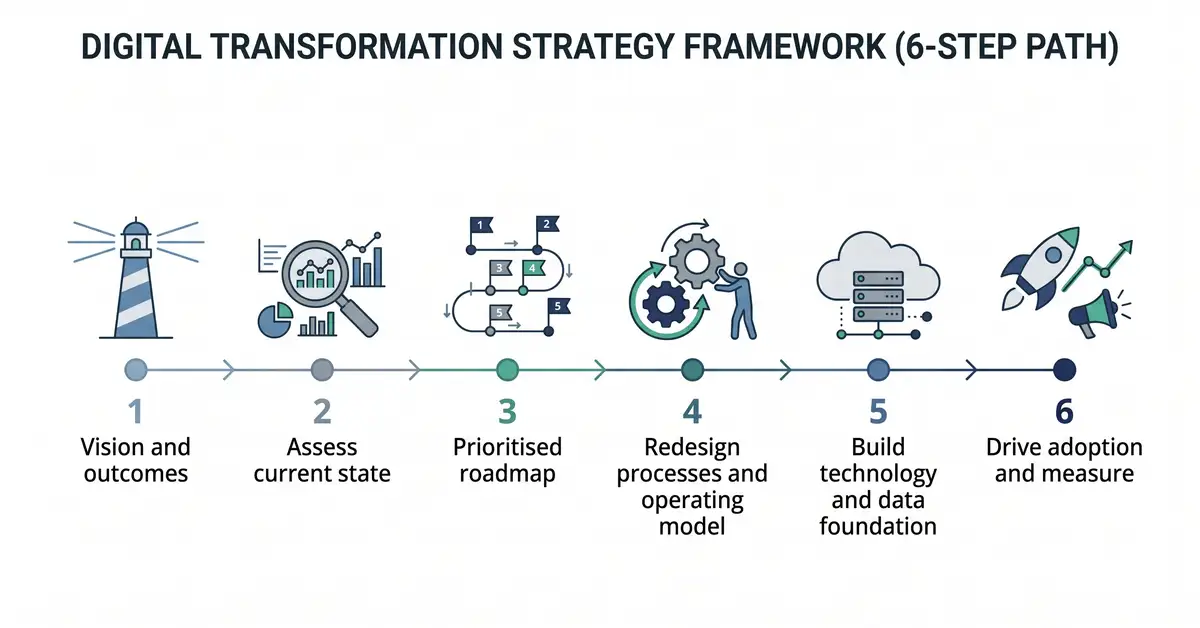
Align leadership and define outcomes
Get the executive team to commit to specific, measurable business outcomes and named sponsorship. Documented alignment is the strongest predictor of success.
Assess the current state
Evaluate technology, processes, people, and data honestly. Identify the high-friction, high-volume processes where transformation will pay back fastest.
Build a prioritised roadmap and business case
Sequence initiatives by value and dependency. Attach a business case and a metric to each so funding follows evidence, not hype.
Redesign the operating model and build capability
Reshape the work around outcomes before automating it, and build the skills and change-champion network that adoption depends on.
Govern execution and adapt
Run value-based governance with leading and lagging metrics. Review, learn, and adjust. Transformation is a loop, not a launch.
Want to find the processes worth transforming first?
See operational efficiency systemsWhere AI and automation fit in 2026
The transformation conversation has moved. A decade ago it meant digitising the back office. In 2026 the leading edge is installing an AI operating system: agentic AI and workflow automation deployed across the customer lifecycle so that output scales without proportional headcount. This is the most consequential shift in what transformation means, because it changes the economics. Instead of adding people to grow, you add autonomous systems that handle the repetitive, rules-based work while your team focuses on judgment and relationships.

The caution is the same one that has always applied: AI without a strategy is just a more expensive version of technology-first thinking, sometimes called AI washing. Bolting an AI agent onto an unmapped, broken process fails exactly the way every other tech-first project fails. The winners treat AI as the enabler inside a clear strategy, not as the strategy itself. If you are weighing this shift, our explainer on agentic AI versus traditional automation shows what actually changed, and our guide on how to build an AI agent covers the practical build.
How to measure success
If you cannot measure it, you cannot govern it, and ungoverned transformations are the ones that quietly fail. Track a balanced mix of leading and lagging indicators. Leading indicators tell you whether change is taking hold: adoption rates, cycle-time reduction, and automation coverage. Lagging indicators tell you whether it is paying off: revenue from new digital offerings, cost-to-serve, margin expansion, and revenue per employee. The discipline that separates the 30% from the 70% is simple to state and hard to maintain: every initiative on the roadmap carries a specific metric, and funding continues only while that metric moves.

Common mistakes and how to de-risk
The failure patterns are predictable, which makes them avoidable. The big-bang mistake is trying to transform everything at once instead of proving value on one process first. The broken-process mistake is automating dysfunction. The budget mistake is starving change management while overspending on tools. The measurement mistake is having no metrics, so no one can tell success from motion. And the leadership mistake is launching without sustained executive sponsorship. De-risking is the same move in every case: start narrow, pick one high-value process, redesign it, prove the return, then expand from a position of evidence rather than faith.
Stop buying software. Start installing an operating system.
peppereffect architects digital transformation the way the winning 30% do it: outcomes first, processes redesigned, then autonomous AI systems installed across your customer lifecycle. The result is growth decoupled from headcount, with the metrics to prove it. We build the machine, you keep the leverage.
Book a Growth Mapping CallFrequently asked questions about digital transformation strategy
What is a digital transformation strategy? A digital transformation strategy is the plan that ties technology and data investments to specific business outcomes, along with the operating-model and people changes needed to realise them. It differs from a digital strategy, which improves the existing model with technology, and from simply buying software. Real transformation changes how the business creates and delivers value, not just which tools it uses.
Why do most digital transformations fail? BCG research found 70% fall short of their objectives, and the causes are consistent: no clear outcome-focused strategy, weak change management and culture, leadership misalignment, and technology-first thinking that automates broken processes. Almost none of the failures are caused by the technology itself. They are caused by skipping the strategy, process, and people work.
How do you develop a digital transformation strategy? Follow five steps: align leadership on measurable outcomes, assess your current state honestly, build a prioritised roadmap with a business case per initiative, redesign the operating model before automating, and govern execution with clear metrics. Each step exists to defuse a known failure cause, and the sequence matters as much as the content.
What is the difference between digitization, digitalization, and digital transformation? Digitization converts analog information to digital, like scanning paper to PDF. Digitalization uses digital technology to improve an existing process, like adopting a CRM. Digital transformation uses technology, data, and new operating models to fundamentally change how the business creates value. The first two optimise what exists; the third reinvents it.
How long does a digital transformation take? It is a continuous journey rather than a fixed project, but the way to make it tractable is to break it into phases that each deliver value. The smartest approach is to start with one high-value process, prove the return in weeks to months, then expand. Treating transformation as a single multi-year big-bang is one of the most reliable ways to join the 70% that fall short.
What role does AI play in digital transformation in 2026? AI has moved from a point solution to the centre of transformation. Leading organisations install AI operating systems, agentic AI and workflow automation across the customer lifecycle, so output scales without adding headcount. The caveat is that AI without a clear strategy repeats the same technology-first failure pattern, so it must sit inside a strategy rather than replace one. change management for technology adoption workflow audit
Resources
- BCG: Flipping the Odds of Digital Transformation Success: the 70% finding and success factors.
- IDC: Worldwide Digital Transformation Spending Guide: the 3.9 trillion dollar 2027 forecast.
- McKinsey: Unlocking Success in Digital Transformations: success factors and root causes.
- Gartner glossary: digitalization vs digital transformation: the definitional distinctions.
- peppereffect: Operational Efficiency: systems that scale without headcount.