

The workflow audit: find the 20% that eats 80% of your time
A workflow audit is a systematic review of how work actually gets done, designed to find the small set of processes that consume a disproportionate share of your team's time, cost, and effort. You run one by inventorying your processes, mapping the current state, capturing time and cost per step, finding the bottlenecks and waste, then prioritising what to fix, eliminate, or automate. It is the diagnostic step that should come before any automation project, because automating a broken process just makes the dysfunction run faster.
Most teams skip this step and jump straight to buying tools, which is exactly why so much automation underdelivers. A workflow audit is how you avoid that. It tells you precisely where the time goes, which processes are worth fixing, and which low-value, high-volume work is ready to hand to a machine. McKinsey found that 60% of all occupations have at least 30% of their activities technically automatable, so the upside hiding in your workflows is almost certainly large. The audit is how you find it.
Sources: GoLeanSixSigma, The 8 Wastes of Lean; McKinsey Global Institute, Jobs Lost, Jobs Gained.
What this guide covers:
- What a workflow audit is and why it comes before automation
- The 80/20 rule applied to your processes
- How to run an audit in five steps
- What to look for: the eight wastes and the bottleneck
- How to turn findings into action, and the metrics that matter
Key Takeaway
You cannot fix or automate what you have not measured. A workflow audit replaces the guesswork of "we should automate something" with evidence about exactly which processes are draining the most time and are worth acting on first.

What a workflow audit is, and why it comes first
A workflow audit is an operational review, not a compliance check. A compliance or financial audit asks whether you followed the rules. A workflow audit asks a different question: where does the work actually go, and where is it being wasted? It traces how a process really runs, end to end, including the handoffs, the waiting, the rework, and the manual workarounds that never appear in the official documentation. The goal is to surface the gap between how work is supposed to happen and how it actually happens, because that gap is where the time and money leak out.
It has to come before automation for one simple reason. If you automate a process that is badly designed, you do not fix it, you just make it run faster and harder to change. The audit is what tells you whether a process should be eliminated, redesigned, standardised, or automated. Skipping it is the single most common reason automation projects fail to deliver. This is the same discipline behind business process mapping, which is the technique you use inside the audit to capture the current state.
Key Takeaway
The order is map, fix, then automate. A workflow audit gives you the map and tells you what to fix, so that when you do automate, you are automating something that actually works.
The 80/20 rule applied to your workflows
Not all processes are worth your attention, and the audit is how you find the ones that are. The Pareto principle, named after the economist Vilfredo Pareto, holds that roughly 80% of effects come from about 20% of causes. Applied to operations, it means a small minority of your processes typically consume the large majority of your team's time and cost. A handful of high-friction, high-volume workflows, the manual invoice reconciliation, the multi-step client onboarding, the report that three people touch every week, quietly eat the calendar.

This is the most important mindset for an audit. The point is not to document every process in the business, which is how audits stall and never lead to action. The point is to find the vital few. When you quantify time and cost across your processes, the 20% that dominate will stand out clearly, and those are the only ones worth your first round of effort. Everything else can wait. Targeting the vital few is what turns an audit from a paperwork exercise into a source of real, fast return.
How to run a workflow audit in five steps
The method is the same whatever your industry. Follow these five steps in order and resist the urge to skip straight to solutions.
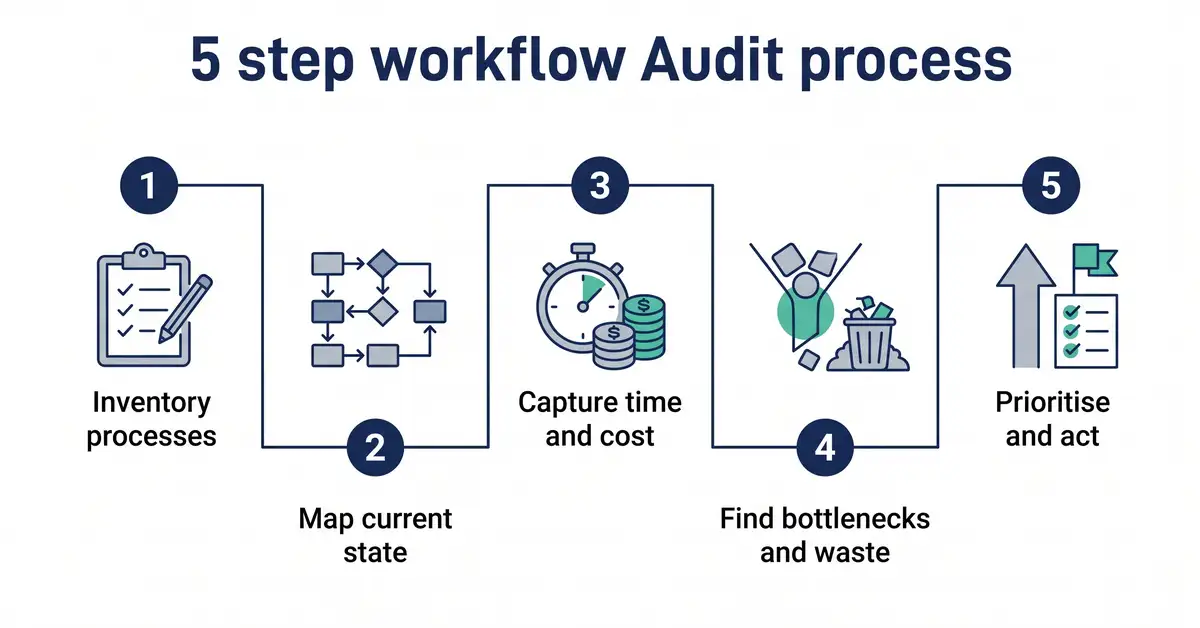
Inventory your processes
List the work that actually runs day to day, organised by what gets done, not by the org chart. Aim for the processes that touch time, money, and customers.
Map the current state
For each priority process, map every step, who does it, which tools they use, and where the handoffs happen. Map reality, not the official version.
Capture time and cost
Record how long each step takes, how often it runs, and what it costs. Separate touch time from waiting time. This is what surfaces the vital few.
Find the bottlenecks and waste
Look for the constraint that limits the whole process and the eight classic wastes: rework, waiting, manual handoffs, and the rest. Mark the manual, rules-based steps.
Prioritise and act
Score findings by impact versus effort, then decide for each: eliminate it, standardise it, or automate it. Start with the highest-impact, lowest-effort wins.
What to look for: the eight wastes and the bottleneck
Two lenses will catch almost everything worth fixing. The first is Lean's eight wastes, remembered by the acronym DOWNTIME: Defects, Overproduction, Waiting, Non-utilised talent, Transportation, Inventory, Motion, and Extra-processing. Every one of these shows up in office workflows, not just factories. Waiting is usually the biggest: in most processes, the majority of the total elapsed time is work sitting in a queue, not anyone actually touching it.

The second lens is the bottleneck. Eliyahu Goldratt's Theory of Constraints makes the point that a process is only as fast as its single slowest step, so improving anything other than the constraint is wasted effort. Find the one step where work piles up, and you have found the lever that governs the whole workflow. Alongside these, watch for handoff friction, shadow processes where people have quietly built their own spreadsheet workarounds, and the low-value, high-volume, rules-based tasks that are the prime candidates for automation. Given that McKinsey puts 30% or more of the activities in most jobs within reach of current automation, that last category is usually where the biggest prize sits.
Watch Out
The documented process is almost never the real process. People build undocumented workarounds to cope with friction, and those workarounds are where the waste hides. If you audit only the official flowchart and never watch the work actually happen, you will optimise a process that does not exist. Observe and interview the people who do the work.
Tools and techniques for the audit
You do not need expensive software to start, but the right techniques sharpen the picture. Process mapping and value stream mapping turn a process into a visual you can analyse and annotate with time and cost. Simple time tracking, even for a week, reveals where hours actually go. Process mining is the more advanced option: it reconstructs the real process automatically from the event logs your systems already generate, which is powerful for high-volume digital workflows because it shows what truly happens rather than what people remember happening. And the oldest technique remains the most reliable: interview and observe the people doing the work, because they know exactly where the friction is and are rarely asked.

Whichever tools you use, the output is the same: a quantified, honest picture of where time and money go, ranked so you know what to act on first.
Found the processes worth fixing? See what to do with them next.
Read the operational efficiency guideTurn findings into action
An audit only pays off if it ends in decisions. Score every finding on a simple impact-versus-effort basis, then sort each one into one of three actions. Eliminate the work that creates no value, because the fastest process is the one you no longer run. Standardise the work that is valuable but inconsistent, so there is one clear best way to do it. And automate the work that is valuable, repetitive, and rules-based, handing it to software so your team stops doing it by hand. The sequence matters: standardise before you automate, so you are encoding the right process rather than freezing a messy one. Once a process is clean and standard, automation turns it into leverage, and our guide to workflow automation tools covers how to build that layer.

The metrics that matter
Measure a few things well rather than everything badly. The most useful workflow metrics are cycle time, the total elapsed time from start to finish; touch time versus wait time, which exposes how much of that cycle is just waiting; cost per transaction, which turns time into money the business understands; error and rework rate, because rework is pure waste; and automation potential, the share of steps that are manual and rules-based. Track these before and after you act, and the audit stops being a one-off report and becomes a baseline you improve against.
We audit the workflow, then build the machine that runs it.
peppereffect runs the workflow audit, finds the 20% of processes draining your team, and installs the AI systems that eliminate, standardise, and automate them. The result is output that scales while your headcount does not, with the cycle-time and cost numbers to prove it. We build the machine, you keep the hours back.
Book a Growth Mapping CallFrequently asked questions about workflow audits
What is a workflow audit? A workflow audit is a systematic review of how work actually gets done in a business, designed to find the processes that consume a disproportionate share of time, cost, and effort. It maps the real flow of work, including handoffs, waiting, rework, and manual workarounds, then identifies what should be eliminated, standardised, or automated. It is an operational efficiency review, distinct from a compliance or financial audit.
Why should you do a workflow audit before automating? Because automating a broken process only makes the dysfunction run faster and harder to change. The audit tells you which processes are worth automating and which should be fixed or scrapped first. Skipping it is the most common reason automation projects fail to deliver their expected return. The right order is map, fix, then automate.
How do you conduct a workflow audit? Follow five steps: inventory your processes, map the current state of the priority ones, capture the time and cost of each step, identify bottlenecks and the eight forms of waste, then prioritise findings by impact versus effort and decide whether to eliminate, standardise, or automate each one. The key discipline is mapping reality rather than the documented version.
What is the 80/20 rule in a workflow audit? The 80/20 rule, or Pareto principle, is the observation that roughly 80% of effects come from about 20% of causes. In a workflow audit it means a small minority of your processes consume the majority of your time and cost. The audit's job is to find that vital 20% so you focus effort where it pays off, rather than trying to document and fix everything.
What should a workflow audit look for? Look for bottlenecks, the single slowest steps that limit the whole process, and the eight Lean wastes summarised by the acronym DOWNTIME: defects, overproduction, waiting, non-utilised talent, transportation, inventory, motion, and extra-processing. Also watch for handoff friction, undocumented workarounds, and low-value, high-volume, rules-based tasks that are ready to automate.
What metrics measure workflow efficiency? The core metrics are cycle time, touch time versus wait time, cost per transaction, error or rework rate, and automation potential. Cycle time shows total speed, the touch-versus-wait split shows how much is just queueing, and cost per transaction translates the waste into money. Measuring these before and after changes turns the audit into an ongoing baseline rather than a one-time exercise. standard operating procedures process documentation
Resources
- GoLeanSixSigma: The 8 Wastes of Lean: the DOWNTIME framework.
- McKinsey: Jobs Lost, Jobs Gained: the 60% of occupations with 30%+ automatable activities.
- peppereffect: Business Process Mapping: the mapping technique used inside the audit.
- peppereffect: Operational Efficiency: turning audit findings into systems that scale.
- peppereffect: Digital Transformation Strategy: where the audit fits in the bigger picture.