

The consulting business model you choose determines whether you build a Freedom Machine or stay trapped in the Technician's Trap. The US management consulting market reached USD 376.30 billion in 2024 according to IBISWorld, with the Big 4 (Deloitte, PwC, EY, KPMG) and MBB (McKinsey, Bain, BCG) anchoring the enterprise tier. But the structural advantage in 2026 belongs to boutique firms and solo operators who escape hourly billing in favor of value-based, retainer, and productized models that achieve 60-80% gross margins and decouple revenue from founder hours. This guide compares the 5 core consulting business models, documents the 8 pitfalls that keep consultants stuck billing time, and lays out the 7-step transition playbook to scale from hourly billing to a Freedom Machine.
Key Takeaway
Hourly billing caps revenue at consultant hours available and produces 15-25% margins. Value-based pricing (Alan Weiss methodology), retainer/subscription models (Gigradar pricing analysis), and productized services (Brennan Dunn PCaaS, Jonathan Stark Hourly Billing Is Nuts) achieve 60-80% gross margins and enable consultants to escape the Technician's Trap. The 5-model framework lets you architect a Freedom Machine generating 7-figures with under 5 hours per week of founder input.
The Consulting Business Model Landscape in 2026

Consulting market structure follows three tiers. The enterprise tier is dominated by the Big 4 (Deloitte, PwC, EY, KPMG) with audit, tax, advisory, and consulting service lines, plus MBB strategy consulting (McKinsey, Bain, BCG), with detailed comparison documented in CaseBasix analysis. The boutique tier captures specialist verticals: Boutique Consulting Club documents how boutique firms use growth strategies that Big 4 and MBB structurally cannot. The solo and microfirm tier captures niche advisors and productized service operators.
Market sizing reinforces the opportunity. Mordor Intelligence US Management Consulting projects sustained growth, European management consulting shows similar expansion, and Consultancy.uk reports UK consulting leaders projecting 5.7% growth in 2026. Firmsconsulting documents how boutique firms successfully compete against McKinsey and BCG through positioning and model choice rather than scale.
The five core consulting business models capture distinct revenue mechanics. Consulting Success documents the standard model taxonomy. Alan Weiss Value-Based Fees 3rd Edition anchors the value-based methodology. Brennan Dunn Double Your Freelancing PCaaS and Jonathan Stark Hourly Billing Is Nuts provide the productized service playbooks.
Architect the consulting business model that converts expertise into recurring premium revenue.
Schedule a Growth Mapping CallThe 5 Core Consulting Business Models Compared
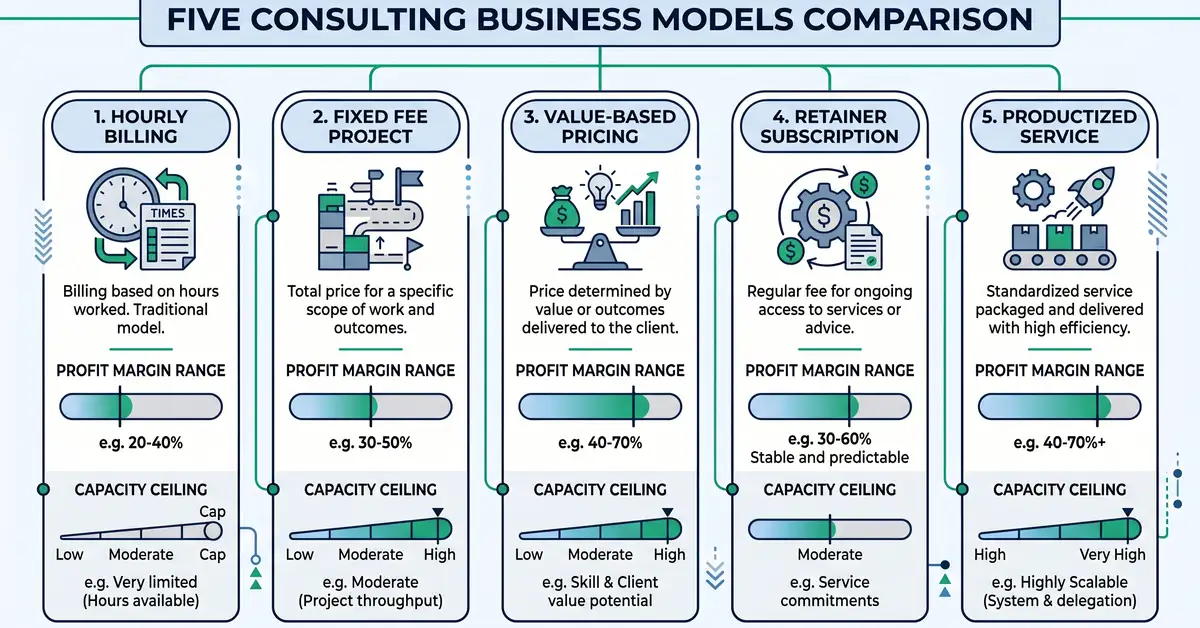
Model 1: Hourly Billing. The default for new consultants. Charge a per-hour rate (typically $100-$500 for solo consultants, $500-$2,000+ for partner-track) multiplied by hours worked. Revenue ceiling equals utilizable hours per year multiplied by hourly rate. Margins 15-25% after overhead. Jonathan Stark documents why hourly billing prevents growth: the model rewards inefficiency, creates perverse incentives, and caps founder revenue at available hours.
Model 2: Fixed-Fee Project. Quote a flat fee for a defined deliverable with clear scope. Margins 25-40% when scope is tight, but vulnerable to scope creep that destroys economics. Effective for diagnostic engagements, implementation work, and one-time interventions. The transition from hourly to fixed-fee is the first leverage move available to most consultants.
Model 3: Value-Based Pricing. Price as a percentage of client economic outcome, typically 4-10% per Mark Stiving Impact Pricing methodology and Alan Weiss Million Dollar Consulting framework. Consulting Success value-based pricing analysis documents 3-5x fee premiums versus hourly equivalents. NMS Consulting 2026 fee analysis confirms top-tier strategy consulting now anchors to value-based methodology. Implementation requires client diagnostic to quantify outcome value before quoting fee.
Model 4: Retainer and Subscription. Recurring monthly fee for ongoing access and defined deliverables. Gigradar retainer pricing analysis documents typical ranges of $5K-$50K/month. Fractional executive roles (fractional CFO, CMO, COO) cluster at $8K-$25K/month per Fractional C-Suite rates analysis. Simon-Kucher recurring revenue models documents why subscription consulting commands valuation premiums.
Model 5: Productized Service. Standardised offer with fixed scope, fixed price, predictable delivery, billed as monthly recurring revenue. Brennan Dunn PCaaS and Jonathan Stark Hourly Billing Is Nuts provide the canonical methodology. Examples include DesignJoy (unlimited design at $5K/month), Kit Creator Pro productized creator consulting, and Thomson Reuters productized tax advisory. Gross margins 60-80% once delivery infrastructure is built.
Install the consulting model that fits your expertise with our Practice Architecture engagement.
Talk to peppereffectCommon Pitfalls in Choosing a Consulting Business Model

Pitfall 1 — Defaulting to hourly billing because it feels safe
Hourly billing is the path of least resistance and the cause of the most consulting business failures. Per Jonathan Stark Hourly Billing Is Nuts, the model structurally prevents growth, rewards inefficiency, and caps founder revenue at available hours. Choose a different model from day one or commit to transition within 6 months.
Pitfall 2 — Pricing based on labor cost rather than client value
Labor-cost pricing produces commodity positioning and price competition. Mark Stiving Impact Pricing methodology requires quantifying client outcome value before quoting fees. Consultants who anchor to client ROI rather than hours achieve 3-5x higher fees per Consulting Success value-based analysis.
Pitfall 3 — No productization preventing scaling beyond founder hours
Custom engagements scale linearly with founder time. Productization per Brennan Dunn PCaaS methodology breaks the linear constraint by standardising delivery. Productized services achieve 60-80% gross margins versus 15-25% for custom consulting.
Pitfall 4 — Mixing too many models simultaneously
Running hourly, fixed-fee, retainer, and productized in parallel creates positioning confusion, pricing inconsistency, and delivery infrastructure fragmentation. Choose one primary model and one supporting model. Migrate clients on the legacy model gradually rather than maintaining all models indefinitely.
Pitfall 5 — Underpricing premium offers
Alan Weiss premium positioning methodology per How to Establish a Unique Brand in the Consulting Profession requires explicit premium pricing aligned to outcome value. Blair Enns Win Without Pitching documents how value-based positioning eliminates price competition entirely.
Pitfall 6 — No recurring revenue mechanism
Project-based revenue produces feast-or-famine income volatility. Adding retainer or productized recurring revenue per Simon-Kucher analysis creates predictable monthly revenue and commands valuation premiums on exit.
Pitfall 7 — Single-channel BD blocking scale
Referral-only or mastermind-only BD has a hard ceiling. Consulting Success podcasting, The Recognized Authority newsletter growth, David A Fields proven framework, and Trusted Advisors Network referral systems show how multi-channel inbound BD eliminates BD time and creates compounding pipeline.
Pitfall 8 — Ignoring AI automation leverage
Competitors using AI automation per Step7 Consulting AI workflow analysis are expanding margins while you bill hours. AI agents, n8n workflows, and asynchronous consulting per Ken Yarmosh async methodology reduce delivery time per engagement by 40-70%.
Profit Margin and Capacity Benchmarks by Model

Profit margins and capacity ceilings drive business model selection. Metric.ai leverage models for professional services documents the underlying math. McKinsey Strategy and Corporate Finance margin analysis reinforces that margin improvement requires deliberate strategic choices, not incremental optimisation:
| Business Model | Gross Margin | Solo Capacity Ceiling |
| Hourly Billing | 15-25% | $500K-$2M/year (at $250-$1,000/hr) |
| Fixed-Fee Project | 25-40% | $750K-$3M/year |
| Value-Based Pricing | 40-60% | $1M-$5M/year |
| Retainer/Subscription | 50-70% | $1.5M-$7M/year |
| Productized Service (MRR) | 60-80% | $2M-$10M+/year |
| Big 4 Partnership Track | 15-25% (partner cut) | Scaled by team leverage |
| MBB Partnership | 25-35% (partner cut) | Scaled by team leverage |
| Boutique Firm (5-30 FTE) | 30-50% | $5M-$50M/year |
Sources: Metric.ai Leverage Models, NMS Consulting Fees 2026, Gigradar Retainer Pricing, Fractional C-Suite Rates
The 7-Step Transition Playbook: From Hourly to Freedom Machine

Identify highest-value engagement type
Audit current engagements by margin, client outcome clarity, and delivery repeatability. Select the engagement type that combines 70%+ margins, measurable client ROI, and standardisable delivery. This becomes the foundation for productization.
Productize into standardised offer
Follow Brennan Dunn PCaaS methodology to define fixed scope, fixed price, fixed delivery timeline. Hormozi Grand Slam Offer framework adds scarcity, urgency, bonuses, and guarantees that justify premium pricing.
Price as recurring or value-based
Set monthly recurring retainer ($5K-$50K range per Gigradar pricing) or value-based percentage (4-10% of outcome per Alan Weiss methodology). Avoid hourly pricing structurally. Document value justification in client-facing materials before launch.
Build delivery infrastructure
Install AI workflows per Step7 Consulting, deploy virtual assistants per Magic Consultants Assistant, build async deliverable systems per Ken Yarmosh async consulting. Target 40-70% founder time reduction per engagement.
Migrate existing clients gradually
Grandfather existing hourly clients at current rates while moving new engagements to the new model. Communicate the transition as a value upgrade rather than a price increase. Target 80% portfolio migration within 12 months.
Build content-driven inbound BD
Launch podcast per Consulting Success podcasting, grow newsletter per The Recognized Authority methodology, install referral systems per Trusted Advisors Network. Mastermind and peer group BD per LXCouncil mastermind comparison remains highest-converting channel for high-ticket consulting.
Layer additional revenue streams
Once productized core is stable (60-80% margins, predictable MRR, under 20 hours/week founder time), layer in mastermind program, productized courses, licensed methodology, or high-ticket coaching per Russell Brunson high-ticket funnel framework. Tim Ferriss 4-Hour Workweek principles and geographic arbitrage compound the lifestyle Freedom Machine outcome.
Build the consulting Freedom Machine.
peppereffect installs the AI operating systems that allow consulting firms and solo consultants to escape hourly billing, productize delivery, and scale recurring revenue without scaling headcount. From productized service architecture to AI delivery automation to inbound BD pipeline, we architect the systems that decouple your revenue from founder hours.
Architect Your Freedom MachineExplore our 4 Pillars approach
Frequently Asked Questions
What is a consulting business model?
A consulting business model defines how a consultancy creates value, prices that value, and captures revenue. The five core models are hourly billing, fixed-fee project, value-based pricing (Alan Weiss methodology), retainer/subscription, and productized service (Brennan Dunn PCaaS, Jonathan Stark Hourly Billing Is Nuts). The US management consulting market was USD 376.30 billion in 2024 per IBISWorld, anchored by Big 4 (Deloitte, PwC, EY, KPMG) and MBB (McKinsey, Bain, BCG), with boutique firms growing fastest.
Why is hourly billing the worst consulting business model?
Hourly billing produces five structural failures: profit ceiling capped by working hours, perverse incentive to extend engagements rather than deliver outcomes faster, value extraction not value creation, pricing anchored to labor cost rather than client outcome value, and scope creep economics. Jonathan Stark Hourly Billing Is Nuts and Alan Weiss Value-Based Fees 3rd edition document the alternatives. Boutique firms transitioning typically achieve 2-3x revenue per consultant and 30-50% margin expansion.
What is value-based pricing for consultants?
Value-based pricing prices consulting engagements as a percentage of the measurable economic value created for the client, typically 4-10% of expected client outcome value per Alan Weiss Million Dollar Consulting methodology and Mark Stiving Impact Pricing framework. Consulting Success documents 3-5x fee premiums and 40-60% margin expansion versus hourly equivalents. NMS Consulting 2026 fee analysis confirms top-tier strategy consulting now anchors to value-based methodology.
What is a productized consulting service?
A productized consulting service is a standardised consulting engagement with fixed scope, fixed price, and predictable delivery, typically billed as monthly recurring revenue. Brennan Dunn Double Your Freelancing teaches the Productized Consulting as a Service model. Examples include DesignJoy (unlimited design at $5K/month), Right Hand Tax productized tax advisory per Thomson Reuters analysis, fractional CFO/CMO/COO retainers at $5K-$50K/month per Fractional C-Suite rates analysis. Productized services achieve 60-80% gross margins versus 15-25% for traditional consulting.
How profitable is the consulting business?
Consulting profit margins vary dramatically by model. Traditional Big 4 partnership-track achieves 15-25% partner margins, MBB strategy 25-35%, boutique firms 30-50%, and productized/value-based 60-80% gross margins. McKinsey notes margin improvement requires deliberate strategic choices. The US market was USD 376.30B in 2024 per IBISWorld, Europe expanding per Mordor Intelligence, UK projecting 5.7% growth in 2026 per Consultancy.uk.
How do I scale a consulting business without hiring?
Five leverage points: productize core engagements into fixed-scope offers, build AI automation infrastructure (n8n workflows, AI agents per Step7 Consulting), deploy virtual assistants per Magic Consultants Assistant methodology, deploy asynchronous consulting per Ken Yarmosh methodology, build content-driven inbound pipeline per David A Fields and The Recognized Authority methodology. Metric.ai leverage models document the math: leveraged team economics enable 3-5x revenue per partner, while productized/AI delivery enables similar leverage at solo scale.
What are common pitfalls in choosing a consulting business model?
The 8 most common pitfalls: defaulting to hourly billing, pricing on labor cost rather than client value, no productization, mixing too many models simultaneously, underpricing premium offers, no recurring revenue mechanism, single-channel BD, and ignoring AI automation leverage.
How do I transition from hourly billing to a scalable consulting model?
The 7-step playbook: identify highest-value engagement type with 70%+ margins, productize into standardised offer per Brennan Dunn PCaaS methodology, price as recurring monthly retainer or value-based percentage per Alan Weiss methodology, build delivery infrastructure (AI workflows, virtual assistants, async deliverables), migrate existing clients gradually, build content-driven inbound BD pipeline, layer in additional revenue streams once core productized model is stable. Transition typically takes 12-24 months for established hourly consultants.
Resources
- IBISWorld US Management Consulting Market Size
- Mordor Intelligence US Management Consulting Market
- Mordor Intelligence Europe Management Consulting Market
- Consultancy.uk UK Consulting Growth 2026
- IE Business School Big 4 Overview
- Big Three Management Consultancies (MBB)
- CaseBasix BCG vs Bain Differences
- Boutique Consulting Club Growth Strategy
- Firmsconsulting Boutique vs McKinsey BCG
- Consulting Success Business Models Taxonomy
- Consulting Success Value-Based Pricing
- Alan Weiss Value-Based Fees 3rd Edition
- Alan Weiss Unique Brand in Consulting
- Mark Stiving Impact Pricing
- Blair Enns Win Without Pitching
- Jonathan Stark Hourly Billing Is Nuts
- Jonathan Stark Hourly Billing Prevents Growth
- Brennan Dunn Productized Consulting as a Service (PCaaS)
- NMS Consulting Fees and Pricing 2026
- Gigradar Retainer Pricing Analysis
- Fractional C-Suite Rates Analysis
- Simon-Kucher Recurring Revenue Models
- Thomson Reuters Productizing Tax Advisory
- Kit Creator Pro Pricing
- Metric.ai Leverage Models Professional Services
- McKinsey Strategy Profit Margins Analysis
- Step7 Consulting AI Workflow Automation
- Ken Yarmosh Asynchronous Consulting
- Magic Consultants Virtual Assistant
- Consulting Success Podcasting for Consultants
- The Recognized Authority Newsletter Growth
- David A Fields Consulting Growth Framework
- Trusted Advisors Network Referral Systems
- LXCouncil Mastermind vs Peer Groups
- Hormozi Grand Slam Offer Framework
- Russell Brunson High-Ticket Funnel Framework
- Tim Ferriss 4-Hour Workweek Principles
- ChooseFI Geographic Arbitrage
- Cal Newport So Good They Can't Ignore You