

Cross-border executive search is the highest-complexity, highest-margin vertical inside the $63.99 billion global executive search market projected by Mordor Intelligence to grow at 10.11% CAGR to USD 103.54 billion by 2031. The 2026 dynamic favors firms that can execute multi-jurisdiction mandates: Talentor International documents increased cross-border hiring for executive and senior management roles, higher demand for relocation-ready or fully remote leaders, and the growing premium on global leadership capability. This guide installs the 7-pillar methodology, names the 8 pitfalls that derail international mandates, and lays out the 7-step playbook to build cross-border executive search into a $10M-$25M annual revenue line within 24 months.
Key Takeaway
Cross-border executive search delivers premium retainer fees ($150K-$500K+ for global CEO mandates), reciprocal mandate flow through AESC global networks, and compounding expertise advantages around compliance and compensation engineering. The practice requires regional sourcing depth across major hubs, cross-cultural assessment methodology, and regulatory compliance infrastructure covering GDPR, PIPL, PDPA, LGPD, and CCPA, but commands 40-60% higher gross margins than single-jurisdiction executive search through complexity-justified pricing.
The Cross-Border Executive Search Market Opportunity in 2026

The cross-border executive search sector covers four primary engagement types: global CEO and C-suite search (single search across multiple jurisdictions), regional MD placement (APAC, EMEA, LATAM, Middle East regional leadership), expatriate executive deployment (sending headquarters executives to international markets), and inbound multinational search (placing executives from one nationality into another country's operations). Each engagement type carries distinct compensation structures, immigration requirements, and regulatory compliance obligations.
Market structure follows two paths. The Big 5 retained firms (Korn Ferry, Spencer Stuart, Heidrick and Struggles, Russell Reynolds, Egon Zehnder) execute cross-border mandates through owned international offices. Juicebox ranks Spencer Stuart among the top-tier C-suite firms globally. Pin's 2026 ranking confirms the SHREK firms (Spencer Stuart, Heidrick, Russell Reynolds, Egon Zehnder, Korn Ferry) dominate board-level cross-border placements. The alternative path runs through global networks of independent firms: AESC aggregates member firms across 70+ countries, Penrhyn International connects leading executive search firms across key business hubs, IRC Global Executive Search Partners documents over 25,000 completed assignments across the global network, Boyden operates 75+ offices in 45+ countries, and Stanton Chase combines global expertise with local insight.
Market sizing converges across multiple analyst sources. Business Research Insights projects the executive search market at USD 258.99 billion in 2026 growing to USD 427.53 billion by 2035 at 5.14% CAGR (broader market definition). Dataintelo identifies the SME segment expanding at 8.0% CAGR through 2034, driven by VC-backed scale-ups. The cross-border premium captures the highest-complexity portion of these flows.
Demand drivers in 2026 favor cross-border firms with depth. Oliver Wyman Forum documents how CEOs and investors must anticipate new cities for growth, diversify operations, and attract executive talent across midsize and large cities globally. Hanover Search 2026 predictions highlight AI adoption, talent gaps, and hiring strategies defining cross-border financial services leadership. M&A Executive Search 2026 trends emphasize process discipline including clear success profiles, fit frameworks, and structured scoring that translate well to cross-cultural mandates.
Architect cross-border infrastructure that converts complexity into premium retainer fees.
Schedule a Growth Mapping CallThe 7 Pillars of Cross-Border Executive Search Methodology
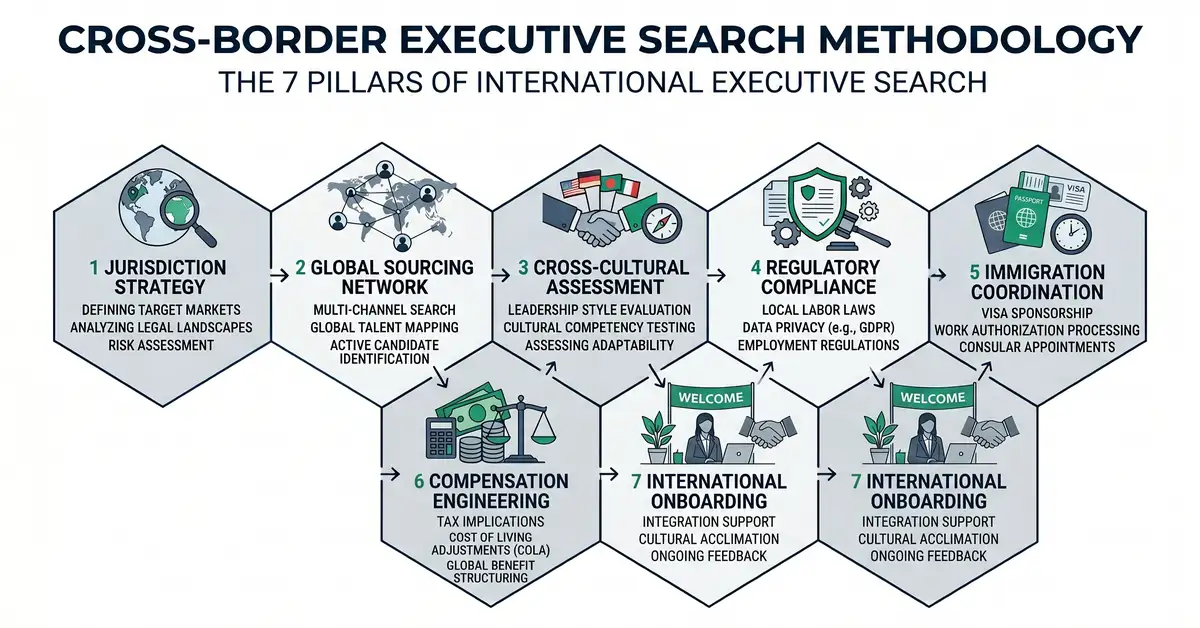
Cross-border executive search differs from single-jurisdiction search across six dimensions: sourcing networks (global vs national), compensation engineering (expatriate packages vs local market), regulatory compliance (multi-jurisdiction data privacy vs single regime), immigration coordination (work authorization vs employment-at-will), cultural assessment (structured agility testing vs experience-based), and onboarding (relocation and family integration vs standard induction). The 7-pillar methodology codifies these dimensions into an installable operating system.
Pillar 1 — Jurisdiction strategy. Every cross-border mandate starts with explicit jurisdiction definition: target country mix for sourcing (where candidates live), primary employment jurisdiction (where the role is based), tax residency strategy (often distinct from employment location), and family residency planning. The jurisdiction matrix drives every downstream decision on compensation, compliance, and immigration.
Pillar 2 — Global sourcing network. Cross-border mandates require multi-network sourcing. Primary channels include AESC (the industry body for retained executive search globally), the Big 5 owned international office network, global networks (IIC Partners, Penrhyn International, IRC Global Executive Search, Boyden 75+ offices in 45+ countries, Stanton Chase), and regional specialists (Swisslinx Middle East for DIFC and ADGM finance, Keller Executive Search Brazil for Sao Paulo and Rio, Gladwin International for India tech leadership, Stanton Chase Africa for sub-Saharan executive mandates).
Pillar 3 — Cross-cultural assessment. Spencer Stuart research documents that most cross-border searches conduct formal interviews but typically lack consistent criteria to identify cross-cultural agility. Structured assessment requires cultural intelligence testing, language proficiency verification, and governance model fluency. Continental two-tier board governance differs materially from Anglo-American single-tier structures, and executives moving between systems require demonstrated capability with each model. Peer-reviewed Manpower research on intercultural competencies among global leaders provides the empirical basis for assessment methodology.
Pillar 4 — Regulatory compliance. Multi-jurisdiction data privacy requires GDPR compliance for EU candidates (lawful basis, SCCs or BCRs for transfers), CCPA/CPRA notices for California candidates, PDPA Singapore compliance for any data transferred into Singapore, PIPL China with separate consent for cross-border transfers and security assessments for sensitive data, and LGPD Brazil mirroring GDPR. EU Standard Contractual Clauses (SCCs) govern transfers under GDPR Article 46(2)(c). 2026 GDPR updates add enhanced AI processing transparency requirements affecting AI-powered candidate matching.
Pillar 5 — Immigration coordination. Major executive immigration routes require search firm coordination: UK Skilled Worker Visa with Home Office sponsorship licence; US Visa Bulletin January 2026 documenting H-1B, L-1A, EB-1, O-1 priority dates; EU Blue Card with 3-12 week processing per Germany 2026 guide; Singapore Employment Pass requiring minimum S$5,600/month (substantially higher for senior executives); Hong Kong ASMTP and QMAS; and UAE Golden Visa.
Pillar 6 — Compensation engineering. Cross-border compensation requires tax equalization (employer policy keeping the executive paying approximately the same tax as a domestic placement), COLA per US State Department DSSR Post Allowance rates, hardship allowances for difficult posts, and currency hedging on multi-year fee commitments. Gallagher CEO and Executive Compensation Trends 2025-2026 provides benchmarking data for global comp structures.
Pillar 7 — International onboarding. Senior international placements require relocation infrastructure ($50K-$150K typical cost), family considerations (schooling, spousal employment), and structured 90-day integration. CSHR Partners documents cultural differences between Europe and the United States in executive recruitment that affect onboarding methodology.
Install all 7 pillars with our Cross-Border Search Practice Architecture engagement.
Talk to peppereffectCommon Pitfalls in Cross-Border Executive Search

Pitfall 1 — Single-jurisdiction sourcing
Cross-border mandates executed through national sourcing networks miss qualified international candidates. AESC member networks, Penrhyn International, IRC Global Executive Search Partners (25,000+ completed assignments), Boyden (75+ offices in 45+ countries), and regional specialists in DIFC, ADGM, Sao Paulo, Mumbai, and Singapore are required infrastructure.
Pitfall 2 — Under-pricing global mandates
Standard 25-35% of first-year compensation pricing underprices cross-border CEO mandates. Global CEO retainers command $150K-$500K+ flat fees plus expense recovery for international travel, multi-jurisdiction legal review, and immigration coordination. Pricing as percentage of comp alone leaves 30-50% margin on the table.
Pitfall 3 — Missing data privacy compliance
GDPR requires SCCs or BCRs for EU candidate data transfers per IAPP guidance. PIPL China requires separate consent for cross-border data transfers and security assessments. PDPA Singapore applies to any overseas-collected data transferred into Singapore. Skipping compliance produces regulatory exposure, candidate withdrawal, and client liability transfer.
Pitfall 4 — Ignoring immigration timing
UK Skilled Worker visa requires Home Office sponsorship licence with 8-12 week processing. US H-1B has annual lottery with priority dates. EU Blue Card 3-12 week processing per Germany guidance. Singapore Employment Pass requires salary documentation. Mistiming offer acceptance against visa processing produces failed placements and rescinded offers.
Pitfall 5 — Inadequate tax equalization design
Without tax equalization or tax protection per expat tax methodology, expatriate executives face net pay shortfalls of 15-30% versus their domestic baseline. Partner with KPMG, PwC, EY, or Deloitte expat mobility teams to engineer correct equalization. Skipping this produces offer rejection and candidate withdrawal.
Pitfall 6 — Single-country compensation benchmarking
Headquarters-country benchmarks miss COLA per US State Department DSSR rates (up to 25%+ for difficult posts), hardship allowances, and FX risk on multi-year commitments. Cross-border comp benchmarking requires multi-source data: Gallagher 2025-2026 trends, regional surveys, and expatriate-specific premium data.
Pitfall 7 — Cross-cultural assessment as language proficiency
Treating cross-cultural agility as fluency in target-country language misses cultural intelligence, governance model fluency (Anglo-American single-tier vs continental two-tier vs Japanese kaisha vs Chinese state-owned enterprise), and structured intercultural competency per Spencer Stuart research. Language alone predicts only weak placement success in cross-border mandates.
Pitfall 8 — Missing currency hedging
Multi-year retainer commitments and expatriate package guarantees expose search firms and clients to FX risk. Without hedging strategy on GBP, EUR, USD, SGD, HKD, CHF commitments, currency moves can erode 15-25% of expected economics. Partner with corporate FX desks early in engagement design.
Cross-Border Compensation Benchmarks and Fee Structures

Cross-border retained executive search fees follow retained methodology per MLA Global retained search overview: one-third on engagement, one-third on shortlist, one-third on placement. Frontline Source Group 2026 analysis documents executive recruiting costs at 25-35% of total first-year compensation. Pact and Partners notes total fees can run 5-15% in contingency models versus 25-35% retained. The cross-border premium reflects multi-jurisdiction complexity:
| Mandate Type | Retainer Fee Range | Notes |
| Global CEO (Multi-Country) | $150,000-$500,000+ | Flat retainer + expense recovery |
| Regional MD (APAC/EMEA/LATAM) | $100,000-$250,000 | Sub-regional or country MD scope |
| International CFO | $100,000-$200,000 | Multi-jurisdiction tax/treasury |
| Expatriate C-Suite Deployment | $75,000-$150,000 | HQ executive to international post |
| Cross-Border NED Placement | $75,000-$200,000 | Public company board placement |
| Tax Equalization Premium | +15-25% of base comp | Per Taxes for Expats methodology |
| Relocation Package | $50,000-$150,000 | Family relocation + temporary housing |
| Immigration Legal Fees | $15,000-$40,000 | Executive + family per jurisdiction |
Sources: Frontline Source Group Executive Recruiting Cost 2026, MLA Global Retained vs Contingency Search, Taxes for Expats Tax Equalization Guide
The 7-Step Playbook: Building a Cross-Border Executive Search Practice

Choose target jurisdiction mix
Select 3-5 priority jurisdictions with $50M+ addressable market: Anglo-American (US, UK, Canada, Australia), EU two-tier (Germany, Netherlands, France), APAC (Singapore, Hong Kong, Tokyo), Middle East (DIFC, ADGM), LATAM (Brazil, Mexico). Generalist global positioning fails against AESC network depth. Specialist jurisdiction concentration wins.
Join AESC and a global network
AESC membership signals retained executive search credibility globally. Join one global network from IIC Partners, Penrhyn International, IRC Global Executive Search Partners, Boyden, or Stanton Chase for reciprocal mandate flow and shared compliance infrastructure. Without network membership, the practice cannot compete for serious cross-border mandates.
Build regional sourcing depth
Establish sourcing presence (owned offices or contracted partners) in primary hubs per Oliver Wyman cities analysis: London, NYC, Singapore, Hong Kong, Zurich, Dubai, Frankfurt, Sao Paulo, Mumbai, Sydney. Each hub requires local researcher capacity plus partnered consultant relationships.
Develop cross-cultural assessment methodology
Build assessment using Spencer Stuart cross-cultural agility framework, structured intercultural competency testing per Manpower peer-reviewed research, and governance model fluency testing covering Anglo-American single-tier, continental two-tier, Japanese kaisha, Chinese SOE structures. Assessment depth justifies retainer-based fees and reduces failure rates.
Install regulatory compliance infrastructure
Build firm-wide compliance for GDPR (SCCs, BCRs, EU-US Data Privacy Framework), CCPA/CPRA candidate notices, PDPA Singapore obligations, PIPL China separate consent and security assessment, LGPD Brazil mirror requirements. Partner with cross-border privacy counsel. Executive reference checking methodology must also accommodate cross-border privacy constraints.
Build expatriate compensation engineering
Install capability covering tax equalization vs tax protection design, COLA application per US State Department DSSR Post Allowance rates, hardship allowances for difficult posts, currency hedging on multi-year commitments. Partner with KPMG, PwC, EY, Deloitte expat mobility teams. Layer in OECD International VAT/GST Guidelines for cross-border fee structuring.
Build BD around international thought leadership
Publish at AESC Global Conference, Oliver Wyman Forum cities events, regional executive summits (Markets Group Private Equity LATAM Forum, AESC APAC Summit). Develop technology stack including Bullhorn executive search software, Invenias, Clinch, Thrive TRM, multilingual candidate search tools, and AI-powered cross-border matching. Transition takes 18-24 months given network buildout and compliance infrastructure timeline.
Decouple your search firm growth from headcount.
peppereffect installs the AI operating systems and methodology infrastructure that allow executive search firms to expand into cross-border mandates at premium retainer fees. From multi-jurisdiction compliance automation to expatriate package engineering to AI-powered international candidate matching, we architect the systems that turn cross-border complexity into recurring high-margin revenue.
Architect Your Cross-Border PracticeExplore our 4 Pillars approach
Frequently Asked Questions
What is cross-border executive search?
Cross-border executive search is the recruitment discipline focused on placing senior executives across national jurisdictions, typically involving multi-country sourcing networks, expatriate compensation engineering, immigration sponsorship coordination, and cross-jurisdictional data privacy compliance. The global executive search market reached USD 63.99 billion in 2026 growing at 10.11% CAGR per Mordor Intelligence. AESC member firms include the Big 5 (Korn Ferry, Spencer Stuart, Heidrick and Struggles, Russell Reynolds, Egon Zehnder) plus global networks IIC Partners, Penrhyn International, IRC Global Executive Search Partners, Boyden (75+ offices in 45+ countries), and Stanton Chase.
What are the 7 pillars of cross-border executive search methodology?
The 7 pillars are: 1) Jurisdiction strategy defining target country mix and primary employment jurisdiction; 2) Global sourcing network through AESC, IIC Partners, Penrhyn International, IRC Global, Boyden, Stanton Chase, and regional hubs; 3) Cross-cultural assessment with structured agility testing covering cultural intelligence, language proficiency, and governance model fluency; 4) Regulatory compliance verification across GDPR, CCPA/CPRA, PDPA, PIPL, LGPD with SCCs or BCRs for data transfers; 5) Immigration coordination through UK Skilled Worker visa, US H-1B/L-1/EB-1/O-1, EU Blue Card, Singapore Employment Pass, Hong Kong ASMTP, UAE Golden Visa; 6) Compensation engineering with tax equalization, COLA, hardship allowances, and FX hedging; 7) International onboarding with relocation, family considerations, and 90-day integration.
How much does cross-border executive search cost?
Cross-border retained executive search fees typically run 25-35% of first-year total compensation per Frontline Source Group 2026 analysis. Global CEO mandates command $150,000-$500,000+ retainer fees. International CFO and Regional MD searches typically $100K-$250K. Layered costs include expatriate package engineering (tax equalization adds 15-25% to base compensation), relocation $50K-$150K, immigration legal fees $15K-$40K per executive plus family. Total cost of placement for senior international executives can reach 50-80% of first-year compensation when relocation, immigration, and tax equalization are included.
Which firms specialise in cross-border executive search?
Specialist global firms include AESC member firms, the Big 5 (Korn Ferry, Spencer Stuart, Heidrick and Struggles, Russell Reynolds, Egon Zehnder), and dedicated global networks: IIC Partners, Penrhyn International, IRC Global Executive Search Partners (25,000+ completed assignments), Boyden (75+ offices in 45+ countries), Stanton Chase. Regional specialists include Swisslinx Middle East (DIFC, ADGM), Keller Executive Search Brazil, Gladwin International (India tech), Witt/Kieffer (healthcare global), Hanover Search (financial services).
What data privacy laws apply to cross-border executive search?
Cross-border executive search must comply with GDPR (EU) requiring lawful basis plus SCCs or BCRs for transfers outside the EEA, plus the EU-US Data Privacy Framework (July 2023). CCPA/CPRA (California) requires candidate privacy notices. PDPA (Singapore) applies to overseas-collected data transferred into Singapore. PIPL (China) effective November 2021 requires separate consent for cross-border data transfers and security assessments for sensitive data. LGPD (Brazil) mirrors GDPR with similar transfer mechanisms.
How do immigration and work authorization affect cross-border executive search?
Major executive immigration routes include UK Skilled Worker visa with Home Office sponsorship licence, US H-1B/L-1A/EB-1/O-1 with January 2026 Visa Bulletin priority dates, EU Blue Card with 3-12 week processing under EU rules, Singapore Employment Pass requiring minimum S$5,600/month (substantially higher for senior executives), Hong Kong ASMTP and QMAS, UAE Golden Visa. Search firms must coordinate immigration timing with offer acceptance, family visa applications, and start date alignment.
What are common pitfalls in cross-border executive search?
The 8 most common pitfalls: 1) Single-jurisdiction sourcing missing AESC, IIC Partners, Penrhyn, IRC Global, Boyden networks; 2) Under-pricing global mandates; 3) Missing data privacy compliance; 4) Ignoring immigration timing; 5) Inadequate tax equalization design; 6) Single-country compensation benchmarking; 7) Treating cross-cultural assessment as language proficiency; 8) Missing currency hedging on multi-year retainer fees and expatriate commitments.
How do I build a cross-border executive search practice?
The 7-step playbook: 1) Choose target jurisdiction mix with $50M+ addressable market; 2) Join AESC and a global network (IIC Partners, Penrhyn, IRC Global, Boyden, Stanton Chase); 3) Build regional sourcing depth in primary hubs; 4) Develop cross-cultural assessment methodology using Spencer Stuart framework; 5) Install regulatory compliance infrastructure for GDPR, PIPL, PDPA, LGPD, CCPA; 6) Build expatriate compensation engineering capability partnered with KPMG, PwC, EY, Deloitte expat mobility teams; 7) Build BD around international thought leadership at AESC Global Conference, Oliver Wyman Forum, regional executive summits. Transition takes 18-24 months.
Resources
- Mordor Intelligence Executive Search Market 2026-2031
- Business Research Insights Executive Search Market 2026-2035
- Talentor International 2026 Executive Search Trends
- AESC Member Firms Directory
- Penrhyn International Global Network
- IRC Global Executive Search Partners Profile
- Boyden Global Executive Search
- Stanton Chase Global Executive Search
- Spencer Stuart Cross-Cultural Agility Research
- Continental Governance Model (Two-Tier Board)
- Leading Across Cultures Empirical Research (NIH/PMC)
- Tax Equalization Guide for Expats
- US State Department DSSR Post Cost of Living Allowance Rates
- CapRelo Hardship Allowances Guide
- IAPP EU Standard Contractual Clauses
- Latham and Watkins Singapore PDPA Cross-Border Guidance
- Personal Information Protection Law (PIPL) China
- BigID 2026 GDPR Compliance Updates
- UK Skilled Worker Visa Application Guide 2026
- US Visa Bulletin January 2026
- Singapore Ministry of Manpower Employment Pass
- Hong Kong Immigration Admission Schemes
- Germany EU Blue Card 2026 Guide
- MLA Global Retained vs Contingency Search Comparison
- Frontline Source Group Executive Recruiting Cost 2026
- Pact and Partners Executive Search Fees Overview
- Gallagher CEO and Executive Compensation Trends 2025-2026
- OECD International VAT/GST Guidelines
- Oliver Wyman Forum Global Cities Driving Business Growth
- Bullhorn Executive Search Software