

Board search and advisory has emerged as the highest-margin extension available to retained executive search firms. The 2025 Spencer Stuart U.S. Board Index, marking 40 years of publication, found that S&P 500 boards are prioritizing experience amid low turnover and heightened complexity. Add the EU Women on Boards Directive requiring 40% female non-executive directors by mid-2026, public REIT board refreshment cycles, and the explosion of private equity portfolio company independent director demand, and the addressable market for specialist board search has expanded materially. This guide installs the 7-pillar methodology, names the 8 pitfalls that derail board search practice expansion, and details the 7-step playbook to build board search and advisory into a $5M-$15M annual revenue line within 24 months.
Key Takeaway
Board search delivers higher margins, recurring advisory revenue, and natural cross-sell into executive search through chair and CEO succession engagements. The practice requires director network infrastructure (NACD, WCD, Catalyst), skills matrix methodology, and committee chair specialization, but commands retainer fees of $75K-$200K per placement at 30-40% higher gross margins than traditional executive search.
The Board Search and Advisory Market Opportunity in 2026

The board search and advisory sector encompasses four primary engagement types: director placement (non-executive director, independent chair, lead independent director, committee chairs), board composition advisory (skills matrix design, gap analysis, succession planning), board effectiveness evaluations (peer reviews, individual director assessments, board self-evaluations), and CEO succession planning (often led by the board search practice given board ownership of the CEO succession process). Each engagement type carries distinct fee structures and margin profiles, with board placement and CEO succession commanding the highest per-engagement fees.
Major firms publishing the canonical industry indices include Spencer Stuart (40-year publication track record with the U.S. Board Index, plus Nordic, UK, German, French, Italian, Spanish, Australian, Brazilian, and Asian regional indices), Harvard Law School Forum on Corporate Governance aggregating board governance research, and Korn Ferry Institute publications. The 2026 Top Executive Search Firms ranking places Korn Ferry, N2Growth, Heidrick & Struggles, Egon Zehnder, Spencer Stuart, Russell Reynolds, and Boyden at the top of the executive search market, with each maintaining dedicated board practices.
Recent industry analysis from Juicebox and Alpha Apex Group documents the continued dominance of the Big 5 retained firms in board placement while highlighting boutique specialists (Diversified Search Group, Major Lindsey & Africa Board Practice) and AI-powered emerging firms entering the space. Pin's 2026 ranking confirms retained board search fees in the $80K-$200K+ range for public company director placements.
The regulatory landscape shapes demand. The EU Directive on Women on Boards imposes a 40% quota for the underrepresented gender on listed company boards across the European Union, with member states required to transpose the Directive by December 2024 and compliance required by mid-2026. The 2026 deadline is driving accelerated board recruitment across EU public companies. In the U.S., the Fifth Circuit Vacated Nasdaq's Board Diversity Rules in December 2024, removing the regulatory mandate. The Fifth Circuit ruling in Alliance for Fair Board Recruitment v. SEC nullified Nasdaq's Rule 5605(f) which had required diversity disclosure and "comply or explain" diversity targets. However, institutional investor expectations (BlackRock, State Street, Vanguard proxy voting policies), Harvard Law CorpGov coverage, and Russell 3000 proxy advisory guidance from ISS and Glass Lewis continue driving voluntary diversity recruitment.
Architect board search infrastructure that converts placement fees into recurring advisory revenue.
Schedule a Growth Mapping CallThe 7 Pillars of Board Search and Advisory Methodology

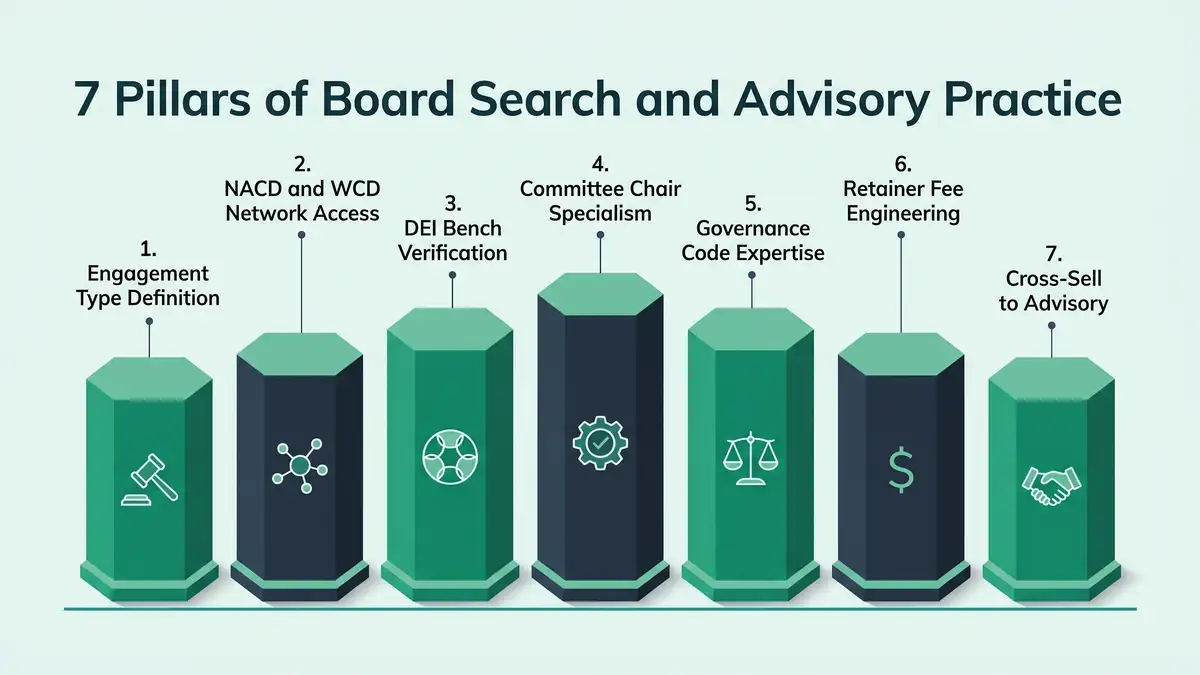
Board search differs from executive search in five fundamental ways: fee structure (retainer-based per placement vs percentage of compensation), assessment methodology (board interview simulations vs operational deep-dive), sourcing networks (NACD/WCD/Catalyst vs LinkedIn/executive Rolodex), regulatory compliance (SEC disclosure, listing standards, EU directive vs at-will employment), and engagement scope (often bundled with advisory vs pure placement). The 7-pillar methodology codifies these differences into an installable operating system.
Pillar 1 — Board composition gap analysis. Every board search engagement starts with a skills matrix audit identifying capability deficits. Modern boards require coverage across financial expertise (Sarbanes-Oxley audit committee financial expert designation), operational scale, digital transformation, cyber risk, AI governance, ESG/sustainability strategy, industry vertical expertise, public company CEO experience, M&A, and international operations. The skills matrix output becomes the search specification.
Pillar 2 — Director network access. Board directors are not sourced through LinkedIn. The primary networks are NACD (National Association of Corporate Directors with 24,000+ members), WCD (Women Corporate Directors with global membership), Catalyst (gender diversity research and director network), BlackRock Center for Stakeholder Capitalism, ULI Board Forum (real estate), prior public company CEO peer networks, and current chair peer networks. Nasdaq listing center resources document board diversity disclosure infrastructure that informs director sourcing requirements.
Pillar 3 — Skills matrix and diversity engineering. Beyond capability gaps, the practice engineers diversity balance across tenure (3-15 year director tenure mix), age (45-75 typical range), gender, ethnicity, and functional expertise. The 40% EU Women on Boards target and U.S. institutional investor pressure require explicit diversity engineering throughout the recruitment pipeline.
Pillar 4 — Multi-modal director assessment. Board candidates require different assessment than executive candidates. Board interview simulations test how candidates engage in board governance dynamics. Prior board service references probe boardroom behavior, committee work, and independence. Committee chair scenario testing evaluates audit, compensation, or nominating chair candidates against specific governance situations.
Pillar 5 — Governance regulatory compliance. SEC Regulation S-K disclosure requirements, NYSE/Nasdaq listing standards (audit committee independence, financial expert designation, compensation committee independence), EU Women on Boards Directive 40% target compliance, and corporate governance code compliance (UK Corporate Governance Code, German Corporate Governance Code, French AFEP-MEDEF Code) all require verification.
Pillar 6 — Director compensation engineering. S&P 500 average non-executive director total compensation of $320,000-$350,000 inclusive of cash retainer and equity per Spencer Stuart 2025 Board Index data anchors public company benchmarking. Russell 3000 director compensation averages $180,000-$220,000. Audit committee chair premium $25,000-$35,000. Independent chair compensation $200,000-$500,000+ above standard director retainer. PE portfolio independent director $75,000-$150,000 cash plus 0.25-0.50% equity. Pre-IPO board equity 0.25-1.0% depending on stage.
Pillar 7 — Onboarding and committee integration. Board onboarding requires board orientation (typically 30-60 days reviewing board materials, prior minutes, strategy documents), committee assignment (matching candidate expertise to audit, compensation, or nominating committee needs), and chair handoff (transferring relationship management from search consultant to board chair).
Install all 7 pillars with our Board Search Practice Architecture engagement.
Talk to peppereffectCommon Pitfalls in Board Search and Advisory
Pitfall 1 — Selling board search as executive search
Board search uses retainer-based fees ($75K-$200K per placement), different sourcing networks (NACD/WCD/Catalyst, not LinkedIn), and different assessment methodology (board interview simulations vs operational deep-dive). Selling board search as executive search produces under-pricing and inadequate methodology.
Pitfall 2 — Inadequate skills matrix analysis
Board searches without rigorous skills matrix gap analysis miss critical capability deficits. Modern boards require coverage across financial expert designation, AI governance, cyber risk oversight, ESG strategy, and industry vertical expertise. Skipping the matrix produces commodity director placements that fail to address actual board needs.
Pitfall 3 — Under-pricing board search engagements
Top board search firms command $75K-$200K per director placement on retainer. Pricing board search at executive search percentage of compensation (33-35% of total comp) under-prices the engagement by 40-60%. Retainer-based fee structure is mandatory.
Pitfall 4 — Single-channel sourcing
NACD (24,000+ members), WCD (global membership), Catalyst, BoardEx/Altrata, BlackRock CSC, ULI Board Forum, and prior public company CEO peer networks are all required sourcing channels. Single-channel reliance on LinkedIn or general executive Rolodex misses qualified directors.
Pitfall 5 — Ignoring committee chair specialization
Audit committee chair requires Sarbanes-Oxley financial expert designation. Compensation committee chair requires executive compensation expertise. Nominating/governance committee chair requires governance experience. Treating all committee chairs as fungible produces failed placements and SEC disclosure problems.
Pitfall 6 — Missing diversity engineering
The 40% EU Women on Boards target by 2026 (per Institute of Directors), institutional investor expectations (BlackRock, State Street, Vanguard), and ISS/Glass Lewis proxy advisory guidance require explicit diversity engineering. Missing this pillar produces board compositions that fail proxy advisory standards and trigger investor opposition votes.
Pitfall 7 — No regulatory compliance verification
SEC disclosure, NYSE/Nasdaq listing standards (audit committee independence, financial expert, compensation committee independence), and EU 40% directive compliance all require verification before placement. Skipping this produces SEC disclosure violations and listing standard breaches.
Pitfall 8 — Ignoring board advisory as recurring revenue
Board placement fees are one-time. Board effectiveness evaluations ($75K-$150K), CEO succession planning ($200K-$500K), and board composition advisory ($100K-$250K) generate recurring revenue beyond placement. Treating board search as pure placement misses 40-60% of practice revenue potential.
Director Compensation Benchmarks (Spencer Stuart 2025 Board Index)

The U.S. Spencer Stuart Board Index publishes the canonical S&P 500 board composition, governance practices, and director compensation data annually. The 2024 and 2025 editions document the following compensation patterns for placement benchmarking:
| Board Role | Average Total Comp | Notes |
| S&P 500 Non-Executive Director | $320,000-$350,000 | Cash retainer + equity, 2025 data |
| S&P 500 Audit Committee Chair | $345,000-$385,000 | $25K-$35K premium above director |
| S&P 500 Independent Chair | $520,000-$850,000+ | $200K-$500K+ above director |
| Russell 3000 Non-Executive Director | $180,000-$220,000 | Mid-cap and small-cap compression |
| PE Portfolio Independent Director | $75,000-$150,000 cash | + 0.25-0.50% equity participation |
| Pre-IPO VC-Backed Board Director | 0.25-1.0% equity | Stage-dependent (Series B vs late stage) |
| Board Search Fee Per Placement | $75,000-$200,000 | Retainer-based, 30-40% higher margin |
Source: 2025 U.S. Spencer Stuart Board Index, Pin 2026 Executive Recruiting Firms Ranking
The 7-Step Playbook: Building a Board Search and Advisory Practice

Choose board search sub-vertical focus
Select one or two sub-verticals with $50M+ addressable market: public company boards (S&P 500, Russell 3000), PE portfolio company boards, pre-IPO VC-backed boards, public REIT boards, family business boards, nonprofit boards. Multi-vertical generalist positioning fails against Big 5 dominance. Specialist depth wins.
Hire or embed senior board advisors
Recruit former public company chairs, NACD fellows, WCD members, prior committee chair veterans as senior advisors. These individuals provide both candidate network access and assessment credibility. Without senior board advisor presence, the practice cannot compete for serious board mandates.
Build director network infrastructure
Establish NACD corporate membership (firm-wide access), WCD partnership, Catalyst engagement, BlackRock Center for Stakeholder Capitalism participation, ULI Board Forum membership (if real estate focus), and chair peer network development. These are not optional. Director sourcing depends on network access.
Develop multi-channel board sourcing
Combine NACD, WCD, Catalyst, BoardEx/Altrata (board intelligence platform), Equilar (compensation benchmarking and director network), prior public company CEO networks, and chair peer references into a unified sourcing process. Document the sourcing methodology so it scales beyond individual consultant relationships.
Develop multi-modal assessment methodology
Build board interview simulations testing governance dynamics, prior board service reference protocols, committee chair scenario testing (audit, compensation, nominating), and skills matrix scoring. Assessment depth differentiates from generalist executive search and justifies retainer-based fees.
Install compensation engineering frameworks
Build internal benchmarking using Spencer Stuart U.S. Board Index, Equilar Board Composition Practice data, Russell 3000 proxy disclosure analysis, PE portfolio benchmarks, and pre-IPO board equity data. Director compensation engineering is a billable advisory service and a placement enablement capability.
Build BD around board thought leadership
Publish board research at NACD Summit, WCD Global Institute, Spencer Stuart Board Index commentary, Harvard Law CorpGov Forum contributions. Speak at board conferences. Build a board search and advisory practice page on the firm website with case studies, compensation benchmarks, and committee chair search methodology. Transition takes 18-24 months given infrastructure requirements.
Decouple your search firm growth from headcount.
peppereffect installs the AI operating systems and methodology infrastructure that allow executive search firms to expand into board search and advisory at 30-40% higher gross margins. From skills matrix automation to director network intelligence to retainer-based fee engineering, we architect the systems that turn placement into recurring advisory revenue.
Architect Your Board Search PracticeExplore our 4 Pillars approach
Frequently Asked Questions
What is board search and advisory?
Board search and advisory is the recruitment and consulting discipline focused on placing non-executive directors, independent chairs, audit committee chairs, compensation committee chairs, and lead independent directors at public companies, private equity portfolio companies, pre-IPO companies, REITs, and large private companies. The practice also encompasses board composition advisory, board effectiveness evaluations, board succession planning, and CEO succession planning.
What are the 7 pillars of board search and advisory methodology?
The 7 pillars are: 1) Board composition gap analysis using skills matrices; 2) Director network access through NACD, WCD, Catalyst, BoardEx; 3) Skills matrix and diversity engineering; 4) Multi-modal director assessment with board interview simulations and committee scenario testing; 5) Governance regulatory compliance verification (SEC, NYSE/Nasdaq, EU 40% directive); 6) Director compensation engineering using Spencer Stuart Board Index benchmarks; 7) Onboarding and committee integration including board orientation and chair handoff.
How much do board directors earn in 2026?
S&P 500 non-executive director total compensation averages $320,000-$350,000 annually inclusive of cash retainer and equity per Spencer Stuart 2025 U.S. Board Index data, with audit committee chairs earning a $25,000-$35,000 premium and independent chairs commanding $200,000-$500,000+ above standard director retainer. Russell 3000 director compensation runs $180,000-$220,000. PE portfolio independent director compensation typically $75,000-$150,000 cash plus 0.25-0.50% equity. Pre-IPO VC-backed board director equity packages range 0.25-1.0%.
Which firms specialise in board search and advisory?
Specialist firms include Spencer Stuart (40-year U.S. Board Index publication), Korn Ferry Board Services, Heidrick & Struggles Board and CEO Practice, Russell Reynolds Board Effectiveness Practice, Egon Zehnder Board Services. Boutique specialists include Diversified Search Group, Major Lindsey & Africa Board Practice, ON Partners Board, BoardEx/Altrata for board intelligence, and Equilar for compensation benchmarking. AI-powered firms like Juicebox and emerging boutiques are entering board placement per 2026 industry rankings.
What did the 2025 Spencer Stuart U.S. Board Index reveal?
The 2025 Board Index, marking 40 years of publication, found that S&P 500 boards prioritize experience amid low turnover and heightened complexity. Average board size remained stable at approximately 10.8 directors with average director tenure of 7.6 years. New director appointments declined relative to historical norms. Only 22% of CEOs report receiving effective board support, creating opportunity for board advisory services.
How does the EU Women on Boards Directive affect board search demand?
The Directive requires every EU stock-listed company to have at least 40% female non-executive directors (or 33% across all director positions) by mid-2026, creating significant board search demand across EU public companies. Member states transposed the Directive by December 2024. In the U.S., the Fifth Circuit vacated the SEC's approval of Nasdaq's board diversity rules in December 2024, removing the regulatory mandate while leaving institutional investor and ISS/Glass Lewis proxy advisory expectations intact.
What are common pitfalls in board search?
The 8 most common pitfalls: 1) Selling board search as executive search; 2) Inadequate skills matrix analysis; 3) Under-pricing board search engagements; 4) Single-channel sourcing; 5) Ignoring committee chair specialization; 6) Missing diversity engineering; 7) No regulatory compliance verification; 8) Ignoring board advisory as recurring revenue beyond placement.
How do I build a board search and advisory practice?
The 7-step playbook: 1) Choose board search sub-vertical with $50M+ addressable market; 2) Hire or embed senior board advisors including former chairs and NACD fellows; 3) Build director network infrastructure with NACD, WCD, Catalyst, BoardEx memberships; 4) Develop multi-channel board sourcing; 5) Develop multi-modal assessment with board interview simulations and committee scenario testing; 6) Install compensation engineering using Spencer Stuart Board Index data; 7) Build BD around board thought leadership at NACD Summit, WCD Global Institute, Spencer Stuart Board Index commentary, Harvard Law CorpGov Forum. Transition takes 18-24 months.
Resources
- Spencer Stuart U.S. Board Index Marks 40 Years (PR Newswire 2025)
- 2025 U.S. Spencer Stuart Board Index
- 2025 U.S. Board Index — Harvard Law CorpGov
- US 2024 Spencer Stuart Board Index — Board Agenda
- European Women on Boards Directive — Institute of Directors
- The EU Directive on Women on Boards — Kluwer Law Online
- EU Directive on Women on Corporate Boards Analysis (RGU SLSS 2025)
- Fifth Circuit Nullifies Nasdaq's Diversity Rule — Ogletree Deakins
- Nasdaq Board Diversity Rules Vacated — Skadden
- Fifth Circuit Vacates SEC's Approval — Harvard Law CorpGov
- Nasdaq's Board Diversity Rule (Listing Center PDF)
- 12 Best Executive Search Firms 2026 — Juicebox
- Top Executive Search Firms Rankings 2026
- Top 10 Executive Search & Recruitment Firms 2026 — Alpha Apex Group
- 10 Best Executive Recruiting Firms 2026 — Pin