

A vendor evaluation framework is a structured, weighted method for scoring technology partners on the criteria that actually predict long-term success - capability, integration, total cost, viability, and support - instead of the demo that dazzled you. Most software decisions do not use one. They run on a polished demo, a discount, and the pressure to show results fast. The result is a stack full of tools nobody uses and partnerships that buckle the moment you try to scale on them. The average company now uses just 49 percent of the SaaS licences it pays for, wasting roughly 18 million dollars a year on shelfware.
The problem compounds when you are choosing AI and automation partners, where a bad pick locks in opaque models, ungoverned data, and switching costs that only surface later. 86 percent of software buyers admit they exclude their security team from the purchasing process because of pressure to move quickly. A vendor evaluation framework - anchored by a repeatable vendor scorecard - is how you slow the decision down just enough to get it right.
This guide covers what a vendor evaluation framework is, why most software purchases fail, how to weigh total cost of ownership against sticker price, how to assess vendor risk and lock-in, the five-dimension scorecard peppereffect uses, and how to evaluate an AI or automation partner specifically. Here is what you will learn:
- Why gut-feel software selection produces shelfware, lock-in, and buyer's remorse
- How to see total cost of ownership behind the sticker price
- The vendor risk and lock-in factors that only surface after you sign
- A five-dimension vendor scorecard you can weight and reuse
- The extra criteria that matter when the vendor is an AI or automation partner
Key Takeaway
A vendor evaluation framework replaces the demo-and-discount reflex with a weighted scorecard. It forces you to price the total cost of ownership, test integration fit, and assess whether the vendor will still be viable and supportive in three years. The goal is not the cheapest tool - it is the partner your business systems architecture can safely stand on.
What Is a Vendor Evaluation Framework?
A vendor evaluation framework is a repeatable process that scores prospective vendors against weighted, multi-dimensional criteria and produces a comparable result - a vendor scorecard - rather than a subjective preference. Procurement specialists describe supplier evaluation as a structured review of a supplier's ability to meet your commercial, operational, and compliance needs, with the depth of the evaluation scaled to spend, risk, and business impact. The critical word is weighted: the factors that matter most to your business should carry more influence on the final score.
Without a framework, selection defaults to whoever demos best or discounts hardest. That is how portfolios balloon. Productiv found the average organisation runs 371 applications, and 51 percent of them are shadow IT - tools bought outside any formal process. When more than half your stack is acquired ad hoc, overlap, low utilisation, and inconsistent security are guaranteed.

The framework matters more, not less, as buying gets slower and more crowded. The median B2B SaaS sales cycle now runs 84 days and has lengthened 22 percent since 2022 as buying committees grow. A framework turns those months of meetings into a structured decision instead of a drawn-out argument settled by whoever is most persuasive in the room.
Why Do Most Software Purchases Fail?
Most software purchases fail because selection outpaces adoption - companies buy more capability than they can absorb and never audit whether it landed. Zylo's data shows that beyond the 49 percent licence utilisation figure, the average company carries 15 duplicative online training apps, 11 project management tools, and 10 team collaboration apps. That is not a technology problem. It is an evaluation problem: nobody checked whether the capability already existed before buying it again.

The financial waste is systemic. IDC estimates 20 to 30 percent of all cloud spending is wasted, and Flexera reports that managing that spend is now the single top cloud challenge, ahead of security, with 22 percent of organisations spending more than 12 million dollars a year on SaaS alone. When a fifth to a third of the budget delivers no value, the discipline gap in vendor selection is measured in millions.
The pressure to rush makes it worse. G2 found buyers expect ROI within six months and, under that pressure, 86 percent cut their security team out of the decision entirely. Speed feels like progress, but a vendor chosen on a demo and a deadline is exactly the vendor that becomes shelfware six months later. This is why data-driven decision making matters as much in procurement as anywhere else in the business.
| Failure Symptom | Figure | Root Cause |
| SaaS licences actively used | 49% | Bought beyond adoption capacity |
| Cloud spend wasted | 20-30% | No total-cost discipline |
| Buyers who skip security review | 86% | Speed pressure over rigor |
| Apps that are shadow IT | 51% | No formal evaluation process |
Sources: Zylo 2024 SaaS Management Index, IDC FinOps, G2 Buyer Behavior Report
How Do You See Total Cost of Ownership Behind the Sticker Price?
Sticker price is the smallest part of what a vendor costs you. Total cost of ownership adds implementation, integration and customisation, training, ongoing support, performance overhead, and eventual migration. A cheap tool that suffers outages, needs constant manual workarounds, or fails a security review is far more expensive in total than a slightly pricier one that is reliable and well integrated. Procurement research is blunt that evaluating on unit price alone is misleading because hidden costs quickly erode apparent savings.
The largest hidden cost is usually integration labour. Bain estimates the market for solutions that reduce cross-system "swivel-chair" labour is roughly 100 billion dollars in the US alone, and more than 90 percent of it is uncaptured. That is human time spent moving data between tools that do not talk to each other - a direct consequence of choosing vendors without weighing interoperability. When integration fails, satisfaction collapses: in one benchmarked sector, only 44 percent of users agreed their system delivered the external integration they expected.
Avoid This Mistake
Do not optimise for the lowest sticker price or the fastest ROI headline. A vendor that wins on price but forces manual data re-entry across your stack imposes a cross-system labour tax that dwarfs the licence fee. Score total cost of ownership and integration fit explicitly, or the savings you booked at signing will leak out through broken workflows all year.
What About Vendor Risk and Lock-In?
The vendor you choose becomes part of your risk surface and your future flexibility. Third-party risk is now the dominant enterprise concern: Deloitte found 62 percent of organisations rank cyber and information security as their top third-party risk, and 63 percent say refreshing their third-party risk methodology is their leading investment priority. Gartner's risk leaders rank third-party viability as the number-one emerging risk at 67 percent, with generative AI second at 66 percent. Choosing a vendor is choosing exposure.
Lock-in is the other long-term cost. Deep data accumulation and integration make exit expensive - 47 percent of enterprises cite data migration as a significant barrier to switching, and 58 percent of customers who feel trapped by a vendor leave anyway and become detractors. Healthy stickiness comes from delivered value; exploitative lock-in comes from artificial barriers. A good framework distinguishes the two by scoring data portability and contract flexibility up front. It is no accident that buyers have pushed one-year contracts from 79 to 85 percent of deals to preserve their optionality.
| Vendor Risk Factor | Figure | What To Score |
| Rank cyber as top third-party risk | 62% | Security certifications, incident response |
| Rank third-party viability as #1 emerging risk | 67% | Financial stability, roadmap |
| Cite data migration as switching barrier | 47% | Data portability, export standards |
| Trapped buyers who leave anyway | 58% | Value vs artificial lock-in |
Sources: Deloitte 2023 TPRM Survey, Gartner via LegalDive, Monetizely
What Are the Five Dimensions of a Vendor Scorecard?
A durable vendor scorecard weighs five dimensions: capability fit, integration, total cost of ownership, vendor viability, and support and governance. Assign a weight to each based on how much it affects your business, score every candidate one to five, and let the weighted total drive the decision. This is the scorecard peppereffect uses when it helps clients select technology partners.
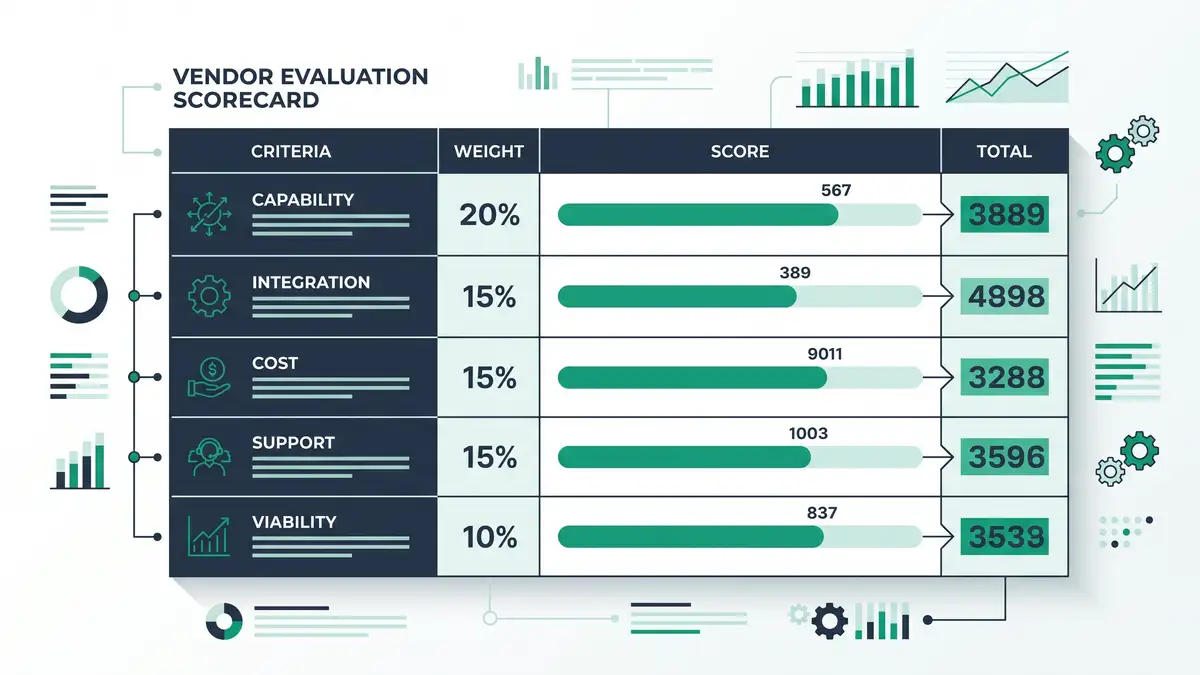
Capability Fit
Does it solve the specific decision or workflow you named, not a generic feature list? Score against your real use case and adoption likelihood, since capability nobody uses becomes shelfware.
Integration and Interoperability
API quality, documentation, and how cleanly it fits your existing stack. This dimension predicts the cross-system labour tax and is routinely underweighted. Weight it heavily.
Total Cost of Ownership
Licence plus implementation, training, support, integration effort, and migration risk - and for AI, the cost of reviewing and correcting outputs. Use a technology ROI framework to make it comparable.
Vendor Viability
Financial stability, roadmap credibility, and reference customers. Third-party viability is the top emerging risk for a reason: a great tool from a failing vendor is a liability.
Support and Governance
Implementation quality, responsiveness, security posture, data portability, and - for AI - transparency and auditability. Implementation quality is a leading predictor of whether you renew.
How Do You Run the Evaluation?
Run it decision-first and cross-functional, front-loading the risk work that usually derails the final stage. The sequence below is how peppereffect structures a vendor selection so it stays rigorous without dragging for two quarters.
Define requirements and weights first. Name the decision or workflow the vendor must serve and set the scorecard weights before you see a single demo, so the demo cannot bias the criteria. Shortlist against the scorecard. Score each candidate on all five dimensions using evidence, not impressions. Bring security and legal in early. The 86 percent who skip this pay for it later; front-load security questionnaires and data agreements instead.
Model total cost of ownership, not price. Include integration and switching costs so a cheap-but-brittle option scores honestly. Pilot before you commit. Favour phased, milestone-based agreements that prove fit before locking in, especially for AI partners where value depends on real-world output quality. This is the same rigour you would apply to any build versus buy decision.
Choosing an AI or automation partner and want the scorecard done right? An evaluation session maps your weighted criteria and pressure-tests the shortlist before you sign.
Book Your Evaluation Session
How Do You Evaluate an AI or Automation Vendor?
AI and automation vendors need every standard dimension plus a governance layer, because the risks are model-, data-, and workflow-specific. Demand for AI is near-universal - 81 percent of buyers say AI capability is important in the software they purchase - but demand is outrunning diligence. IBM found that ungoverned and shadow AI systems are more likely to be breached and more costly when they are, precisely because they were adopted without access controls or governance policies.
So the AI-specific criteria matter. Score the vendor on data ownership and portability, model transparency and auditability, and willingness to support algorithmic impact assessments and cross-functional oversight. A partner that operates a black box and resists scrutiny creates lock-in that is technical, regulatory, and reputational at once. A strong AI agency evaluation weighs governance-friendly architecture and human-in-the-loop controls as heavily as raw capability. The right AI automation partner does not just deliver a tool - it helps you decouple revenue from headcount on infrastructure you can audit and, if you ever need to, leave.
Frequently Asked Questions
What is a vendor evaluation framework?
A vendor evaluation framework is a structured, repeatable process for scoring prospective vendors against weighted criteria - typically capability fit, integration, total cost of ownership, vendor viability, and support and governance. Instead of choosing whoever demos best or discounts hardest, you assign each criterion a weight based on business impact, score every candidate, and let the weighted total drive the decision. The output is a vendor scorecard that makes the comparison objective and defensible. It matters most for high-spend or high-risk purchases like AI and automation partners, where a poor choice creates lock-in and risk that only surface later.
What criteria should a vendor scorecard include?
A strong vendor scorecard covers five dimensions: capability fit against your specific use case, integration and interoperability with your existing stack, total cost of ownership beyond the sticker price, vendor viability and financial stability, and support and governance including security and data portability. Weight each according to how much it affects your business - integration and total cost are routinely underweighted and deserve more emphasis. For AI vendors, add data ownership, model transparency, and auditability. Procurement research recommends scaling the depth of evaluation to the spend value and risk of the category.
Why do so many software purchases end up as shelfware?
Because companies buy more capability than they can realistically adopt and never evaluate for overlap or adoption likelihood. The average organisation uses only 49 percent of its SaaS licences and carries duplicative tools - 11 project management apps, 10 collaboration apps - because purchases happen ad hoc, with 51 percent of apps acquired as shadow IT outside any formal process. Pressure to show ROI fast pushes buyers to skip rigorous evaluation. A vendor evaluation framework that checks existing capability and adoption fit before purchase is the direct antidote to shelfware.
How is total cost of ownership different from the price?
Sticker price is only the licence fee. Total cost of ownership adds implementation, integration and customisation, training, ongoing support, performance overhead, and eventual migration - plus, for AI, the cost of reviewing and correcting outputs. The biggest hidden cost is usually integration labour; Bain estimates a 100 billion dollar market just in reducing the cross-system work caused by tools that do not connect. A cheap vendor that forces manual workarounds often costs far more in total than a reliable, well-integrated one, which is why total cost of ownership belongs on the scorecard.
How do I avoid vendor lock-in?
Score data portability and contract flexibility before you sign, not after. Lock-in builds through accumulated data and deep integration - 47 percent of enterprises cite data migration as a major barrier to switching - so favour vendors with clean export standards, open APIs, and shorter or milestone-based contracts. Distinguish healthy stickiness that comes from delivered value from exploitative lock-in built on artificial barriers; 58 percent of buyers who feel trapped leave anyway and become detractors. For AI vendors, insist on model transparency and clear data-ownership terms so you retain the option to move.
What is different about evaluating an AI or automation vendor?
AI and automation vendors carry model-, data-, and workflow-specific risks on top of standard criteria. Add data ownership and portability, model transparency and auditability, and the vendor's willingness to support algorithmic impact assessments and cross-functional oversight. IBM found ungoverned and shadow AI systems are more likely to be breached and costlier when they are, so governance is not optional. Favour partners that offer human-in-the-loop controls, integrate with your existing security tooling, and are transparent about how models and data are handled. Capability matters, but governance and viability predict whether the partnership lasts.
Choose Technology Partners That Last
peppereffect helps B2B founders evaluate and select the AI and automation partners their growth depends on - with a weighted vendor scorecard that prices total cost of ownership, tests integration fit, and screens for governance and viability. We are also the kind of partner we tell you to look for: transparent, auditable, and built to eliminate lock-in.
Book Your Evaluation SessionResources
- Zylo - 2024 SaaS Management Index (licence waste and shelfware)
- Productiv - 2023 State of SaaS Series (shadow IT and app sprawl)
- Flexera - 2024 State of the Cloud Report
- IDC - Control Cloud Costs and Expand Transparency with FinOps
- G2 - 2023 Buyer Behavior Report
- Deloitte - 2023 Global Third-Party Risk Management Survey
- Gartner via LegalDive - Generative AI and Third-Party Viability Risk
- Bain - The 100 Billion Dollar SaaS Opportunity in Cross-System Labor
- Monetizely - Pricing for Lock-In and Switching Costs in SaaS
- ORM Tech - B2B SaaS Sales Cycle Length Benchmarks