

Business systems architecture is the deliberate design of how your workflows, data, and tools connect so the whole operation keeps working as volume climbs. It is the difference between a company that adds clients and stays calm, and one that adds clients and starts dropping handoffs, duplicating data entry, and firefighting integration breaks. Most founders never design their systems on purpose. They accumulate tools, wire them together with quick fixes, and discover the cracks only once growth exposes them. By then the repair bill is steep: companies pay an extra 10 to 20 percent on every modernisation project just to service accumulated technical debt.
The evidence that ad hoc systems break at scale is overwhelming. More than 80 percent of digital transformation initiatives fail, and the leading causes are not exotic: poor coordination across functions and flawed technology implementation. The average enterprise now runs 897 applications, of which only 29 percent are integrated. That gap - hundreds of disconnected tools held together by manual effort - is precisely what breaks when you scale.
This guide covers what business systems architecture actually is, why workflows break at scale, the four layers every resilient system needs, the design principles that keep those systems from cracking, and how agentic AI is raising the stakes. Here is what you will learn:
- Why brittle workflows are a systemic problem, not a series of isolated tool failures
- How application sprawl and integration debt quietly cap your growth
- The four architectural layers that separate systems that scale from systems that break
- Six design principles - from API-first to a single source of truth - that make workflows durable
- How to sequence a systems architecture build without stalling the business
Key Takeaway
Scaling is no longer a headcount problem - it is an architecture problem. Companies that design their systems deliberately decouple revenue growth from headcount, because the system absorbs more volume instead of more people. Companies that let systems accumulate by accident hit a wall where operations consume more time than delivery.
What Is Business Systems Architecture?
Business systems architecture is the structural blueprint for how information, decisions, and work move through your company. It defines which tools own which data, how those tools talk to each other, where automated workflow orchestration takes over from manual effort, and where humans stay in the loop. Software architects use the term for code; applied to a business, it means the same discipline aimed at your operating model rather than a single application.
The distinction that matters is intent. Every company has a systems architecture whether or not anyone designed it. The question is whether it was engineered to scale or assembled by accretion. An accreted architecture looks like this: a CRM here, a project tool there, three spreadsheets bridging the gaps, and a founder who is the only person who understands how it all fits together. It works at 10 clients. At 50, the manual bridges become full-time jobs. At 200, they fail.

A deliberately architected system inverts that. When a deal closes, the workflow itself creates the project workspace, provisions access, triggers the onboarding sequence, and updates every downstream system - without anyone retyping the same data four times. That is not a productivity hack. It is revenue infrastructure, and it is the foundation of the Freedom Machine peppereffect installs for its clients.
Why Do Workflows Break When You Scale?
Workflows break at scale because the number of connections between systems grows faster than the systems themselves. Add a tool and you have not added one thing to maintain - you have added a link to every other tool it touches. This is why application sprawl is so corrosive. The average company used 106 SaaS applications in 2024, and the rate at which companies consolidate overlapping tools has collapsed from 14 percent to just 5 percent year on year. Tool count keeps climbing while the discipline to rationalise it fades.

Each unconnected application is a manual handoff waiting to fail. When only 29 percent of the average enterprise's applications are integrated, and just 2 percent of organisations have more than half their applications connected, the rest of the work happens in the gaps - copy-paste between systems, reconciliation spreadsheets, and status updates typed by hand. Nine in ten organisations report concrete business obstacles caused by data silos. That is the mechanism of breakage: information cannot move, so people move it, and people do not scale linearly.
The cost is not hypothetical. IT teams now spend 39 percent of their time building custom integrations rather than shipping new capabilities. Nearly two of every five engineering days are spent compensating for the absence of a coherent architecture. Meanwhile the human toll compounds: after just 20 minutes of repeated interruptions, people report significantly higher stress, frustration, and perceived workload - and constant tool switching is a primary driver of exactly that interruption load.
| Symptom At Scale | Root Architectural Cause | What Fixes It |
| Same data entered in 3+ places | No single source of truth | Authoritative data ownership per entity |
| Handoffs dropped between teams | Manual, event-less transitions | Event-driven triggers |
| Every new tool needs custom wiring | Point-to-point integration | API-first, hub integration |
| Reports never quite reconcile | Fragmented data across silos | Unified data layer |
| Only the founder understands the flow | Undocumented tribal knowledge | Modelled, documented workflows |
Sources: Salesforce MuleSoft Connectivity Benchmark 2025, BetterCloud SaaS Statistics 2026
Avoid This Mistake
Do not automate a broken process. Layering automation on top of a brittle architecture just makes the failure faster and harder to see. This is a major reason 80 percent of transformations fail. Model the workflow, fix the structure, then automate what works. Business process mapping is the mandatory first step before any automation build.
What Does Brittle Architecture Really Cost?
The true cost of a brittle system is not the visible breakage - it is the tax on every future change. McKinsey describes technical debt as a vicious cycle: shortcuts in system design accumulate into interest payments that inflate the cost of every subsequent improvement by 10 to 20 percent. The more brittle your architecture, the more expensive it becomes to fix, which discourages fixing it, which makes it more brittle. Left alone, that loop ends in a system nobody dares to touch.
For smaller companies the stakes are existential rather than merely expensive. SCORE's 2024 analysis found that 18 percent of small business failures trace to pricing and cost-structure problems - and inefficient, manual operating models are a direct contributor to bloated cost structures. When brittle workflows force you to add a person for every increment of volume, your unit economics erode exactly when you need them to improve.
Key Takeaway
Brittle architecture imposes a revenue ceiling. Orchestrated automation on a sound foundation lifts it: large enterprises report 240 percent ROI within 12 months and 210 percent over three years. The returns come from labour avoided, errors eliminated, and cycle times cut - none of which are reachable while your systems live in silos.
What Are the Four Layers of Scalable Systems Architecture?
Every business system that survives scale is built on four layers: data, integration, orchestration, and interface. Get the order right and each layer reinforces the one above it. Get it wrong - typically by buying interface tools before fixing the data layer - and you build on sand. The layered model below is how peppereffect architects operating systems for B2B founders.
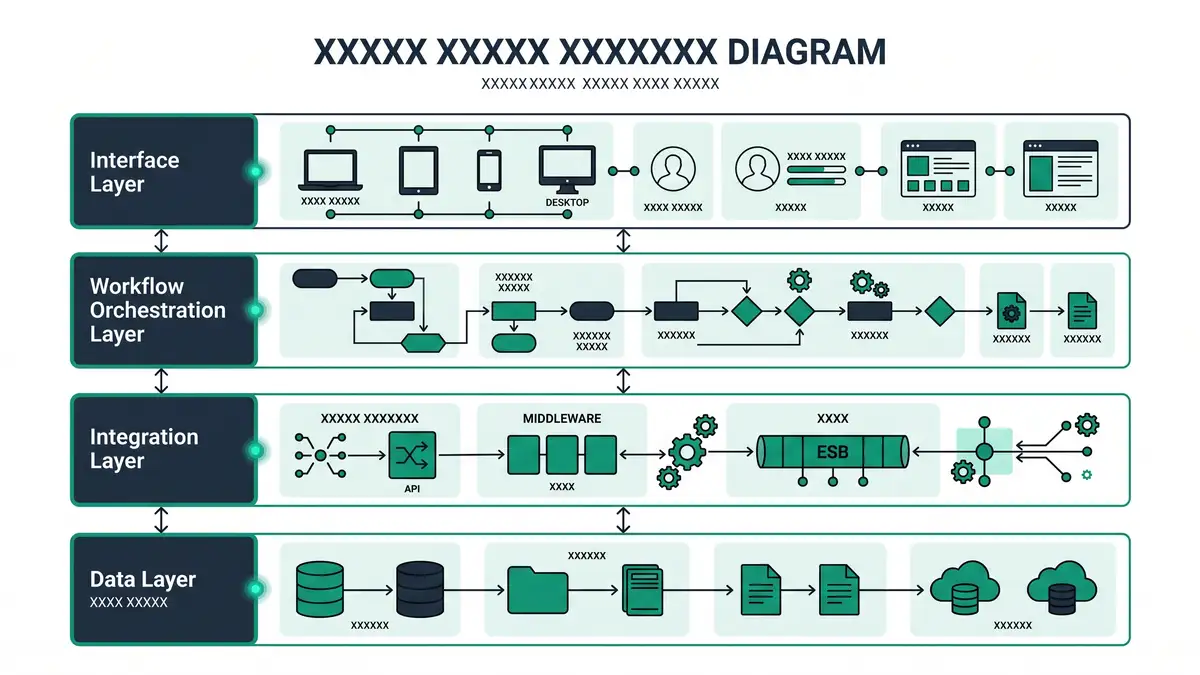
Data Layer - The Single Source of Truth
Decide which system owns each entity: contacts, deals, projects, invoices. Every other tool reads from that authority rather than keeping its own copy. Without this layer, 90 percent of organisations hit data-silo obstacles and reports never reconcile.
Integration Layer - The Connective Tissue
Connect systems through APIs and a central hub rather than fragile point-to-point links. APIs already drive 40 percent of company revenue, up from 25 percent in 2018, and disciplined integration is what stops IT from spending 39 percent of its time on custom connectors.
Orchestration Layer - The Logic
This is where AI workflow automation lives. Events in one system trigger actions in others, with logic gates and approval checkpoints. Orchestration turns a pile of connected tools into a workflow that runs itself.
Interface Layer - The Human Surface
Dashboards, notifications, and the handful of decision points where people intervene. Built last and built thin, so humans touch the system only where judgement genuinely adds value.
Which Design Principles Keep Workflows From Breaking?
Six principles separate architectures that scale from architectures that crack. They are not exotic. They are the disciplines that get skipped when a company grows by accretion instead of design.

API-first. Choose tools that expose robust APIs and connect them through a hub, not a web of one-off links. IDC forecasts organisations will spend 4 billion dollars on standalone API management software by 2026, a signal of how central disciplined integration has become. Single source of truth. One authoritative record per entity, referenced everywhere else, so operational transparency replaces reconciliation. Event-driven design. Actions fire from events, not from someone remembering to do them, which is what eliminates dropped handoffs.
Modularity. Build in components with clear boundaries so you can replace one tool without re-architecting the whole. Human-in-the-loop. Automate the coordination, keep people at the high-judgement checkpoints - a principle we cover in depth in human-in-the-loop AI. Centralised governance. Only 54 percent of organisations have a framework for centralised governance, and that gap is exactly where shadow systems and ungoverned agents create risk.
Not sure which layer of your architecture is the bottleneck? An operations audit maps where your workflows break before you spend a dollar automating them.
Book Your Operations Audit
How Is Agentic AI Changing Systems Architecture?
Agentic AI raises both the payoff and the penalty of your architecture. Autonomous agents that take goal-directed actions across applications have reached 35 percent adoption within two years, with a further 44 percent planning deployments. When those agents run on a well-integrated architecture, they multiply the leverage of every layer beneath them. When they run on a fragmented one, they multiply the chaos.
The data is blunt about which is happening. Half of AI agents currently operate in isolated silos, and 86 percent of IT leaders warn that without proper integration, agents add more complexity than value. Yet 96 percent agree that agent success depends on seamless, debt-free data integration. The lesson is unambiguous: agentic workflows are only as good as the architecture they sit on. Bolting an agent onto a brittle system does not fix the system - it just gives the brittleness a faster engine.
| Agentic AI Reality | Figure | Architectural Implication |
| Agents operating in silos | 50% | Integration layer is missing |
| IT leaders: agents add complexity without integration | 86% | Fix data layer first |
| Agree success depends on seamless integration | 96% | API-first is non-negotiable |
| Have centralised governance framework | 54% | Governance gap creates shadow AI |
Source: MuleSoft 2026 Connectivity Benchmark Report
How Do You Build a Business Systems Architecture?
Build it in the order the layers depend on each other, not the order the tools tempt you. The sequence below is how peppereffect installs an operating system that holds at scale, and it mirrors the Scaling Up methodology of fixing the structure before adding load.
Map the workflows you actually run
Document how work moves today, including the manual bridges. You cannot architect what you have not modelled. This is where hidden handoffs and duplicate data entry surface.
Establish the data layer
Assign one authoritative owner per entity and eliminate competing copies. Everything above this layer depends on it being clean.
Wire the integration hub
Connect systems through APIs and a central integration layer so new tools plug in rather than requiring bespoke wiring each time.
Orchestrate, then keep humans at the gates
Layer event-driven automated fulfillment on the connected foundation, with approval checkpoints where judgement matters. Start narrow, validate, then expand.
Frequently Asked Questions
What is the difference between business systems architecture and enterprise architecture?
Enterprise architecture is a broad discipline covering an organisation's entire technology, data, and business structure, often governed by frameworks like TOGAF. Business systems architecture is the practical subset most founders actually need: how your specific workflows, data, and tools connect so operations do not break as you grow. You do not need a formal enterprise architecture practice to benefit from deliberately designing your systems. Start by mapping your real workflows through business process mapping, establish a single source of truth for your data, and connect your tools through an integration layer rather than manual handoffs.
Why do most business workflows break at scale?
Workflows break because connections between systems grow faster than the systems themselves, and most of those connections are manual. The average enterprise runs 897 applications but integrates only 29 percent of them, leaving the rest bridged by copy-paste and spreadsheets. At low volume that manual effort is invisible; at high volume it becomes the bottleneck, because people do not scale linearly. The fix is architectural: connect systems through APIs, establish authoritative data ownership, and let events trigger transitions instead of relying on someone remembering to act.
How does business systems architecture help decouple revenue from headcount?
When your architecture absorbs additional volume through automated workflow orchestration, you stop adding a person for every increment of growth. The system handles the coordination, data movement, and routine decisions, so headcount grows with strategic need rather than transaction volume. This is the core mechanism behind decoupling revenue from headcount, and it is why large enterprises running orchestrated automation report 240 percent ROI within a year.
Should I fix my processes before automating them?
Yes, always. Automating a broken process makes the failure faster and harder to diagnose, and this is a leading reason more than 80 percent of digital transformation initiatives fail. Model the workflow, remove the structural flaws such as duplicate data entry and undocumented handoffs, then automate what remains. The order is model, fix, automate - never automate first.
What role does agentic AI play in systems architecture?
Agentic AI acts as an autonomous orchestration layer, taking goal-directed actions across your connected systems. But it amplifies whatever is beneath it: on a well-integrated architecture it multiplies leverage, and on a fragmented one it multiplies chaos. Since 86 percent of IT leaders warn that agents add complexity without proper integration, the prerequisite for building agentic workflows is a clean data layer and an API-first integration hub. Get those right first.
How long does it take to build a scalable systems architecture?
It depends on your starting point, but the smart approach is incremental rather than a big-bang rebuild. Start by mapping workflows and fixing the data layer, which often takes a few weeks, then wire integration and orchestration in phases. Companies that attempt to automate everything at once see maintenance overhead balloon and success rates fall. Narrow scope, validate, and expand - each layer delivers value before the next begins.
Architect Systems That Hold at Scale
peppereffect designs and installs the AI operating system your B2B business needs to grow without breaking. We start with an operations audit that maps exactly where your workflows crack, then architect the data, integration, and orchestration layers that decouple your revenue from headcount.
Book Your Operations AuditSee how the Freedom Machine works → consulting exit strategy
Resources
- Salesforce - 2025 MuleSoft Connectivity Benchmark Report
- MuleSoft - 2026 Connectivity Benchmark Report (agentic AI and integration)
- BetterCloud - The Big List of 2026 SaaS Statistics
- McKinsey - Breaking Technical Debt's Vicious Cycle
- Oludapo et al. (2024) - Why Do So Many Digital Transformations Fail?
- Arcade - AI Workflow Automation Metrics and Enterprise ROI
- MIT Sloan Management Review and BCG - The Emerging Agentic Enterprise
- Asana - Context Switching: Costs and Fixes at Work
- Broadcom - Securing the API Economy (IDC API management forecast)