

Product-market fit is the moment most SaaS founders stop reading hiring playbooks and start running on instinct. Customer love is real. Revenue is climbing 10% month on month. The temptation is to keep the original team, add a few more individual contributors, and ride the wave. Eighteen months later the founder is the bottleneck, two functions are on fire at once, and the company is hiring reactively to put out the loudest one. This is when first VP hires fail at 67% rates and where the $10M-$50M plateau begins.
This article installs the canonical sequence for the first five executive hires after product-market fit. Reader: SaaS founder at $3M-$25M ARR scaling toward $40M+, currently running the company with co-founders or first individual contributors. The framework synthesises Lenny Rachitsky, SaaStr, Wasserman, Carta, ICONIQ Growth, and Bessemer 2025-2026 data on sequencing, compensation, evaluation criteria, and 90-day onboarding. It interlocks with our SaaS growth strategy and GTM strategy frameworks.
Strategic intent
The first five executive hires are an architecture decision, not a series of fire fights. Right order, right archetype, right onboarding gets the company to $50M ARR twice as fast as reactive peers. One wrong hire costs $1M to $3M and 12 to 18 months.
The Sequencing Problem Most Founders Get Wrong
Reactive hiring is the dominant failure mode. A fire breaks out. The founder hires to extinguish it. Six months later another fire breaks out in a different function, the founder hires there, and now they have two senior executives with overlapping mandates and zero operating cadence. Lenny Rachitsky's hiring research documents this pattern in dozens of founder interviews. The fix is to sequence the first five hires by founder bottleneck cost, not by which fire feels hottest.

The right sequence depends on the founder's profile and the company's GTM motion. Technical founders typically need the VP Sales hire first because their natural bias is to solve product problems while the commercial side of the business stalls. Commercial founders typically need the VP Engineering hire first because they hit a code-quality wall by 8-12 engineers and the founder has no instinct to fix it. Both patterns converge on the same five-role set at $20M+ ARR.
The Five-Hire Sequence for $5M-$40M ARR
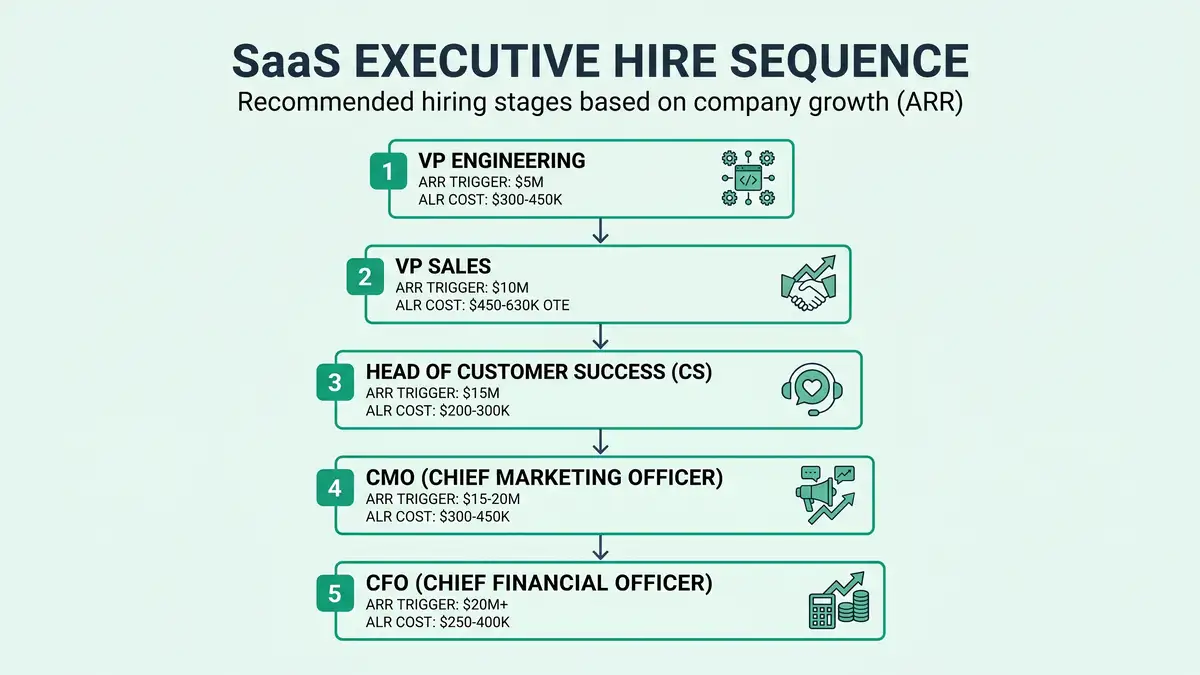
| # | Role | ARR trigger | Symptom that signals readiness | 2026 ALR (US, fully loaded) | Equity |
| 1 | VP Engineering / Director of Engineering | $3M-$10M ARR or 8-12 engineers | Ship velocity slowing; founder still merging PRs; codebase coordination failures | $300K-$450K | 1.0-2.0% |
| 2 | VP Sales / Head of Sales | $5M-$10M ARR with 2 reps independently at quota | Motion repeatable but capped at founder bandwidth; deals stalling at top of funnel | $450K-$630K OTE | 0.75-1.5% |
| 3 | Head of Customer Success | $10M-$20M ARR or NRR drifting under 100% | 10+ enterprise customers; churn signals emerging; expansion stalling | $200K-$320K | 0.4-0.8% |
| 4 | Head of Marketing / CMO | $10M-$20M ARR with structured marketing budget need | Pipeline capped at outbound; brand search flat; competitors taking share of voice | $300K-$450K | 0.4-0.8% |
| 5 | CFO (fractional then full-time) | $15M-$25M ARR or pre-Series B | Board reporting heavy; capital decisions pending; fundraise in next 12 months | $5-$15K/mo fractional; $250K-$400K full-time | 0.3-0.6% |
Source: Carta State of Private Markets 2026, Closedwon Talent 2026, Pavilion 2026 Compensation Report, ICONIQ 2025 State of GTM.
The Chief of Staff Exception
Many technical founders should hire a Chief of Staff as the "0.5" hire before any VP. The Chief of Staff multiplies founder bandwidth 2-3x while the first VPs are still being scoped. ALR runs $200K-$300K, equity 0.25-0.5%, and the role typically lasts 18-36 months before promoting into a VP role or transitioning. Lenny Rachitsky's operator research documents this as the highest-leverage first hire for founders still personally running the operating cadence.
Engineering First vs Sales First: The Sequencing Decision Tree

The dominant decision is whether VP Engineering or VP Sales comes first. The framework synthesises Lenny, SaaStr, and ICONIQ 2026 data. Technical founder + sales-led motion: sales first. Commercial founder + product-led motion: engineering first. Technical founder + PLG motion: engineering first (commercial side runs on product virality). Commercial founder + sales-led motion: engineering first (sales is your zone of competence; engineering is the bottleneck).
| Founder profile | GTM motion | First hire | Why |
| Technical (engineer-CEO) | Sales-led | VP Sales | Founder runs engineering instinctively; sales is the immediate revenue ceiling |
| Technical | PLG / hybrid | VP Engineering | Product is the GTM; engineering scale unlocks PLG velocity |
| Commercial (sales-CEO) | Sales-led | VP Engineering | Sales is your zone; engineering bottleneck is the threat |
| Commercial | PLG / hybrid | VP Engineering | Product velocity needs an engineer-leader before adding GTM layers |
| Product (designer / PM-CEO) | Any | VP Engineering | Product founders typically struggle with engineering management first |
Source: synthesis of Lenny Rachitsky, First Round Review, ICONIQ 2025 GTM.
The Five Evaluation Criteria for Every VP Hire
Resume credentials and "executive presence" are the two least predictive evaluation inputs. The criteria below have measurable answers and surface stage fit reliably. Apply them to every shortlisted candidate before extending the offer.
Prior-stage match
The candidate's last operating stage must match yours within one tier. A VP Sales who scaled $50M to $200M typically fails at $10M; a VP Eng from a 200-person team typically fails managing 12. Ask: "Walk me through one quarter at the stage equivalent to ours, from operating metrics to hiring decisions." Strong answers include specific numbers, named hires, and what changed quarter over quarter. The full archetype analysis sits in the first VP of Sales framework.
Operating cadence experience
The candidate must have run a documented weekly, monthly, quarterly cadence. Ask: "What was your forecast accuracy? How did you structure deal reviews, sprint reviews, or QBRs?" Strong answers reference specific operating rhythm and metric discipline. Weak answers describe ad-hoc forecasting or "we knew our numbers." Tie this to the company's weekly CEO dashboard and quarterly board deck cadence.
Recruiting track record
"How many people have you hired? How many are still there after two years? How many have been promoted?" Strong answer: concrete numbers with bench-development evidence. Weak answer: generalities. VP-level operators must build teams; senior individual contributors at VP titles cannot.
Cultural fit with founder
Half-day shadow visit. Two-on-one meetings between candidate and existing team without founder present. Ask the team: "Would you work for this person?" Ask the founder: "Could you accept being told you are wrong by this person for the next three years?" Generic executive presence is the most common false-positive signal; specific working chemistry is the only valid one.
Functional excellence (the documented playbook)
Can the candidate walk through their function's playbook in detail? VP Sales: discovery framework, MEDDPICC or similar, objection responses, ramp plan. VP Eng: sprint structure, code review process, on-call rotation, technical debt ledger. Head of CS: onboarding playbook, NRR motion, escalation tree. If they cannot articulate the playbook, they will not build one for you.
Want a custom executive hire sequence mapped to your founder profile, GTM motion, and the next $30M of ARR? Plus the 90-day onboarding template the new VP signs at offer.
Book a Freedom Machine DiagnosticThe Seven Failure Patterns Founders Keep Repeating
Seven failure patterns that explain most VP hire failures
(1) Hiring the big-company executive who cannot scrappily build. (2) Hiring junior at VP title because cheaper. (3) Hiring on resume brand vs stage fit. (4) Founder not letting go after hiring. (5) Vague success criteria or undefined 90-day ramp. (6) Hiring without a documented playbook for the function. (7) Mismatching archetype to stage (Scaler at $10M, Builder at $50M).
The 90-Day Onboarding Framework for Every VP
The first 90 days largely determine whether the executive succeeds at the 18-month mark. Companies with documented onboarding frameworks show meaningfully higher retention. The structure synthesises Charlie Cowan's 90-day VP plan, David Sacks operating cadence, and the peppereffect scale-revenue-without-headcount framework.
Days 1-30: Listen and shadow
Zero ownership of targets. The VP attends every meeting in their function, reviews every key metric for the last 18 months, meets one-on-one with every direct report and adjacent leader, and audits the current playbook. Output by Day 30: written diagnostic of current state, top three process gaps, top two opportunities.
Days 31-60: Diagnose and propose
VP produces a 90-day plan written down. Sections: current-state assessment, team capability mapping, process gaps, GTM/product/talent strategy adjustments, first-quarter hiring plan, comp-structure assessment. Presented to founder and board by Day 65.
Days 61-90: Operationalise and ship first wins
Methodology documented and socialised. First hire decision launched (interviewing in week 5-6, offer week 10). Operating cadence implemented (deal review for sales, sprint review for engineering, QBR for customer success). By Day 90: documented function, one win shipped, second hire candidate identified, preliminary results presented.
Five Case Studies: How Real Founders Built Their First Leadership Teams
| Company | Sequence taken | Key transition |
| Notion (Ivan Zhao) | COO (Akshay Kothari) early, then VP Eng, Head of Marketing (Camille Ricketts) | Designer-founder partnered with operator COO before adding C-suite |
| Linear (Karri Saarinen) | VP Engineering (Tuomas Artman) early; product founder retained design and strategy | Co-founder operating model preserved; engineering layer scaled first |
| Calendly (Tope Awotona) | Bootstrap to $70M ARR, then VP Sales + VP Eng + CMO post-OpenView | Founder-led sales through bootstrap; full C-suite built post raise |
| Mailchimp (Ben Chestnut + Dan Kurzius) | COO (Mark DiCristina) handled operations while founders ran product and culture | Operator COO before VP-level expansion; bootstrap-friendly sequencing |
| PostHog (James Hawkins + Tim Glaser) | Community-led; leadership added layer by layer with strong cultural filtering | No exec hiring before culture and playbook were documented |
Source: First Round Review, founder interviews, public company blogs.
The AI-Era Exception: Head of Growth Engineering / Head of AI
The Signal Club's 2026 analysis of the fastest-growing private B2B companies shows AI-native SaaS increasingly hires a Head of Growth Engineering or Head of AI as the fourth or fifth hire instead of a traditional CMO. The role spans technical capability (building AI agent stacks on top of Clay, Apollo, Default, Common Room) and growth strategy. The signal: 65% of fastest-growing private B2B companies use Clay; zero use an off-the-shelf AI SDR. For AI-native SaaS at $10M-$40M ARR, evaluate whether a Head of Growth Engineering replaces or precedes the CMO hire.
Investor Expectations by ARR Stage
| ARR stage | Expected exec hires | Board diligence point |
| $3M-$10M (Series A) | VP Engineering or VP Sales (motion-dependent); Chief of Staff likely | "Who is the first VP hire and when?" |
| $10M-$20M (Series A/B) | VP Eng + VP Sales; Head of CS in motion | "What is the leadership team gap and the next hire?" |
| $20M-$40M (Series B/C) | Full first 5: VP Eng + VP Sales + Head of CS + CMO + CFO | "Who is your bench? Who runs the company in your six-month sabbatical scenario?" |
| $40M+ (Series C) | Second-layer managers under each VP; CRO consolidation often emerges | "Where is the next CRO / President hire? IPO-ready leadership map?" |
Source: Bessemer Atlas 2026, ICONIQ 2025 State of GTM.
The 30/60/90-Day Hiring Rollout Plan
Days 1-30: Diagnose the bottleneck
Run the Founder's Bottleneck Index. Identify the founder profile + GTM motion to set first-hire priority. Build the role spec, comp band, equity band, and 90-day success criteria before opening the search.
Days 31-60: Source and evaluate
Open the search through retained recruiter (for VP-level), founder network, and investor referrals. Apply the five evaluation criteria. Run half-day shadow visits for finalists. Reference-check at depth (5+ references including detractors).
Days 61-90: Offer and onboarding kickoff
Offer with written 6/12/18-month success markers attached. 90-day onboarding plan signed at offer. Founder commits to three hours weekly with new VP for first 90 days. Brief the board on hire and timeline. Begin sourcing the next hire in the sequence.
Frequently Asked Questions
What is the right sequence for the first 5 SaaS executive hires?
For most $5M-$40M ARR B2B SaaS: (1) VP Engineering or VP Sales (depending on founder profile and GTM motion), (2) the other of those two, (3) Head of Customer Success, (4) Head of Marketing / CMO, (5) CFO (often fractional first, full-time pre-Series B). Many founders should add a Chief of Staff as a "0.5" hire before any VP. Sequence is determined by founder bottleneck cost, not by which function is loudest.
When should I hire my first VP Engineering?
At $3M-$10M ARR or once the engineering team exceeds 8-12 engineers. Triggers: ship velocity declining, founder still merging PRs, codebase coordination failures, hiring quality slipping because no one runs structured interview loops. 2026 ALR runs $300K-$450K with equity 1.0-2.0%. Director of Engineering is the cheaper alternative when the team is under 8 engineers.
When should I hire my first VP Sales?
When two reps are independently hitting quota with a documented sales motion, founder-led selling has plateaued at 50%+ founder time on sales, and ACV is in the band that justifies sales-led economics ($25K+). The full archetype, evaluation, and 90-day onboarding framework is in our VP of Sales hiring guide. 67% of first VP Sales hires fail in 18 months when these conditions are not met.
How much should I pay my first 5 SaaS executives?
2026 fully-loaded benchmarks for $10M-$40M ARR US SaaS: VP Engineering $300K-$450K (equity 1.0-2.0%), VP Sales $450K-$630K OTE (equity 0.75-1.5%), Head of Customer Success $200K-$320K (equity 0.4-0.8%), CMO $300K-$450K (equity 0.4-0.8%), CFO $250K-$400K full-time or $5-$15K/month fractional (equity 0.3-0.6%). Total added ALR $1.2M-$2.0M across the five.
Should I hire a Chief of Staff before the C-suite?
For most technical founders, yes. The Chief of Staff multiplies founder bandwidth 2-3x while the first VPs are still being scoped. ALR runs $200K-$300K, equity 0.25-0.5%. The role typically lasts 18-36 months before promoting into a VP role or transitioning. Lenny Rachitsky's operator research documents the Chief of Staff as the highest-leverage first hire for founders still personally running the operating cadence.
VP Engineering or VP Sales first?
Technical founder with sales-led motion: VP Sales first. Technical founder with PLG/hybrid motion: VP Engineering first. Commercial founder with any motion: VP Engineering first. Product/designer founder with any motion: VP Engineering first. Override only with specific structural reason; default to the framework.
What equity should the first 5 executives receive?
Series B-stage benchmark: VP Engineering 1.0-2.0%, VP Sales 0.75-1.5%, Head of Customer Success 0.4-0.8%, CMO 0.4-0.8%, CFO 0.3-0.6%. Standard four-year vesting with one-year cliff. Some companies use milestone acceleration (50% of grant accelerates on specific ARR or operational milestones). Carta 2025-2026 equity benchmarks support the lower end; Series A-stage SaaS often grants the upper end to attract talent.
What are the most common executive-hire failure patterns?
Seven recurring patterns: (1) hiring the big-company executive who cannot scrappily build, (2) hiring junior at VP title because cheaper, (3) hiring on resume brand vs stage fit, (4) founder not letting go after hiring, (5) vague success criteria or undefined 90-day ramp, (6) hiring without a documented playbook for the function, (7) mismatching archetype to stage (Scaler at $10M, Builder at $50M). Each pattern accounts for 10-20% of failed VP tenures.
Build the leadership team that takes your SaaS from $10M to $50M ARR without burning the founder out.
peppereffect installs the five-hire sequence, the 90-day onboarding framework signed at offer, and the AI-augmented operating cadence that lets a 10-12 person leadership team deliver what a 20-person team produced two years ago. The result: a CEO back in the strategy seat, a leadership bench the board respects, and a company that operates without the founder in every meeting. scaling from $10M to $50M ARR
Architect Your Freedom MachineResources
- Lenny Rachitsky: Hiring Your Early Team (B2B)
- Lenny Rachitsky: What I Learned Hiring an Operator CEO
- Noam Wasserman: The Founder's Dilemma (HBR)
- Carta: State of Private Markets 2025-2026
- Pavilion: 2026 Compensation Report
- Closedwon Talent: 2026 GTM Comp Benchmarks
- Hustlex: VP Sales Graveyard 67% Failure Data
- David Sacks: The Cadence (Craft Ventures)
- Charlie Cowan RevOps: First 90-Day Plan for a VP Sales
- First Round Review: Going from PLG to Enterprise
- Bessemer Atlas: State of the Cloud 2026
- ICONIQ Growth: 2025 State of Go-to-Market