

It is 2am. Your SaaS company crossed $14M ARR last quarter, you have 47 employees, and you are still in the codebase fixing a bug that should have been a Director of Engineering's problem six months ago. Tomorrow you will close a $180K deal that your VP Sales should be closing, run an all-hands you should have delegated, and skip the strategic planning block again because something is on fire. You have not slept seven hours in three months. The board will ask about Rule of 40 next week. You are the company's single point of failure.
This is the Technician's Trap. Michael Gerber named it in 1986 in The E-Myth. Forty years later it still snares the majority of SaaS founders between $5M and $40M ARR, especially the technical ones, because the part of the work that brought them success early is the exact part that strangles the company late. This article installs the diagnostic, the cost analysis, and the 90-day reset. It interlocks with the broader SaaS growth strategy playbook and the scale-revenue-without-headcount framework that determines whether the founder's hours are the binding constraint.
Strategic intent
The Technician's Trap is an identity problem with a financial cost, not a time-management problem. The founder who escapes stops shipping code and starts shipping systems. The company that escapes stops needing the founder to function and starts compounding without them.
What Gerber Actually Said
Michael Gerber's E-Myth Revisited argued every founder is actually three people fighting for control: the Technician who loves the craft (the coder), the Manager who imposes order, and the Entrepreneur who sees the future. In most founders the Technician wins by default because the work feels productive, urgent, and tangible. Lines of code ship. Pull requests get merged. The deal closes. Dopamine arrives.
The trap is that the very behaviours that built the company to $5M ARR become the behaviours that prevent it from reaching $50M. The founder optimises for the part of the job they enjoy, not the part the company needs. Noam Wasserman's HBR research documents that 65% of failed startups trace failure to founder conflict or overwork, not market timing or product.

Want to see your own CAC against peer benchmarks? Run the CAC Diagnostic for your true CAC, the 30 to 50% reduction agentic deployment delivers, and a board-ready PDF in 60 seconds.
Run the CAC DiagnosticThe Five Symptoms at $10M to $40M ARR
Test against the five symptoms. If three or more are true, the trap has you.
| Symptom | What it looks like | The cost |
| 1. CEO still owns the codebase | Founder is still merging PRs, fixing production bugs, or shipping core feature work themselves | Engineering team underutilised; founder time worth $300+/hr spent on $80/hr work |
| 2. CEO closes the top three deals every quarter | VP Sales exists but founder is on every $100K+ deal; team learns founder credibility is required | Sales motion does not generalise; VP Sales fails inside 18 months |
| 3. CEO runs every C-level 1:1 and the all-hands | Founder is the connective tissue across functions; no leadership team operates without the founder in the room | No succession plan; key-person risk priced into valuation |
| 4. CEO is the only person who knows the customer database | Renewals, expansions, and churn calls escalate to the founder; CSM team feels like message-takers | NRR drifts; founder cannot take a week off without churn risk |
| 5. CEO sleeps under six hours and skips strategic thinking | Calendar is back-to-back; no time for board prep, M&A, or competitive strategy | Compounds. The strategy gap widens every quarter the founder is in firefighting mode. |
Source: synthesis of Lenny Rachitsky operator-CEO research, SaaStr founder transition, David Sacks Operating Cadence.
The Founder's Bottleneck Index

Score yourself 0-10 on each question, where 10 is "this describes me exactly every week" and 0 is "this is never true". Total the score against the bands at the bottom.
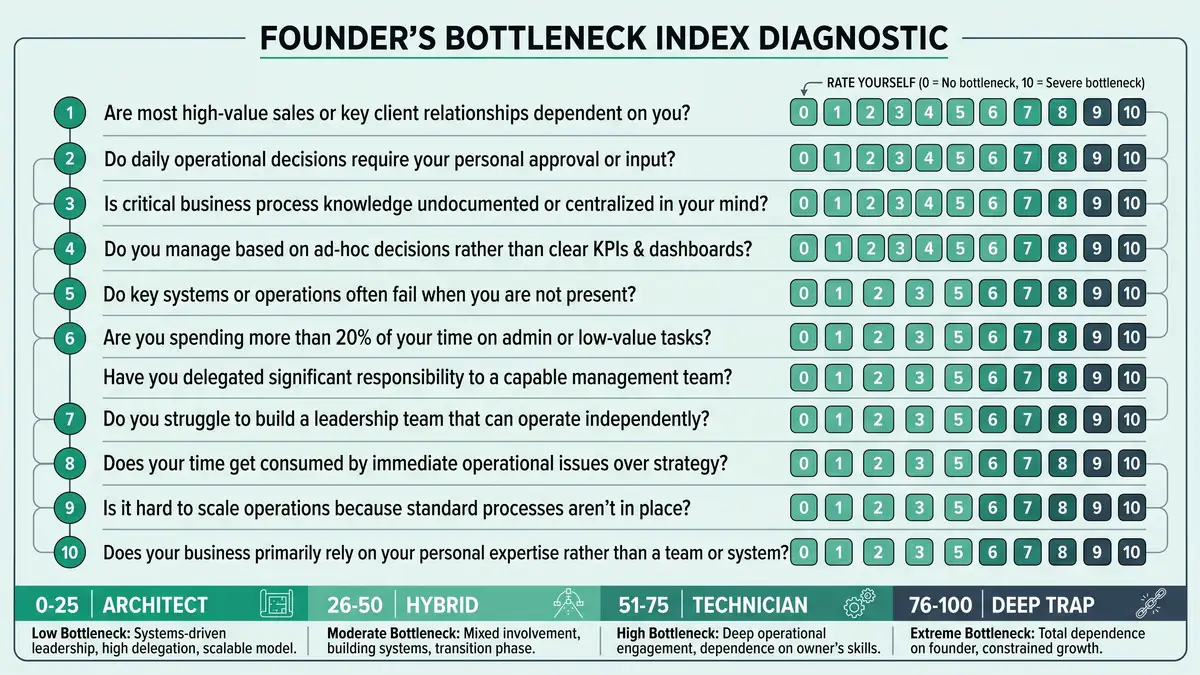
| # | Question | Score 0-10 |
| 1 | I personally code or merge PRs in the production codebase at least weekly. | __ |
| 2 | I personally close at least 50% of new ARR above $50K ACV. | __ |
| 3 | My calendar is over 80% booked Mon-Fri 8am to 7pm. | __ |
| 4 | I am the only person who can answer questions from the top 10 customers. | __ |
| 5 | I review or write 30+ emails per day on operational topics. | __ |
| 6 | I have under three hours per week of uninterrupted strategic thinking. | __ |
| 7 | I sleep under seven hours per night three nights or more in an average week. | __ |
| 8 | The company cannot function for two weeks without me physically online. | __ |
| 9 | I have personally hired more than 50% of all employees in the last 12 months. | __ |
| 10 | I am the only person who maintains relationships with the board, top investors, and key customers. | __ |
Source: peppereffect 2026 diagnostic synthesising Wasserman HBR, Lenny Rachitsky 2026, Gerber E-Myth.
| Total score | Diagnosis | Action |
| 0-25 (Architect) | Time and identity already shifted from technician to architect | Defend the cadence; build the next layer of leadership bench |
| 26-50 (Hybrid) | Healthy transition in progress; some operational dependencies remain | Identify the two highest-cost dependencies and delegate within 90 days |
| 51-75 (Technician) | Clear Technician's Trap pattern; the company is constrained by founder bandwidth | 90-day reset (below) is mandatory; consider hiring Chief of Staff in next 60 days |
| 76-100 (Deep Trap) | Founder is the single point of failure; valuation cap and burnout risk both active | Immediate action: time audit, leadership hire kickoff, board conversation about the gap |
The Financial Cost of Staying in the Trap
The cost compounds three ways. First, the founder is doing work that someone else could do for 30-50% of the implicit hourly rate, which means the difference between founder labour cost and replacement cost is destroyed value. A $10M ARR founder personally worth $300/hour doing $40/hour work loses $260 per hour over 50 hours per week, which compounds to roughly $650K per year in pure cost-arbitrage destruction.
Second, the strategic work that does not happen has its own cost. The board deck that gets thrown together in 90 minutes the night before the meeting. The competitive response that takes six weeks instead of six days. The acquisition opportunity that gets missed because the founder did not have a half-day to evaluate it. Wasserman's HBR analysis documents this as the dominant cause of mid-stage stagnation.
Third, the valuation penalty. First Page Sage 2026 valuation data shows founder-dependent SaaS trades at 3-4x EBITDA versus 7-8x for systematised businesses. LockedOn Leadership data on the Key Person Discount runs 10-30% across mid-market acquisitions. For a $30M ARR SaaS heading toward an exit, the founder-dependency penalty is $30M-$90M in enterprise value left on the table.
The 12-month projection
If the founder keeps personally doing $30-$80/hour operational work for the next 12 months, the company loses an estimated $1M to $3M in compounded strategic execution and valuation drift. The cost is real even when nothing breaks visibly, because the strategy gap widens every quarter while the daily firefighting stays the same.
Why Technical Founders Are More Vulnerable
Technical founders fall in harder because four forces compound. The codebase feels safer than people decisions; shipping a feature is unambiguous, hiring a VP is ambiguous and slow. The dopamine cycle is shorter; a merge takes hours, a sales hire takes 90 days to ramp. The identity is reinforced for years before the company exists; the title "founder" is new, the identity "engineer" is decades old. And the social signal of "still coding the product myself" plays well at YC dinners, even when it is a tax on the business. Paul Graham's YC essays document the retraining cycle YC runs to break this pattern.
The Freedom Machine Antidote
The escape from the Technician's Trap is not "delegate more." Delegation alone fails when there is no system for the delegate to plug into. The Freedom Machine is five pillars that together remove the founder from the operational critical path.
Documented playbooks for sales, customer success, and product
The SaaS sales playbook, customer onboarding system, and product roadmap process all live as written documents anyone on the team can execute. If the founder is the only person who knows how to close a deal, the playbook does not exist.
Hired second-line management team
The five hires that get the founder out of the trap (sequence below). Each one removes one or more of the five symptoms permanently when the playbook is in place to support them.
AI-augmented automation across operations and GTM
Operational AI agents (Claude, custom workflows in Default, Clay flows, Common Room intent signals) absorb 20-40% of the work the founder previously did personally, mapped against the agentic workflows framework. Email triage, contract drafting, pipeline reporting, customer health monitoring all run on infrastructure that does not need founder time.
Operating cadence the company runs to
Weekly CEO dashboard on Monday. Monthly all-hands the second Wednesday. Quarterly board deck on the third Tuesday. Annual strategy offsite in January. Every meeting on the calendar belongs to one of these layers. Everything else is exceptional.
Founder time-block discipline (60/30/10)
60% of weekly hours on strategic work (product strategy, fundraising, M&A, brand, vision). 30% on talent (hiring, 1:1s, leadership coaching). 10% on operations (the small set of decisions only the founder can make). Anything else gets delegated or deleted.
Want the 90-day Freedom Machine reset tailored to your bottleneck index score, your current leadership bench, and your CEO dashboard?
Book a Freedom Machine DiagnosticThe Five Hires That Get You Out
| Hire | When | 2026 cost (ALR) | Symptom solved |
| 1. Chief of Staff | $5M-$15M ARR | $200-$300K | Calendar control, 1:1 coordination, founder leverage 2-3x |
| 2. VP Sales | $10M ARR when motion is repeatable and 2 reps independently at quota | $450-$630K OTE | CEO out of top deals |
| 3. Director of Engineering / VP Eng | $10M-$20M ARR | $300-$450K | CEO out of the codebase |
| 4. Head of Customer Success | $15M-$25M ARR with NRR over 100% | $200-$300K | CEO out of customer escalations and renewal calls |
| 5. Strategic CFO (fractional or full) | $20M+ ARR or pre-Series C | $250-$400K (full) or $5-$15K/month (fractional) | Board prep, capital strategy, financial reporting off the founder's plate |
Source: synthesis of Lenny Rachitsky operator hiring, Closedwon Talent 2026 comp benchmarks, David Sacks cadence.
Total added ALR for the five hires: $1.2M-$2.0M. Cost of not making them: $1M-$3M per year in opportunity cost plus the 10-30% valuation discount on a future exit. The math is rarely close.
Five Founders Who Escaped
| Founder | Stage at exit | Key transition |
| Ben Chestnut (Mailchimp) | $700M+ ARR pre-Intuit acquisition | Built operating bench with COO Mark DiCristina; remained technical but stopped owning operations |
| Tope Awotona (Calendly) | $70M ARR pre-OpenView | Bootstrapped to $70M then reorganised leadership before raising; hired VP Eng and VP Sales |
| Ivan Zhao (Notion) | $200M+ ARR | Brought in Akshay Kothari as COO to handle operations while Ivan remained design-led |
| Karri Saarinen (Linear) | $50M+ ARR | Hired VP Engineering Tuomas Artman early; founder remained on product strategy not code |
| James Hawkins (PostHog) | $25M+ ARR community-led | Built leadership team layer by layer; founder remained accessible but not bottleneck |
Source: First Round Review, founder interviews, public company blogs.
The Architect vs The Technician: Identity Reframe
The CEOs who escape do it through an identity reframe, not a productivity hack. The Technician identity is "I am the person who builds the thing." The Architect identity is "I am the person who designs the system that builds the thing." Both are honourable. Only one scales past $10M ARR. The architect writes the playbook, hires the people who execute it, designs the operating cadence, and intervenes only when the system has produced a signal the system cannot itself process. The architect's calendar reflects the identity: long thinking blocks, structured 1:1s, weekly strategic review, no daily code.
The 90-Day Founder Reset
Days 1-30: Time audit and codification
Track every 30-minute block for 14 days. Categorise: strategic, talent, operations, technician work. Then list the top five tasks only the CEO currently does. For each, write down what would need to be true to delegate it. Output: the written delegation map.
Days 31-60: Delegation and AI augmentation
Hand off two of the top five tasks. Implement AI agents for two more (email triage, customer health monitoring, pipeline reporting, contract drafting). Hire the Chief of Staff if not already in place. Block 60/30/10 calendar discipline starting Week 5.
Days 61-90: Operating cadence and leadership lift
Install the weekly CEO dashboard, monthly all-hands, quarterly board deck cadence. Sequence the next leadership hire (VP Sales, VP Eng, or Head of CS based on bottleneck index gaps). Brief the board on the transition; invite their support and accountability. Re-score the bottleneck index. Target: 20-point reduction by Day 90, 40-point reduction by Day 180.
AI Agents as the 2026 Escape Hatch
The 2026 difference from 2018 is the AI agent layer. Lenny Rachitsky and Jason Lemkin's 2026 analysis documents teams replacing 20+ operational FTEs with custom AI agents. For a $10M-$40M ARR founder still in the trap, the practical menu includes: Claude or ChatGPT Teams for email triage and content drafting, Default or Common Room for pipeline and intent monitoring, Clay flows for prospect research, Gong or Chorus for call summarisation, custom agents for board prep and KPI rollups. Net effect: 20-40% of the founder's previously personal operational work absorbed at $30-$60K total annual spend, far below the $200K+ cost of an additional human FTE doing the same work.
What the Post-Trap CEO Looks Like
5-10 hours per week on operations, 30 hours on strategic work, board-ready any quarter. Sleeps seven plus hours. Owns three things no one else can do: vision, top-three M&A and capital decisions, and the culture floor. The leadership team operates the company without daily founder input. Customers know the founder by reputation but rarely deal with them. The board has confidence the company would survive a six-month founder sabbatical. That is the Freedom Machine outcome, and the math on getting there is overwhelmingly in the founder's favour.
Frequently Asked Questions
What is the Technician's Trap for SaaS founders?
The Technician's Trap is Michael Gerber's E-Myth concept applied to SaaS: the technical founder who built the product becomes trapped doing the technical work plus all management plus all strategy. At $10M to $40M ARR, 40-60% of CEO time remains in technical or operational work according to First Round and SaaStr 2025-2026 surveys, even though that work is the highest-cost destruction of founder leverage at this stage. 65% of failed startups trace failure to founder conflict or overwork according to Noam Wasserman's HBR Founder's Dilemmas research.
What are the five symptoms of the Technician's Trap?
(1) CEO still owns the codebase and merges PRs. (2) CEO closes the top three deals every quarter. (3) CEO runs every C-level 1:1 and the all-hands. (4) CEO is the only person who knows the customer database. (5) CEO sleeps under six hours and skips strategic thinking. Three or more out of five indicates active Technician's Trap pattern at $10M-$40M ARR.
How much does the Technician's Trap cost a SaaS company?
Three layers of cost compound. Cost-arbitrage destruction: roughly $650K per year when a $10M ARR founder personally worth $300/hour does $40/hour work for 50 hours weekly. This number compounds through the Rule of 40 equation directly. Strategic execution gap: $1M-$3M annually in compounding missed opportunities. Valuation penalty: 10-30% Key Person Discount on acquisition (LockedOn Leadership) plus the 3-4x EBITDA versus 7-8x EBITDA gap for founder-dependent versus systematised SaaS (First Page Sage 2026). For a $30M ARR exit candidate, the founder-dependency penalty is $30M-$90M in enterprise value.
What is the Founder's Bottleneck Index?
A 10-question self-assessment scoring 0-10 each, with bands: 0-25 Architect (healthy), 26-50 Hybrid (transition in progress), 51-75 Technician (active trap), 76-100 Deep Trap (single point of failure). Questions cover code involvement, deal closing, calendar density, customer access, email volume, strategic-thinking time, sleep, two-week absence resilience, hiring ownership, and external relationship monopoly.
What is the Freedom Machine framework for escaping the trap?
Five operational pillars that together remove the founder from the critical path: (1) documented playbooks for sales, customer success, product; (2) hired second-line leadership team; (3) AI-augmented automation across operations and GTM; (4) operating cadence (weekly CEO dashboard, monthly all-hands, quarterly board, annual strategy); (5) founder time-block discipline split 60% strategic / 30% talent / 10% operations.
Which hires get a SaaS founder out of the Technician's Trap fastest?
The sequence: (1) Chief of Staff at $5M-$15M ARR ($200-$300K), (2) VP Sales when motion is repeatable at $10M ARR ($450-$630K OTE), (3) Director/VP Engineering at $10M-$20M ARR ($300-$450K), (4) Head of Customer Success at $15M-$25M ARR with NRR over 100% ($200-$300K), (5) Strategic CFO at $20M+ ARR or pre-Series C ($250-$400K full-time or $5-$15K/month fractional). Total added cost $1.2M-$2.0M, vs the $1M-$3M annual opportunity cost of not making them.
Are technical founders more vulnerable to the Technician's Trap?
Yes. Four forces compound for technical founders: codebase feels safer than people decisions; dopamine cycle is shorter (merge in hours vs hiring ramp in 90 days); engineer identity is older and more reinforced than founder identity; "still coding the product myself" carries social cachet at YC dinners even when it taxes the business. Paul Graham's YC essays document the retraining cycle required to break this pattern.
How do AI agents help founders escape the Technician's Trap in 2026?
AI agents absorb 20-40% of the operational work that founders previously did personally. The practical 2026 menu: Claude or ChatGPT Teams for email triage and content drafting; Default or Common Room for pipeline and intent monitoring; Clay flows for prospect research; Gong or Chorus for call summarisation; custom agents for board prep and KPI rollups. Total cost $30K-$60K per year vs $200K+ for the additional human FTE that would otherwise be needed. Lenny Rachitsky and Jason Lemkin documented teams in 2026 replacing 20+ operational FTEs with custom agent stacks.
Stop being the company's most expensive engineer. Start being its architect.
peppereffect installs the Freedom Machine: documented playbooks, AI-augmented operational stack, operating cadence, and the leadership-hire sequence that takes a $10M-$40M ARR SaaS founder out of the Technician's Trap in 90 days. The result: a CEO back on strategy, a company that does not depend on you to function, and a valuation that finally reflects what you built instead of what you alone can hold together. SaaS management team hiring sequence
Architect Your Freedom MachineResources
- Michael Gerber: The E-Myth Revisited (full PDF)
- Noam Wasserman: The Founder's Dilemma (HBR)
- Wasserman: Understanding Founder's Dilemmas (Business of Software)
- Paul Graham: What I've Learned From Users
- Paul Graham: How to Lose Time and Money
- David Sacks: The Cadence (Craft Ventures)
- Lenny Rachitsky: We Replaced Our Sales Team With 20 AI Agents (2026)
- Lenny Rachitsky: What I Learned Hiring an Operator CEO
- SaaStr: The Founder's Guide to Transitioning from Founder-Led Sales
- First Round Review: Going from PLG to Enterprise
- First Page Sage: Private SaaS Valuation Multiples 2026