

AI referral traffic is small. Across 97 B2B websites and 29 million sessions measured by Orbit Media between July 2025 and June 2026, visits from ChatGPT, Perplexity, Gemini, Copilot and Claude came to 0.5% of all traffic. One visit in every two hundred. So when a CMO says AI is 2% of her traffic, she is not exaggerating. She is being generous. The problem is that traffic share was never the number that decided whether her company got into the deal.
Is AI really only 2% of your traffic?
Almost certainly, yes. Orbit Media's analysis of 97 B2B and lead-generation sites found 140,000 AI-referred sessions inside 29 million total visits. ChatGPT produced 82.3% of them. Every other engine split the remainder. If your analytics says 2%, you are running ahead of the benchmark, not behind it.
So the objection is factually correct, and marketers who raise it are reading their data properly. What they are doing wrong is treating a referral channel as a measure of influence. Those are different quantities. A B2B buying group does not decide by clicking. It decides by shortlisting, and the shortlist is built weeks before anyone lands on your pricing page.
What you'll get from this article:
- Why the shortlist, not the session, is where B2B deals are decided, and the survey data behind that claim.
- The four ways your analytics undercounts AI by construction, so your 2% is a floor rather than a ceiling.
- The cleanest available proof that citation share and traffic share have come apart: five review platforms that lost most of their traffic and kept almost all of their influence.
- A five-minute self-check that produces your influence share instead of your traffic share.
- An honest account of what being cited is worth, including the categories where it is worth least.
Key Takeaway
Traffic share answers "how many people did AI send me." The question that decides revenue is "when my buyer asked the model for options, was my name in the answer." A company can have 2% AI traffic and 0% influence share, and the second number is the one costing it deals.

Why is traffic share the wrong denominator for B2B?
Because the buying decision is largely made before your website ever records a session. 6sense surveyed close to 4,000 B2B buyers for its 2025 Buyer Experience Report and found that buyers now contact a vendor about 61% of the way through their journey, down from 69% a year earlier. By that point 94% of buying groups have already ranked a shortlist.
The next finding is the one that should move budget. Ninety-five percent of the time, the vendor that eventually wins was already on that Day One shortlist, and four deals in five go to the pre-contact favorite. Read the inverse: only one deal in twenty is won by a vendor that was not on the first list. Website conversion optimization does not touch that twentieth deal, because the loss happened before the visit.
So the operative question is how that Day One list gets written. In the same 6sense research, 94% of buyers used large language models during the journey. Forrester's 2025 Buyers' Journey Survey puts AI use across the B2B buying process at 94%, up five points from 89%, and found that twice as many buyers named generative AI or conversational search as a more meaningful source of information than any other, ahead of vendor websites and ahead of salespeople.
Put those together carefully. The list is written early, nearly every buyer has a model open somewhere in the process, and the list usually contains the winner. Those are three separately measured facts. None of them proves the model wrote the list, and no published study does. What they establish between them is that the decision is largely formed during a phase where your analytics records almost nothing. Your 2% is the receipt for the few buyers who clicked a link on the way through. It is not a measurement of how often you made the list. That measurement is your Share of Model, and most B2B companies have never taken it.
What can your analytics not see?

Your AI number is a floor, not a ceiling, and the reason is structural rather than sloppy. Orbit Media flagged this in its own methodology: the true figure is almost certainly higher than 0.5%, because several of the largest AI surfaces do not identify themselves to your analytics at all. Three of the four routes below are invisible or misfiled by default in GA4, and the fourth produces no session to count.
A marketer who looks at a 2% line and concludes "small channel, low priority" is reading a number that was never built to carry that weight. Here is what the channel report physically cannot record.
| Where the visit came from | Where GA4 files it | Why |
| A click inside Google AI Mode or an AI Overview | Organic Search | Google serves the answer from its own domain, so the referrer is Google |
| A link opened from the ChatGPT desktop or mobile app | Direct | Native apps strip referrer data |
| A link inside a Perplexity or Copilot answer in a browser | Referral, when the referrer survives | Client behavior varies, so the channel is inconsistently populated |
| An answer that named you and produced no click | Nowhere | There is no session, so there is nothing to record |
Sources: Orbit Media, 2026 methodology notes, SparkToro and Similarweb, 2026.
The fourth row is the one worth sitting with. It is not a tracking gap that better instrumentation will close. When 68.01% of US Google searches ended without a click between January and April 2026, the majority of search behavior stopped producing sessions anywhere. That is the same decoupling you see when impressions hold while clicks fall, and it is why AI Overviews can reshape a market while your traffic report barely moves.
What proves influence survives when traffic collapses?
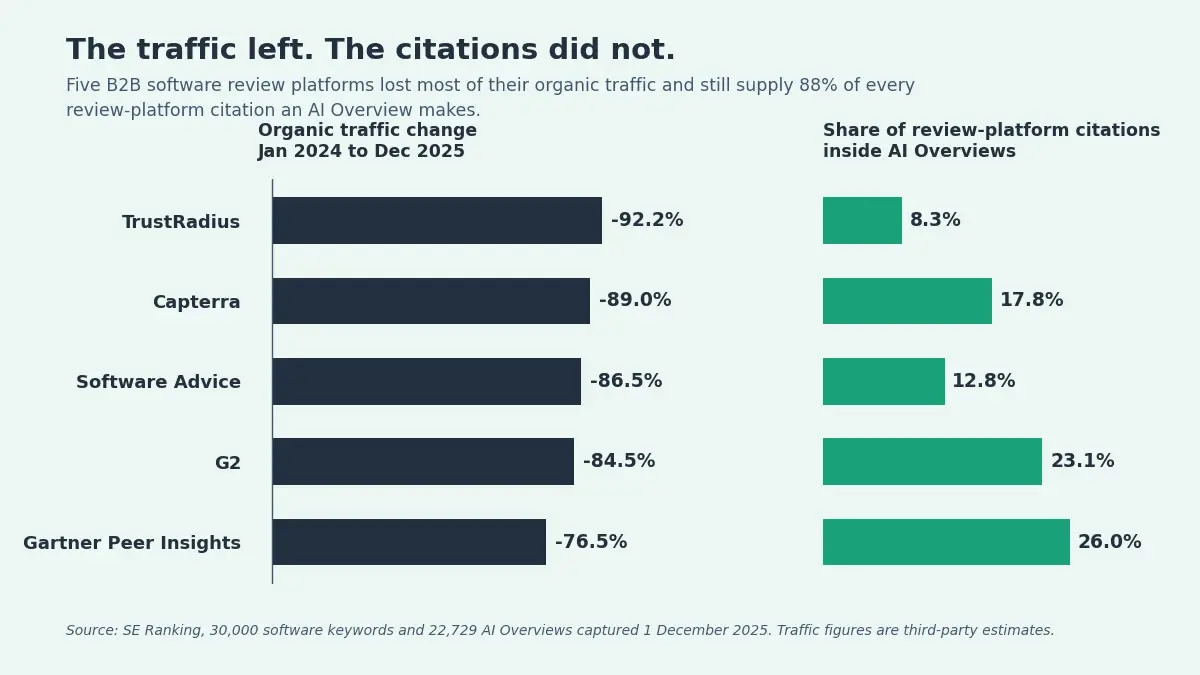
The B2B software review platforms are the cleanest natural experiment available, and the result is unambiguous. SE Ranking measured organic traffic for the major review sites between January 2024 and December 2025, then measured how often those same sites were cited inside AI Overviews across 30,000 software-related keywords. The two lines went in opposite directions.
| Platform | Organic traffic change, Jan 2024 to Dec 2025 | Share of review-platform citations in AI Overviews |
| TrustRadius | -92.2% | 8.3% |
| Capterra | -89% | 17.8% |
| Software Advice | -86.5% | 12.8% |
| G2 | -84.5% | 23.1% |
| Gartner Peer Insights | -76.5% | 26.0% |
Source: SE Ranking, 30,000 keywords and 22,729 AI Overviews captured 1 December 2025. Traffic figures are third-party estimates.
Between them, those five platforms supply 88% of every review-platform citation an AI Overview makes. Judge G2 by its traffic line and you would conclude it stopped mattering to software buying in 2024. Judge it by what the model quotes when your buyer asks which tool to pick, and it is more central than ever. The audience did not leave. It stopped arriving as sessions.
That is the whole argument in one table. Influence and traffic used to be the same measurement because a citation was a link and a link was a visit. They have separated. Any B2B company still using the traffic line as a proxy for market presence is reading a gauge that came unplugged from the engine.
Our own measurement points the same way from the other direction. Across 3,011 B2B domains with a verified organic collapse, peppereffect found a 64% median decline from peak organic traffic, while a live engine named the company being asked about in 25% of 926 category buying questions. The full breakdown sits in the category benchmark data. Traffic severity and citation rate move independently, which is precisely why one cannot stand in for the other.
See how often ChatGPT, Gemini, Claude and Perplexity name your company for your category's buying questions, and which competitors they name instead.
Get Your Free MeasurementHow do you measure influence share in five minutes?

This check produces a different number from the traffic report, using nothing but a browser and a spreadsheet. It is deliberately not the same test as asking whether AI is eating your traffic. That one diagnoses loss. This one measures presence, and you can run both in a morning.
Run it once a quarter with the same six questions and the same three engines. The absolute number matters less than the direction of travel, and a fixed question set is the only thing that makes two quarters comparable.
Write your six real buying questions
Not your brand name. The questions a buyer types before they know you exist: "best [category] for [company type] with [constraint]", "alternatives to [the incumbent]", "what should I look for in a [category] vendor". Six is enough to be indicative and small enough to finish.
Ask three engines, in clean sessions
ChatGPT, Gemini and Perplexity, logged out or in a fresh window so personalization and memory do not flatter you. Six questions times three engines gives 18 answers. Paste each answer into a sheet with the vendors it named, in the order it named them.
Calculate your influence share
Count the answers that name you. Divide by 18. That percentage is your influence share for this category. Record position too, because being named fourth in a list of five is closer to absence than to presence.
Name your real competitive set
Any vendor appearing in more than half of the 18 answers is a competitor for this category, whether or not your sales team lists them on the battlecard. This is usually the most uncomfortable output, and the most useful.
Put the two numbers side by side
AI referral sessions as a percentage of total sessions, next to influence share. If the first reads 2% and the second reads 0%, you have your answer about which number was hiding the problem.
Avoid This Mistake
Do not run the check on your own brand name. Asking a model "what is [your company]" will almost always return a competent description and a false sense of safety, because you are handing it the answer inside the question. The category question is the one your buyer actually asks, and it is the only one that tells you whether you exist in the model's shortlist.
Key Takeaway
Influence share is a zero-sum measurement in a way traffic never was. A page can rank alongside ten others. An answer names three vendors. Every point of influence share you gain comes out of a named competitor, which is why the metric behaves like market share rather than like a marketing channel. The mechanics of how models pick those three sit in the citation selection process.

What is a citation actually worth, and what is it not?
The small slice converts unusually well, and that is the honest secondary argument rather than the main one. In the Orbit Media sample, AI-referred sessions converted to leads at 1.91% against 0.71% for organic search. Narrow it to the largest single source and ChatGPT visitors converted at 2.08% against 0.50% from Google Search. Roughly three times the rate, on traffic that arrives already briefed.
That number is real but it should not carry the business case on its own. Three times a very small number is still a small number, and anyone selling answer engine optimization purely on conversion rate is quietly making the same denominator error as the objection. The case rests on the shortlist, and the conversion rate is a bonus that shows the traffic which does arrive is worth having.
Our own client data behaves consistently with that. Helium42 moved from close to zero AI-sourced visits to 250 per quarter within 90 days, a factor of 83. Two caveats we apply to our own number as firmly as to anyone else's: the absolute figure belongs with the multiple, because 83 times nothing is still very little without the 250 beside it, and a single account over one quarter demonstrates correlation, not causation.
Where the argument is weakest is worth stating plainly. Citation rates are not evenly distributed by category. Similarweb's measurement of US ChatGPT answers found the overall citation rate rose from 1.6% in June 2025 to 6.8% by May 2026, but professional services sat under 4%, well below travel at roughly 23%. If you sell a service into a fragmented category, models frequently answer from general knowledge without linking to anyone, and sometimes invent vendor names outright. Being citable helps. It does not guarantee you a mention in a category the model treats as generic.
The practical read for a B2B SaaS marketing team: treat influence share as a quarterly leading indicator alongside pipeline, not as a traffic channel to be judged on sessions. If you want the sequencing, our 90-day operating plan covers what to change first, and the SaaS-specific view covers what good looks like at your stage.
Frequently Asked Questions
How do I track AI traffic in GA4?
Build a custom channel group with a regex on session source matching chatgpt.com, chat.openai.com, perplexity.ai, gemini.google.com, copilot.microsoft.com and claude.ai, then apply it as a comparison in your acquisition reports. Expect it to undercount. Traffic from Google AI Mode and AI Overviews arrives labeled as Organic Search because Google serves those answers from its own domain, and links opened inside the ChatGPT apps land in Direct because native apps strip the referrer. Treat the resulting figure as a floor and pair it with an off-analytics measurement of how often models name you.
How do I track traffic from AI Overviews?
Separately from referrals, because it does not appear as one. Google Search Console's generative AI performance reporting shows how often your URLs surface inside AI Overviews and AI Mode, which is the only first-party view of that surface. Inside GA4, those clicks are indistinguishable from ordinary organic sessions. The workable proxy is the pattern described in impressions up and clicks down: stable impressions with falling click-through on informational queries, which is the fingerprint of an answer being served above your result.
What is a normal AI referral traffic share for a B2B site?
Around 0.5% is the measured benchmark. Orbit Media found 140,000 AI-referred sessions inside 29 million visits across 97 B2B and lead-generation websites between July 2025 and June 2026. Anything between 0.5% and 3% is unremarkable in 2026. The share is growing fast, with Similarweb recording 9.5 billion average monthly visits across generative AI platforms in the year to May 2026, up 70%, but it is growing from a small base. Judging the channel by that percentage misses where the effect actually lands, which is the shortlist rather than the session.
Does AI referral traffic convert better than organic search?
In the largest published B2B sample, yes, by roughly three times. Orbit Media measured 1.91% conversion to leads from AI-referred sessions against 0.71% from organic search, and 2.08% from ChatGPT specifically against 0.50% from Google Search. The plausible explanation is selection: someone who arrives after a model has described what you do and why you fit has already completed the qualification step. Note that this is one study of 97 sites with manually categorized conversion events, so treat the ratio as directional rather than as a planning constant.
Why is my ChatGPT referral traffic falling?
Often because the market moved, not because you lost visibility. Similarweb's platform tracking shows ChatGPT's share of generative AI web visits falling from roughly 76% in June 2025 to about 53% by May 2026, while Gemini climbed to 27% or 28% and Claude roughly quadrupled to 9%. A flat total with a falling ChatGPT line usually means your buyers redistributed across engines. Before treating it as a loss, run the same category questions through Gemini and Perplexity and compare where you are named.
Should I invest in AI visibility if AI is only 2% of my traffic?
Decide it on influence share, not traffic share. The relevant test is whether models name you when buyers ask your category's buying questions, because 6sense found 95% of winning vendors were already on the Day One shortlist and 94% of buying groups ranked that shortlist before speaking to any seller. If you are named in most answers, the 2% is fine and you have no problem to solve. If you are named in none, the 2% was never the issue, and the cost is arriving in lost deals that never showed up as a traffic decline. Measure first, then decide.
Find Out Whether the Models Name You or Your Competitors
peppereffect measures your Share of Model across ChatGPT, Gemini, Claude and Perplexity using your category's real buying questions, shows which competitors are named in your place, and returns the specific gaps behind the difference. Free, inside 48 hours.
Get Your Free AI Visibility MeasurementResources
- Orbit Media Studios, AI Traffic Conversion Rates: research from 97 B2B websites and 29M visits
- 6sense, The B2B Buyer Experience Report 2025
- Forrester, B2B Buyers Make Zero-Click Number One
- SparkToro, In 2026 Less Than One Third of Google Searches Still Send a Click
- SE Ranking, Despite 90% Traffic Loss Review Platforms Top AI Overview Citations
- Similarweb, AI Search Stats 2026: market share, referral and citation data
- Similarweb, Zero-Click Searches in 2026