

Social selling is dead as a B2B growth strategy — and the data leaves no room for polite disagreement. LinkedIn connection acceptance rates for cold outreach have plateaued at 30-45%. Cold email reply rates collapsed from 7% in 2024 to 5.1% in 2025 — a 27% year-over-year decline. Organic LinkedIn reach has dropped 47% across nearly 400,000 profiles analysed after the platform's 360Brew algorithm reset. And 67% of B2B buyers now actively prefer a rep-free buying experience, according to Gartner research on 650+ B2B buyers. B2B demand generation strategy
The playbook that dominated SDR training through 2024 — connection request, content engagement, SSI chasing, nurture-via-feed — has become a structurally inefficient channel. What works now is something entirely different: diagnostic engagement, a consultative outbound methodology where the first interaction delivers a micro-diagnosis of a specific business problem rather than a relationship-building attempt.
This article lays out the evidence for the death of traditional B2B social selling, the buyer-behaviour shifts that killed it, and the architecture of the methodology replacing it. If you are a founder or revenue leader still running LinkedIn-centric playbooks, the cost of not reading this is measurable in pipeline.
The short version
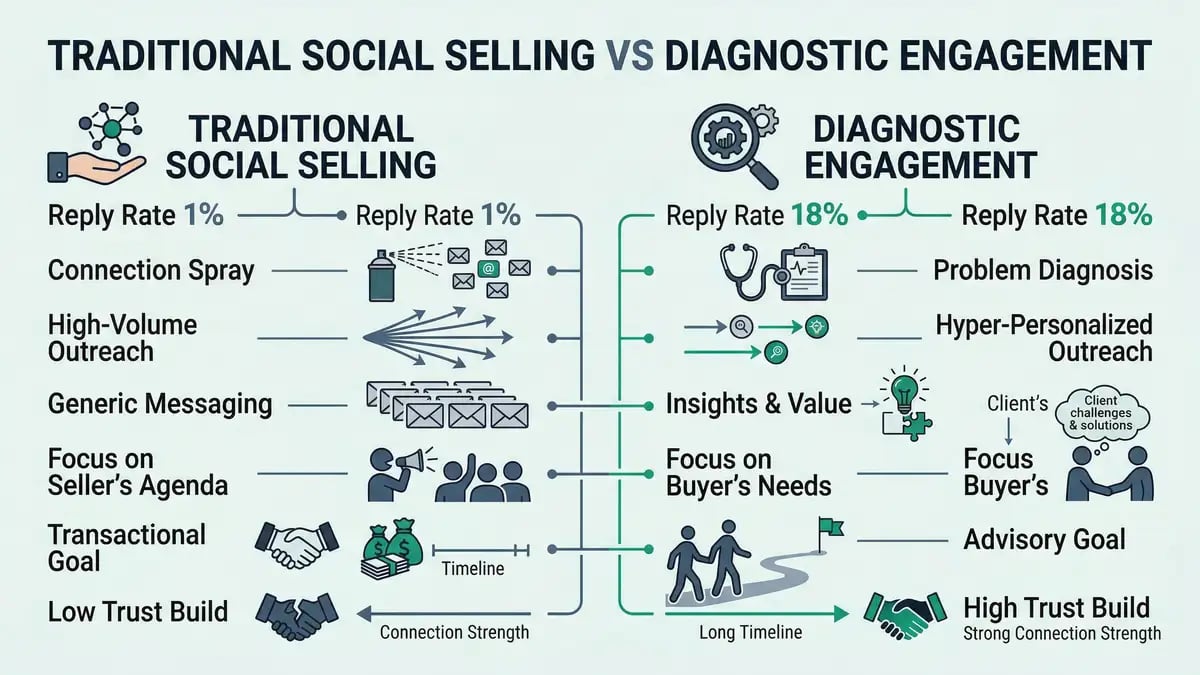
Traditional social selling optimises for the wrong moment in the buyer journey. Buyers finish 70% of their research before they want a vendor conversation, and 81% already have a preferred vendor by the time you connect. Diagnostic engagement inverts the sequence — instead of building rapport over weeks of content nurture, your first touch delivers a data-backed diagnosis of a specific business problem. Reply rates climb 5-15x. Deal cycles compress. Win rates rise.
What is diagnostic engagement, and why does it replace social selling?
Diagnostic engagement is a B2B outbound methodology where the first interaction delivers a specific, research-backed observation about a problem inside the prospect's business — quantified in their own metrics — and invites confirmation or correction. It is not a meeting request. It is not a pitch. It is not relationship building. It is a micro-consulting deliverable offered in the first sentence.
Traditional social selling is the opposite. It assumes a linear buyer journey where prospects encounter your content, develop familiarity, warm to your brand over weeks or months, and eventually raise their hand. It assumes you have time. It assumes you have organic reach. It assumes the buyer wants to be nurtured. None of those assumptions survive contact with 2026 B2B buying behaviour.
Diagnostic engagement assumes the opposite: you have one message to earn attention, the prospect has already done most of their research, and the only thing that cuts through is a signal that you actually understand their specific situation better than they expected a cold outreach could.

The performance collapse: what the 2024-2026 data actually shows
The decline of social selling is not anecdotal. Every metric that used to support the doctrine has moved in the wrong direction.
Connection acceptance has stratified against the top of the market. Cold connection acceptance rates for C-level executives now sit at just 10-20%, according to Cleverly's 2026 LinkedIn benchmark analysis of 16,492 requests. VP and director-level professionals accept 20-30%. Only individual contributors approach the 30-45% baseline. For revenue leaders targeting enterprise buyers — the highest-value segment — LinkedIn has become an actively inefficient acquisition channel.
LinkedIn's algorithm now penalises the volume playbook directly. LinkedIn's weekly connection limit is no longer fixed — it now varies between 50 and 200 requests per account based on acceptance rate, SSI, and account history. Accounts running spray-and-pray sequences get throttled. The platform has structurally dismantled the tactics that SDR training courses were still teaching last year.
Organic reach is in free-fall. LinkedIn replaced thousands of task-specific ranking models with a single AI system called 360Brew in late 2024. The result, per Botdog's analysis of the 2026 LinkedIn algorithm changes: average visibility dropped 47%, engagement declined 39%, and follower growth fell 42%. Saves now drive 5x more reach than likes. Engagement pods are penalised. The entire content-nurture flywheel of traditional social selling no longer turns.
Cold outreach channels are all underperforming simultaneously. Cold email reply rates now average 3.43%, with only the top 10% exceeding 10%, per Instantly.ai's 2026 benchmark report. Cold call-to-meeting conversion sits at 2.3% according to Gong's analysis of 2.5 million sales calls. LinkedIn InMail averages 6.38% across all campaigns. Every primary social selling channel is simultaneously converting at the lowest rates in the history of measurement.
The Social Selling Index is a vanity metric
LinkedIn's Social Selling Index — marketed for a decade as the strategic performance indicator for social selling — has weak correlation with actual pipeline. LinkedIn's own marketing claims high-SSI users generate 45% more business opportunities, but this is correlation, not causation. Salespeople who invest enough time in LinkedIn activity to achieve high SSI scores are, by definition, spending less time on revenue-generating outbound. When SDRs already spend 41% of their day on admin and only 28-39% on revenue-generating activity, time spent grooming SSI is opportunity cost, not investment.
The buyer behaviour shifts that made social selling obsolete
The deeper reason social selling stopped working is not platform decline. It is a structural change in how B2B buyers research, evaluate, and decide. Three shifts are doing the damage.

Shift 1: The 70% research threshold. According to 6sense research cited by Demand Gen Report, 80% of B2B buyers initiate first contact only once they are 70% through their buying journey. At that moment, 81% already have a preferred vendor and 85% have established purchase requirements. If you are running a social selling playbook designed for early-stage rapport, you are intervening in a stage of the journey that no longer exists in measurable form. The top of the funnel has gone dark.
Shift 2: Buying committees, not buyers. The average B2B buying committee now includes 10-13 stakeholders spanning multiple departments, with complex enterprise deals involving up to 22 people. More than 40% of B2B deals stall because of internal misalignment within the buying group, per Edelman. Single-threaded social selling — nurturing one champion — creates a single point of failure. The champion leaves, loses internal authority, or gets outvoted, and the deal dies. Multi-threaded diagnostic engagement is designed around this committee reality; social selling was not.
Shift 3: Active seller avoidance. This is the one that should stop every revenue leader cold. 67% of B2B buyers explicitly prefer a rep-free buying experience. 79% of B2B decision-makers ignore cold LinkedIn DMs entirely, per Superhuman Prospecting. This is not passive disengagement — it is active avoidance. Buyers have developed sophisticated filters for templated outreach, and the rise of AI-generated sequences has commoditised what was once a differentiated tactic. The more you look like every other sales message, the more invisible you become.
Social selling vs diagnostic engagement: the head-to-head
The table below captures the difference between what most B2B teams are still doing and what the best-performing revenue organisations have moved to.
| Dimension | Traditional Social Selling | Diagnostic Engagement |
| First-touch objective | Build rapport, share content, earn familiarity | Deliver a specific, quantified diagnosis of a business problem |
| Targeting basis | ICP fit + presence on LinkedIn | ICP fit + trigger event + intent signal |
| Stakeholder coverage | Single champion, nurtured over time | Multi-threaded, 4-5 stakeholders in parallel, role-specific diagnosis |
| Average reply rate | 1-5% (cold), 10% (warm DMs) | 10-30% with deep research |
| Timing logic | Continuous nurture, hope for inbound | Trigger-driven — funding, hiring, leadership change, product launch |
| Metric that matters | SSI, connections, post engagement | Intent-to-diagnosis accuracy, multi-thread engagement rate, meeting-to-opportunity conversion |
Sources: Cleverly LinkedIn Benchmarks 2026 LinkedIn lead generation for B2B, Gong win rate data, Outreach.io SES benchmarks, Edelman-LinkedIn 2025 Thought Leadership Impact Report.
How diagnostic engagement actually works
Diagnostic engagement is not a messaging trick. It is an operating system that replaces the entire sequence of prospect research, targeting, messaging, and multi-threading. The architecture runs on five components.
Buying committee and problem mapping
For each target ICP, map the full buying committee outbound sales strategy — not a persona description, but the actual roles (CFO, controller, VP ops, end-user) and the specific problem each role is accountable for. Then define the data signals that would diagnose each problem. This is the foundation that distinguishes diagnostic engagement from spray-and-pray.
Intent signal monitoring and trigger events
Rather than reaching out to every ICP-match account, monitor for trigger events that indicate an active buying window: funding rounds, hiring patterns, leadership changes, product launches, earnings call keywords, technology stack shifts. Dark funnel intelligence tools also surface companies whose employees are researching solutions in your category without filling any forms. Reach out disproportionately to accounts showing signal.
The diagnostic first touch
Craft an opening that delivers a specific, quantified observation about something measurable in the prospect's business, benchmarked against peer data. Example: "We reviewed your latest 10-K and your peer group. Your revenue collection cycle is 8-12 days slower than direct competitors — roughly $2-3M in trapped working capital. This usually comes from [specific cause X] or [specific cause Y]. Which one are you seeing?" Notice what this does: it proves research, quantifies impact, demonstrates peer context, and asks a diagnostic question rather than booking a meeting.
Multi-threaded role-specific sequences
Instead of pursuing a single champion, deploy role-specific diagnoses across 4-5 stakeholders in parallel. The CFO gets an audit-risk diagnosis. The controller gets a process-efficiency diagnosis. The VP of operations gets a close-cycle diagnosis. All three tracks reference the same underlying business problem but speak to each role's distinct accountability. According to RAIN Group research, multi-threaded deals with 4+ contacts see 58% win rates versus materially lower rates for single-threaded pursuits.
Sales engagement platform orchestration
Diagnostic engagement at scale requires orchestration through a sales engagement platform like Outreach or Salesloft, combined with intent data, CRM automation, and agentic research assistants. The workflow identifies accounts meeting ICP + intent criteria, maps committees, triggers staggered multi-threaded outreach with role-specific diagnoses, tracks engagement signals, and adapts follow-up based on which stakeholder engaged first.
Need a diagnostic engagement system architected for your B2B growth motion? We install the intent signals, committee maps, and agentic research infrastructure that make this methodology work at scale.
Why diagnostic engagement outperforms: the reply-rate maths

The performance gap is measurable. Cold, generic outreach converts at 1-2% reply rates. Warm outreach to prospects who have engaged with content converts at 14.6%. Diagnostic outreach targeting high-intent accounts with role-specific problem diagnoses converts at 10-30% depending on research depth and targeting precision, per early-2026 practitioner case data from Outreach.io's Sequence Engagement Score benchmarks.
Why the lift? Three compounding effects. First, diagnostic outreach passes the buyer's AI-detection filter — the message could not have been generated by a template because it references the prospect's specific financials, peer benchmarks, or operational context. Second, it short-circuits the early relationship-building phase entirely; the buyer does not need weeks of content nurture because the first touch already demonstrates contextual understanding. Third, it arrives during a buying window rather than during a research phase, because trigger-event targeting filters out accounts that are not in active evaluation.
The 2025 Edelman-LinkedIn B2B Thought Leadership Impact Report reinforces the underlying shift: 91% of "hidden buyers" — decision-makers not yet in-market — value fresh industry insights, compared to 53% for those already in-market. The way to earn attention from hidden buyers is not relationship building. It is demonstrating unique insight into their situation.
Warning: diagnostic engagement is not "personalised cold email personalized email outreach at scale" rebranded
Adding a first name and a company reference to a generic sequence is not diagnostic engagement. If the prospect could replace their company name with any other company in their sector and the message would still read identically, you are doing templated personalisation, not diagnosis. Real diagnostic engagement requires research depth that cannot be faked at scale — which is why it is typically run by founders, AEs on named-account lists, or agentic systems with deep prospect-data integrations.
What this means for your B2B growth strategy in 2026
If your pipeline is still running on LinkedIn connection sequences, SSI grooming, and content-driven nurture as the primary mechanism, the data is telling you to stop. Not because LinkedIn is irrelevant — it remains a reach and positioning layer. But because treating it as your primary conversion channel is structurally unprofitable in 2026 economics.
The transition is not instant. It requires investment in buyer-committee mapping, intent signal infrastructure, trigger event monitoring, and sales engagement platform orchestration. It also requires retraining your SDR function away from activity metrics (connections sent, messages delivered) toward diagnostic metrics (intent-to-diagnosis accuracy, multi-thread engagement rate, meeting-to-opportunity conversion). Most teams cannot execute diagnostic engagement at scale with manual workflows — it requires agentic research assistants that can pull public company data, benchmark peer metrics, and draft role-specific diagnoses in minutes rather than hours.
For founders running B2B growth motions on LinkedIn, the practical implication is sharper: your best pipeline is no longer going to come from connection volume. It is going to come from a small number of accounts you understand deeply enough to diagnose publicly, reaching 4-5 stakeholders per account with role-specific insight, at the moment a trigger event puts them in a buying window.
Install a Diagnostic Engagement Engine
peppereffect architects the intent signal monitoring, buyer committee mapping, and multi-threaded outreach infrastructure account-based marketing implementation that replaces dying social selling playbooks cold email outreach playbook with measurable diagnostic systems. Built for SaaS, executive search, and high-ticket consulting. Deployed in 60-90 days.
Frequently Asked Questions
What is B2B social selling?
B2B social selling is a sales methodology where sellers use social platforms — primarily LinkedIn — to identify prospects, build relationships through content engagement and messaging, share value through posts and comments, and nurture buyer familiarity over time. It became the dominant B2B outbound paradigm in the early 2020s. The data from 2024-2026 now shows that its core assumptions — linear buyer journeys, time to build rapport, organic reach — have broken down.
Is social selling dead in 2026?
Traditional social selling as a primary pipeline driver is structurally dead. LinkedIn connection acceptance is stratified against senior buyers, organic reach has declined 47%, cold email reply rates have halved since 2024, and 79% of decision-makers actively ignore cold LinkedIn DMs. LinkedIn still has value as a positioning, reach, and thought leadership layer — but it is no longer where the conversion happens. The methodologies that convert in 2026 are diagnostic engagement, intent-driven outbound, and multi-threaded account pursuit.
What is a good LinkedIn SSI score and does it matter?
A LinkedIn Social Selling Index score above 70 is considered strong. However, SSI correlates poorly with actual pipeline generation. LinkedIn's own marketing claims high-SSI users see 45% more opportunities, but this is correlation, not causation. Time spent grooming SSI is time not spent on diagnostic outbound. Revenue leaders in 2026 should treat SSI as a vanity metric and track intent-to-diagnosis accuracy and multi-thread engagement rate instead.
How is diagnostic engagement different from consultative selling?
Consultative selling describes the behaviour of a seller during a conversation — asking probing questions, understanding needs, recommending solutions. Diagnostic engagement describes the architecture of the outreach before any conversation happens. It treats the first cold touch as a diagnostic deliverable, using public data and peer benchmarks to make a specific, quantified observation about a problem in the prospect's business. Consultative selling is a sales-call style. Diagnostic engagement is a pipeline-generation operating system.
What reply rates can I expect from diagnostic engagement?
Well-executed diagnostic outreach to a single role typically achieves 8-15% reply rates, with top practitioners reaching 20-30% when combining deep research, trigger-event targeting, and personalised video delivery. That compares to 1-5% for cold email, 3-8% for standard LinkedIn InMail, and 2.3% cold-call-to-meeting conversion. The lift is 5-15x depending on research depth and targeting precision.
Do I still need LinkedIn if social selling is dead?
Yes, but for different reasons. LinkedIn remains the best platform for founder-led thought leadership, positioning, mental availability for out-of-market buyers, and warming target accounts before diagnostic outreach. What dies is LinkedIn as a direct conversion channel — the connection-then-pitch sequence. Treat LinkedIn as a reach layer and thought leadership engine, and run diagnostic engagement as your primary pipeline machine.
How do I start transitioning from social selling to diagnostic engagement?
Start with buyer committee mapping for your top ICP — list the 4-5 roles involved in a purchase and the specific problem each owns. Then build a diagnostic hypothesis for one role and test it against 20-30 target prospects with a specific, quantified opener. Measure reply rate and refine. Once single-role diagnostics are working, layer in intent signal monitoring and multi-threaded sequencing. Full transition typically takes 12 weeks for a focused revenue team.
What tools do I need for diagnostic engagement?
A working stack includes: intent signal and trigger event data (6sense, Bombora, or similar), a sales engagement platform (Outreach, Salesloft), an agentic research assistant capable of pulling public company data and benchmarking against peers, a CRM with committee-level account tracking, and optionally a personalised video tool (Loom, Vidyard) for high-priority diagnoses. The infrastructure cost is higher than a LinkedIn-only stack — but so is the conversion math.
Resources
- LinkedIn Benchmarks 2026: Connection Rate, Engagement Rate — Cleverly
- LinkedIn Response Benchmarks for 2025 — EngageKit
- LinkedIn Algorithm Reset Q4 2025 — PropelGrowth
- 5 Biggest LinkedIn Algorithm Changes in 2026 — Botdog
- Cold Email Benchmark Report 2026 — Instantly.ai
- Gartner: 67% of B2B Buyers Prefer a Rep-Free Experience — Demand Gen Report
- 80% of B2B Buyers Initiate First Contact at 70% of Journey — Demand Gen Report / 6sense
- B2B Buyer Journey: What 24,000+ Buyers Reveal in 2026 — Prospeo
- Biggest SDR Challenges in 2026 — Prospeo
- 2025 Edelman-LinkedIn B2B Thought Leadership Impact Report (PDF)
- The Impact of Personal Branding in B2B Sales — Superhuman Prospecting
- 114 Essential Sales Statistics — RAIN Group
- 75+ Sales Call Statistics for 2026 — GreetNow
- Sequence Engagement Score (SES) Overview — Outreach.io