

Employer branding strategy is the deliberate management of the firm's reputation as an employer, the articulation of the employer value proposition (EVP), the candidate-facing brand expression across owned and earned channels, and the internal experience that delivers the brand promise. For executive search firms advising clients, employer brand strategy is the highest-leverage advisory layer because it compounds across every mandate the firm runs for that client and reshapes the entire talent attraction economics over 3 to 5 year horizons.
This guide architects employer branding strategy for managing directors of boutique executive search firms advising CHROs and CEOs, and for CHROs building or refreshing in-house employer brand. We benchmark the 7-element EVP framework, ROI mechanics including the 50 percent cost-per-hire reduction and 28 percent retention uplift from strong employer brand, the 8-step strategy build, channel activation portfolio, the 6 engagement models for executive search firms, AI augmentation, 8 execution pitfalls, and the 7-step playbook. Every recommendation maps to the boutique advisor lens and reinforces the broader talent acquisition strategy framework that elite firms install for high-growth clients.
What Employer Branding Strategy Is and Why It Compounds
Employer branding strategy is the architectural layer that determines how the firm is perceived by candidates, employees, and the broader talent market. Per Symphony Talent's analysis of why your corporate brand is not your employer brand, the discipline is distinct from corporate brand (B2B customer-facing) and consumer brand (B2C customer-facing). It is also distinct from recruitment marketing, which is a tactical activity that runs on top of employer brand infrastructure.
The strategic logic differs from corporate brand in three ways. First, the audience is candidates and employees, not customers. Second, the value proposition is about the work experience, not the product or service. Third, the proof points come from internal employee voices, not marketing-controlled brand assets. Per Metaview's EVP framework, the employer value proposition (EVP) is the codified articulation of what makes the firm distinctively valuable as a place to work, expressed in language that target candidates recognize as true.
The compounding mechanic is what most firms miss. A company that invests in employer brand in year 1 attracts higher-quality candidates in year 2, retains them at higher rates in year 3, and pays 30 to 50 percent less cost-per-hire by year 4 because brand-aware candidates self-select into the firm. Per SmartDreamers' employer brand research, LinkedIn data shows a 43 percent decrease in cost-per-hire for businesses with strong employer brand, and per Taggd's ultimate guide to ROI of employer branding initiatives, the cumulative impact often exceeds the entire annual recruiting budget within 24 months.
The employer brand thesis
Employer brand is not a recruiting tactic. It is the multi-year infrastructure that compounds talent attraction economics. A firm that treats employer brand as a campaign pays the full cost-per-hire forever. A firm that installs employer brand as strategic infrastructure compounds 30 to 50 percent cost-per-hire reduction, 28 percent turnover reduction, and quality-of-hire lift across every mandate the firm runs over the next 5 years.

The 7-Element Employer Value Proposition (EVP) Framework
The EVP is the heart of employer brand strategy. It codifies the seven elements that target candidates evaluate when assessing whether the firm is distinctively valuable as a place to work. Per Mercer's framework for compelling employee value propositions and Universum Global's employer branding methodology, the seven elements operate as an integrated system, not as independent levers.
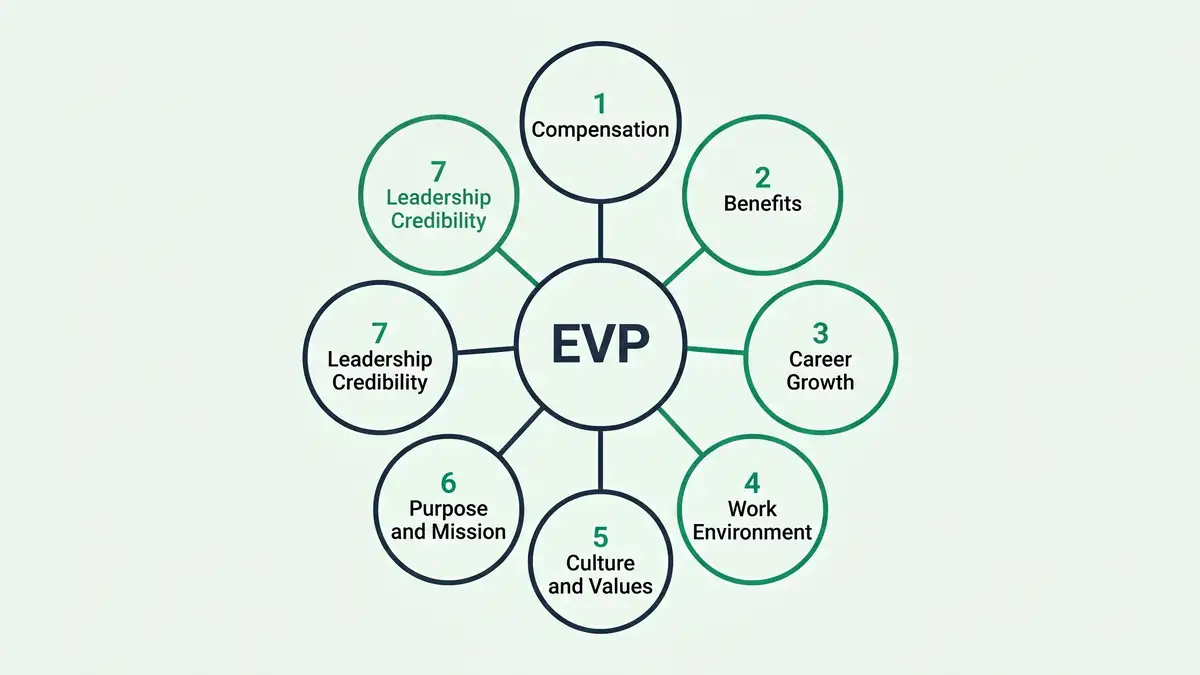
| EVP Element | Scope | Evaluation Question |
| 1. Compensation | Salary, equity, total cash, market positioning | Is the package competitive for my market segment? |
| 2. Benefits | Health, retirement, parental leave, learning stipends, wellness | Does the benefit package match my life stage? |
| 3. Career Growth | Promotion pathways, skill development, internal mobility | Where will I be in 3 to 5 years if I succeed here? |
| 4. Work Environment | Office, hybrid, remote, tooling, autonomy | Will I be productive and supported here? |
| 5. Culture and Values | Stated values, behavioral norms, decision-making style | Will I belong and thrive here? |
| 6. Purpose and Mission | Why the firm exists, impact, social contribution | Does my work matter beyond the paycheck? |
| 7. Leadership Credibility | Founder narrative, executive team quality, board strength | Do I trust leadership to steward the company? |
Sources: Mercer EVP framework, Universum Global employer branding methodology, Metaview EVP framework
Employer Brand ROI: Cost-Per-Hire, Retention, and Application Quality
Employer brand investment ROI is measurable and consistent across research waves. Per SmartDreamers' employer brand research, LinkedIn data shows a 43 percent decrease in cost-per-hire for businesses with strong employer brand. Per peppereffect's talent acquisition strategy framework, that effect is durable across 24 to 36 month horizons. Per Universum's research on employer branding on LinkedIn, strong employer brand drives 50+ percent improvement in application volume and quality combined.
Retention economics are equally compelling. Per LinkedIn Talent Brand data referenced across multiple practitioner sources, strong employer brand drives 28 percent lower turnover, which compounds the cost-per-hire savings into retention economics. Per Gallup's State of the Global Workplace research, engaged employees (a downstream proxy for brand alignment) drive 21 percent higher profitability and 17 percent higher productivity than disengaged counterparts.
Per Happydance's 2026 employer brand benchmark report, the firms that consistently outperform on brand investment also report measurably better candidate-conversion economics across the funnel: application-to-screen rates, screen-to-interview rates, and offer-acceptance rates all lift between 15 and 35 percent for firms scoring in the top quartile on employer brand health.
The 8-Step Employer Branding Strategy Build
The 8-step build below converts the EVP framework into execution sequence. Per Balencio's complete employer branding guide 2026 and operating patterns observed across high-performing 2026 brand build programs, this sequence compresses typical strategy build cycles from 18-24 months to 6-9 months.
Discovery and current state audit
Per Menseek's employer brand audit methodology, the audit covers Glassdoor sentiment, LinkedIn brand index, application volume baseline, employee NPS, candidate NPS, and competitive brand positioning. The audit is the baseline against which all subsequent investment is measured.
Internal research
Structured interviews with employees across seniority, function, and tenure. Surveys of employee experience. Manager focus groups. The internal research surfaces the EVP elements that employees actually experience versus the marketing narrative the firm tells itself.
External research
Candidate research, exit-interview synthesis, competitive brand audit, talent market segment analysis. External research validates whether the internal narrative resonates with candidates and how the firm is differentiated from competing employers in the same talent segment.
EVP articulation
Codify the EVP across the 7 elements. Express it in language that target candidates recognize as true. Avoid generic ("great culture, smart people") and lean into specific ("we ship customer-facing features in 2-week cycles with senior engineer review on every PR"). The EVP becomes the firm's employer narrative anchor.
Brand asset creation
Careers site refresh, LinkedIn company page optimization, Glassdoor profile management, employee story content, leadership thought leadership, internal brand collateral. Per Stories Incorporated's 2026 employer brand trends, employee stories outperform marketing copy by 5 to 10x on engagement and trust.
Channel activation
Sequenced rollout across owned, earned, and paid channels. Careers site (always-on), LinkedIn company page (weekly cadence), Glassdoor profile (continuous management), employee advocacy (per-employee cadence), industry awards (annual cycle). Avoid channel sprawl; sequence focused activation.
Internal alignment and authenticity
Per MIT Sloan Management Review's research on strategic alignment, employer brand collapses without internal alignment between the brand promise and the lived employee experience. Train managers, audit policies against brand promises, course-correct where the gap is widest.
Measurement and continuous improvement
Per Universum's measurement framework for employer branding ROI, quarterly tracking of brand index, cost-per-hire, time-to-fill, candidate NPS, employee NPS, application volume, and Glassdoor sentiment. Brand investment compounds only with measurement discipline.
Need help architecting your firm's or your client's employer branding strategy?
Book a Growth Mapping CallChannel Activation Portfolio for Employer Branding 2026
The 2026 channel mix spans owned, earned, and paid layers. Per Hootsuite's 2026 social trends research, the channels that deliver the highest brand impact in 2026 are the ones that combine high-trust signals (employee voices, third-party validation) with high-frequency distribution.
| Channel | Type | Best Use |
| Careers site | Owned (always-on) | EVP anchor, employee stories, role-specific content |
| LinkedIn company page | Owned (weekly) | Thought leadership, culture content, leadership voices |
| LinkedIn personal pages | Owned/earned hybrid | Employee advocacy, founder voice, leadership content |
| Glassdoor profile | Earned (continuous) | Sentiment management, employee voice, transparency |
| Indeed company page | Earned | Job seeker conversion, salary transparency |
| Employer awards | Earned (annual) | Best Places to Work, Great Place to Work certification |
| Employee advocacy | Earned (multiplier) | 8x reach amplification, authenticity premium |
Sources: Lea LinkedIn employee advocacy 8x multiplier, Glassdoor Best Places to Work, Great Place to Work certification, Hootsuite 2026 Social Trends
Why Employee Advocacy Outperforms Company Page
Per Lea's analysis of the LinkedIn employee advocacy multiplier, content shared by employees on their personal LinkedIn profiles reaches up to 8x further than the same content shared on the company page alone. Per Refine Labs' analysis of personal versus company page engagement, personal LinkedIn content drives substantially higher engagement rates because the audience trusts individual voices over corporate accounts. Per Edelman's Trust Barometer, employees consistently outrank executives and corporate communications as trusted sources for information about a company.
How Executive Search Firms Add Value in Employer Branding
Executive search firms hold a privileged vantage point on talent markets that pure brand consultancies cannot replicate. Per Top Echelon's analysis of employer branding's importance in executive search, the search firm's day-to-day candidate conversations surface real-time intelligence about what target candidates actually value, why they leave their current firms, and how the client's brand is perceived in market. That intelligence is the raw material for credible EVP work.

The advisory layer for elite executive search firms spans 6 engagement models. peppereffect's analysis of executive search methodology and building an executive search practice details how these models integrate into the firm's broader advisory architecture.
Embedded EVP discovery within retained mandate
The search firm conducts EVP discovery as part of mandate kickoff: candidate conversations surface real-time positioning intelligence; the EVP refinement happens organically across the search engagement. Fee uplift: $5k to $15k as a bundled add-on.
Standalone EVP discovery and articulation
Discrete engagement focused on EVP articulation across all 7 elements with deliverable templates, brand asset recommendations, and activation roadmap. Fee range: $25k to $150k depending on scope and firm scale.
Employer brand audit and recommendation
Diagnostic deliverable: current state of employer brand across Glassdoor, LinkedIn, careers site, Indeed, and candidate sentiment. Specific recommendations for the highest-leverage improvements. Fee range: $15k to $50k.
Continuous talent market intelligence subscription
Quarterly intelligence on brand positioning, competitive movements, candidate sentiment shifts. Bundles with retained mandate flow. Fee range: $50k to $150k annual.
Brand activation in candidate outreach
The search firm carries the client's EVP into every candidate conversation across mandates. Mandate-level fee structure, no separate fee. The compounding asset that builds the client's brand authority in the talent market over time.
Post-placement integration brand alignment
Brand promise versus brand delivery audit at 90 days, 180 days, and 12 months post-placement. Surfaces friction between EVP and lived experience while it can still be corrected. Fee range: $5k to $20k per placement as a bundled add-on.

AI Augmentation in Employer Branding Strategy 2026
AI augments employer branding strategy across several dimensions in 2026. Per Employer Branding News' future-proofing analysis for an AI-driven workplace, the firms thriving in 2026 are pairing AI augmentation with disciplined human governance rather than treating AI as a replacement for human judgment.
What AI augments well in employer branding 2026: AI-generated EVP articulation drafts that synthesize internal research outputs, sentiment analysis of employee reviews across Glassdoor and internal surveys, predictive talent market positioning, AI-driven candidate persona development from candidate research conversations, conversational brand discovery interfaces for prospective candidates, employer brand content generation at scale with editorial governance. Per Josh Bersin's employer brand research and Bullhorn's GRID 2026 industry trends report, top-performing brand programs in 2026 use AI to amplify human-led brand work rather than replace it.
What AI does not replace in employer branding 2026: the strategic judgment about what differentiates the firm, the cultural intelligence required for credible EVP articulation, the trust-building required for employee advocacy programs, and the sensitive communication required when brand promise diverges from lived experience. peppereffect's broader guidance on AI for executive search details the human-AI workflow architecture that distinguishes brand leaders from brand laggards in 2026.
8 Employer Branding Strategy Execution Pitfalls
1. Generic EVP that fails to differentiate
"We are a great place to work with smart people" describes 80 percent of firms in the market. Generic EVP attracts generic candidates and pays the full attraction cost. Specific EVP ("we ship customer-facing features in 2-week cycles with senior engineer review on every PR") attracts mission-aligned candidates and reduces cost-per-hire by 30 to 50 percent.
2. Internal-external misalignment producing brand inauthenticity
Marketing promises one experience; employees deliver another. Glassdoor reviews and exit interviews expose the gap. Brand investment without internal alignment compounds the credibility deficit rather than the brand asset.
3. Channel sprawl without focus
Activating on 10 channels at low quality outperforms 0 channels but underperforms activating on 3 channels at high quality. Sequence focused activation rather than diluting investment across all available channels.
4. Employee advocacy without governance
Asking employees to post content without training, content infrastructure, or feedback loops produces low-quality output that damages rather than builds the brand. Per Oktopost's employer brand social media advocacy analysis, governed advocacy programs outperform laissez-faire programs by 5 to 10x on quality-adjusted reach.
5. Single-platform dependence
Over-reliance on LinkedIn alone creates concentration risk. When platform economics shift, the entire brand pipeline contracts. Build a multi-platform channel mix even when LinkedIn dominates the early stages.
6. Weak measurement framework
Tracking application volume alone is not measurement. Mature brand programs measure brand index, cost-per-hire, time-to-fill, candidate NPS, employee NPS, Glassdoor sentiment, application quality, and offer acceptance rate together.
7. Leadership skepticism without sponsorship
Employer brand without CEO and CHRO sponsorship dies in the quarterly budget cycle. Executive sponsorship signals that brand is strategic infrastructure, not a marketing campaign. Tie brand investment to business outcomes the executive team owns.
8. No continuous improvement cycle
Brand strategy set in year 1 and never revisited ossifies. The 2026 talent market evolves quarterly with Gen Z expectations shifting, AI disrupting work patterns, and pay transparency reshaping disclosure norms. Build review cadence into the strategy itself.

The 7-Step Playbook for Executive Search Firms Launching Employer Brand Advisory
Codify the firm's standard EVP discovery methodology
Document the firm's repeatable approach to EVP discovery: internal interview templates, candidate research protocols, competitive audit framework, deliverable templates. The methodology is the productized asset.
Build the tooling stack
LinkedIn Talent Insights, Glassdoor data, Universum benchmarks, employee survey platforms, sentiment analysis tools. The tools layer enables consistent delivery across consultants.
Train consultants on EVP positioning conversations
Every consultant must be able to position the firm's EVP advisory in business development conversations and run discovery interviews credibly. Without consultant capability, the advisory layer never reaches market.
Productize the 6 engagement models
Embedded EVP, standalone EVP, brand audit, talent intelligence subscription, brand activation, post-placement alignment. Each with defined scope, deliverable, and fee structure. Publish fee bands.
Develop deliverable templates
EVP articulation document template, brand audit scorecard, channel activation roadmap, measurement dashboard. Templates compress production time and ensure consistency across consultants.
Measure outcomes and tie to mandate flow
Track engagement outcomes (cost-per-hire change, application volume change, time-to-fill change, candidate NPS change) alongside mandate flow from brand engagement clients. Brand work that does not translate to mandate flow has limited strategic value.
Build the case study library
Document 3 to 5 client case studies with quantified outcomes. Case studies are the highest-leverage business development asset for converting prospect conversations into engagement contracts. peppereffect's broader work on executive search KPIs details the measurement architecture that supports defensible case studies.
Architect Your Employer Branding Strategy With peppereffect
peppereffect installs the AI-augmented employer branding operating system that decouples talent attraction from market spend. Whether you are a CHRO building strategy or an executive search managing director launching brand advisory, we architect EVP discovery, build channel activation, install measurement discipline, and engineer the continuous improvement cycle that converts brand from campaign into compounding infrastructure.
Book a Growth Mapping CallFrequently Asked Questions About Employer Branding Strategy
What is employer branding strategy?
Employer branding strategy is the deliberate management of the firm's reputation as an employer, including the employer value proposition (EVP) articulation across 7 elements (compensation, benefits, career growth, work environment, culture and values, purpose and mission, leadership credibility), the candidate-facing brand expression across owned and earned channels, and the internal experience that delivers the brand promise. Per Metaview's EVP framework, the discipline is distinct from corporate brand and from recruitment marketing, sitting at the intersection of HR, marketing, and strategic talent acquisition.
Why is employer branding important?
Employer branding compounds talent attraction economics across multi-year horizons. Per LinkedIn data referenced in SmartDreamers' employer brand research, strong employer brand drives 43 percent decrease in cost-per-hire and 28 percent lower turnover. Per Happydance's 2026 employer brand benchmark report, top-quartile brand firms also report 15 to 35 percent improvement across the candidate funnel including application-to-screen, screen-to-interview, and offer-acceptance rates. The compounding ROI typically exceeds the entire annual recruiting budget within 24 months.
What is an employer value proposition (EVP)?
An employer value proposition (EVP) is the codified articulation of what makes the firm distinctively valuable as a place to work, expressed across 7 elements: compensation, benefits, career growth, work environment, culture and values, purpose and mission, and leadership credibility. Per Mercer's framework for compelling employee value propositions, the EVP must be specific (not generic), credible (matched to lived employee experience), and differentiated (distinctive from competing employers in the same talent segment).
How does employer branding strategy reduce cost-per-hire?
Employer branding strategy reduces cost-per-hire through several compounding mechanisms: brand-aware candidates self-select into the firm and require less paid sourcing investment; higher application quality reduces screening overhead; strong employer brand improves offer acceptance rates and reduces re-hire cost from declined offers; brand-aligned hires retain at higher rates, reducing the all-in cost-per-hire amortized over employee tenure. Per SmartDreamers' analysis citing LinkedIn data, mature employer brand drives 43 percent decrease in cost-per-hire versus weak brand counterfactuals.
How long does it take to build employer branding strategy?
Mature employer branding strategy build typically takes 6 to 9 months from kickoff to channel activation, with measurable cost-per-hire and application quality improvements emerging within 6 to 12 months post-activation. The build sequence: discovery and audit (weeks 1-3), internal research (weeks 3-6), external research (weeks 5-9), EVP articulation (weeks 8-12), brand asset creation (weeks 10-18), channel activation (weeks 14-24), internal alignment (weeks 16-26), measurement and continuous improvement (ongoing).
How can executive search firms help clients with employer branding?
Executive search firms add value through 6 engagement models: (1) embedded EVP discovery within retained mandate ($5k-$15k add-on), (2) standalone EVP discovery and articulation ($25k-$150k), (3) employer brand audit and recommendation ($15k-$50k), (4) continuous talent market intelligence subscription ($50k-$150k annual), (5) brand activation in candidate outreach across mandates, (6) post-placement integration brand alignment ($5k-$20k per placement). The search firm's privileged vantage point on real-time candidate conversations surfaces intelligence that pure brand consultancies cannot replicate.
What are common employer branding strategy execution pitfalls?
The 8 most common pitfalls are: 1) generic EVP that fails to differentiate; 2) internal-external misalignment producing brand inauthenticity; 3) channel sprawl without focus; 4) employee advocacy without governance; 5) single-platform dependence; 6) weak measurement framework; 7) leadership skepticism without sponsorship; 8) no continuous improvement cycle. Each pitfall is preventable with disciplined execution and quarterly governance cadence. executive search marketing
Resources
- Metaview: Employee Value Proposition EVP Framework
- Symphony Talent: Why Your Corporate Brand Is Not Your Employer Brand
- Mercer: Compelling Employee Value Propositions
- Universum Global: Employer Branding Methodology
- Universum: Employer Branding on LinkedIn
- Universum: Measure Employer Branding ROI
- SmartDreamers: Employer Brand and Cost-Per-Hire
- Taggd: Ultimate Guide to ROI of Employer Branding Initiatives
- Happydance: 2026 Employer Brand Benchmark Report
- Employer Branding News: Evolving the EVP for 2026
- Employer Branding News: Future-Proofing EVP for an AI-Driven Workplace
- Stories Incorporated: Employer Branding Trends 2026
- Balencio: Complete Employer Branding Guide 2026
- Top Echelon: Importance of Employer Branding in Executive Search
- Menseek: Employer Brand Audit Methodology
- Lea: LinkedIn Employee Advocacy 8x Multiplier
- Refine Labs: Personal LinkedIn Engagement vs Company Page
- Oktopost: Employer Brand Social Media Advocacy
- Glassdoor: Best Places to Work Awards
- Great Place to Work Certification
- Edelman: Trust Barometer
- Gallup: State of the Global Workplace
- Hootsuite: 2026 Social Trends
- MIT Sloan Management Review: Strategic Alignment Reconciles Purpose and Profitability
- Forrester: Employer Branding Is the New Marketing Imperative
- Josh Bersin: Employment Brand Research
- Bullhorn: GRID 2026 Industry Trends Report