

A recruiter's week is mostly not recruiting. Studies put roughly 44 percent of it on sourcing and another 22 percent on reviewing CVs, which means two-thirds of the week is gone before a single live candidate conversation. Recruitment automation exists to give that time back, and the firms that deploy it well are not just faster, they are measurably more profitable. This guide covers what to automate across the hiring lifecycle, the documented ROI, where executive search differs, the compliance you cannot ignore, and how to start.
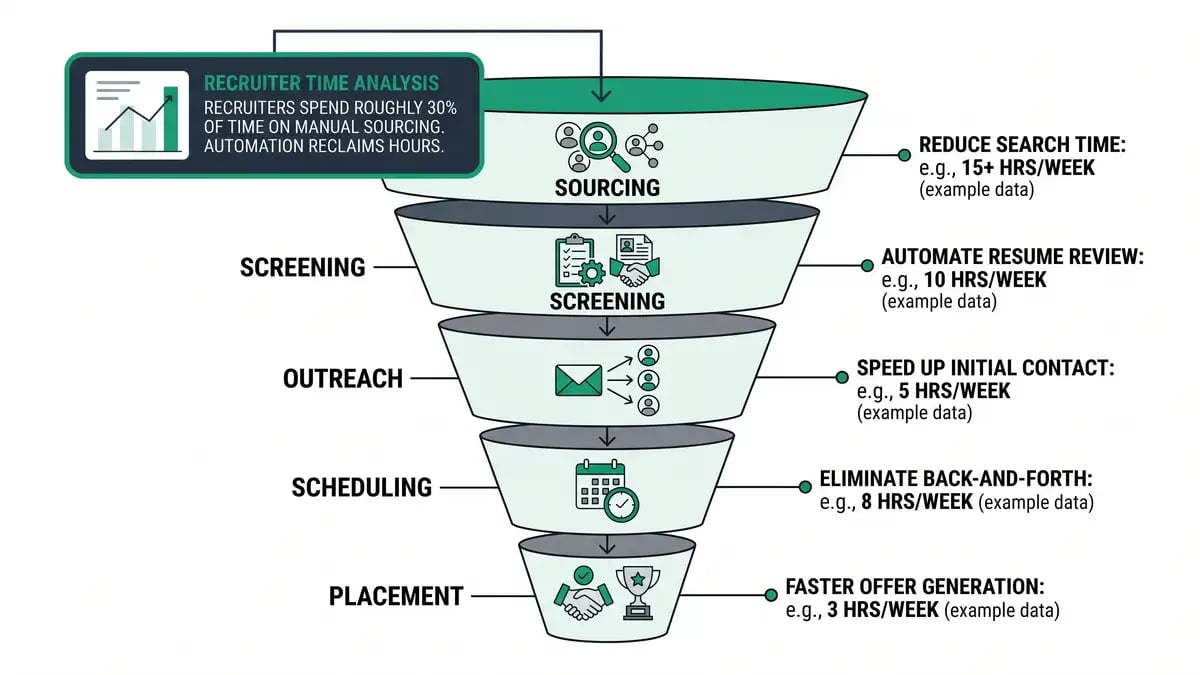
Recruitment automation uses rules-based workflows, machine-learning matching, and AI agents to handle the repetitive parts of hiring: sourcing, screening, outreach, scheduling, CRM updates, and placement. Recruiters spend about 44 percent of their week sourcing and only 20 percent on candidate-facing work, and Bullhorn estimates automation can return up to 17 hours a week. The payoff is concrete: time-to-hire down up to 75 percent, cost-per-hire down 20 to 40 percent, 64 percent more jobs filled per recruiter, and firms using AI for better matches 96 percent more likely to have grown revenue. The winning model is human-plus-machine: automate the volume, keep judgment, relationships, and final decisions human.
The opportunity is biggest for staffing and executive search firms, where placement velocity is the business model. Below is the evidence and the playbook. Every figure is sourced.
What does recruitment automation actually cover?
Recruitment automation is a layered stack, not a single tool. It spans the full lifecycle: candidate sourcing, screening and shortlisting, outreach and engagement, interview scheduling, CRM and ATS maintenance, reference and background checks, and placement or redeployment. There are three layers. Rules-based automation executes predefined actions, such as moving a candidate forward when an assessment clears a threshold. Machine-learning matching ranks and filters candidates against a role using models trained on historical hiring data. Agentic AI, the newest layer, runs semi-autonomous agents that source, screen, schedule, and update records continuously, escalating only the hard cases to a human (Bullhorn GRID 2025).

Sourcing is where automation has the biggest immediate impact, because it is where the time goes. AI sourcing tools scan job boards, networks, and internal databases to surface qualified candidates in seconds, replacing manual Boolean strings with continuous discovery. Screening is the second target: AI parses CVs, normalises skills, and pre-scores candidates so recruiters validate a ranked shortlist instead of skimming hundreds of profiles. About 45 percent of staffing firms are already experimenting with AI to sort CVs and find the best profiles to screen (Bullhorn). We go deep on this in our piece on AI candidate screening at scale.
Scheduling, outreach, and CRM hygiene round it out. Scheduling alone has historically consumed around 35 percent of recruiter time (TechTree), and automated scheduling, reminders, and ATS stage updates remove most of it. The point of all of it is the same: shift recruiter hours from admin to relationships, which is exactly the systems-first principle behind our wider AI automation services.
The takeaway
Do not think of recruitment automation as one product. It is a stack: rules for compliance-critical steps, machine learning for matching, and agents for day-to-day sourcing and engagement. The firms that win automate the whole lifecycle rather than bolting on a single point tool, because fragmented automation delivers fragmented results.
The time problem: why recruiters never get to recruit
The case for automation starts with how little of a recruiter's week is spent on high-value work. Recruiters spend roughly 44 percent of their time sourcing and 22 percent reviewing CVs, and industry analysts describe an 80/20 split where 80 percent of hours go to admin and repetitive tasks, leaving just 20 percent for candidate-facing engagement (TechTree). Nearly half of tech recruiters spend more than 30 hours a week just searching, about 75 percent of a standard week.

Bullhorn's GRID 2025 report quantifies the staffing-specific version: recruiters spend an average of 14.6 hours a week searching for candidates, and 30 percent of firms name recruiter productivity as their single biggest obstacle to cutting costs. The same report estimates that autonomous search and match can save 4.5 hours a week on searches plus 3.6 hours on screening and admin, and that AI and automation together can give recruiters up to 17 hours back each week (Bullhorn). That is not a marginal efficiency. It is close to doubling the time a recruiter can spend on relationships and revenue.
For a search firm, reclaimed sourcing time is reclaimed placement capacity. A recruiter who handled ten roles can handle twelve to fifteen without losing quality, which lifts throughput without adding headcount. That is the same decoupling of output from headcount we model in our executive search automation playbook, and it is the reason recruiting is one of the highest-ROI places to automate at all.
What is the ROI of recruitment automation?
The outcome data is unusually concrete for an emerging category. Time-to-hire falls by up to 75 percent with AI recruitment automation, driven by faster screening, engagement, and scheduling (Impress.ai). Cost-per-hire drops 20 to 40 percent when AI automates screening and scheduling, and automation adopters fill 64 percent more jobs while submitting 33 percent more candidates per recruiter (HireTruffle). The revenue link is the headline for firm owners: Bullhorn found firms using AI for faster placement are twice as likely to have grown revenue, firms using AI for better matches are 96 percent more likely, and firms automating the full cycle are more than twice as likely (Bullhorn).
| Outcome | Result | Source |
| Time-to-hire reduction | Up to 75% | Impress.ai |
| Cost-per-hire reduction | 20-40% lower | Greenhouse / GoodTime |
| Jobs filled per recruiter | 64% more | HireTruffle |
| Candidates submitted per recruiter | 33% more | HireTruffle |
| Revenue growth (better matches) | 96% more likely | Bullhorn GRID 2025 |
| Weekly time reclaimed | Up to 17 hours | Bullhorn GRID 2025 |
Sources: Impress.ai, HireTruffle, Bullhorn GRID 2025. Figures are 2024-2025 indicative.
Candidate experience improves too, which compounds over time. Bullhorn found 73 percent of candidates had a positive experience with an AI voice interview and 88 percent rated it equal to or better than a live one, and that any AI use lifted candidate loyalty by 30 percent, rising to 45 percent for a positive AI experience (Bullhorn). Adoption reflects this: 84 percent of talent acquisition leaders plan to use AI in 2026 and 52 percent plan to add autonomous agents to their teams (Korn Ferry), against a market where AI recruitment technology is forecast to roughly double from 661.5 million USD in early 2024 toward 1.1 billion by 2030 (SmartRecruiters).
Want to know which recruiting workflow to automate first?
Map your highest-leverage stepRecruitment automation in executive search
Retained executive search is the nuanced case, because the product is judgment and relationships, not volume. The answer is not less automation but selective automation: let AI run the research-heavy front end while the human owns everything that requires trust. Leading search firms use AI-enhanced systems to identify leadership candidates across hundreds of variables, map global leadership markets in real time, and surface emerging leaders from non-traditional backgrounds, while keeping qualification, competency assessment, candidate experience, and final decisions human-led (National Search Group).

The framing the industry has settled on is "human plus artificial." The Association of Executive Search and Leadership Consultants notes that AI is already reshaping how search firms conduct research and manage workflows (AESC), and integrated AI-plus-human models have been reported to cut executive search time-to-hire by up to 40 percent while improving quality of hire through a mix of objective data and human emotional intelligence (National Search Group). For a boutique firm, that is the whole game: automate the longlisting and intelligence so the partners spend their hours on the chemistry, the assessment, and the client advisory that justify the fee. Our deep dive on AI for recruiting shows how that cuts time-to-shortlist from 14 days to 4, and candidate report automation handles the executive summaries.
The strategic point is that automation protects, rather than threatens, the high-touch model. When the machine carries the sourcing load, the human capacity goes where it is differentiated. That is the opposite of the commoditisation search firms fear from technology.
The compliance you cannot ignore
Recruitment AI is now explicitly regulated, and treating that as an afterthought is a real risk. New York City's Local Law 144 requires firms using automated employment decision tools to conduct annual bias audits and notify candidates (NYC). The EU AI Act goes further, classifying AI used for recruitment and promotion decisions as high-risk, which triggers audit, transparency, and bias-mitigation obligations (EU AI Act, Annex III). For a firm placing candidates across jurisdictions, this is not optional.
Design for compliance, not around it
Keep a human in the loop on every consequential decision, document how the system reaches its recommendations, and audit for bias before you deploy, not after a complaint. The same human-in-the-loop design that satisfies regulators also protects candidate experience and the quality of your shortlists. Over-automating the decision, not the admin, is where firms get into trouble.
How to start with recruitment automation

The firms that get a return scope it deliberately. The ones that waste money buy a tool and hope. Follow these five steps, which mirror the de-risking discipline behind every build that avoids the reasons AI automation projects fail.
Start at the highest-volume manual step
That is almost always sourcing or screening, because that is where recruiters lose 44 and 22 percent of their week. Automate the bottleneck first, not the most impressive-sounding feature.
Scope process-first, not tool-first
Map the workflow before choosing technology. Automating a broken sourcing process just produces bad shortlists faster. Fix the process, then automate it.
Keep a human in the loop for judgment
Let AI source, screen, and schedule, but keep the assessment, the relationship, and the final decision human. This is both the quality safeguard and the compliance requirement.
Automate the full cycle, not point tools
Firms that automate end to end are more than twice as likely to have grown revenue than those with fragmented tools. Build one connected system rather than five disconnected subscriptions.
Measure placement velocity and hours reclaimed
Baseline your time-to-fill and recruiter hours before you build, then track them. If you cannot show hours reclaimed and faster placements, the automation is not working.
Done this way, recruitment automation is one of the clearest-ROI investments a search or staffing firm can make: it lifts capacity without headcount, shortens time-to-fill, and reinvests recruiter hours into the relationships that win mandates. If you want help deciding what to build versus buy, our guides to automation consulting and what AI automation costs lay out the engagement and budget side.
Reclaim the 70 percent your recruiters lose to manual work
We architect AI-powered operating systems for staffing and executive search firms that automate sourcing, screening, and scheduling, then hand them over for you to own. More placements, the same headcount, your team focused on relationships. Book a Growth Mapping Call and we will map the highest-leverage workflow to automate first.
Book your Growth Mapping CallFrequently asked questions
What is recruitment automation?
The use of rules-based workflows, machine-learning matching, and AI agents to handle the repetitive parts of hiring across the full lifecycle: sourcing, screening, outreach, scheduling, CRM and ATS updates, reference checks, and placement. It removes manual admin so recruiters spend more time on relationships, with humans keeping judgment and final decisions.
How much time does recruitment automation save?
Recruiters spend about 44 percent of their week sourcing and 22 percent reviewing CVs, with roughly 80 percent of hours on admin and only 20 percent candidate-facing. Bullhorn's GRID 2025 report estimates AI and automation can give recruiters up to 17 hours back each week across search, screening, scheduling, and admin.
What is the ROI of recruitment automation?
Documented outcomes include time-to-hire down up to 75 percent, cost-per-hire down 20 to 40 percent, and adopters filling 64 percent more jobs while submitting 33 percent more candidates per recruiter. Firms using AI for better matches are 96 percent more likely to have grown revenue. Our AI automation ROI framework shows how to measure it.
How does automation apply to executive search?
Automation handles the research-heavy front end: talent mapping, longlisting, and candidate intelligence across hundreds of variables. The relationship, the assessment of leadership chemistry and cultural fit, and the final decision stay human. Integrated AI-plus-human models have cut executive search time-to-hire by up to 40 percent while improving quality of hire.
Is AI in recruiting legal and compliant?
Legal but increasingly regulated. New York City's Local Law 144 requires bias audits and candidate notice for automated employment decision tools, and the EU AI Act classifies recruitment AI as high-risk with audit, transparency, and bias-mitigation duties. Keep humans in the loop, document the logic, and audit for bias before deployment.
Where should a firm start with recruitment automation?
Start at the highest-volume manual step, usually sourcing or screening. Scope process-first, keep a human in the loop for judgment, and measure placement velocity and hours reclaimed. Automate the full cycle rather than buying fragmented point tools, because end-to-end automation drives far stronger revenue results. The wider playbook is in our guide to agentic workflows.
Resources
- Bullhorn: GRID 2025 Talent Trends Report
- Bullhorn: staffing firms using AI twice as likely to grow revenue
- TechTree: the 80/20 problem in recruiting
- Impress.ai: AI recruitment automation and time-to-hire
- HireTruffle: AI recruitment statistics
- Korn Ferry: talent acquisition trends 2026
- SHRM: 2025 Talent Trends, AI in HR
- SmartRecruiters: recruitment statistics on AI
- National Search Group: AI and human expertise in executive search
- NYC: automated employment decision tools (Local Law 144)
- EU AI Act: Annex III high-risk systems