

Automate vs Hire: How to Make the Decision
The automate vs hire decision is a function-by-function economic choice: deploy automation when the work is high-volume, rule-based, and repeatable, and hire when it demands judgment, relationships, creativity, or accountability. The mistake most B2B leaders make is treating it as a gut call ("we feel understaffed, let's hire") instead of a quantified comparison. When you model the fully loaded cost of a hire against the real cost and payback of automation, the right answer is usually obvious, and frequently not the one the org chart wants.
The pressure to get this right is rising. US total compensation costs rose 3.4% in the year to December 2025, so every incremental head carries a structurally higher long-run cost. At the same time, private SaaS companies now report a median revenue per employee of $129,724, evidence that investors expect output per worker to climb, not payroll, a pressure we unpack in our revenue per employee benchmarks. Automation has matured to meet that pressure: AI agents in production now save a median 6.4 hours per knowledge worker per week with payback in 4 to 9 months.
This is the core of peppereffect's thesis: decouple revenue from headcount. But automation is not a universal answer. This guide gives you the framework, the numbers, and the cost calculator logic to decide, defensibly, for any given role or workflow.
What you'll learn in this guide:
- The true, fully loaded cost of a hire, and why it is far higher than base salary
- The real cost, payback period, and failure rate of automation in 2026
- A clear test for which work to automate and which to hire for
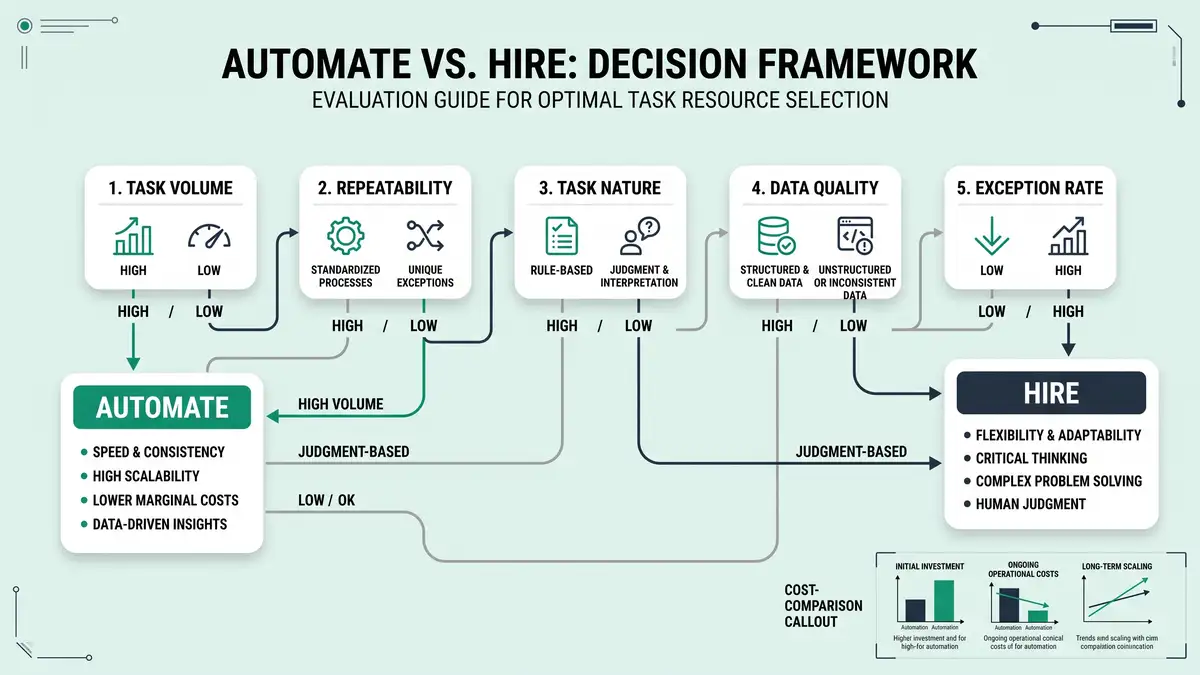
- A five-question decision framework to apply before you add any headcount
- When automation is the wrong call, and hiring is still correct
Key Takeaway
Automate vs hire is not an ideology, it is arithmetic plus task-fit. The fully loaded first-year cost of a single hire routinely exceeds $100,000 once benefits, recruiting, onboarding, and ramp are counted, while a well-scoped automation often pays back in 4 to 9 months. But automation only wins on the right kind of work. Decide function by function, never company-wide.

The True Cost of a Hire (Most Teams Underestimate It)
When leaders debate a hire, the conversation centres on base salary. The actual cost to the organisation is far higher. The fully loaded cost of an employee, as defined in Incident.io's ROI framework, is salary plus benefits, payroll taxes, equipment, and overhead, typically 1.25 to 1.4 times base salary. A $90,000 hire is really a $112,000 to $126,000 commitment in year one, before you count the cost of finding and ramping them.
Those acquisition and ramp costs are substantial. SHRM's 2025 benchmarking puts the average cost-per-hire near $4,700 for non-executive roles and around $36,000 for executive roles. Onboarding adds roughly $1,830 per employee at SMBs and over $3,000 at enterprise scale. And the clock is slow: time-to-fill reached 63 to 68 days nationally by January 2026, nearly double the 36 to 44 days of 2023. During that vacancy, work goes undone or piles onto your existing team.
| Cost Component | Typical 2026 Figure | Source |
| Base salary (example, non-exec) | $90,000 | Illustrative |
| Benefits, taxes, overhead (1.25-1.4x) | +$22,500 to $36,000 | Incident.io |
| Cost-per-hire (recruiting) | ~$4,700 (non-exec) | SHRM 2025 |
| Onboarding | $1,830 to $3,000+ | High5Test |
| Time-to-fill (vacancy gap) | 63-68 days | TheResource |
| Replacement cost if they leave | $45,236 per departure | Insignia |
Sources: Incident.io, SHRM (2025), High5Test, TheResource, Insignia Resources
Then there is turnover risk, the cost most models ignore. US voluntary turnover hit 23.4% in 2026, with the average cost to replace an employee reaching $45,236 per departure, roughly 45 to 55% of a knowledge-worker salary. Worse, around 30% of new hires leave within the first 90 days, often before they ever reach full productivity. A hire is not a fixed cost, it is a recurring bet with a meaningful failure rate. Understanding where that capacity actually leaks is the same discipline we apply in a workflow audit.
The Cost and ROI of Automation in 2026

Automation economics have shifted from "promising" to "measurable." Digital Applied's 2026 benchmark, compiled from McKinsey, Gartner, Forrester, Bain, Deloitte, and BCG data, finds AI agents in production save a median 6.4 hours per knowledge worker per week, up 64% year on year, with cost-per-task reductions of 9 to 66 times and median payback of 4 to 9 months. In customer service, an AI-resolved ticket runs about $0.46 versus $4.18 handled by a human. For the underlying economics of building these systems, see our breakdown of what AI automation costs and the ROI of AI automation.
But the returns are uneven, and honesty matters here. Only 41% of agent rollouts reach positive ROI within 12 months, and 19% never reach payback, almost always due to governance gaps and poor evaluation rather than weak technology. Deloitte's analysis similarly found most AI use cases take two to four years to reach satisfactory ROI, with only 6% reporting payback in under a year. The lesson is not "automation is risky," it is "automation is risky when it is unscoped." This is exactly why so many initiatives stall, a pattern we document in why AI projects fail.
The structural case remains overwhelming. McKinsey estimates that 60 to 70% of the time employees spend working has the theoretical potential to be automated by generative AI combined with other technologies, and IDC reports SMBs are moving decisively from AI experimentation to strategic adoption. The temporal comparison is the punchline: a hire's true ROI horizon runs about a year from requisition to full productivity, while automation often hits first value in 38 to 94 days. On the right work, automation is both cheaper and faster.
Key Takeaway
Automation's edge is speed-to-value, not just cost. A scoped build reaches first value in 38 to 94 days and payback in 4 to 9 months, versus a roughly 12-month ROI horizon for a new hire. But that edge evaporates without clean data and clear governance, which is why scoping matters more than the tool you choose.
Which Work to Automate, and Which to Hire For

Cost tells you the stakes; task-fit tells you the answer. The single most reliable predictor of automation success is the nature of the work itself. High-volume, rule-based, repeatable, digital, and predictable work is ideal for automation. Work that hinges on judgment, ambiguity, relationships, creativity, or high-stakes accountability still belongs to people. Automating the former frees your team to do more of the latter, which is where revenue and retention actually come from.
This is why turnover and task-fit interact. Repetitive, low-progression roles drive attrition; automating the drudgery inside them can both cut cost and improve retention of the humans who remain. Conversely, strategic account management, complex sales, and senior leadership reward investment in hiring and talent strategy, not automation. The comparison below is the test we run on every function.
| Signal | Lean Automate | Lean Hire |
| Task volume | High, recurring | Low, sporadic |
| Repeatability | Standardised, rule-based | Unique, judgment-based |
| Data quality | Structured, clean | Ambiguous, unstructured |
| Exception rate | Low and predictable | High, novel cases |
| Core value | Speed, consistency, scale | Relationships, creativity, trust |
| Stakes of an error | Low to moderate, reversible | High, hard to reverse |
Source: peppereffect decision framework, synthesising McKinsey (2023-2025) and Digital Applied (2026)
Want to put real numbers behind your next hire-vs-automate call before you commit budget?
Book a Growth Mapping CallThe Decision Framework: 5 Questions Before You Add Headcount
Run every "we need to hire someone" request through these five questions first. The goal is a repeatable, defensible decision, not a reflex. This is the framework we install with clients so the choice is made the same way every time, function by function.
What is the work, really?
Break the proposed role into its actual tasks. Most "roles" are 60-70% repeatable process and 30-40% judgment. You rarely need to hire or automate the whole role, only the parts.
What is the fully loaded cost of the hire?
Base salary times 1.25-1.4, plus ~$4,700 to hire, plus onboarding, plus the expected replacement cost weighted by turnover risk. Compare that to the build-and-run cost of automating the repeatable portion.
Is the process stable and the data clean?
Automation amplifies whatever it runs on. If the process changes weekly or the data is a mess, fix that first. Start with process mapping before any build.
What is the payback and who owns governance?
Model it with an automation ROI calculator, target payback inside 12 months, and name a human owner for oversight, exceptions, and quality. The 19% of automations that never pay back fail here, not on capability.
Does this hire create durable strategic value?
If the work needs relationships, creativity, or high-stakes judgment, hire, and automate the admin around the role so the person spends their time on what only a human can do.

When Automation Is the Wrong Call
A disciplined framework says no to automation as often as yes. Automation is the wrong choice when the process is unstable or undocumented, when volume is too low to justify the build, when the data feeding it is unreliable, when exception rates are high and unpredictable, or when the work is fundamentally relational or creative. In those cases, hiring (and automating the admin around the hire) is the correct, ROI-positive decision.
Avoid This Mistake
Never automate a broken process. Automating chaos just produces faster, larger-scale chaos, and it is the number-one reason the 19% of automations that never reach payback fail. Stabilise and document the workflow, clean the data, define the success metric, then automate. The same anti-pattern sinks bigger programmes, as we cover in why AI projects fail.
The most capital-efficient operators do not pick a side. They automate the repeatable 70% and hire selectively for the judgment-heavy 30%, building what we call a Freedom Machine: a business whose throughput is decoupled from its headcount. That is the real answer to automate vs hire. It is rarely either-or, and almost always both, in deliberate proportion.
Frequently Asked Questions
When should you automate instead of hiring?
Automate when the work is high-volume, rule-based, repeatable, digital, and runs on clean, structured data with a low exception rate. These tasks suit automation because consistency and speed matter more than judgment, and the payback is fast: AI agents in production save a median 6.4 hours per worker per week with payback in 4 to 9 months. Hire when the work demands relationships, creativity, ambiguity, or high-stakes accountability. In practice most roles are a mix, so automate the repeatable portion and hire for the judgment-heavy portion rather than treating the whole role as one decision.
What is the true cost of hiring an employee?
Far more than base salary. The fully loaded cost is base salary times roughly 1.25 to 1.4 to cover benefits, payroll taxes, equipment, and overhead, so a $90,000 hire is a $112,000 to $126,000 first-year commitment. On top of that, average cost-per-hire is near $4,700 for non-executive roles (around $36,000 for executives), onboarding adds $1,830 to $3,000-plus, and if the person leaves, the average replacement cost is $45,236. With roughly 30% of new hires departing within 90 days, turnover risk should be weighted into every hiring decision.
How long does automation take to pay back versus a new hire?
Automation is usually faster. Well-scoped AI and automation deployments hit first value in 38 to 94 days and reach payback in a median of 4 to 9 months. A new hire's true ROI horizon is closer to a year: time-to-fill alone reached 63 to 68 days nationally in 2026, and full productivity typically takes six to twelve months. That said, only 41% of automation rollouts reach positive ROI within 12 months, so payback depends heavily on scoping, governance, and data quality, not just the technology.
Which tasks should not be automated?
Avoid automating work that is judgment-intensive, relationship-driven, creative, or high-stakes, where an error is costly and hard to reverse. Also avoid automating processes that are unstable, undocumented, low-volume, or built on poor-quality data, because automation amplifies whatever it runs on. McKinsey estimates 60 to 70% of work time is theoretically automatable, but the practical, ROI-positive subset is narrower. The rule of thumb: if you cannot clearly document the process and define what "good" looks like, fix that before automating, and keep a human in the loop for exceptions.
Does automation reduce the need to hire entirely?
No, it changes what you hire for. Automation handles the repetitive, high-volume work, which lets you grow output without growing payroll at the same rate, the core of decoupling revenue from headcount. But you still hire for relationships, strategy, creativity, and complex judgment. Done well, automation also improves retention by removing drudgery from roles, reducing the turnover that costs an average of $45,236 per departure. The goal is a leaner, higher-leverage team, not a headcount-free company.
How do I build an automate-vs-hire business case?
Quantify both sides. For the hire, total the fully loaded salary, cost-per-hire, onboarding, and turnover-weighted replacement cost over a 12-month horizon. For automation, estimate build plus run cost and the hours reclaimed per week valued at a fully loaded hourly rate (around $150 for a salaried professional). Then check task-fit: stable process, clean data, low exception rate, and a named governance owner. If automation clears a sub-12-month payback on suitable work, it wins. Our team runs this analysis in a business process automation assessment.
Stop Guessing. Quantify the Decision.
peppereffect diagnoses where your team's hours actually go, quantifies the fully loaded cost of your next hire against a scoped automation build, and installs the systems that let you scale output without scaling payroll. Measurable in Hours Reclaimed, payback, and margin expansion.
Book Your Growth Mapping CallExplore our AI automation services → where your working hours actually go breaking through a growth plateau
Resources
- US Bureau of Labor Statistics — Employment Cost Index, December 2025
- SHRM — 2025 Recruiting Benchmarking Report (cost-per-hire)
- High5Test — Employee Onboarding Statistics & Trends 2025
- TheResource — Average Time to Hire (2026 update)
- Insignia Resources — Average Turnover Rate and Replacement Cost by Industry
- SaaS Capital — Revenue Per Employee Benchmarks 2025
- Digital Applied — AI Agent Productivity Statistics 2026
- Deloitte — AI ROI: The Paradox of Rising Investment and Elusive Returns
- McKinsey — The Economic Potential of Generative AI
- Incident.io — Fully Loaded Cost and ROI Framework
- IDC — The SMB 2026 Digital Landscape
- Pin — Time-to-Hire Metrics and AI Acceleration