

What Is an Integration Strategy?
An integration strategy is a deliberate design for how data and processes move between your tools, so the systems that run your business behave like one operating system instead of a pile of disconnected apps. It is not a shopping list of connectors. It is a set of decisions about which systems hold the authoritative version of each piece of data, how that data flows to everything else, and who governs those flows as the stack changes. Integration has quietly become one of the highest-leverage decisions an operations leader makes, because the number of tools has exploded while the discipline to connect them has not.
The scale of the problem is easy to underestimate. Okta's identity data shows the average company now runs 101 applications, crossing the 100-app milestone for the first time, and Productiv's dataset puts the average enterprise portfolio at 342 applications. Every one of those tools holds a slice of the truth about your customers, deals, and operations. Without a strategy tying them together, that truth fragments, and your people become the integration layer, manually copying data from one screen to the next.
Here is what this guide covers: why disconnected tools drain far more money than their licence fees suggest, the four integration approaches and when each one wins, a decision framework for choosing between them, the measurable ROI of getting integration right, and why an integrated data layer is now the prerequisite for any serious AI deployment.
Key Takeaway
Integration strategy is not a tooling question, it is a governance and design question. The goal is not more connectors. It is a coherent flow of authoritative data across the business, so your stack works like one system and your people stop acting as the glue between apps.

Why Do Disconnected Tools Cost So Much More Than Their Licences?
The licence fee is the visible cost of a tool. The invisible cost is the human labour required to move data between tools that do not talk to each other. This is the "swivel-chair" tax, and it is enormous. Zapier's research found that manual data entry, not meetings, is the single biggest hidden drain on productivity, with office workers losing hours a day to routine digital busywork. Slack's data adds that 68 percent of app users spend at least 30 minutes a day just toggling between applications, and 56 percent say the switching itself makes essential work harder.

That wasted time compounds into wasted money. On average, businesses burn 18 million dollars a year on unused SaaS licences, according to Zylo, and per-employee software spend keeps climbing, reaching 4,830 dollars per employee, up almost 22 percent year over year. The waste is not confined to the long tail of niche apps. It sits inside core platforms with broad seat allocations and uneven adoption, precisely the systems that most need to be connected.
Then there is the cost of the bad data that disconnection produces. When the same customer record is rekeyed into CRM, billing, support, and marketing, the versions drift apart. Gartner estimates poor data quality costs the average enterprise 12.9 million dollars per year, with McKinsey putting the productivity hit at up to 20 percent. Disconnected tools do not just slow people down. They corrode the data those people rely on to make decisions, which is why data-driven decision making collapses when the underlying systems are not integrated.
| Hidden Cost | Figure | Source |
| Unused SaaS licences per year | $18M average | Zylo 2024 |
| SaaS spend per employee | $4,830 (+21.9%) | Zylo 2025 |
| Poor data quality cost | $12.9M / enterprise / year | Gartner |
| Productivity hit from bad data | Up to 20% | McKinsey |
| Time toggling between apps | 30+ min/day for 68% of users | Slack |
Sources: Zylo 2024 SaaS Management Index, Zylo 2025 SaaS Management Index, Tealium citing Gartner and McKinsey, Slack
What Are the Main Integration Approaches?
There are four broad ways to connect systems, and the right choice depends on scale, criticality, and how much governance you need. Most companies drift into the first one by accident and never deliberately choose the others. Understanding the trade-offs is the core of any real integration strategy, and it maps directly onto the same discipline you would apply to a build versus buy decision.
The first approach is point-to-point: a direct connection between two systems, usually a script or a native one-off connector. It is fast for simple problems and terrible at scale. The math is unforgiving. To connect every system directly to every other, you need n times n-minus-one, divided by two connections. Ten systems means 45 connections. Fifty systems means 1,225. At Okta's average of 100 apps, full point-to-point coupling would imply nearly 5,000 potential integrations, each with its own logic and its own way to break. This is how you get "integration spaghetti."
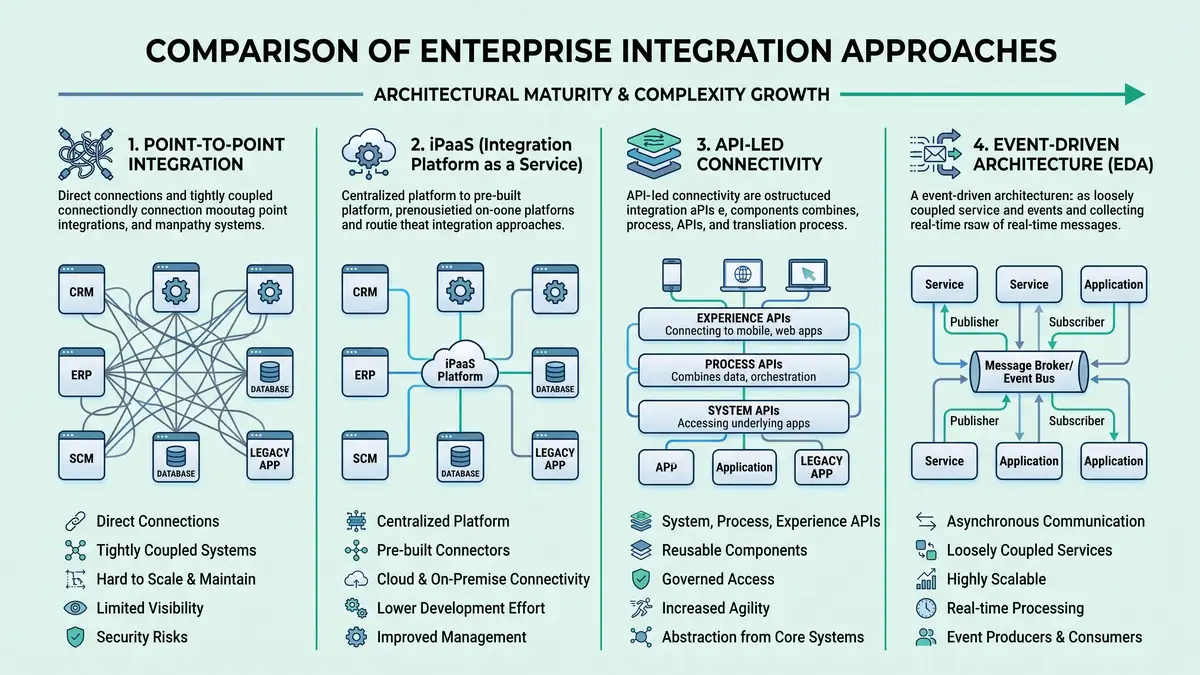
The second approach is middleware or an enterprise service bus, a central backbone that systems publish to and subscribe from. It centralises logging, transformation, and routing, which makes it strong for a small number of heavy, mission-critical systems such as an ERP. The cost is agility: every new connection needs configuration, and it demands specialist skills. The third approach, iPaaS (integration platform as a service), is the modern default for SaaS-heavy stacks. Platforms such as MuleSoft, Boomi, Workato, Zapier, Make, and n8n offer pre-built connectors and low-code flows, which is why business operations teams, not central IT, now automate the most processes. Choosing between these platforms is itself a discipline, which we cover in our guide to the best agentic automation platforms and the practical differences in n8n versus Zapier versus Make.
The fourth approach is API-led and event-driven architecture, where systems expose clean API contracts and communicate through events like "OrderPlaced" or "CandidateHired" rather than direct calls. It offers the strongest scalability and governance, at the cost of more upfront design. Workato's data shows how far the centre of gravity has shifted toward accessible platforms: operations teams automated 27.7 percent of all processes in 2023, more than any other group, IT included.
| Approach | Best For | Weakness |
| Point-to-point | Simple, low-risk, stable connections | Breaks down past a handful of systems |
| Middleware / ESB | Few heavy, mission-critical legacy systems | Slow to change, needs specialists |
| iPaaS | SaaS-heavy stacks, ops-led automation | Flow sprawl without governance |
| API-led / event-driven | Scale, high volume, strong governance | More upfront design investment |
Sources: Workato 2024 Work Automation and AI Index, MuleSoft 2026 Connectivity Benchmark
Avoid This Mistake
Do not let point-to-point connectors become your architecture by default. Every ad-hoc script feels cheap to build and quietly expensive to maintain, because its logic lives outside any central governance. When an upstream schema changes, these connectors fail silently, corrupting data until a business user notices. Catalogue what you have before you add more.

How Do You Choose the Right Integration Approach?
Choosing an approach is a decision framework, not a preference. Work through four questions in order, and the right architecture usually reveals itself. This is the same structured logic that separates a disciplined technology decision from an expensive guess, the kind of rigour we apply in our technology ROI framework.
Map the critical data flows first
Before choosing tools, identify which data flows are revenue-critical or compliance-critical, such as lead-to-cash or recruit-to-hire. These flows deserve governed, monitored integration. A nightly export to a reporting sheet does not. Run a workflow audit to find where data actually moves and where it stalls.
Assess your stack profile
If a few heavy legacy systems anchor your operations, middleware gives you a robust spine. If the stack is mostly cloud-native SaaS, iPaaS aligns better with the speed you need. Most mid-market firms are the second case and over-engineer toward the first.
Designate a master for each entity
Decide which system owns customer identity, which owns financial terms, which owns service history. A functional single source of truth is not one database. It is authoritative sources feeding everything else through governed flows, which is the foundation of solid business systems architecture.
Fund integration as a product, not a project
Integrations are not one-off builds. They need monitoring, versioning, and ownership as underlying systems change. Treating integration as a project that ends is the fastest route to the brittle failures that plague stalled technology initiatives.
Not sure which integration approach fits your stack? We map your critical data flows and design the architecture before a single connector is built.
Book Your Growth Mapping CallWhat ROI Does a Real Integration Strategy Deliver?
Integration done well pays back on hard numbers, not vague promises of "efficiency." Forrester's Total Economic Impact study of a leading integration platform found time savings of 33 to 67 percent on integration projects, cutting complex builds from three months to two and simple ones from three days to one. Across 135 projects over three years, that schedule compression was worth 1.2 million dollars to the composite organisation.

The reliability gains were just as concrete. Consolidating onto a single integration platform delivered a 40 percent reduction in application downtime, worth 1.3 million dollars in avoided losses, plus another 1.3 million from retiring redundant file-transfer and API-management tools. The headline result was an ROI of 176 percent and a net present value of 2.43 million dollars over three years. Integration is one of the rare operational investments where the business case is unusually clean, provided you cost it against the swivel-chair labour and licence waste it eliminates rather than against zero.
There is a security dividend too. IBM's 2025 research found the global average cost of a data breach fell 9 percent, driven by faster identification and containment, which depend on connected monitoring and identity systems. Siloed logs make threats harder to spot. Integrated telemetry shortens the breach lifecycle. When you weigh the full picture, the cost of not integrating is almost always higher than the cost of doing it, a calculation worth running formally alongside your broader automation cost analysis.
Key Takeaway
A consolidated integration platform in Forrester's study returned 176 percent ROI and 2.43 million dollars in net present value over three years, driven by faster delivery, 40 percent less downtime, and tool consolidation. Integration is not overhead. It is one of the cleanest operational business cases available.
How Does Integration Strategy Enable AI Agents?
AI agents are only as capable as the data and tools they can reliably reach, which makes integration the real bottleneck for AI adoption. MuleSoft's 2026 benchmark is blunt about this: 96 percent of leaders agree the success of AI agents depends heavily on seamless, debt-free data integration. The word "debt-free" matters. Undocumented point-to-point connectors, inconsistent schemas, and outdated APIs are exactly the technical debt that makes agents brittle or unsafe.
An agent that can move a signed contract into provisioning, billing, and project management automatically is transformative, but only if those systems expose clean, governed interfaces. If your integration landscape is a tangle of ad-hoc connectors, every agent needs custom adaptation code, and the risk of an agent propagating an error or violating a consent rule rises sharply. This is why an integrated data layer, not model quality, is usually the real prerequisite for intelligent automation that actually holds up in production.
The reverse is also true: AI is starting to help build and maintain integrations, inferring mappings, generating connector code, and flagging anomalous flows. Used well, it reduces integration debt. Used carelessly, it creates a new kind of spaghetti that even its designers cannot explain. The governing principle is the same one that runs through every part of a sound integration strategy, and through disciplined CRM and marketing automation: connect deliberately, govern at the boundaries, and treat data quality as a first-class objective.
Frequently Asked Questions
How do I know which integration method to use?
Start with the data flow, not the tool. If the flow is revenue-critical or compliance-critical, such as syncing CRM deals with billing, use a governed approach like iPaaS or API-led integration that centralises logic and provides monitoring. If it is a simple, low-risk, low-volume flow whose failure would not compromise anything important, a point-to-point connector is acceptable. The mistake is defaulting to point-to-point for everything, because that architecture becomes unmanageable past a handful of systems. Map your critical flows first, then match each one to the lightest approach that still gives you the governance the flow deserves.
What are the four types of integration?
The four broad approaches are point-to-point (direct connections between two systems), middleware or enterprise service bus (a central backbone for heavy legacy systems), iPaaS (cloud platforms with pre-built connectors and low-code flows), and API-led or event-driven architecture (clean API contracts and asynchronous events). They trade off along speed, scalability, and governance. Point-to-point is fastest for simple problems but fails at scale. iPaaS suits SaaS-heavy stacks. API-led and event-driven offer the strongest scalability and governance for organisations willing to invest in design. Most real strategies combine several, using the right pattern for each class of data flow.
What is the difference between integration and automation?
Integration is about connecting systems so data flows between them. Automation is about triggering actions based on that data. They are closely related but distinct: you can integrate two tools so a record syncs, and separately automate a workflow that fires when the record changes. In practice, modern iPaaS platforms deliver both, which is why the line blurs. A strong integration strategy is the foundation that makes reliable automation possible, because automation built on disconnected or low-quality data simply propagates errors faster. Get the data layer right first, then layer automation on top.
How many apps does the average company use?
It depends on how you count, but the numbers are consistently in the triple digits for enterprises and rising for mid-market firms. Okta's identity data puts the average at 101 applications, crossing 100 for the first time, while Productiv's dataset reports 342 applications in the average enterprise portfolio. Even accounting for methodology differences, triple-digit app counts are now normal rather than exceptional. That scale is exactly why integration strategy matters: dozens of systems of record, each holding a slice of the truth, cannot deliver coherent operations without a deliberate design for how their data connects.
Is a single source of truth realistic?
Yes, but not in the way most people imagine. A single source of truth is rarely one database that holds everything. It is an architecture where each key entity has a designated authoritative system, customer identity in the CRM, financial terms in billing, service history in support, and those masters feed everything else through governed integrations. The goal is consistency, not centralisation. When different teams pull from the same authoritative sources rather than maintaining local copies, the endless "whose numbers are right" debates disappear. Achieving it is an integration and governance exercise, not a storage decision.
Does integration strategy matter for AI adoption?
It is arguably the deciding factor. MuleSoft's 2026 benchmark found 96 percent of leaders agree AI agent success depends on seamless, debt-free data integration. Agents need reliable, well-documented interfaces to the systems they act on. If your integrations are a tangle of undocumented connectors and inconsistent schemas, agents become brittle and risky, and every deployment needs custom adaptation code. Companies that invested in clean API-led integration and data quality are AI-ready. Those that did not will find the integration layer, not the model, is what holds them back. Fix the data fabric before scaling AI.
Make Your Tools Work Like One System
peppereffect architects the integration layer that turns your scattered stack into a single operating system: authoritative data, governed flows, and a foundation clean enough to run AI agents on. We map your critical data flows, choose the right approach for each, and build for scale instead of spaghetti.
Book Your Growth Mapping CallResources
- Okta - Businesses at Work 2025 (average apps per company)
- Productiv - Top SaaS statistics IT leaders need to know in 2025
- Zylo - 2024 SaaS Management Index (unused licence waste)
- Zylo - 2025 SaaS Management Index (per-employee spend)
- MuleSoft - 2026 Connectivity Benchmark Report (AI and integration)
- Workato - 2024 Work Automation and AI Index
- Forrester - Total Economic Impact of IBM Integration (ROI data)
- Tealium - Why Most Data Problems Start at Collection (Gartner and McKinsey data)
- Zapier - Meetings Aren't Killing Productivity, Data Entry Is
- Slack - The App Era Is Here (app switching cost)
- IBM - Cost of a Data Breach Report 2025