
What does answer engine optimization mean for a B2B service business?
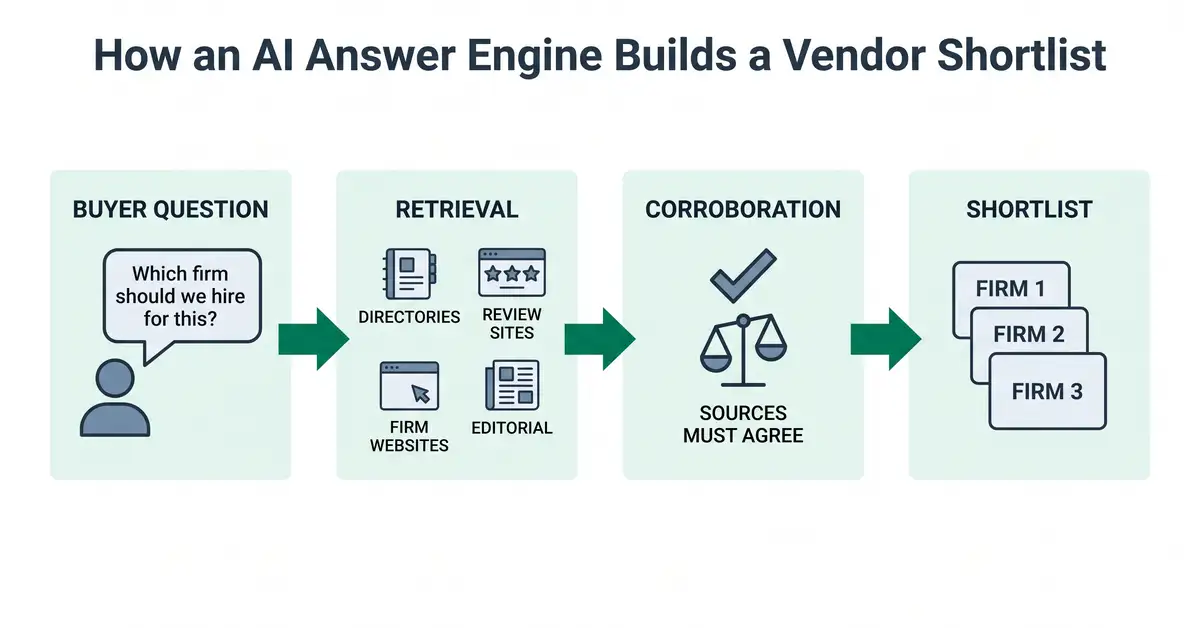
Your buyer no longer opens ten tabs. They ask an assistant who to hire, read the three names it gives back, and start there. Answer engine optimization for a service firm is the work of making sure your firm is one of those three names. It is a different job from ranking, and harder for a consultancy than for a software product.
The reason is structural. A software company arrives at the answer engine with a category, a review profile, a pricing page and a few hundred third-party mentions that all describe it the same way. A twenty-person advisory firm arrives with a website and a LinkedIn page. With almost nothing to corroborate, the model reaches for the sources that do contain lists of firms, which are directories, roundups and review platforms, and names whoever is already there.
We have numbers on this. Across 1,440 buyer-question tests run through our own measurement pipeline, firms we classified as agency and professional services were named in an AI answer 8.5% of the time. The rate across all categories was 24.0%. That gap is the subject of this playbook.
What you will get from this page:
- Our measured naming rate for service firms against eleven other categories, with sample sizes
- Why the thing that decides your inclusion is corroboration rather than content quality
- A five-layer playbook with a pass threshold for each layer, usable as a working template
- The measurement trap that makes most AEO reporting for service firms worthless, including one we fell into ourselves
- What this evidence does not establish
Key Takeaway
For a service firm, the binding constraint is not the quality of your writing. It is whether enough independent sources say the same sentence about what you do, so a model can repeat that sentence with confidence. Fix the corroboration layer and the content starts working. Fix the content alone and nothing moves.

How often do AI answers actually name a service firm?
Our pipeline takes a company, infers the buying question its customers would ask, puts that question to an assistant, and records whether the company appears in the answer. By 16 September 2026 it had produced 1,440 verdicts across 3,629 verified domains. Naming rate by category, restricted to categories with at least 30 verdicts:
| Category | Verdicts (n) | Times named | Named rate |
| Martech | 47 | 21 | 44.7% |
| Sales tech | 45 | 15 | 33.3% |
| Logistics | 50 | 15 | 30.0% |
| Data tech | 54 | 16 | 29.6% |
| Ops tech | 115 | 32 | 27.8% |
| Compliance | 51 | 12 | 23.5% |
| IT services and tooling | 97 | 22 | 22.7% |
| Healthcare IT | 33 | 6 | 18.2% |
| Fintech | 69 | 12 | 17.4% |
| HR tech | 78 | 11 | 14.1% |
| Agency and professional services | 59 | 5 | 8.5% |
| Proptech | 33 | 2 | 6.1% |
| All categories including long-tail | 1,440 | 346 | 24.0% |
Source: peppereffect internal aggregation, read-only run 142480, 16 September 2026. Aggregates only. No company names or domains are published. Categories with fewer than 30 verdicts are excluded from the table and counted only in the all-category row.
Agency and professional services is the lowest-scoring category in the set with more than 50 verdicts. Proptech scores lower on a point estimate but rests on 33 verdicts. With 5 hits from 59 tests, the 95% confidence interval on the service-firm rate runs from 3.7% to 18.4%. The interval for the all-category rate runs from 21.9% to 26.3%. They do not overlap, so the shortfall is not an artefact of a small sample, though the exact size of it is loosely bounded.
Two more numbers from the same run shape how you plan. The median answer named three firms, never fewer than two and never more than four, across 1,408 answers containing a list. Of 2,957 distinct firms named across 4,224 mentions, 2,355 were named exactly once, which is 79.6%. The top ten most-named firms accounted for 3.1% of all mentions.
Key Takeaway
The list is short and the list is not a cartel. Three slots, and four out of five named firms appear only once in the whole dataset. There is no incumbent to displace in most categories. There is a slot that goes to whoever the model can describe confidently, and today that is usually nobody in particular.
What actually decides whether a model names your firm?

Start by ruling out the answer most agencies sell you. It is not schema markup. Google's documentation on AI features says it plainly: "You don't need to create new machine readable files, AI text files, or markup to appear in these features. There's also no special schema.org structured data that you need to add." The publisher of the largest answer engine is telling you the thing being sold to you is not the mechanism. Structured data still earns its place, but it is not the lever.
It is also not your Google ranking. Ahrefs tested 15,000 long-tail queries across search engines and assistants in August 2025 and found only 12% of URLs cited by AI assistants appeared in Google's top ten for the same prompt. Perplexity was closest at 28.6%, ChatGPT sat at 8.0% for in-text citations and 6.1% for its reference list. A firm can rank first and go unnamed, which is the pattern we see in the service category.
What is left is corroboration. A model assembling a shortlist needs to state a claim about you, and it will only state a claim it can find repeated. The claim has two halves: what you do, and who you do it for. Phrase both the same way on your site, in the places that list firms like yours, and in anything written about you by someone else, and the model has a sentence it can reuse. Let each source describe you differently and it has nothing safe to say, so it names someone else. Same mechanism as in how large language models decide what to cite, in a category where the corroborating layer is thin to begin with.
There is an industry-level measurement that puts a number on this. Trendos, analysing 107 million AI answers across ChatGPT, Perplexity, Gemini and Google AI Overviews and publishing the breakdown in Search Engine Journal on 27 August 2026, found that for IT and solutions services, community and user-generated sources supplied 51% of citations and independent editorial and B2B review directories supplied 47%. Brand-owned sources supplied 2%, the lowest figure of any industry in the study. Read that as the ceiling on what your own website can do for you in this category. The author founded the company that produced the data, which is a conflict worth holding in mind, though the direction matches what we see in our own casework.
The thinness is getting worse in one specific way. The B2B review platforms that once did the corroborating have lost most of their audience. SE Ranking, analysing 30,000 commercial keywords captured on 1 December 2025, reports TrustRadius down 92.2%, Capterra down 89% and G2 down 84.5% from early 2024. The same study found review platforms still supply three of the five most-cited domains inside AI Overviews while accounting for fewer than one link in ten. They stopped being a traffic source and stayed an authority source. For a service firm that means a directory listing nobody clicks can still be the reason a model names you.
Side by side, the asymmetry is entirely about what exists off your own domain.
| Corroboration source | Typical software vendor | Typical 20-person service firm |
| Category directory entry | Several, structured, with a fixed category | Often none, or an unstructured listing |
| Third-party review profile | Dozens to hundreds of reviews | Rarely present in professional services |
| Comparison and roundup pages | Written about them by others | Written by them about themselves |
| Quotable outcome numbers | On a public pricing or results page | Inside a gated PDF or a slide image |
| Consistent category label | Enforced by the directories | Drifts across site, deck and profile |
Source: peppereffect audit observations across client engagements in 2026. Descriptive pattern from our own casework, not a sampled study.
The mistake we see most often
Firms respond to this by publishing more thought leadership. It is the wrong end of the problem. Thirty articles in your own voice give a model thirty copies of one source. One listing, one podcast appearance and one client-side case study give it three independent ones. Independence is what the corroboration step is checking for, and you cannot manufacture it from your own domain.
The five-layer AEO playbook for service firms
Each layer has a pass threshold you can check in an afternoon. Run them in order: layer three cannot be built before layers one and two are settled, and firms that skip ahead corroborate an inconsistent claim.
Entity sentence
One sentence naming what your firm does and for whom, written to be quoted verbatim. Pass threshold: the same sentence, word for word, appears on your homepage, your about page and your LinkedIn company description. Fail if any of the three paraphrases it.
Category claim
The category label a buyer would actually type, not the one your positioning deck prefers. Pass threshold: the label returns results when you search it, and your service page uses it in the H1. Fail if the label is invented, and fail if you claim more than two categories.
Off-site corroboration
Independent sources repeating layers one and two. Pass threshold: five sources on five domains you do not control, each carrying your firm name next to your category label. Directory listings, association member pages, podcast episode notes, conference speaker bios and client-side press all count. Your own guest post does not, because you wrote it.
Evidence pages
Named outcomes a model can quote. Pass threshold: three case studies that each state a client type, a starting number and an ending number in the body text rather than in an image. Orbit Media's analysis of 97 B2B sites found case-study pages convert AI-referred visitors better than any other page type, so this layer pays twice.
Machine access
Whether the fetchers can read any of it. Pass threshold: your robots.txt does not block GPTBot, OAI-SearchBot, PerplexityBot or Google-Extended, and your service pages render their main content without JavaScript. Check your server logs for those user agents rather than assuming. Note that Google-Extended is a robots.txt token and will never appear in a log as a user agent.
Layer three is where the calendar time goes, because you are waiting on other people to publish. Most firms we audit pass layers one, four and five, fail layer two on an invented category, and fail layer three outright with zero or one qualifying source. That combination produces exactly the outcome the data shows: a good-looking site that no model will name.
Scored as a template, the five layers look like this. Run the 21 checks against your own firm before you commission anything.
| Layer | Pass threshold | Checks | Usual failure |
| 1. Entity sentence | Identical wording in three places | 4 | Each page paraphrases, so nothing is quotable |
| 2. Category claim | A searched label, two categories at most | 4 | A coined category with no search behind it |
| 3. Off-site corroboration | Five sources on five domains you do not control | 6 | Zero or one qualifying source |
| 4. Evidence pages | Three case studies with numbers as text | 3 | Numbers trapped inside images or gated PDFs |
| 5. Machine access | Fetchers unblocked, body renders without JavaScript | 4 | Assumed rather than checked in server logs |
Source: peppereffect working thresholds, assembled from client audits and the published correlational research cited on this page. Open the scored template to work through all 21 checks and print the result.
Use the template
The five-layer AEO playbook template runs all 21 checks with a score, four interpretation bands and a print view. Nothing you enter is stored or transmitted. Score yourself before you brief anyone, because the score decides whether your next move is content or corroboration.
Want the measured version of this for your own firm before you start? We run the same pipeline that produced the numbers on this page.
Get your AI visibility measured
How do you measure this without fooling yourself?

Traffic is the wrong meter and it will mislead you for at least a year. Orbit Media's study of 97 B2B websites and 28.9 million sessions, covering July 2025 to June 2026, found AI sources accounted for about 0.5% of total traffic. Reading that as "AI does not matter yet" is the single most expensive misreading in this field, because the same study found AI-sourced visitors converted at 1.91% against 0.54% from organic search, with ChatGPT at 2.1%. Small, and worth roughly three times as much per visit.
The number that governs your pipeline is not traffic. 6sense's 2025 Buyer Experience Report, surveying close to 4,000 B2B buyers, found buyers pick from their Day One shortlist 95% of the time, and first contact a seller around 61% of the way through their process. The shortlist forms before you know the buyer exists. Whether a model named you at that moment leaves no trace in your analytics.
So measure the naming directly. Write out the ten questions a buyer would ask before hiring a firm like yours, put each to several assistants on a fixed schedule, and record whether you were named and who was named instead. That is share of model, the only metric here that survives a board meeting. Our AI visibility audit sets out the checks, and the measurement framework covers a missing referrer.
A measurement error we made ourselves
Our first citation checker reported zero citations for every domain we pointed it at, including domains with more than 270,000 ranking keywords. The tool was silently falling back to a SERP AI Overview probe instead of querying the assistants. A check that returns zero for everything has no discriminating power and tells you nothing. If your AEO tool reports a flat zero across an entire portfolio, assume the tool is broken before you assume the portfolio is invisible.
What this evidence does not establish
Four limits, stated plainly, because a playbook that hides them is a sales document.
The category comparison is observational. We did not assign firms to categories at random or control for firm size, age, budget or existing press coverage. Service firms in our sample are smaller on average than the software companies, and size plausibly drives both the corroboration deficit and the naming rate. The 8.5% figure is a real measurement of a real gap. It is not proof that being a service business causes the gap.
The five layers are our working model, not a tested one. We assembled them from audits and the published correlational work. Nobody, us included, has run a controlled study that adds corroboration sources to a randomised set of firms and measures the change in naming rate. Treat the thresholds as a starting discipline, not established dose-response.
Answers move. Ahrefs found that the sources cited by ChatGPT, Perplexity and Google AI Overviews barely overlap, with only 7 of the top 50 most-mentioned sites shared across all three. A win on one engine does not transfer to the others, and a single measurement is a snapshot rather than a position.
One quarter is not a trend. The strongest result we can point to from our own client work is Helium42, which went from close to zero to 250 AI-sourced visits per quarter, a factor of 83, inside ninety days. One firm, one quarter, no control group. We report it as a worked example, and the full methodology is published so you can judge it rather than take it.
Frequently Asked Questions
What AEO approach should a B2B service firm start with?
Start with the entity sentence and the category claim, because everything downstream repeats them. Write one sentence that names what you do and who you do it for, and put that exact wording on your homepage, your about page and your LinkedIn profile. Then pick the category label a buyer would type rather than the one your positioning deck prefers. Only then go looking for off-site sources to repeat it. Firms that begin with content production instead spend six months producing material that reinforces an inconsistent claim, which is why our answer engine optimization guide puts the entity work first.
How is AEO for a service business different from AEO for software?
The difference is the corroboration layer, not the technique. A software product arrives with a review profile, a category page and hundreds of third-party mentions that all describe it the same way, so a model has plenty to check a claim against. A service firm usually has a website and a LinkedIn page, and directories in professional services are thinner and less structured than software directories. That is the mechanism behind the 8.5% naming rate we measured against 24.0% across all categories. The fix is deliberately building the independent sources that software gets for free.
Does schema markup get you cited by AI?
Not by itself, and Google says so directly. Its documentation on AI features states there is "no special schema.org structured data that you need to add" to appear in AI Overviews or AI Mode. Structured data remains worth implementing for rich results and for machine-readable clarity, and it costs little. Treat it as hygiene rather than as the lever. If an agency's AEO proposal is mostly schema work, ask what it is doing about your off-site corroboration, which is the part that actually moves the naming rate.
How many firms does an AI answer usually name?
Three. Across 1,408 answers in our dataset that contained a vendor list, the median was three names, the minimum was two and the maximum was four. That matters for how you frame the goal internally. You are not competing for a ranking position where tenth place still earns something. You are competing for one of three slots, and the shortlist that comes out of it is the one 95% of B2B buyers end up choosing from, according to 6sense's 2025 report.
Is it too late to get into these answers?
The data says the opposite. Of 2,957 distinct firms named across our 4,224 recorded mentions, 2,355 were named exactly once, and the ten most-named firms together accounted for only 3.1% of mentions. There is no entrenched incumbent in most service categories. The slots are being filled provisionally, by whichever firm the model can describe with confidence on the day. That is a position that changes when your corroboration changes, which is different from the decade-long grind of traditional organic competition.
Is there a template I can work through?
Yes. The five-layer AEO playbook template puts all 21 checks on one page with a running score, four interpretation bands and a print view. It stores nothing and sends nothing anywhere, so you can fill it in with real client detail. In our audits the layer that fails is almost always layer three, the off-site corroboration, while the on-site layers pass. If your score sits in the middle band for that reason, the next move is layer three and not another article.
Which engines should a B2B service firm prioritise?
Measure all of them and expect the results to disagree. Ahrefs found only 7 of the top 50 most-mentioned sources were shared across ChatGPT, Perplexity and Google AI Overviews, so a win on one tells you very little about the others. In practice ChatGPT deserves the most attention for B2B, because Orbit Media's 97-site study found it accounted for 82.3% of AI-referred traffic and converted at 2.1%. Start there, but do not report a single engine as though it were your visibility. The ChatGPT-specific checks go deeper on that engine.
Find out whether the answer engines name your firm
We run the buying questions your clients actually ask through the major assistants and report who gets named, how often, and which corroboration sources are doing the work. Same pipeline, same method, same numbers as the ones on this page.
Get your AI visibility measuredResources
- Google Search Central, AI features and your website. The primary statement on structured data and AI Overviews
- Ahrefs, 11 August 2025. Only 12% of AI-cited URLs rank in Google's top 10, across 15,000 queries
- Ahrefs, 12 June 2025. 86% of top-mentioned sources are not shared across ChatGPT, Perplexity and AI Overviews
- Orbit Media, 22 July 2026. AI traffic conversion rates across 97 B2B websites and 28.9 million sessions
- 6sense, 2025 B2B Buyer Experience Report. Day One shortlist and point of first contact, ~4,000 buyers
- Pew Research Center, 22 July 2025. Click behaviour with AI summaries across 68,879 searches
- Search Engine Journal, 27 August 2026. Trendos analysis of 107 million AI answers, citation source types by industry
- SE Ranking. Review platform traffic collapse and their share of AI Overview citations, 30,000 commercial keywords