

What changed at Helium42 in ninety days?
Helium42 went from near zero to 250 AI-sourced visits per quarter in ninety days, a factor of 83 against the previous quarter. The two numbers only mean anything together, and the multiple is the less interesting half. Near zero is a tiny base, so 83x is arithmetic. The part worth arguing about is 250 qualified visits a quarter from a channel that previously produced almost none. Anyone quoting a multiple without its absolute number is hiding the base.
The interesting part isn't the result. It's that Google publishes documentation saying there is nothing special to do. In its guidance on AI features in Search, Google states plainly: "There are no additional requirements to appear in AI Overviews or AI Mode, nor other special optimizations necessary." No new schema. No AI text file. So if the fundamentals were already the answer, why was a functioning consultancy with an indexed site invisible in the answers its buyers were reading?
Helium42 is an AI consultancy for European mid-market companies, which puts it in a fragmented service category with no dominant brand. That detail turns out to matter more than anything we did on the page.
What you'll get from this page:
- Why service-category brands go missing from AI answers even when their site is indexed and ranking
- The six changes we made, in the order we made them, with the check you can run on your own site for each
- How AI-sourced visits are actually attributed, and the three blind spots that make every number in this field softer than it looks
- An honest account of which parts we can and cannot credit for the result
Key Takeaway
Nothing in the ninety days was a trick or a hack. Every change made the site easier to retrieve, easier to quote, and harder to confuse with a competitor. The reason it moved the number is that most firms in fragmented service categories have never done any of it, so the bar is low and the gap closes fast.
Why was a working consultancy invisible in AI answers?
Start with the finding that reframes the whole problem. Ahrefs ran 15,000 long-tail queries through ChatGPT, Gemini, Copilot and Perplexity in August 2025 and checked where the cited URLs sat in Google. Only 12% of AI-cited URLs ranked in Google's top 10 for the same query. Around 80% did not appear in the top 100 at all. Perplexity was the outlier at 28.6%; ChatGPT, Gemini and Copilot each sat near 8%.
So being findable and being quotable are close to separate problems. Ranking helps, and it is nowhere near sufficient. That is why a technically sound, ranking site can be absent from the answers its own buyers are reading, and why "we already do SEO" is not a defence.
The second half of the explanation is what the model reaches for instead. When a buyer asks a broad category question, it needs a page that states a defensible answer in a form it can lift. In categories with clear market leaders, it finds them. In fragmented service categories, it finds directories, review platforms and listicles, because those are the only pages structured as comparisons.
The scale of that fallback is documented. SE Ranking analysed 30,000 US keywords in December 2025, of which 22,729 returned an AI Overview, and classified more than 211,000 links. Review platforms turned up in roughly a third of AI Overviews. In the same period those platforms lost most of their organic traffic: TrustRadius down 92.2%, Capterra down 89%, G2 down 84.5%, Gartner Peer Insights down 76.5% between January 2024 and December 2025.
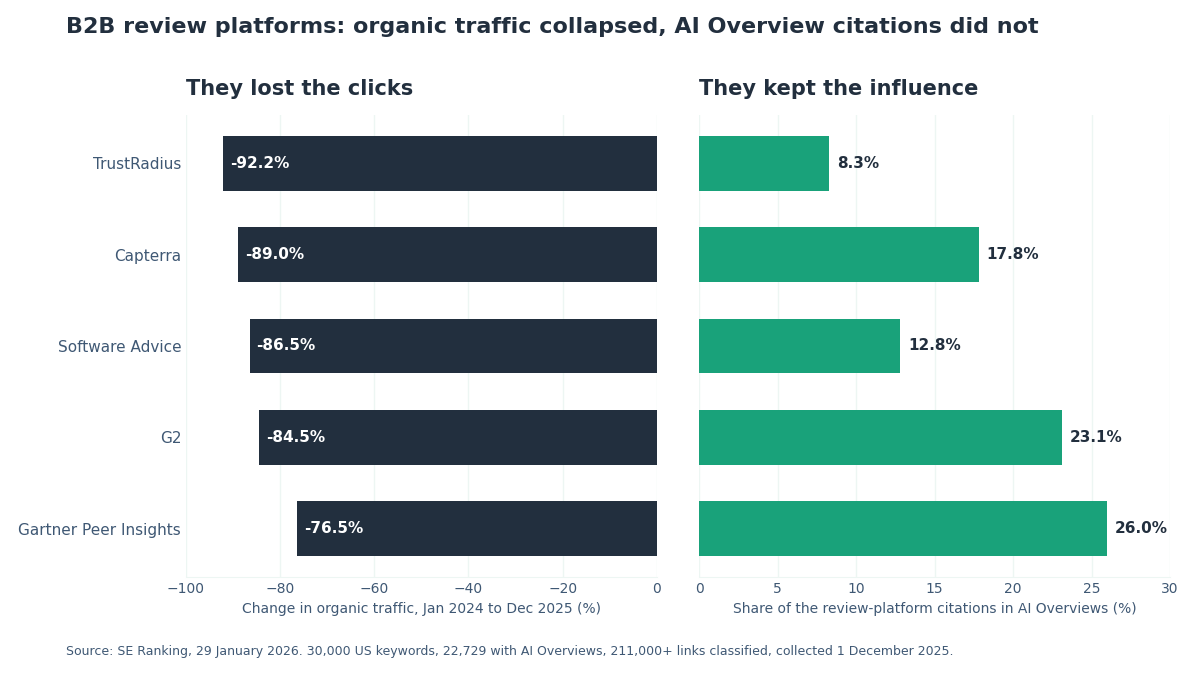
Source: SE Ranking, "Despite 90% Traffic Loss, Review Platforms Top AI Overview Citations", 29 January 2026. 30,000 US keywords, 22,729 with AI Overviews, 211,000+ links classified, collected 1 December 2025.
The pages that used to moderate B2B software selection stopped receiving the visit and kept the influence. Their opinion still shapes the shortlist. It just does it inside the answer now, where nobody clicks through to check. We wrote about the mechanics of that shift in how LLMs decide what to cite.
Helium42's problem was a version of this. The site was indexed, technically sound and ranking for its own brand. What it had almost none of was a page that answered a category buying question with a position rather than a description of services. When the model needed a source for "who does practical AI implementation for European mid-market companies", it had nothing to lift, so it lifted a directory instead.
The failure mode nobody checks for
In thin service categories, models don't just omit you. They invent competitors. In our own scanning we've seen answer engines return confident vendor names for fragmented categories that do not correspond to any real company. Being absent from a category answer isn't a neutral state, because the slot gets filled by something, and sometimes by nothing that exists.
The 90-day rebuild, step by step
Every step below carries what we changed, why it should matter to a retrieval system, and a check you can run on your own site in under ten minutes. The order matters: steps 1 and 2 decide whether anything after them is measurable.
| Dimension | Before (quarter to 14 March 2026) | After (90 days from 15 March 2026) |
| AI-sourced visits per quarter | Near zero | 250 (83x) |
| Category buying questions answered on-site | None as a direct answer | Each primary question answered in its own page, in the first paragraph |
| Positioning in category answers | Described services, took no position | Stated a defensible verdict a model can quote |
| Entity consistency across third-party sources | Inconsistent naming and description | One name, one description, repeated everywhere |
| Measurement | No separation of AI-sourced sessions | AI referrers isolated and reported weekly |
Source: peppereffect programme record for Helium42, March to June 2026. Reported figures are limited to the two we publish: 83x and 250 AI-sourced visits per quarter.
The six changes, with the check for each
1. Isolate AI-sourced sessions before changing anything
We split sessions by referrer host (chatgpt.com, perplexity.ai, gemini.google.com, copilot.microsoft.com and the rest) into their own reported segment, and froze a ninety-day baseline before touching the site. Without that line drawn first, any later number is a story rather than a measurement.
Your check: open your analytics, filter sessions by those referrer hosts for the last ninety days, and write the number down today. If you cannot produce it in five minutes, that gap is your first problem, not your content.
2. Write down the category's real buying questions
Not keywords. The eight to twelve questions a buyer actually types into an assistant when they are choosing, phrased the way a person phrases them. We took them from sales calls and from the assistants themselves, then ran each one and recorded which brands got named. That baseline is what we call share of model.
Your check: run your five most commercially important buying questions in ChatGPT and Google AI Mode right now. Count how many name you. That count is the number the rest of this work moves.
3. Give every question one page that answers it in the first paragraph
One question, one page, answer stated before the context. Retrieval systems lift passages, and a passage that hedges for four paragraphs before committing gives them nothing to lift. This is also the discipline that stops a site cannibalising itself, which is worth more than most people think. We wrote up our own version of that rule in the 23-check citation standard.
Your check: take your most important commercial page and read only the first 60 words. If a stranger couldn't repeat your answer from them, a model can't either.
4. Take a position that can be quoted and attributed
Descriptions of services are interchangeable, and interchangeable text gets summarised rather than cited. A stated verdict with a reason behind it gives the model something only you said. This is the single change we'd repeat first on any site, and it's the one most firms refuse, because a position can be argued with.
Your check: find one sentence on your site that a direct competitor could not put on theirs without lying. If you can't, you have a positioning problem wearing a visibility costume.
5. Make the entity consistent everywhere the model can see it
One spelling of the name, one description, the same founders and the same category words on the site, in the profiles, in the directories, and in anything third parties publish. Models resolve entities across sources. Inconsistency reads as two weak entities instead of one strong one.
Your check: search your brand name and read the first ten results as if you were a machine trying to work out what this company is. Note every place the description disagrees with itself.
6. Make the pages structurally boring and technically open
Question headings, short direct answers, tables where there is comparative data, sources named inline, structured data that matches what's visible on the page. Crawlers allowed. Nothing exotic. Google's documentation says explicitly that no special markup is required, and our experience matches that: the wins come from clarity, not from tricks. See schema markup and AI citation for what structured data does and does not do here.
Your check: confirm your robots.txt doesn't block AI crawlers you actually want, and confirm your structured data describes the page a reader sees.

How do you measure AI-sourced traffic, and what can't you see?
AI-sourced visits are attributed the crude way: by referrer host. A visit from an assistant that passes a referrer gets counted. Everything else does not. That method has three holes, and anyone selling you a number without naming them is selling you confidence rather than measurement.
The first hole is the answer that never produces a visit. Pew Research Center tracked 68,879 Google searches from 900 US adults in March 2025. When an AI summary appeared, 8% of searches led to a click on a traditional result, against 15% without one. Clicks on the source links inside the summary itself occurred in 1% of visits. Your brand can be named in an answer thousands of times and generate almost nothing your analytics will ever see.
The second hole is Search Console. Google folds AI Overview and AI Mode data into overall Search performance rather than breaking it out. You can see impressions holding while clicks fall, which is the classic signature we describe in impressions up, clicks down, but you cannot isolate the AI surface itself.
The third hole is the assistant that strips the referrer, or arrives through a copied link, or lands as direct traffic from a phone. Every AI-sourced number in this industry, ours included, is a floor rather than a count.
| What you can measure | How | What it misses |
| AI-sourced visits | Referrer host segment in analytics | Stripped referrers, copied links, app traffic |
| Share of model | Repeated prompting of buying questions, brand mentions counted | Answer variance between runs and accounts |
| Click decoupling | Search Console impressions against clicks over time | Cannot separate AI surfaces from classic results |
| Commercial value | Conversion rate of the AI-sourced segment | Small samples move percentages violently |
Sources: Pew Research Center, 22 July 2025; Google Search Central, AI features and your website.
One number does argue that the small volumes are worth chasing. Orbit Media measured conversion across 97 B2B websites and about 29 million sessions, finding 1.91% conversion from AI sources against 0.50% from organic search. Treat it as a directional finding from one dataset rather than a law. It matches what we see, which is not the same as proving it.
Want your own baseline before you change anything? We measure how often your brand is named in AI answers to your category's buying questions, and hand you the numbers.
Get your AI visibility measurementWhich parts actually caused the result?

We don't know, and we're not going to pretend otherwise. Six changes shipped inside one ninety-day window on one site. That design cannot separate their effects. Anyone presenting a single-site before-and-after as proof of causation is describing a correlation and hoping you don't notice.
What we can say is narrower. The changes ran in a defined order, the baseline was frozen before the first of them, and the window was fixed in advance rather than chosen afterwards to look good. That is what separates a case record from an anecdote.
Our judgement, offered as judgement: step 4 did most of the work. Taking a position that could be quoted is the change that gave answer engines something they could only get from this site. Steps 3 and 6 made it retrievable, step 5 made it attributable to the right entity, and steps 1 and 2 made the whole thing legible. Remove step 4 and we think the other five produce a well-organised site that still says nothing worth quoting.

What this case does not prove
It's one company, in one category, over one quarter. Mid-market European AI consultancy is a thin category, which cuts both ways: there was little competition for the citation slot, and the absolute numbers are small because the category's search demand is small. A crowded category with entrenched incumbents will not move 83x in ninety days, and any agency promising you it will is quoting our number back at you out of context.
The wider backdrop is real, though. SparkToro and Similarweb found that 68.01% of US Google searches ended without a click between January and April 2026, browser searches only. Ahrefs measured a 34.5% lower click-through rate for the top-ranking page on informational queries when an AI Overview was present, across 300,000 keywords, desktop only, published April 2025. Both numbers carry narrow methodology, and both point the same way. The click and the ranking have come apart, which is the argument we make in full in geo vs seo as a competitive moat.
Key Takeaway
Treat this as a worked example of a method, not as a benchmark for your own category. The transferable part is the sequence: baseline first, questions second, position third. The 83x and the 250 behind it belong to Helium42's specific starting point, and copying either number is how people end up disappointed.
How do you run the same ninety days on your own site?
Four moves, in order. The first two cost nothing but an afternoon, and most firms skip them, which is why most firms cannot tell you whether their content programme worked.
Freeze a baseline you can defend
Ninety days of AI-sourced sessions by referrer host, plus a recorded count of how often your brand is named across your category's buying questions. Date it. Save it somewhere you cannot quietly edit later.
Pick the questions before the keywords
Eight to twelve real buying questions beat a spreadsheet of 400 keywords, because answer engines respond to questions and buyers ask them. Our AI visibility benchmarks by category shows what typical performance looks like before you start.
Publish one page per question, with a position in it
Answer in the first paragraph, take a stance a competitor couldn't copy, cite your sources inline. Volume is the wrong lever here. Four pages that say something specific beat forty that summarise the field, and they carry far less cannibalisation risk. If a page already exists on the topic, refresh it rather than adding a second one.
Re-measure on the date you set, not when it looks good
Same questions, same method, same segment. Movement in share of model shows up before movement in visits, usually by several weeks, so judge the leading indicator first and hold your nerve on the lagging one.
Frequently Asked Questions
What is AI visibility?
AI visibility is how often, and in what terms, a brand is named in the answers that assistants such as ChatGPT, Google AI Overviews, Perplexity, Claude and Gemini give to its category's questions. It is a share measure rather than a traffic measure, which is the part most teams get wrong when they first look at it. Two brands can hold identical search rankings while one is named in most category answers and the other in none. We track it as share of model, and it moves weeks before referral traffic does.
How do you measure AI visibility?
Two measurements, run together. The first is a mention count: put your category's real buying questions to each assistant repeatedly, and record how often your brand appears and in what company. The second is a traffic segment: isolate sessions arriving from AI referrer hosts in your analytics. The mention count is the leading indicator and the honest one. The traffic segment is a floor, because stripped referrers and in-answer reading mean it always undercounts. Our page on zero-click visibility measurement goes into the mechanics.
How does generative engine optimization work?
It works by making a page easy to retrieve and worth quoting. Retrieval is the familiar half: indexed, crawlable, structurally clear, with questions as headings and answers directly beneath them. Worth quoting is the half most sites fail, and it means carrying something the answer cannot generate on its own, such as a stated position, original data or a real comparison. Google's own documentation says no special AI markup is needed, and that is consistent with what we see. The differentiator is the content, not the plumbing. Start with answer engine optimization.
How long does it take to see results from AI visibility work?
In this case the visit numbers moved inside ninety days, in a thin category with little competition for the citation slot. Expect mention counts to move first, often within four to six weeks of publishing, and referral visits to follow. In a crowded category with entrenched incumbents, plan on two to three quarters and judge progress on share of model rather than sessions. Anyone quoting you a fixed timeline before seeing your category's answers is guessing.
Is AI visibility worth it if AI is a small share of my traffic?
Volume is the wrong frame for it. The mention happens whether or not anyone clicks, and it shapes the shortlist before you ever appear in a CRM. Orbit Media's data across 97 B2B sites found AI-sourced visits converting at 1.91% against 0.50% from organic search, so the traffic that does arrive tends to arrive further along. We take that objection apart properly in AI is only 2% of my traffic.
Can you get cited by ChatGPT without ranking on Google?
Yes, and it happens more often than most teams expect. Ahrefs found that only 12% of AI-cited URLs ranked in Google's top 10 for the same query across 15,000 long-tail queries, and roughly 80% were absent from the top 100 entirely. Ranking still helps, because it makes a page easier to retrieve, and it is plainly not a precondition. The more durable route is to be the source others cite about you, since third-party mentions feed entity resolution across every engine at once. See how to get cited by ChatGPT.
Why do AI answers recommend companies that do not exist?
In fragmented categories with no dominant brands, a model asked to name vendors has weak retrieval to work from and a strong instinct to complete the pattern. It fills the slot with something plausible. We have seen confidently stated vendor names in service categories that correspond to no real company. The practical implication for a real firm is blunt: if you are absent from your category's answers, the slot is not being held for you.
Find out whether your category's answers name you
We measure how often your brand appears in AI answers to the buying questions your category actually asks, then show you which pages are doing the work and which are invisible. You get the numbers whether or not we work together.
Get your AI visibility measurementResources
- Google Search Central: AI features and your website
- SE Ranking: Despite 90% Traffic Loss, Review Platforms Top AI Overview Citations (29 January 2026)
- Pew Research Center: Google users are less likely to click on links when an AI summary appears (22 July 2025)
- Ahrefs: AI Overviews Reduce Clicks by 34.5% (17 April 2025)
- Ahrefs: Only 12% of AI Cited URLs Rank in Google's Top 10 (11 August 2025)
- SparkToro and Similarweb: In 2026, Less than One Third of Google Searches Still Send a Click
- Orbit Media: AI Traffic Conversion Rates across 97 B2B Websites
- Google Search Central: Introduction to robots.txt